Introduction
Smart contract development tools help developers build, test, audit, deploy, debug, and maintain blockchain-based applications and decentralized systems. These tools simplify the process of writing smart contracts for networks such as Ethereum, Polygon, Solana, Avalanche, Base, Arbitrum, and other blockchain ecosystems. In simple terms, they provide the frameworks, libraries, IDEs, testing environments, automation systems, and security tooling needed to build secure and scalable Web3 applications.
These tools matter because smart contracts are immutable after deployment, meaning security flaws or coding mistakes can become extremely expensive. Modern Web3 teams require reliable testing, debugging, deployment automation, security validation, and monitoring workflows to reduce risks. Smart contract tooling is now critical for DeFi, NFTs, DAOs, tokenization, gaming, enterprise blockchain, and AI-integrated blockchain systems.
Common use cases include DeFi protocol development, NFT marketplaces, blockchain gaming, DAO governance systems, token issuance, cross-chain infrastructure, enterprise blockchain applications, and smart contract security auditing. Buyers should evaluate framework flexibility, testing depth, security tooling, ecosystem support, blockchain compatibility, developer experience, deployment automation, scalability, debugging support, and community maturity.
Best for: blockchain developers, Web3 startups, DeFi teams, enterprise blockchain architects, smart contract auditors, protocol engineers, and organizations building decentralized applications. Not ideal for: teams with no blockchain use cases, simple web applications without on-chain logic, or organizations that only need traditional backend systems.
Key Trends in Smart Contract Development Tools
- Security-first development is becoming mandatory because smart contract exploits continue to cause major financial losses across Web3 ecosystems.
- Foundry and Hardhat are increasingly dominating developer workflows due to speed, testing flexibility, and modern tooling capabilities.
- AI-assisted smart contract development is growing with code generation, vulnerability scanning, and automated testing becoming more common.
- Multi-chain development support is expanding as developers deploy across Ethereum, Layer 2 networks, Solana, Avalanche, and modular chains.
- Formal verification and static analysis are becoming more important for high-value DeFi and enterprise contracts.
- Developer experience is improving with integrated debugging, simulation, deployment automation, and transaction tracing.
- Smart contract automation platforms are gaining adoption for scheduled execution, monitoring, and operational workflows.
- Cloud-based blockchain development infrastructure is growing with managed RPC providers and blockchain APIs simplifying deployment.
- Battle-tested contract libraries are heavily preferred to reduce custom security risks.
- Observability and real-time monitoring are becoming critical as protocols require faster incident detection and transaction visibility.
How We Selected These Tools
This list was selected using a practical Web3 engineering, smart contract security, and developer productivity evaluation approach.
- We prioritized tools with strong relevance in smart contract development, deployment, testing, security, and monitoring.
- We included IDEs, frameworks, security libraries, infrastructure providers, testing platforms, and debugging tools.
- We evaluated ecosystem adoption across Ethereum and broader EVM environments.
- We considered developer productivity, testing depth, extensibility, and deployment workflows.
- We reviewed security capabilities including auditing, static analysis, simulation, and monitoring.
- We prioritized tools with active developer communities and strong ecosystem momentum.
- We included both beginner-friendly and advanced engineering-focused tools.
- We considered integration support with CI/CD, blockchain APIs, cloud infrastructure, and developer environments.
- We avoided unsupported compliance claims or invented ratings.
- We used “Not publicly stated” or “Varies / N/A” where details were uncertain.
Top 10 Smart Contract Development Tools
#1 — Hardhat
Short description: Hardhat is one of the most widely used Ethereum development environments for smart contracts and decentralized applications. It provides local blockchain simulation, testing frameworks, debugging capabilities, deployment automation, and plugin extensibility. Hardhat is especially popular among professional Ethereum developers building DeFi protocols, DAOs, NFT systems, and enterprise blockchain applications. It is best suited for teams needing a flexible and extensible Web3 development workflow.
Key Features
- Local Ethereum network simulation
- JavaScript and TypeScript support
- Advanced debugging and stack traces
- Plugin ecosystem for deployment and testing
- Flexible testing workflows
- Smart contract scripting and automation
- Strong EVM ecosystem compatibility
Pros
- Very flexible and developer-friendly
- Strong ecosystem and community support
- Excellent debugging capabilities
- Good integration with modern Web3 tooling
Cons
- Requires Node.js ecosystem familiarity
- Large projects may require workflow optimization
- Plugin management can become complex
- Learning curve for advanced configuration
Platforms / Deployment
Windows / macOS / Linux.
Self-hosted / Local / Cloud CI environments.
Security & Compliance
Supports development security workflows through testing, plugins, deployment controls, and ecosystem integrations. Buyers should validate operational security practices and deployment governance separately.
Integrations & Ecosystem
Hardhat integrates deeply into Ethereum and EVM development ecosystems with strong tooling compatibility.
- Ethers.js
- OpenZeppelin
- Alchemy
- Infura
- Chainlink
- CI/CD workflows
Support & Community
Strong open-source community with extensive documentation, tutorials, plugins, and ecosystem adoption across professional Web3 development teams.
#2 — Foundry
Short description: Foundry is a fast and modern smart contract development toolkit focused on Solidity-native workflows. It provides testing, fuzzing, deployment, scripting, and debugging directly from the command line. Foundry has rapidly gained adoption among advanced Ethereum developers because of its speed and powerful testing capabilities. It is best suited for performance-focused Web3 engineering teams.
Key Features
- Solidity-native development workflow
- Fast compilation and testing
- Built-in fuzz testing support
- Advanced scripting and deployment tooling
- Command-line focused development
- Debugging and tracing capabilities
- Efficient smart contract benchmarking
Pros
- Extremely fast testing and execution
- Strong fit for advanced Solidity developers
- Powerful fuzzing and testing capabilities
- Modern developer workflow design
Cons
- More technical than beginner-friendly tools
- Command-line heavy workflow
- Smaller plugin ecosystem compared to Hardhat
- Requires Solidity-focused development knowledge
Platforms / Deployment
Windows / macOS / Linux.
Self-hosted / Local / CI/CD environments.
Security & Compliance
Supports secure testing workflows, fuzzing, and deployment validation. Operational security depends on deployment practices and infrastructure configuration.
Integrations & Ecosystem
Foundry integrates well into modern Ethereum engineering and DevSecOps workflows.
- Solidity
- EVM chains
- CI/CD pipelines
- OpenZeppelin
- Ethereum testing environments
- Smart contract auditing workflows
Support & Community
Rapidly growing developer community with strong adoption among advanced Ethereum engineering teams and security researchers.
#3 — Remix IDE
Short description: Remix IDE is a browser-based integrated development environment designed for Ethereum smart contract development. It allows developers to write, test, debug, and deploy Solidity contracts without complex local setup. Remix is especially useful for beginners, educators, rapid prototyping, and lightweight smart contract development. It remains one of the most accessible tools in Web3 development.
Key Features
- Browser-based Solidity IDE
- Real-time compilation
- Built-in debugging tools
- Direct deployment capabilities
- Plugin support
- Solidity testing workflows
- Beginner-friendly interface
Pros
- Easy to start using immediately
- No complex setup required
- Excellent educational tool
- Good for rapid prototyping
Cons
- Not ideal for very large production systems
- Limited compared to full local development stacks
- Browser-based workflows may feel restrictive
- Advanced automation requires external tooling
Platforms / Deployment
Web browser.
Cloud / Local browser-based development.
Security & Compliance
Supports testing and debugging workflows but operational security depends on deployment setup and wallet practices.
Integrations & Ecosystem
Remix integrates into Ethereum development workflows and supports deployment to EVM-compatible chains.
- MetaMask
- Solidity compiler
- Ethereum test networks
- EVM chains
- Plugin ecosystem
- Smart contract debugging workflows
Support & Community
Strong educational and developer community with extensive tutorials and documentation for Ethereum development beginners.
#4 — OpenZeppelin
Short description: OpenZeppelin provides battle-tested smart contract libraries, security tooling, upgrade frameworks, and operational tools for Ethereum and EVM-compatible chains. It is widely trusted for ERC token standards, governance systems, access control, and upgradeable contract patterns. OpenZeppelin is essential for developers who want secure reusable components instead of writing critical contract logic from scratch.
Key Features
- Battle-tested smart contract libraries
- ERC token implementations
- Upgradeable contract frameworks
- Security-focused contract patterns
- Access control and governance modules
- Defender automation platform
- Smart contract deployment tooling
Pros
- Strong security reputation
- Widely adopted across Web3
- Reduces development risk
- Excellent documentation and examples
Cons
- Some advanced customization may require deep Solidity expertise
- Upgrade patterns require careful governance
- Enterprise workflows may need additional tooling
- Misconfigured reusable components can still introduce risk
Platforms / Deployment
Windows / macOS / Linux / Web.
Cloud / Self-hosted / Hybrid depending on tooling.
Security & Compliance
Strong security-focused development practices with audited libraries and operational tooling. Buyers should validate governance and deployment controls independently.
Integrations & Ecosystem
OpenZeppelin integrates broadly across Ethereum development and smart contract security workflows.
- Hardhat
- Foundry
- Defender
- EVM chains
- Governance systems
- CI/CD pipelines
Support & Community
One of the strongest communities in Ethereum development with extensive documentation, tutorials, and enterprise adoption.
#5 — Truffle Suite
Short description: Truffle Suite is a long-standing Ethereum development framework that provides smart contract compilation, testing, deployment, and blockchain interaction capabilities. It has historically been one of the most widely used Web3 development ecosystems. Truffle remains useful for developers who want a structured Ethereum application framework with integrated testing and deployment workflows.
Key Features
- Smart contract compilation and deployment
- Integrated testing framework
- Migration management
- Blockchain interaction tooling
- JavaScript development support
- Ganache integration
- Structured project workflows
Pros
- Mature Ethereum development ecosystem
- Good beginner documentation
- Integrated workflow design
- Strong historical adoption
Cons
- Slower compared to newer frameworks
- Some developers prefer Foundry or Hardhat now
- Legacy workflows may feel outdated
- Performance can be less optimized
Platforms / Deployment
Windows / macOS / Linux.
Self-hosted / Local / CI/CD environments.
Security & Compliance
Supports testing and deployment workflows but operational security depends on developer implementation and infrastructure controls.
Integrations & Ecosystem
Truffle integrates into Ethereum and EVM development ecosystems with testing and deployment workflows.
- Ganache
- Solidity
- Web3.js
- Ethereum networks
- Deployment pipelines
- Testing environments
Support & Community
Large historical community with extensive educational resources and legacy project support.
#6 — Ganache
Short description: Ganache is a local Ethereum blockchain simulator designed for smart contract testing and development. It allows developers to deploy contracts, simulate transactions, and test applications in a controlled environment without using real cryptocurrency. Ganache is useful for debugging, rapid iteration, and local blockchain experimentation.
Key Features
- Local Ethereum blockchain simulation
- Fast smart contract testing
- Transaction inspection and debugging
- Account and balance management
- Deterministic testing environments
- Rapid iteration workflows
- Integration with Ethereum frameworks
Pros
- Excellent for local development
- Easy testing without real blockchain costs
- Fast transaction simulation
- Good beginner and professional utility
Cons
- Not a production blockchain environment
- Limited compared to real-world network conditions
- Complex multi-chain testing may require additional tools
- Some workflows now prefer integrated local nodes in newer frameworks
Platforms / Deployment
Windows / macOS / Linux.
Local / Self-hosted development environments.
Security & Compliance
Primarily designed for local testing and development rather than enterprise production security workflows.
Integrations & Ecosystem
Ganache integrates into Ethereum testing and local development stacks.
- Truffle
- Hardhat
- Solidity workflows
- Ethereum simulation
- Web3.js
- Smart contract testing pipelines
Support & Community
Widely used educational and development tool with strong community familiarity across Ethereum development.
#7 — Tenderly
Short description: Tenderly is a smart contract monitoring, debugging, and transaction simulation platform for Web3 applications. It provides developers with real-time observability, transaction tracing, debugging tools, and deployment visibility. Tenderly is especially useful for DeFi protocols and production Web3 applications requiring operational monitoring.
Key Features
- Transaction simulation
- Real-time monitoring and observability
- Smart contract debugging tools
- Performance tracing and analytics
- Production workflow visibility
- Alerting and incident analysis
- Multi-network support
Pros
- Excellent production observability
- Strong debugging experience
- Useful for DeFi operations
- Helps reduce incident response time
Cons
- More operational than development-focused
- Premium features may require paid plans
- Advanced usage requires workflow integration
- Smaller projects may not need full observability depth
Platforms / Deployment
Web platform / developer environments.
Cloud.
Security & Compliance
Supports operational monitoring and debugging workflows. Buyers should validate governance, access control, and operational security practices.
Integrations & Ecosystem
Tenderly integrates into Web3 production engineering and monitoring workflows.
- Ethereum
- Layer 2 networks
- CI/CD systems
- Developer alerting workflows
- Smart contract observability
- DeFi infrastructure
Support & Community
Strong developer-focused platform with modern UI, documentation, and growing enterprise Web3 adoption.
#8 — Slither
Short description: Slither is a static analysis framework for Ethereum smart contracts focused on vulnerability detection, code review, optimization analysis, and security auditing. It is widely used by security researchers and smart contract auditors. Slither is best suited for teams prioritizing secure development and vulnerability detection.
Key Features
- Static analysis for Solidity contracts
- Vulnerability detection
- Code quality analysis
- Optimization recommendations
- Automated security review support
- Intermediate representation analysis
- Fast smart contract scanning
Pros
- Strong security auditing capabilities
- Fast analysis performance
- Useful for CI/CD security workflows
- Widely respected in Ethereum security
Cons
- Requires understanding of security findings
- False positives may require manual review
- More security-focused than beginner-friendly
- Not a full deployment framework
Platforms / Deployment
Windows / macOS / Linux.
Self-hosted / CI/CD / Local environments.
Security & Compliance
Focused on smart contract vulnerability analysis and secure development practices. Operational compliance depends on broader governance controls.
Integrations & Ecosystem
Slither integrates into security auditing and DevSecOps workflows for Ethereum contracts.
- Solidity
- CI/CD pipelines
- Security auditing workflows
- Smart contract analysis
- Automated testing systems
- Ethereum security tooling
Support & Community
Strong security research and auditing community adoption with extensive documentation and ecosystem trust.
#9 — Alchemy
Short description: Alchemy provides blockchain infrastructure, APIs, RPC nodes, analytics, and developer tooling for building and scaling Web3 applications. It simplifies blockchain connectivity and infrastructure management for developers building smart contract applications. Alchemy is especially useful for production-scale decentralized applications.
Key Features
- Managed blockchain infrastructure
- RPC node services
- Smart contract APIs
- Analytics and monitoring
- Multi-chain support
- Developer dashboards
- Web3 application scaling support
Pros
- Reduces infrastructure management burden
- Strong scalability support
- Useful analytics and developer tooling
- Good fit for production applications
Cons
- Infrastructure dependency on third-party provider
- Costs can increase at scale
- Advanced customization may require additional tooling
- Vendor dependency considerations
Platforms / Deployment
Web platform / APIs / cloud infrastructure.
Cloud.
Security & Compliance
Supports infrastructure security workflows, monitoring, and operational controls. Buyers should validate deployment architecture and access governance.
Integrations & Ecosystem
Alchemy integrates deeply into Ethereum and multi-chain Web3 development stacks.
- Hardhat
- Foundry
- EVM chains
- Smart contract APIs
- Web3 applications
- Monitoring workflows
Support & Community
Strong Web3 developer ecosystem with documentation, APIs, tutorials, and enterprise infrastructure support.
#10 — Chainlink
Short description: Chainlink provides decentralized oracle infrastructure and automation tooling for smart contracts. It enables smart contracts to access off-chain data, automation triggers, and cross-system integrations securely. Chainlink is essential for many DeFi, insurance, gaming, and enterprise blockchain applications that require external data or automated execution.
Key Features
- Decentralized oracle infrastructure
- Smart contract automation
- External data integration
- Cross-chain communication support
- Reliable blockchain data feeds
- Automation triggers for contracts
- Strong DeFi ecosystem adoption
Pros
- Critical infrastructure for many Web3 systems
- Strong ecosystem trust and adoption
- Useful automation capabilities
- Good fit for external data workflows
Cons
- Adds dependency on oracle infrastructure
- Advanced integrations can become complex
- Costs depend on usage and network
- Requires careful architecture planning
Platforms / Deployment
Web3 infrastructure / APIs / blockchain integrations.
Cloud / Decentralized infrastructure.
Security & Compliance
Supports decentralized oracle security models and automation workflows. Buyers should validate governance, node decentralization, and operational controls.
Integrations & Ecosystem
Chainlink integrates into smart contract systems requiring automation and external data.
- DeFi protocols
- Ethereum ecosystems
- EVM chains
- Smart contract automation
- Oracle data feeds
- Cross-chain workflows
Support & Community
Large Web3 developer ecosystem with extensive adoption, documentation, tutorials, and enterprise blockchain relevance.
Comparison Table
| Tool Name | Best For | Platform Supported | Deployment | Standout Feature | Public Rating |
|---|---|---|---|---|---|
| Hardhat | Flexible Ethereum development | Windows, macOS, Linux | Self-hosted / Local | Extensible Ethereum development framework | N/A |
| Foundry | Fast Solidity-native workflows | Windows, macOS, Linux | Self-hosted / Local | High-speed testing and fuzzing | N/A |
| Remix IDE | Beginner-friendly smart contract development | Web browser | Cloud / Browser-based | Instant browser-based Solidity IDE | N/A |
| OpenZeppelin | Secure reusable smart contract libraries | Windows, macOS, Linux, Web | Cloud / Hybrid | Battle-tested smart contract components | N/A |
| Truffle Suite | Structured Ethereum application workflows | Windows, macOS, Linux | Self-hosted / Local | Integrated Ethereum development ecosystem | N/A |
| Ganache | Local blockchain simulation | Windows, macOS, Linux | Self-hosted / Local | Personal Ethereum blockchain testing | N/A |
| Tenderly | Smart contract monitoring and debugging | Web platform | Cloud | Real-time transaction simulation | N/A |
| Slither | Smart contract security analysis | Windows, macOS, Linux | Self-hosted / CI/CD | Static vulnerability analysis | N/A |
| Alchemy | Blockchain infrastructure and APIs | Web platform | Cloud | Managed Web3 infrastructure | N/A |
| Chainlink | Smart contract automation and oracles | Blockchain infrastructure | Cloud / Decentralized | Decentralized oracle network | N/A |
Evaluation & Scoring of Smart Contract Development Tools
| Tool Name | Core | Ease | Integrations | Security | Performance | Support | Value | Weighted Total |
|---|---|---|---|---|---|---|---|---|
| Hardhat | 9 | 8 | 9 | 8 | 8 | 9 | 9 | 8.65 |
| Foundry | 9 | 7 | 8 | 9 | 9 | 8 | 9 | 8.55 |
| Remix IDE | 7 | 10 | 7 | 7 | 7 | 8 | 9 | 7.95 |
| OpenZeppelin | 9 | 8 | 9 | 10 | 8 | 9 | 9 | 8.95 |
| Truffle Suite | 8 | 8 | 8 | 7 | 7 | 8 | 8 | 7.80 |
| Ganache | 7 | 9 | 8 | 6 | 8 | 8 | 9 | 7.80 |
| Tenderly | 8 | 8 | 8 | 8 | 8 | 8 | 7 | 7.90 |
| Slither | 8 | 6 | 7 | 10 | 8 | 8 | 9 | 8.00 |
| Alchemy | 8 | 9 | 9 | 8 | 9 | 8 | 7 | 8.20 |
| Chainlink | 9 | 7 | 9 | 9 | 8 | 9 | 7 | 8.35 |
These scores are comparative and intended as a practical evaluation guide rather than an absolute ranking. Development frameworks score strongly for flexibility and ecosystem depth, while infrastructure and monitoring platforms provide operational scalability. Security-focused tools such as OpenZeppelin and Slither are essential for reducing smart contract risks. Buyers should validate workflow compatibility, blockchain support, and operational requirements before production deployment.
Which Smart Contract Development Tool Is Right for You?
Solo / Freelancer
Solo developers and independent Web3 builders should start with Remix IDE, Hardhat, and OpenZeppelin because they offer accessible onboarding and strong documentation. Foundry is excellent for developers comfortable with command-line workflows and Solidity-native engineering. Ganache is useful for local testing and experimentation.
SMB
SMBs should focus on balancing speed, security, and deployment simplicity. Hardhat, OpenZeppelin, Tenderly, and Alchemy provide a strong combination for production-ready Web3 applications. SMBs should prioritize reusable audited libraries and automated testing rather than building everything from scratch.
Mid-Market
Mid-market organizations often need stronger observability, deployment automation, and security auditing. Foundry, Hardhat, OpenZeppelin, Tenderly, Slither, and Chainlink create a strong modern development stack. Teams should prioritize CI/CD integration, monitoring, and incident response workflows.
Enterprise
Enterprises should combine development frameworks, security tooling, infrastructure providers, and operational monitoring. Hardhat or Foundry should be paired with OpenZeppelin, Slither, Tenderly, Chainlink, and managed infrastructure such as Alchemy. Governance, auditability, multi-chain strategy, and deployment approval processes become critical at enterprise scale.
Budget vs Premium
Open-source tools such as Hardhat, Foundry, Remix, Slither, and OpenZeppelin provide excellent value for engineering-focused teams. Premium infrastructure and monitoring platforms such as Tenderly and Alchemy reduce operational complexity but increase dependency on managed services. The right mix depends on internal engineering maturity.
Feature Depth vs Ease of Use
Remix IDE is easiest for beginners, while Foundry provides deeper performance-focused workflows for advanced engineers. Hardhat balances flexibility and usability for most professional Web3 teams. OpenZeppelin dramatically reduces risk through reusable audited contracts, making it essential for many production systems.
Integrations & Scalability
Large Web3 applications should prioritize integration support with CI/CD, RPC infrastructure, monitoring systems, analytics platforms, and security scanning tools. Multi-chain deployment support and automation become increasingly important as protocols scale across ecosystems.
Security & Compliance Needs
Smart contracts cannot easily be patched after deployment, so security validation is critical. Teams should combine testing frameworks, static analysis, simulation, reusable audited libraries, monitoring, and formal auditing processes. Governance and deployment controls are just as important as code quality.
Frequently Asked Questions
1. What are smart contract development tools?
Smart contract development tools are frameworks, IDEs, libraries, testing environments, monitoring systems, and infrastructure platforms used to build blockchain applications. They help developers write, deploy, test, secure, and manage smart contracts. These tools are essential for reducing development risk and improving productivity. Modern Web3 projects depend heavily on strong tooling ecosystems.
2. Why are smart contract development tools important?
Smart contracts are usually immutable after deployment, meaning bugs can become permanent and financially damaging. Development tools help developers test code, detect vulnerabilities, simulate transactions, and automate deployment workflows. They reduce operational risk and improve engineering efficiency. Strong tooling is critical for production-grade blockchain systems.
3. Which framework is better: Hardhat or Foundry?
Hardhat is generally more beginner-friendly and highly extensible with plugins and JavaScript tooling. Foundry is faster and preferred by many advanced Solidity engineers because of its native workflow and powerful testing capabilities. Both are excellent choices depending on developer preference and project requirements. Many teams even use both together.
4. What is the easiest smart contract IDE for beginners?
Remix IDE is usually the easiest starting point because it works directly in the browser and requires minimal setup. Beginners can quickly write, compile, test, and deploy Solidity contracts without configuring a local development environment. It is widely used in education and tutorials. Larger production systems often move to Hardhat or Foundry later.
5. Why is OpenZeppelin so widely used?
OpenZeppelin provides battle-tested reusable smart contract libraries for tokens, governance, permissions, and upgradeable contracts. Developers trust these libraries because they reduce the need to write critical security-sensitive code from scratch. OpenZeppelin also supports operational tooling and deployment workflows. It has become a standard component in Ethereum development.
6. What tools help with smart contract security?
Security-focused tools include Slither, OpenZeppelin, Tenderly, Foundry fuzzing workflows, and formal verification systems. These tools help identify vulnerabilities, simulate transactions, and reduce deployment risk. Security audits and testing frameworks should always complement secure coding practices. No single tool alone guarantees safety.
7. What are blockchain RPC providers?
RPC providers such as Alchemy and Infura give developers reliable access to blockchain networks without running their own full nodes. They simplify blockchain connectivity, analytics, transaction broadcasting, and infrastructure scaling. These providers are important for production decentralized applications. Teams should evaluate reliability, pricing, and multi-chain support carefully.
8. What is smart contract automation?
Smart contract automation allows contracts to execute scheduled or condition-based actions automatically. Tools such as Chainlink automation systems and OpenZeppelin Defender support these workflows. Automation is commonly used in DeFi, liquidation systems, gaming, staking, and DAO operations. It helps reduce reliance on centralized manual processes.
9. Can smart contracts be upgraded after deployment?
Some smart contracts can be upgraded using proxy patterns and upgrade frameworks such as those supported by OpenZeppelin. However, upgradeability introduces governance and security considerations. Immutable contracts are simpler but harder to modify. Teams should carefully decide whether upgradeability aligns with their governance and risk model.
10. How should organizations choose the right smart contract development stack?
Organizations should first define which blockchain networks, security requirements, scalability goals, and developer workflows matter most. Most teams benefit from combining frameworks, reusable libraries, monitoring tools, security scanners, and infrastructure providers. A strong stack should include testing, auditing, deployment automation, and observability. The best approach is to run a pilot with realistic workflows before full production rollout.
Conclusion
Smart contract development tools are the foundation of modern Web3 engineering and decentralized application delivery. Frameworks such as Hardhat, Foundry, Truffle, and Remix provide the core development experience, while OpenZeppelin, Slither, Tenderly, Chainlink, Alchemy, and Ganache help improve security, scalability, automation, observability, and infrastructure management. The best toolset depends on your blockchain ecosystem, engineering maturity, operational complexity, and security requirements. Smaller teams may prioritize simplicity and rapid iteration, while enterprises need deeper governance, monitoring, and multi-chain scalability. No single tool solves every Web3 challenge, so organizations should build layered development workflows combining testing, auditing, automation, reusable libraries, and operational monitoring. Start by shortlisting a modern development framework, a security toolkit, and a reliable infrastructure provider, then validate the stack with a pilot before deploying production smart contracts at scale.

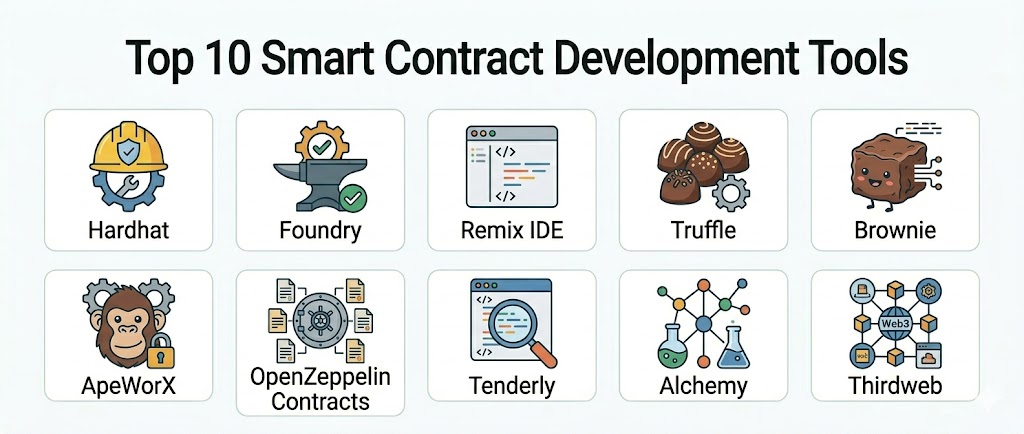
Helpful comparison guide showcasing smart contract development tools and how they support faster coding, testing, and deployment of blockchain applications.