Introduction
Digital Asset Compliance Tools help crypto businesses, financial institutions, Web3 platforms, exchanges, custodians, payment providers, and fintech teams monitor blockchain activity, detect risk, screen wallets, investigate transactions, and meet compliance obligations around digital assets. In simple terms, these tools help organizations understand whether a wallet, transaction, token flow, or counterparty may be linked to fraud, sanctions exposure, scams, money laundering, darknet activity, ransomware, stolen funds, or other high-risk behavior.
These tools matter because digital assets move quickly across public blockchains, bridges, exchanges, wallets, DeFi protocols, mixers, and cross-chain environments. Without proper monitoring, organizations may struggle to identify risky funds, suspicious customers, regulatory exposure, or unusual transaction patterns. Common use cases include wallet screening, transaction monitoring, AML investigations, sanctions risk checks, exchange compliance, custody risk management, DeFi protocol monitoring, and law enforcement investigations.
Buyers should evaluate blockchain coverage, risk scoring accuracy, alert quality, entity attribution, sanctions screening, case management, reporting, API support, investigation tools, compliance workflows, audit trails, customer support, and integration with KYC, SIEM, fraud, and transaction systems.
Best for: crypto exchanges, banks, fintech companies, custodians, payment processors, DeFi platforms, wallet providers, regulators, law enforcement teams, compliance officers, fraud teams, and digital asset risk teams. Not ideal for: casual crypto users, small teams with no regulated activity, organizations that only need simple portfolio tracking, or businesses that do not handle customer transactions, custody, token flows, or compliance-sensitive blockchain activity.
Key Trends in Digital Asset Compliance Tools
- Cross-chain compliance is becoming essential: Risk now moves across Bitcoin, Ethereum, Solana, stablecoin networks, bridges, layer-two networks, and many other chains, so single-chain monitoring is no longer enough.
- DeFi risk monitoring is a growing priority: Compliance teams need better visibility into decentralized exchanges, lending protocols, bridges, liquidity pools, mixers, and smart contract-based flows.
- Stablecoin transaction monitoring is becoming more important: Stablecoins are widely used for payments, settlement, trading, and treasury movement, making wallet screening and transaction risk controls critical.
- Real-time wallet screening is now expected: Exchanges, custodians, and payment providers increasingly need instant risk checks before deposits, withdrawals, onboarding, or transfers are approved.
- Entity attribution quality is a major differentiator: Buyers want accurate labels for exchanges, darknet markets, scam wallets, mixers, sanctioned entities, ransomware groups, bridges, and high-risk services.
- Compliance teams want fewer false positives: Alert overload is a major problem, so tools with better risk scoring, workflow controls, and contextual investigation features are becoming more valuable.
- Digital asset compliance is converging with fraud prevention: Teams increasingly combine blockchain analytics with customer risk, device signals, transaction behavior, and account activity.
- Case management is becoming more important: Compliance teams want investigation notes, evidence trails, escalations, workflow status, and audit-ready reports inside the same platform.
- API-first compliance is expanding: Developers need APIs for wallet screening, transaction monitoring, address clustering, and automated decisioning inside exchanges, wallets, and fintech products.
- Regulated institutions need enterprise-grade controls: Banks, asset managers, and custodians require strong access control, audit logs, support, reporting, and integration with broader compliance systems.
How We Selected These Tools
The tools below were selected based on their relevance to blockchain analytics, AML compliance, wallet risk scoring, transaction monitoring, sanctions screening, investigation workflows, and enterprise digital asset risk management.
- Market adoption and mindshare: Preference was given to tools widely recognized by crypto exchanges, regulators, compliance teams, investigators, financial institutions, and blockchain businesses.
- Feature completeness: Tools were evaluated for wallet screening, transaction monitoring, risk scoring, case management, investigation workflows, and reporting.
- Blockchain coverage: Platforms with broad support for major chains, tokens, stablecoins, DeFi ecosystems, and cross-chain activity were prioritized.
- Entity attribution: Tools with strong labeling, clustering, risk categorization, and investigative intelligence were rated higher.
- Compliance workflow fit: Case management, alert triage, audit logs, reporting, and policy workflows were considered important.
- API and integration support: Developer APIs, transaction system integration, KYC compatibility, and enterprise workflow integration were considered.
- Security and enterprise readiness: Access control, role management, auditability, support, and enterprise deployment readiness were reviewed where clearly known.
- Buyer fit: The list includes options for exchanges, banks, custodians, fintech teams, DeFi protocols, investigators, and compliance operations teams.
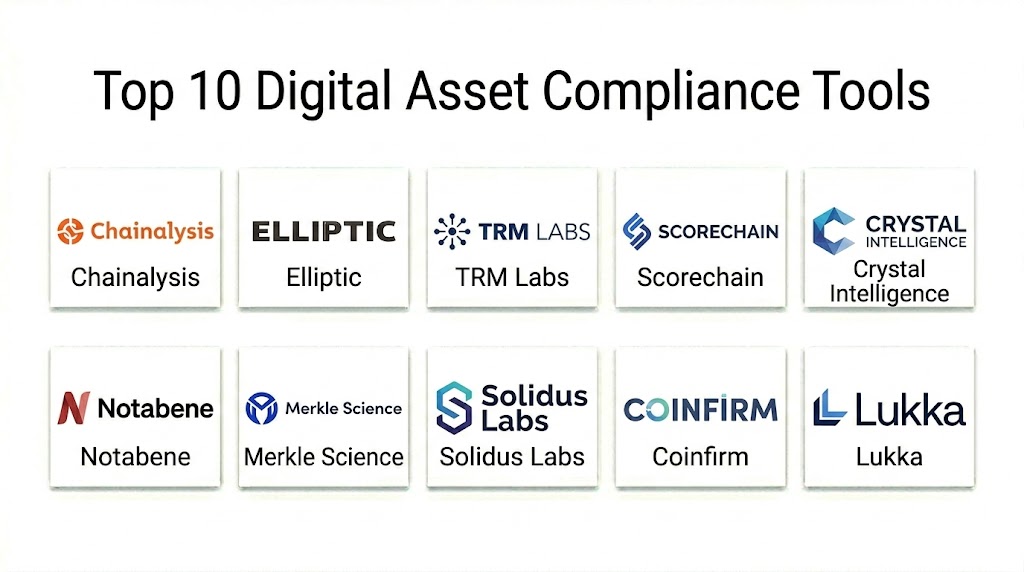
Top 10 Digital Asset Compliance Tools
#1 — Chainalysis
Short description: Chainalysis is one of the most widely recognized blockchain analytics and digital asset compliance platforms. It helps organizations screen wallets, monitor transactions, investigate blockchain activity, and understand exposure to illicit finance risks. Chainalysis is commonly used by exchanges, financial institutions, regulators, law enforcement teams, and crypto businesses. It is best for organizations that need mature blockchain intelligence, investigation workflows, and compliance-grade risk monitoring.
Key Features
- Wallet screening and transaction monitoring.
- Blockchain investigation tools for tracing fund flows.
- Risk scoring for addresses, entities, and transactions.
- Support for compliance, fraud, and investigation workflows.
- Entity attribution for exchanges, illicit services, scams, and high-risk categories.
- Case management and reporting capabilities.
- API support for integrating risk checks into business systems.
Pros
- Strong market recognition and enterprise adoption.
- Useful for both compliance teams and investigators.
- Broad blockchain analytics and intelligence capabilities.
- Strong fit for regulated digital asset businesses.
Cons
- May be expensive for smaller teams.
- Implementation can require compliance workflow planning.
- Alert tuning may be needed to reduce false positives.
- Some advanced features may require higher-tier packages.
Platforms / Deployment
Cloud / Web / API / Enterprise compliance platform.
Security & Compliance
Enterprise controls may include role-based access, auditability, secure platform access, and administrative controls depending on plan and configuration. Specific certifications and compliance claims should be verified directly. If uncertain, write: Not publicly stated.
Integrations & Ecosystem
Chainalysis fits into regulated digital asset operations where wallet screening, monitoring, and investigation workflows need to connect with internal systems.
- Crypto exchanges
- Custody platforms
- KYC and onboarding workflows
- Transaction monitoring systems
- Case management workflows
- Law enforcement investigation workflows
Support & Community
Chainalysis provides enterprise support, documentation, training, investigation resources, and customer success services. It has strong visibility among compliance professionals, regulators, and blockchain investigators.
#2 — TRM Labs
Short description: TRM Labs provides blockchain intelligence, wallet screening, transaction monitoring, and investigation tools for digital asset compliance teams. It is used by crypto businesses, financial institutions, public-sector teams, and risk teams that need to detect illicit finance exposure. TRM Labs is especially useful for compliance teams that want risk scoring, entity intelligence, alerting, and investigation workflows in one platform. It is best for regulated businesses that need modern blockchain risk intelligence and API-driven monitoring.
Key Features
- Wallet screening and transaction monitoring.
- Blockchain investigation and fund tracing tools.
- Risk scoring for addresses, transactions, and entities.
- Support for sanctions, scams, fraud, and illicit finance detection.
- API integration for real-time compliance workflows.
- Case management and alert triage support.
- Cross-chain monitoring capabilities.
Pros
- Strong fit for compliance and risk teams.
- Useful for exchanges, fintechs, and public-sector investigations.
- Good API-first workflow support.
- Strong blockchain intelligence and investigation focus.
Cons
- Pricing may be more suitable for serious compliance operations.
- Requires compliance expertise to configure policies effectively.
- Buyers should validate chain coverage for specific needs.
- Advanced investigation workflows may require training.
Platforms / Deployment
Cloud / Web / API / Compliance and investigation platform.
Security & Compliance
Enterprise security controls may include user roles, access control, audit trails, secure platform access, and administrative settings depending on plan. Specific certifications should be verified directly. If uncertain, write: Not publicly stated.
Integrations & Ecosystem
TRM Labs is designed to fit into digital asset compliance operations, fraud workflows, and investigation environments.
- Exchanges and trading platforms
- Wallet and custody systems
- KYC and onboarding tools
- Transaction monitoring workflows
- Law enforcement investigations
- Fintech compliance systems
Support & Community
TRM Labs provides customer support, compliance resources, training, and implementation guidance. It is well known among digital asset compliance teams and public-sector investigators.
#3 — Elliptic
Short description: Elliptic provides blockchain analytics, wallet screening, transaction monitoring, and crypto risk intelligence for digital asset businesses and financial institutions. It helps teams identify exposure to sanctions, fraud, money laundering, scams, and other high-risk blockchain activity. Elliptic is especially useful for organizations that need risk-based compliance controls and investigative visibility across digital asset flows. It is best for exchanges, banks, custodians, fintech firms, and compliance teams.
Key Features
- Wallet and transaction risk screening.
- Blockchain analytics and investigation tools.
- Entity attribution and risk categorization.
- Sanctions and illicit finance exposure detection.
- APIs for integrating compliance checks into internal systems.
- Alerting and monitoring workflows for compliance teams.
- Support for regulated digital asset business operations.
Pros
- Strong reputation in blockchain analytics and compliance.
- Useful for financial institutions and digital asset businesses.
- Good fit for risk-based compliance programs.
- Helps connect blockchain risk with operational workflows.
Cons
- Enterprise pricing may not fit very small teams.
- Buyers should validate chain and token coverage.
- Alert configuration and triage process require planning.
- Some workflows may need integration with existing compliance systems.
Platforms / Deployment
Cloud / Web / API / Blockchain analytics platform.
Security & Compliance
Enterprise controls may include access control, audit logs, user management, and secure platform workflows depending on plan. Specific certifications and compliance claims should be verified directly. If uncertain, write: Not publicly stated.
Integrations & Ecosystem
Elliptic integrates into digital asset compliance stacks that need wallet screening, monitoring, and investigative analytics.
- Crypto exchanges
- Banking compliance systems
- Custody platforms
- Payment providers
- Investigation workflows
- API-based risk checks
Support & Community
Elliptic provides enterprise support, documentation, training, and customer success resources. It has strong visibility among financial crime compliance, crypto compliance, and blockchain analytics teams.
#4 — CipherTrace
Short description: CipherTrace is a digital asset intelligence and compliance platform focused on cryptocurrency AML, transaction monitoring, wallet risk, and investigation support. It is relevant for exchanges, banks, payment providers, and compliance teams that need visibility into blockchain transaction risk. CipherTrace helps organizations screen addresses, identify risky activity, and investigate crypto flows. It is best for teams that need blockchain compliance tools connected to broader financial crime risk management.
Key Features
- Crypto AML transaction monitoring.
- Wallet and address risk assessment.
- Blockchain investigation and fund tracing.
- Support for sanctions, fraud, and illicit activity detection.
- Risk intelligence for digital asset businesses.
- Compliance reporting and investigation workflows.
- API support for automated screening.
Pros
- Strong fit for AML-focused crypto compliance.
- Useful for exchanges and financial institutions.
- Helps identify risky blockchain exposure.
- Can support investigation and reporting workflows.
Cons
- Buyers should validate current product packaging and platform scope.
- Chain coverage should be tested against business needs.
- Advanced workflows may require training.
- Pricing and support may vary by customer profile.
Platforms / Deployment
Cloud / Web / API / Compliance platform.
Security & Compliance
Security features may include platform access controls, auditability, administrative permissions, and secure workflow features depending on plan. Specific certifications and compliance claims should be verified directly. If uncertain, write: Not publicly stated.
Integrations & Ecosystem
CipherTrace fits organizations that need crypto AML risk checks and investigation workflows integrated into compliance operations.
- Exchanges
- Payment platforms
- Banks and financial institutions
- Transaction monitoring tools
- Wallet screening workflows
- AML investigation teams
Support & Community
Support and onboarding may vary by product package and customer needs. Buyers should validate training, documentation, and implementation support during evaluation.
#5 — Crystal Intelligence
Short description: Crystal Intelligence provides blockchain analytics, transaction monitoring, and investigation tools for compliance and risk teams. It helps organizations analyze blockchain flows, identify risky wallets, screen transactions, and support AML investigations. Crystal is useful for exchanges, investigators, regulators, and financial institutions that need blockchain intelligence across digital asset activity. It is best for teams that need visual investigation, wallet risk analysis, and compliance monitoring.
Key Features
- Blockchain transaction monitoring and analytics.
- Wallet and entity risk scoring.
- Visual investigation tools for tracing fund movement.
- Support for AML and sanctions-related workflows.
- Helps identify exposure to risky entities and services.
- API support for compliance integration.
- Reporting and case investigation workflows.
Pros
- Strong visual investigation capabilities.
- Useful for compliance analysts and investigators.
- Good fit for wallet screening and transaction monitoring.
- Supports digital asset risk analysis workflows.
Cons
- Buyers should validate chain and token coverage.
- May require analyst training for deeper investigations.
- Pricing and packaging may vary by organization size.
- Alert tuning and workflow design are still important.
Platforms / Deployment
Cloud / Web / API / Blockchain analytics platform.
Security & Compliance
Enterprise controls may include user management, access controls, and audit-related workflows depending on plan. Specific certifications should be verified directly. If uncertain, write: Not publicly stated.
Integrations & Ecosystem
Crystal Intelligence fits compliance, fraud, and investigation teams that need blockchain analytics connected to operational workflows.
- Crypto exchanges
- Investigation teams
- Wallet screening systems
- AML compliance workflows
- Regulatory analysis
- API-based monitoring systems
Support & Community
Crystal provides documentation, onboarding, and support resources depending on customer plan. It is most relevant for trained analysts and compliance teams working with blockchain investigations.
#6 — Coinfirm
Short description: Coinfirm provides blockchain analytics and AML compliance tools for crypto businesses, financial institutions, and digital asset risk teams. It helps organizations assess wallet risk, monitor transactions, and generate compliance insights for digital asset flows. Coinfirm is useful for businesses that need practical AML workflows and risk scoring for blockchain transactions. It is best for exchanges, fintechs, payment providers, and compliance teams looking for crypto AML automation.
Key Features
- Wallet risk scoring and AML checks.
- Transaction monitoring for digital asset flows.
- Entity and address risk intelligence.
- API integration for automated compliance workflows.
- Supports reporting and compliance operations.
- Useful for exchanges and crypto payment businesses.
- Helps detect exposure to high-risk blockchain activity.
Pros
- Practical AML-focused digital asset compliance tool.
- Useful for wallet screening and transaction monitoring.
- API support helps automate risk checks.
- Good fit for crypto-native compliance workflows.
Cons
- Buyers should validate coverage for required chains.
- Advanced investigation depth may vary by product tier.
- Alert quality depends on configuration and use case.
- Enterprise requirements should be reviewed carefully.
Platforms / Deployment
Cloud / Web / API / AML compliance platform.
Security & Compliance
Security features may include access controls, secure platform workflows, and administrative settings depending on plan. Specific certifications and compliance claims should be verified directly. If uncertain, write: Not publicly stated.
Integrations & Ecosystem
Coinfirm fits digital asset businesses that need AML screening integrated into onboarding, deposits, withdrawals, and transaction workflows.
- Crypto exchanges
- Payment processors
- Wallet services
- KYC systems
- Transaction monitoring workflows
- API-based compliance systems
Support & Community
Coinfirm provides customer support, documentation, and onboarding resources depending on plan. It is most useful for teams with defined AML and compliance workflows.
#7 — Scorechain
Short description: Scorechain provides blockchain analytics and AML compliance tools for crypto asset service providers, financial institutions, and investigators. It helps teams monitor transactions, assess wallet risk, and investigate suspicious digital asset flows. Scorechain is useful for compliance teams that need operational AML workflows, reporting, and blockchain intelligence. It is best for regulated crypto businesses and financial institutions managing digital asset risk.
Key Features
- Wallet screening and risk scoring.
- Transaction monitoring for AML compliance.
- Blockchain investigation and analytics tools.
- Support for suspicious activity analysis and reporting workflows.
- API access for integration with internal systems.
- Risk indicators for high-risk entities and transaction behavior.
- Compliance workflow tools for digital asset businesses.
Pros
- Strong fit for crypto AML operations.
- Useful for regulated service providers.
- Supports monitoring and investigation workflows.
- Can help compliance teams operationalize blockchain risk controls.
Cons
- Buyers should validate supported assets and network coverage.
- May require training for investigation workflows.
- Pricing and support may vary by business size.
- Needs careful alert tuning to avoid excessive false positives.
Platforms / Deployment
Cloud / Web / API / Compliance and analytics platform.
Security & Compliance
Security controls may include platform user management, access controls, and audit-related workflow features depending on plan. Specific certifications and compliance claims should be verified directly. If uncertain, write: Not publicly stated.
Integrations & Ecosystem
Scorechain integrates into compliance operations where businesses need risk scoring, monitoring, and investigation support.
- Crypto asset service providers
- Banks and fintechs
- Wallet screening workflows
- AML monitoring systems
- Compliance reporting
- Investigation teams
Support & Community
Scorechain provides documentation, support, and customer success resources depending on plan. It is most useful for compliance teams with established AML review processes.
#8 — Merkle Science
Short description: Merkle Science provides crypto risk intelligence, transaction monitoring, wallet screening, and investigation tools for digital asset compliance teams. It helps organizations detect illicit activity, screen counterparties, and manage blockchain risk across crypto transactions. Merkle Science is especially relevant for exchanges, law enforcement, regulators, and financial institutions needing risk-based monitoring. It is best for teams that want blockchain intelligence with compliance and investigation workflows.
Key Features
- Wallet screening and transaction monitoring.
- Crypto risk intelligence and entity attribution.
- Investigation tools for tracing suspicious funds.
- Support for sanctions, fraud, and illicit activity risk checks.
- API integration for compliance automation.
- Case management and reporting workflows.
- Useful for exchanges, regulators, and investigators.
Pros
- Good fit for crypto compliance and investigations.
- Useful for risk-based transaction monitoring.
- Supports API-driven compliance checks.
- Relevant for both private-sector and public-sector teams.
Cons
- Buyers should validate blockchain coverage for target markets.
- Pricing and feature depth may vary by plan.
- Investigation features may require analyst training.
- Integration effort depends on internal compliance stack.
Platforms / Deployment
Cloud / Web / API / Compliance intelligence platform.
Security & Compliance
Security features may include user access controls, secure platform access, workflow controls, and auditability depending on plan. Specific certifications should be verified directly. If uncertain, write: Not publicly stated.
Integrations & Ecosystem
Merkle Science fits compliance systems that need blockchain risk intelligence, monitoring, and investigation workflows.
- Exchanges and custodians
- Law enforcement workflows
- Regulatory investigations
- Payment providers
- KYC and onboarding systems
- Transaction monitoring platforms
Support & Community
Merkle Science provides support, documentation, and compliance resources depending on customer needs. It is relevant for compliance analysts, investigators, and digital asset risk teams.
#9 — Notabene
Short description: Notabene focuses on crypto Travel Rule compliance and transaction authorization workflows for virtual asset service providers. It helps digital asset businesses exchange required transaction information, screen counterparties, and manage compliance workflows around regulated transfers. Notabene is especially useful for exchanges, custodians, brokers, and payment providers that need Travel Rule coordination. It is best for regulated crypto businesses that need counterparty messaging and transfer compliance.
Key Features
- Travel Rule compliance workflows.
- Counterparty discovery and messaging.
- Transaction authorization and transfer compliance support.
- Useful for exchanges, custodians, brokers, and payment providers.
- Helps coordinate required originator and beneficiary information.
- Supports compliance policy workflows and risk review.
- API support for integrating with transfer systems.
Pros
- Strong focus on Travel Rule requirements.
- Useful for regulated virtual asset service providers.
- Helps manage counterparty compliance workflows.
- Complements blockchain analytics and AML tools.
Cons
- Not a general-purpose blockchain investigation platform.
- Best fit is for regulated transfer compliance use cases.
- Requires integration with internal transaction systems.
- Buyers may still need separate wallet screening and analytics tools.
Platforms / Deployment
Cloud / Web / API / Compliance workflow platform.
Security & Compliance
Security features may include access controls, secure messaging workflows, platform governance, and audit-related controls depending on plan. Specific certifications and compliance claims should be verified directly. If uncertain, write: Not publicly stated.
Integrations & Ecosystem
Notabene fits digital asset businesses that need Travel Rule compliance connected to transaction authorization and counterparty workflows.
- Exchanges
- Custodians
- Brokers
- Payment providers
- Transaction systems
- Compliance review workflows
Support & Community
Notabene provides compliance-focused support, onboarding, documentation, and industry resources. It is strongest for teams managing Travel Rule obligations and counterparty coordination.
#10 — Solidus Labs
Short description: Solidus Labs provides crypto-native market integrity, trade surveillance, transaction monitoring, and risk tools for digital asset businesses. It is especially relevant for exchanges, trading platforms, brokers, and marketplaces that need to detect manipulation, abuse, suspicious trading, and risky transaction behavior. Solidus Labs helps compliance and risk teams monitor digital asset activity beyond basic wallet screening. It is best for organizations that need market surveillance and digital asset risk controls in trading environments.
Key Features
- Crypto market surveillance and trade monitoring.
- Transaction monitoring and risk detection workflows.
- Helps detect manipulation, abuse, and suspicious activity.
- Useful for exchanges, brokers, and trading platforms.
- Compliance reporting and alert management.
- Supports digital asset market integrity programs.
- Can complement AML and blockchain analytics tools.
Pros
- Strong fit for trading venues and market integrity teams.
- Useful beyond basic wallet screening.
- Helps detect suspicious trading behavior.
- Good complement to blockchain analytics platforms.
Cons
- Not primarily a wallet attribution or chain tracing platform.
- Best suited to trading and market surveillance use cases.
- May require integration with trading and order systems.
- Buyers may need additional tools for AML investigations.
Platforms / Deployment
Cloud / Web / API / Compliance and surveillance platform.
Security & Compliance
Security controls may include role-based access, auditability, platform governance, and secure access depending on plan. Specific certifications and compliance claims should be verified directly. If uncertain, write: Not publicly stated.
Integrations & Ecosystem
Solidus Labs fits exchanges, trading systems, and crypto market operations where teams need surveillance, compliance monitoring, and risk controls.
- Crypto exchanges
- Trading platforms
- Broker systems
- Market surveillance workflows
- Transaction monitoring systems
- Compliance operations
Support & Community
Solidus Labs provides enterprise support, onboarding, and compliance-focused resources. It is strongest for teams operating trading platforms or digital asset market infrastructure.
Comparison Table
| Tool Name | Best For | Platform Supported | Deployment | Standout Feature | Public Rating |
|---|---|---|---|---|---|
| Chainalysis | Enterprise blockchain analytics and investigations | Web / API / Cloud | Cloud | Mature wallet screening and investigation intelligence | N/A |
| TRM Labs | Risk intelligence and real-time monitoring | Web / API / Cloud | Cloud | API-driven blockchain risk and investigations | N/A |
| Elliptic | Financial institutions and crypto compliance | Web / API / Cloud | Cloud | Risk-based wallet and transaction screening | N/A |
| CipherTrace | Crypto AML and financial crime workflows | Web / API / Cloud | Cloud | Digital asset AML intelligence | N/A |
| Crystal Intelligence | Visual blockchain investigations | Web / API / Cloud | Cloud | Visual fund flow tracing and risk analytics | N/A |
| Coinfirm | AML automation for crypto businesses | Web / API / Cloud | Cloud | Wallet risk scoring and AML checks | N/A |
| Scorechain | Crypto asset service provider compliance | Web / API / Cloud | Cloud | AML monitoring and investigation workflows | N/A |
| Merkle Science | Compliance and investigation teams | Web / API / Cloud | Cloud | Crypto risk intelligence and entity attribution | N/A |
| Notabene | Travel Rule compliance | Web / API / Cloud | Cloud | Counterparty messaging and transfer compliance | N/A |
| Solidus Labs | Market surveillance and trading compliance | Web / API / Cloud | Cloud | Crypto market integrity and surveillance | N/A |
Evaluation & Scoring of Digital Asset Compliance Tools
| Tool Name | Core 25% | Ease 15% | Integrations 15% | Security 10% | Performance 10% | Support 10% | Value 15% | Weighted Total |
|---|---|---|---|---|---|---|---|---|
| Chainalysis | 10 | 8 | 9 | 9 | 9 | 9 | 8 | 8.95 |
| TRM Labs | 9 | 8 | 9 | 9 | 9 | 9 | 8 | 8.80 |
| Elliptic | 9 | 8 | 9 | 9 | 8 | 8 | 8 | 8.55 |
| CipherTrace | 8 | 7 | 8 | 8 | 8 | 8 | 7 | 7.75 |
| Crystal Intelligence | 8 | 8 | 8 | 8 | 8 | 8 | 8 | 8.00 |
| Coinfirm | 8 | 8 | 8 | 8 | 8 | 7 | 8 | 7.90 |
| Scorechain | 8 | 8 | 8 | 8 | 8 | 7 | 8 | 7.90 |
| Merkle Science | 8 | 8 | 8 | 8 | 8 | 8 | 8 | 8.00 |
| Notabene | 8 | 8 | 8 | 8 | 8 | 8 | 8 | 8.00 |
| Solidus Labs | 8 | 8 | 8 | 8 | 8 | 8 | 8 | 8.00 |
These scores are comparative and based on digital asset compliance fit, not absolute product quality. A higher score means the platform aligns strongly with wallet screening, transaction monitoring, risk intelligence, integrations, investigation support, and enterprise compliance workflows. Blockchain analytics platforms score well for AML and investigations, while specialized platforms such as Notabene and Solidus Labs score strongly for Travel Rule and market surveillance use cases. Buyers should adjust weights based on whether their priority is wallet screening, trading surveillance, Travel Rule compliance, or investigation depth.
Which Digital Asset Compliance Tool Is Right for You?
Solo / Freelancer
Solo users usually do not need enterprise-grade digital asset compliance tools unless they are consultants, investigators, or independent compliance professionals. For basic personal crypto safety, wallet hygiene and simple public explorers may be enough. However, independent analysts working on investigations may evaluate tools such as Crystal Intelligence or Merkle Science if they need visual tracing and wallet risk insights. Most full compliance platforms are better suited to businesses with customer transactions or regulated operations.
SMB
SMBs handling crypto transactions should focus on practical wallet screening, transaction monitoring, and API integration. Coinfirm, Scorechain, Merkle Science, and Crystal Intelligence may be practical options depending on coverage and budget. If the business is a small exchange, payment provider, or wallet service, automated screening and alert workflows are important from the start. SMBs should avoid relying only on manual review because risk can scale quickly as transaction volume grows.
Mid-Market
Mid-market digital asset businesses often need stronger alert management, case workflows, API automation, and chain coverage. TRM Labs, Elliptic, Chainalysis, and Merkle Science are strong candidates for AML and blockchain intelligence. Notabene becomes important if Travel Rule workflows apply. Solidus Labs is useful if the business operates a trading venue or needs market surveillance. Mid-market teams should test alert quality, false positives, and integration effort before selecting a platform.
Enterprise
Enterprises, banks, custodians, exchanges, and institutional platforms should prioritize broad chain coverage, high-quality attribution, strong support, audit trails, API performance, and enterprise workflow integration. Chainalysis, TRM Labs, and Elliptic are strong options for broad blockchain analytics and compliance operations. Notabene fits regulated transfer compliance, while Solidus Labs supports trading surveillance and market integrity. Enterprises should involve compliance, legal, fraud, engineering, and security teams during evaluation.
Budget vs Premium
Budget-conscious teams should start by identifying the minimum compliance controls required for their business model. Smaller companies may begin with wallet screening and basic monitoring before expanding into advanced investigation and case management. Premium platforms are more appropriate when transaction volume, regulatory exposure, customer risk, or investigation complexity is high. Total cost should include licensing, API usage, analyst time, training, integration, support, and false-positive review workload.
Feature Depth vs Ease of Use
For deep blockchain intelligence and investigation capabilities, Chainalysis, TRM Labs, and Elliptic are strong options. For visual investigations, Crystal Intelligence may be helpful. For simpler AML automation, Coinfirm or Scorechain may fit some teams. For specialized workflows, Notabene is focused on Travel Rule compliance and Solidus Labs is focused on market surveillance. Buyers should choose based on the workflow they need most, not only the longest feature list.
Integrations & Scalability
Digital asset compliance tools should integrate with onboarding, KYC, transaction systems, custody platforms, withdrawal approval flows, fraud tools, case management systems, and reporting workflows. API reliability is important for real-time screening. Chain coverage and token support should be tested against actual customer activity. Scaling also requires alert routing, analyst queues, escalation rules, and audit-ready evidence management.
Security & Compliance Needs
Security-sensitive teams should prioritize role-based access, audit logs, secure APIs, data protection, alert history, case evidence, and administrative controls. Compliance teams should verify sanctions screening, wallet attribution, reporting, risk categories, policy configuration, and regulator-friendly outputs. Trading venues should also consider market surveillance tools, while virtual asset service providers should evaluate Travel Rule workflows. No tool replaces compliance governance, trained analysts, and documented procedures.
Frequently Asked Questions
1. What are digital asset compliance tools?
Digital asset compliance tools help organizations monitor crypto wallets, blockchain transactions, token flows, and digital asset activity for financial crime and regulatory risk. They can screen addresses, assign risk scores, detect suspicious patterns, and support investigations. These tools are commonly used by exchanges, custodians, fintechs, banks, regulators, and law enforcement teams. They help businesses manage risk in blockchain-based financial activity.
2. Why do crypto businesses need compliance tools?
Crypto businesses need compliance tools because blockchain transactions can involve sanctioned entities, scams, darknet markets, ransomware, stolen funds, mixers, or other high-risk sources. Manual review is usually not enough at scale. Compliance platforms help automate screening, monitoring, alerting, and investigations. They also help create evidence trails for internal review, audits, and regulatory reporting.
3. What is wallet screening?
Wallet screening is the process of checking a blockchain address for risk before allowing onboarding, deposits, withdrawals, transfers, or business activity. The tool may assess whether the wallet is linked to scams, sanctions, illicit services, mixers, stolen funds, or other risky behavior. Wallet screening can happen in real time through APIs. It is one of the most common digital asset compliance workflows.
4. What is transaction monitoring in digital asset compliance?
Transaction monitoring tracks blockchain activity to detect suspicious or risky transfers. It can review transaction amounts, counterparties, exposure to high-risk entities, movement through mixers, unusual patterns, and changes in customer behavior. Monitoring helps compliance teams identify potential money laundering, fraud, sanctions exposure, or policy violations. Good monitoring tools also support alert triage and case investigation.
5. What is the Travel Rule in crypto compliance?
The Travel Rule requires certain information about the originator and beneficiary of a virtual asset transfer to be shared between regulated entities in applicable situations. Tools such as Notabene help virtual asset service providers coordinate counterparty messaging and transfer compliance. Travel Rule workflows are different from general blockchain analytics. Many organizations need both Travel Rule tools and wallet screening tools.
6. Are digital asset compliance tools accurate?
Accuracy depends on blockchain coverage, address clustering, entity attribution, risk models, and data quality. No tool is perfect because blockchain activity changes quickly and bad actors use complex routing methods. Good tools reduce risk but still require trained analysts and clear compliance policies. Buyers should test tools with real transaction samples and compare false positives, missed risks, and investigation quality.
7. How are digital asset compliance tools priced?
Pricing varies by vendor, transaction volume, API usage, number of users, modules, chains covered, and enterprise support needs. Some platforms price wallet screening, monitoring, investigations, and Travel Rule workflows separately. Larger exchanges and institutions often need custom plans. Buyers should estimate cost based on expected transaction volume, analyst seats, alert workload, and required integrations.
8. What integrations should buyers look for?
Important integrations include KYC tools, onboarding systems, transaction engines, withdrawal approval workflows, custody platforms, fraud systems, SIEM tools, case management platforms, reporting workflows, and internal APIs. Real-time API integration is important for deposits and withdrawals. Compliance teams should also evaluate export options and audit trails. The best tools fit into existing operational processes without creating manual bottlenecks.
9. What are common mistakes when choosing a digital asset compliance tool?
A common mistake is choosing a tool only by brand recognition without testing coverage for actual chains and customer activity. Another mistake is ignoring false positives and analyst workload. Some teams also forget specialized needs such as Travel Rule compliance or trading surveillance. Successful buyers run a pilot, test real wallet and transaction samples, validate alerts, and involve compliance, fraud, legal, and engineering teams.
10. What is the best digital asset compliance tool overall?
There is no single best tool for every organization. Chainalysis, TRM Labs, and Elliptic are strong choices for broad blockchain analytics and compliance. Crystal Intelligence, Coinfirm, Scorechain, and Merkle Science are useful for AML monitoring and investigations. Notabene is best for Travel Rule workflows, while Solidus Labs is strong for market surveillance. The best choice depends on your business model, chains supported, transaction volume, regulatory obligations, and compliance workflow maturity.
Conclusion
Digital Asset Compliance Tools are essential for organizations that handle crypto transactions, custody, trading, payments, wallet activity, token flows, or regulated digital asset services. The best platform depends on the workflow you need most: Chainalysis, TRM Labs, and Elliptic are strong for broad blockchain analytics and investigations, while Coinfirm, Scorechain, Crystal Intelligence, and Merkle Science support AML monitoring and wallet risk workflows. Notabene is important for Travel Rule compliance, and Solidus Labs is valuable for exchanges and trading platforms that need market surveillance. Buyers should not choose only by reputation; they should test real transactions, chain coverage, risk scoring, false positives, API performance, case workflows, and reporting quality. Start by defining your compliance obligations, shortlist two or three tools, run a pilot with actual wallet and transaction data, validate integration with operations, then scale with documented policies and analyst review processes.

Regulatory requirements for digital assets continue to evolve rapidly across jurisdictions. Tools that adapt quickly to compliance changes often provide greater long-term value.