Introduction
Data Transformation Tools help organizations clean, standardize, enrich, validate, and restructure raw data into formats suitable for analytics, reporting, AI workloads, and operational systems. These platforms play a central role in modern data engineering pipelines by transforming fragmented and inconsistent data into reliable business-ready datasets. From ETL and ELT workflows to real-time processing and machine learning preparation, transformation tools are essential for scalable data operations.
As enterprises increasingly adopt cloud-native analytics, AI-driven automation, and real-time data architectures, transformation platforms have evolved far beyond traditional ETL systems. Modern solutions now emphasize automation, observability, scalability, governance, and interoperability across hybrid and multi-cloud environments.
Common real-world use cases include:
- Preparing analytics-ready datasets
- Cleaning and standardizing enterprise data
- Transforming streaming and batch data
- Building AI and machine learning pipelines
- Automating ELT workflows in cloud warehouses
Key evaluation criteria for buyers include:
- Transformation flexibility
- Performance and scalability
- Cloud-native compatibility
- Workflow automation capabilities
- Integration ecosystem
- Security and governance controls
- Observability and monitoring
- Ease of deployment
- AI-assisted automation
- Cost efficiency
Best for: Data engineers, analytics teams, cloud architects, AI/ML operations teams, enterprises managing large-scale data pipelines, and organizations modernizing analytics infrastructure.
Not ideal for: Organizations with minimal data complexity, lightweight reporting requirements, or teams that only require basic spreadsheet-level transformation.
Key Trends in Data Transformation Tools
- ELT-first architectures are replacing traditional ETL workflows.
- AI-assisted transformation recommendations are becoming more common.
- Real-time transformation capabilities are growing rapidly.
- Cloud-native transformation engines are prioritizing scalability and elasticity.
- Data observability is increasingly integrated into transformation platforms.
- SQL-first transformation tools are becoming more developer-friendly.
- Low-code and no-code transformation workflows are expanding adoption.
- Governance and lineage tracking are becoming mandatory enterprise requirements.
- Streaming transformation support is growing alongside event-driven architectures.
- Multi-cloud interoperability is becoming a critical enterprise requirement.
How We Selected These Tools
The tools in this list were selected based on market adoption, transformation capabilities, scalability, ecosystem maturity, and enterprise readiness.
Evaluation factors included:
- Industry adoption and visibility
- Transformation engine flexibility
- Performance and scalability
- Cloud-native architecture support
- Security and governance capabilities
- Integration ecosystem depth
- Observability and monitoring features
- AI and automation readiness
- Ease of deployment and usability
- Suitability for SMB and enterprise environments
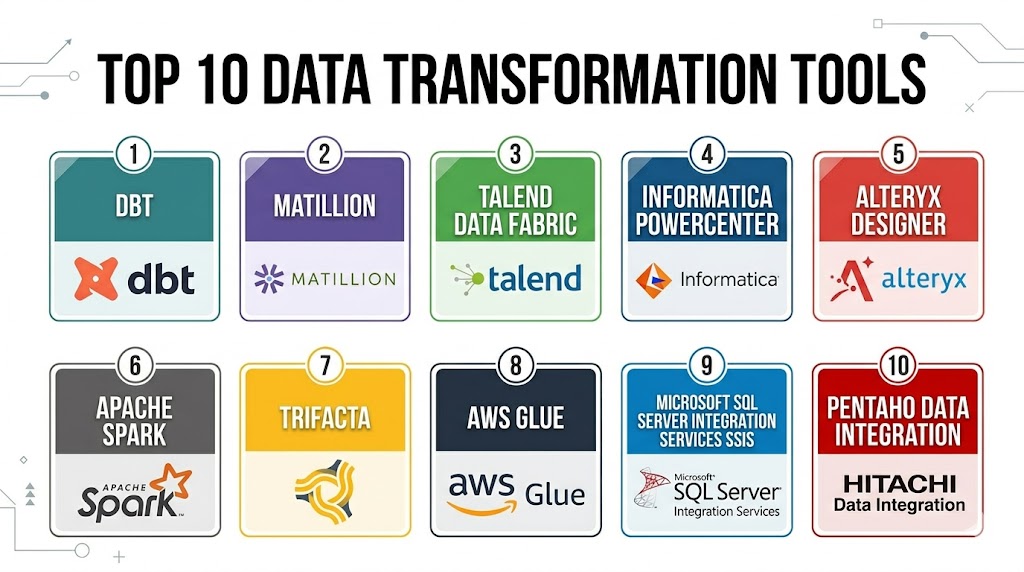
Top 10 Data Transformation Tools
1- dbt
Short Description:
dbt is one of the most widely adopted modern data transformation platforms built around SQL-based analytics engineering workflows. It enables teams to transform data directly inside cloud data warehouses while supporting testing, documentation, lineage tracking, and version control. dbt is especially popular among analytics engineering and cloud-native data teams.
Key Features
- SQL-based transformations
- Built-in testing framework
- Data lineage visualization
- Version-controlled workflows
- Modular transformation logic
- Documentation generation
- Cloud warehouse optimization
Pros
- Excellent developer experience
- Strong analytics engineering ecosystem
- Works natively with modern warehouses
- Large and active community
Cons
- SQL-centric approach may limit non-SQL users
- Advanced orchestration requires external tools
- Enterprise features may increase costs
- Limited native streaming support
Platforms / Deployment
Cloud / Self-hosted / Hybrid
Security & Compliance
SSO, RBAC, audit logging, encryption support. Additional compliance capabilities vary by deployment plan.
Integrations & Ecosystem
dbt integrates deeply with cloud warehouses, orchestration tools, observability platforms, and analytics systems.
- Snowflake
- BigQuery
- Databricks
- Redshift
- Airflow
- Prefect
Support & Community
Very strong community with extensive documentation, learning resources, and enterprise support options.
2- Informatica Intelligent Data Management Cloud
Short Description:
Informatica Intelligent Data Management Cloud is an enterprise-grade data integration and transformation platform designed for hybrid and multi-cloud environments. It combines ETL, governance, quality management, and automation capabilities into a unified enterprise data platform.
Key Features
- Enterprise ETL and ELT workflows
- AI-powered automation
- Data quality management
- Metadata-driven transformation
- Hybrid cloud support
- Workflow orchestration
- Governance and lineage tracking
Pros
- Strong enterprise governance capabilities
- Broad integration ecosystem
- Mature transformation engine
- Scalable enterprise architecture
Cons
- Higher licensing costs
- Complex implementation
- May require specialized administrators
- Steeper learning curve
Platforms / Deployment
Cloud / Hybrid
Security & Compliance
SSO, RBAC, encryption, audit logging, enterprise governance controls, and compliance support.
Integrations & Ecosystem
Informatica integrates with enterprise applications, cloud platforms, and analytics systems.
- AWS
- Azure
- Google Cloud
- SAP
- Oracle
- Snowflake
Support & Community
Strong enterprise support with global professional services ecosystem.
3- Talend Data Fabric
Short Description:
Talend Data Fabric is a data integration and transformation platform focused on cloud data management, governance, and analytics automation. It supports both ETL and ELT architectures while providing data quality and compliance management features.
Key Features
- ETL and ELT workflows
- Data quality tools
- Visual pipeline builder
- Cloud-native integration
- Governance capabilities
- Real-time processing support
- API integration management
Pros
- Strong data governance capabilities
- Broad connector ecosystem
- Visual development experience
- Flexible deployment models
Cons
- Enterprise pricing can be expensive
- Complex workflows may require expertise
- UI may feel heavy for smaller teams
- Performance tuning may require optimization
Platforms / Deployment
Cloud / Self-hosted / Hybrid
Security & Compliance
RBAC, SSO, encryption, audit logging, and enterprise governance capabilities.
Integrations & Ecosystem
Talend integrates with cloud platforms, databases, warehouses, and enterprise applications.
- Snowflake
- AWS
- Azure
- Salesforce
- SAP
- Hadoop
Support & Community
Strong enterprise support and established customer ecosystem.
4- Apache Spark
Short Description:
Apache Spark is a distributed data processing engine widely used for large-scale data transformation, analytics, streaming, and machine learning workloads. It provides high-performance in-memory processing capabilities for modern big data environments.
Key Features
- Distributed data processing
- Real-time streaming support
- Machine learning libraries
- Batch and streaming transformations
- Scalable cluster computing
- SQL processing engine
- Multi-language support
Pros
- Extremely scalable architecture
- Excellent performance for big data
- Broad analytics ecosystem
- Strong support for AI workloads
Cons
- Requires infrastructure expertise
- Operational complexity can be high
- Resource-intensive deployments
- Debugging distributed workloads can be difficult
Platforms / Deployment
Cloud / Self-hosted / Hybrid
Security & Compliance
Encryption, RBAC, authentication integrations, and secure cluster management support.
Integrations & Ecosystem
Apache Spark integrates with data lakes, warehouses, orchestration tools, and cloud infrastructure.
- Hadoop
- Databricks
- Kafka
- AWS
- Kubernetes
- Snowflake
Support & Community
Massive open-source ecosystem with broad enterprise adoption and community support.
5- Matillion
Short Description:
Matillion is a cloud-native data transformation platform designed for modern ELT workflows and cloud warehouse optimization. It provides visual pipeline building, automation, and orchestration capabilities for analytics engineering teams.
Key Features
- Cloud-native ELT workflows
- Visual transformation builder
- Workflow orchestration
- Data pipeline automation
- Prebuilt connectors
- Scheduling and monitoring
- Warehouse-native execution
Pros
- Easy-to-use visual interface
- Strong cloud warehouse support
- Fast deployment experience
- Good scalability capabilities
Cons
- Best optimized for cloud warehouses
- Enterprise pricing may be costly
- Less flexible for custom coding
- Advanced customization may require expertise
Platforms / Deployment
Cloud
Security & Compliance
SSO, RBAC, encryption, and audit logging support.
Integrations & Ecosystem
Matillion integrates with major cloud data warehouses and SaaS applications.
- Snowflake
- BigQuery
- Redshift
- Salesforce
- AWS
- Azure
Support & Community
Strong onboarding resources and growing enterprise customer ecosystem.
6- Fivetran
Short Description:
Fivetran is a managed data movement and transformation platform focused on automated ELT workflows. It simplifies pipeline maintenance by handling schema changes, synchronization, and warehouse loading with minimal operational overhead.
Key Features
- Automated ELT pipelines
- Managed schema evolution
- Prebuilt connectors
- Cloud warehouse synchronization
- Scheduling automation
- Monitoring dashboards
- Transformation support
Pros
- Very low operational overhead
- Easy deployment and onboarding
- Extensive connector ecosystem
- Strong cloud-native architecture
Cons
- Pricing can scale quickly
- Less flexibility for custom transformations
- Limited deep workflow orchestration
- Best suited for managed ELT use cases
Platforms / Deployment
Cloud
Security & Compliance
Encryption, RBAC, SSO, audit logging, and enterprise-grade governance support.
Integrations & Ecosystem
Fivetran integrates with SaaS applications, cloud warehouses, and analytics systems.
- Snowflake
- BigQuery
- Salesforce
- HubSpot
- AWS
- Databricks
Support & Community
Strong enterprise support and simplified onboarding experience.
7- AWS Glue
Short Description:
AWS Glue is a serverless ETL and data transformation service built for cloud-native analytics environments. It provides automated schema discovery, workflow orchestration, and scalable data transformation capabilities within the AWS ecosystem.
Key Features
- Serverless ETL workflows
- Automated schema discovery
- Data catalog management
- Workflow scheduling
- Scalable transformation engine
- Streaming data support
- Native AWS integrations
Pros
- Minimal infrastructure management
- Strong AWS ecosystem integration
- Scalable serverless architecture
- Integrated metadata catalog
Cons
- Best suited for AWS environments
- Vendor lock-in concerns
- Complex pricing structure
- Debugging can be challenging
Platforms / Deployment
Cloud
Security & Compliance
IAM integration, encryption, RBAC, audit logging, and enterprise cloud security controls.
Integrations & Ecosystem
AWS Glue integrates natively with analytics, storage, and streaming services within AWS.
- S3
- Redshift
- Athena
- Lambda
- Lake Formation
- Kafka
Support & Community
Strong enterprise documentation and broad AWS ecosystem support.
8- Microsoft SQL Server Integration Services
Short Description:
Microsoft SQL Server Integration Services is a mature ETL and transformation platform used for enterprise data integration and workflow automation. It is widely adopted in organizations running Microsoft-based infrastructure and database environments.
Key Features
- ETL workflow automation
- Visual workflow designer
- Enterprise scheduling
- Data cleansing capabilities
- Workflow monitoring
- SQL Server integration
- Batch processing support
Pros
- Mature enterprise platform
- Strong SQL Server integration
- Familiar Microsoft ecosystem
- Reliable batch processing
Cons
- Less cloud-native flexibility
- UI feels dated compared to modern tools
- Limited support for modern streaming workloads
- Best optimized for Microsoft environments
Platforms / Deployment
Windows / Self-hosted / Hybrid
Security & Compliance
RBAC, encryption, authentication integration, and enterprise governance controls.
Integrations & Ecosystem
SSIS integrates deeply with Microsoft databases, analytics systems, and enterprise applications.
- SQL Server
- Azure
- Power BI
- Oracle
- SAP
- Excel
Support & Community
Large enterprise customer base with extensive documentation and Microsoft support.
9- Pentaho Data Integration
Short Description:
Pentaho Data Integration is an ETL and transformation platform designed for enterprise reporting, analytics, and hybrid data integration workflows. It provides visual transformation design and supports both traditional and modern analytics environments.
Key Features
- Visual ETL workflows
- Data transformation engine
- Batch processing support
- Scheduling automation
- Big data integration
- Workflow monitoring
- Data quality management
Pros
- Flexible transformation workflows
- Strong reporting ecosystem
- Broad deployment options
- Good hybrid integration support
Cons
- UI may feel outdated
- Performance tuning may be required
- Smaller modern cloud ecosystem
- Limited AI-driven automation
Platforms / Deployment
Cloud / Self-hosted / Hybrid
Security & Compliance
Encryption, RBAC, authentication integration, and enterprise governance support.
Integrations & Ecosystem
Pentaho integrates with databases, warehouses, analytics systems, and enterprise platforms.
- Hadoop
- Oracle
- AWS
- SQL Server
- SAP
- MongoDB
Support & Community
Established enterprise user base with long-term community adoption.
10- StreamSets
Short Description:
StreamSets is a modern data operations and transformation platform focused on continuous data movement, pipeline observability, and real-time transformation workflows. It helps organizations manage evolving schemas and dynamic data environments.
Key Features
- Continuous data ingestion
- Real-time transformation support
- Schema drift handling
- Pipeline observability
- Hybrid cloud support
- Workflow monitoring
- DataOps automation
Pros
- Excellent observability capabilities
- Strong real-time processing support
- Good schema evolution handling
- Flexible hybrid deployment options
Cons
- Enterprise-focused pricing
- Learning curve for advanced workflows
- Smaller ecosystem than larger competitors
- May require DataOps expertise
Platforms / Deployment
Cloud / Self-hosted / Hybrid
Security & Compliance
RBAC, encryption, SSO, audit logging, and governance support.
Integrations & Ecosystem
StreamSets integrates with streaming systems, warehouses, cloud infrastructure, and analytics tools.
- Snowflake
- Kafka
- AWS
- Azure
- Databricks
- Google Cloud
Support & Community
Strong enterprise onboarding and growing modern DataOps ecosystem.
Comparison Table
| Tool Name | Best For | Platform(s) Supported | Deployment | Standout Feature | Public Rating |
|---|---|---|---|---|---|
| dbt | Analytics engineering | Web / Cloud | Hybrid | SQL-first transformations | N/A |
| Informatica | Enterprise transformation | Cloud | Hybrid | Governance and automation | N/A |
| Talend | Hybrid data integration | Web / Cloud | Hybrid | Data quality management | N/A |
| Apache Spark | Big data transformation | Linux / Cloud | Hybrid | Distributed processing | N/A |
| Matillion | Cloud ELT workflows | Web / Cloud | Cloud | Warehouse-native ELT | N/A |
| Fivetran | Managed ELT automation | Web / Cloud | Cloud | Automated connectors | N/A |
| AWS Glue | Serverless transformation | Cloud | Cloud | AWS-native ETL | N/A |
| SSIS | Microsoft environments | Windows | Hybrid | SQL Server integration | N/A |
| Pentaho | Enterprise ETL workflows | Web / Windows / Linux | Hybrid | Visual transformations | N/A |
| StreamSets | DataOps and streaming | Web / Cloud | Hybrid | Schema drift handling | N/A |
Evaluation & Scoring of Data Transformation Tools
| Tool Name | Core | Ease | Integrations | Security | Performance | Support | Value | Weighted Total |
|---|---|---|---|---|---|---|---|---|
| dbt | 9 | 8 | 9 | 8 | 8 | 9 | 8 | 8.5 |
| Informatica | 9 | 7 | 9 | 9 | 9 | 9 | 6 | 8.4 |
| Talend | 8 | 7 | 9 | 8 | 8 | 8 | 7 | 7.9 |
| Apache Spark | 10 | 6 | 9 | 8 | 10 | 9 | 8 | 8.7 |
| Matillion | 8 | 9 | 8 | 8 | 8 | 8 | 7 | 8.0 |
| Fivetran | 8 | 10 | 9 | 9 | 8 | 8 | 6 | 8.2 |
| AWS Glue | 8 | 7 | 9 | 9 | 9 | 8 | 7 | 8.1 |
| SSIS | 7 | 7 | 8 | 8 | 8 | 8 | 8 | 7.7 |
| Pentaho | 7 | 7 | 8 | 7 | 7 | 7 | 8 | 7.3 |
| StreamSets | 8 | 8 | 8 | 8 | 8 | 8 | 7 | 7.9 |
These scores are comparative and intended to help organizations evaluate relative strengths across transformation capabilities, integrations, usability, governance, and scalability. Teams should prioritize categories aligned with their technical and operational goals rather than focusing only on overall totals.
Which Data Transformation Tool Is Right for You?
Solo / Freelancer
dbt and Fivetran are strong choices for smaller teams because they simplify transformation workflows and reduce operational overhead. They provide fast onboarding and strong cloud-native experiences.
SMB
Matillion, dbt, and Talend provide strong balances between scalability, usability, and integration flexibility for growing organizations managing analytics modernization initiatives.
Mid-Market
Apache Spark, dbt, and StreamSets are strong options for organizations scaling analytics operations, machine learning pipelines, and hybrid cloud data architectures.
Enterprise
Informatica, Talend, AWS Glue, and Apache Spark are excellent enterprise choices because of governance capabilities, scalability, and support for large-scale transformation environments.
Budget vs Premium
Open-source tools such as dbt and Apache Spark reduce licensing costs but may increase infrastructure and operational complexity. Enterprise platforms provide stronger governance and support but often increase total ownership costs.
Feature Depth vs Ease of Use
Apache Spark and Informatica offer advanced transformation capabilities for complex workloads, while Fivetran and Matillion focus more on simplicity and faster deployment.
Integrations & Scalability
Organizations managing multi-cloud or hybrid infrastructure should prioritize platforms with broad integration ecosystems and scalable transformation engines.
Security & Compliance Needs
Highly regulated industries should prioritize RBAC, encryption, audit logging, governance controls, and deployment flexibility when evaluating transformation platforms.
Frequently Asked Questions
1. What are Data Transformation Tools?
Data Transformation Tools help organizations clean, standardize, enrich, and restructure raw data into formats suitable for analytics, reporting, machine learning, and operational systems. These tools automate complex transformation workflows across multiple data sources.
2. How are ETL and ELT different?
ETL transforms data before loading it into a destination system, while ELT loads raw data first and performs transformations inside the warehouse or lakehouse. Modern cloud analytics environments increasingly prefer ELT architectures.
3. Are open-source transformation tools suitable for enterprises?
Yes, many enterprises use open-source tools such as dbt and Apache Spark for large-scale analytics and transformation workflows. However, organizations should evaluate operational complexity and governance requirements carefully.
4. Which transformation tool is best for cloud-native analytics?
dbt, Matillion, Fivetran, and AWS Glue are strong choices for cloud-native analytics environments because they integrate closely with modern cloud warehouses and scalable infrastructure.
5. What security features should buyers prioritize?
Organizations should evaluate RBAC, encryption, audit logging, SSO, secrets management, and governance capabilities. Regulated industries should also review deployment flexibility and compliance controls.
6. Are data transformation tools expensive?
Costs vary significantly depending on deployment model, infrastructure scale, and licensing approach. Managed SaaS platforms reduce maintenance overhead but may increase operational costs at scale.
7. Can transformation tools support machine learning workflows?
Yes, modern transformation platforms increasingly support AI and machine learning pipelines through integrations with cloud AI services, orchestration platforms, and feature engineering systems.
8. What are the biggest implementation mistakes?
Common mistakes include weak data governance planning, poor observability design, underestimating infrastructure costs, ignoring schema evolution challenges, and selecting tools that do not fit actual workloads.
9. How difficult is migration between transformation platforms?
Migration complexity depends on workflow customization, pipeline architecture, integrations, and transformation logic. Organizations with heavily customized ETL systems may require significant migration planning.
10. How should organizations evaluate transformation tools?
Teams should run pilot projects using real workloads, validate integration compatibility, assess governance features, evaluate scalability, and compare operational overhead before standardizing on a platform.
Conclusion
Data Transformation Tools have become foundational infrastructure for modern analytics, AI operations, cloud-native engineering, and enterprise reporting environments. As organizations manage increasingly complex and distributed data ecosystems, transformation platforms now play a critical role in automation, governance, scalability, observability, and workflow efficiency. dbt continues to lead modern analytics engineering adoption with its SQL-first transformation approach, while enterprise platforms such as Informatica and Talend deliver strong governance and large-scale integration capabilities. Apache Spark remains one of the most powerful engines for distributed transformation and machine learning workloads, while cloud-native services such as AWS Glue and Matillion simplify modern ELT architectures. The best platform ultimately depends on workload complexity, cloud strategy, governance requirements, operational maturity, and budget priorities. Organizations should shortlist multiple tools, run pilot deployments, validate integration and security requirements, and evaluate long-term operational fit before making a final technology decision.

This article provides a very clear and practical overview of data transformation tools with well-structured comparisons and useful insights. The simple explanations made it much easier to understand the strengths and use cases of each platform.
This article clearly explains data transformation tools and how they help businesses clean, organize, and prepare data more efficiently for analysis and decision-making.
A topic that deserves more attention is the operationalization of transformation logic as software rather than just data processing. Many teams successfully build transformations but struggle with versioning, testing, rollback strategies, and dependency management as pipelines grow. In practice, transformation failures often stem from upstream schema changes, data contract violations, or poorly governed business logic rather than tool limitations. Treating transformations with the same CI/CD, observability, and automated testing standards as application code can significantly reduce production incidents and improve long-term maintainability. The growing adoption of analytics engineering platforms reflects this shift toward software engineering practices in data workflows.
Data transformation tools are often evaluated based on features and performance, but the long-term challenge is managing transformation logic as business rules evolve. In mature data environments, hundreds of pipelines can become difficult to maintain when dependencies are poorly documented or ownership is unclear. Including best practices around lineage tracking, impact analysis, and change management would help teams avoid technical debt and reduce the risk of downstream reporting inconsistencies.