Introduction
API aggregators help businesses connect to multiple third-party services through one unified API layer. Instead of integrating separately with dozens of providers, teams can use an aggregator to standardize authentication, requests, responses, monitoring, data mapping, and provider switching. In simple terms, API aggregators reduce integration complexity by giving developers one consistent interface for many external systems.
These platforms are important for fintech, HR tech, travel, logistics, ecommerce, healthcare, communication, payments, banking, identity, and SaaS products that depend on many external APIs. They help reduce engineering effort, speed up product launches, simplify maintenance, and improve reliability when providers change or fail.
Common use cases include payment aggregation, banking data connectivity, HR system integration, shipping carrier APIs, travel booking APIs, communication APIs, identity verification, healthcare data exchange, and SaaS workflow automation. Buyers should evaluate API coverage, reliability, developer experience, security controls, pricing, documentation, monitoring, compliance posture, webhook support, data normalization, and scalability.
Best for: SaaS companies, fintech startups, marketplaces, enterprise product teams, developers, platform engineers, and businesses that need multiple third-party integrations. Not ideal for: teams using only one or two APIs, organizations needing complete control over every provider relationship, or highly specialized use cases where direct API integration is simpler.
Key Trends in API Aggregators
- Unified API models are becoming more popular because companies want faster integration across fragmented software ecosystems.
- Fintech and open banking aggregation are expanding as businesses need secure access to bank accounts, payments, cards, lending, and financial data.
- Vertical-specific aggregators are growing in areas like HR, travel, logistics, healthcare, and ecommerce.
- AI products are increasing API aggregation needs because AI agents often need access to many external tools and business systems.
- Reliability and fallback routing are becoming important as businesses want provider redundancy and fewer API outages.
- Security expectations are rising with stronger demand for OAuth, audit logs, encryption, token management, and access governance.
- No-code and low-code API aggregation is expanding for business teams that want workflow integrations without deep engineering support.
- Webhook management and event-driven APIs are becoming standard for real-time product experiences.
- Data normalization is a major differentiator because businesses need consistent formats across many providers.
- Usage-based pricing is common but buyers increasingly want transparent pricing and predictable scaling costs.
How We Selected These Tools
This list was selected using a practical SaaS, developer platform, and integration architecture evaluation approach.
- We prioritized platforms that simplify access to multiple APIs through unified interfaces or aggregation workflows.
- We included tools across fintech, HR, automation, travel, communication, commerce, and general integration categories.
- We considered developer experience, documentation quality, API reliability, and integration coverage.
- We evaluated support for authentication, webhooks, data normalization, monitoring, and error handling.
- We considered security features such as encryption, access controls, OAuth support, and auditability.
- We included both developer-first API platforms and business-friendly integration aggregators.
- We avoided guessed ratings, certifications, or unsupported compliance claims.
- We considered scalability for startups, SMBs, mid-market teams, and enterprises.
- We evaluated ecosystem strength and practical adoption across common business workflows.
- We used “Not publicly stated” or “Varies / N/A” where details are uncertain.
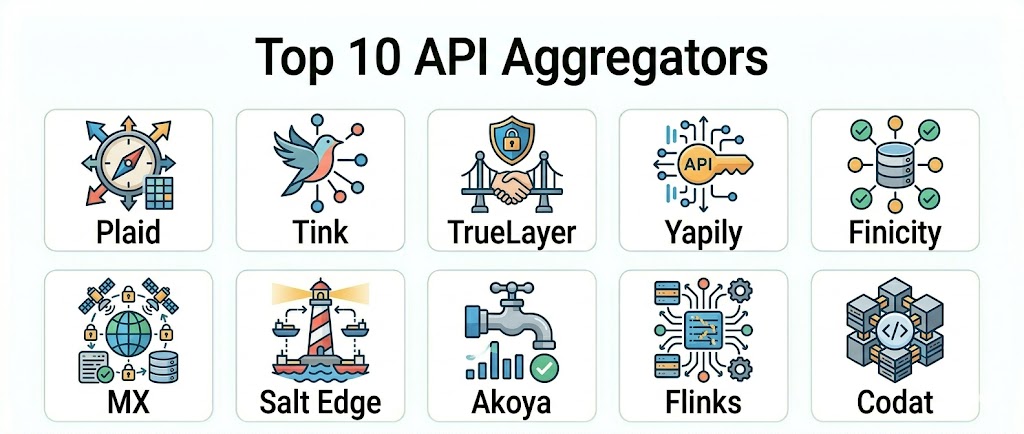
Top 10 API Aggregators
#1 — Plaid
Short description: Plaid is a financial API aggregator that connects applications to bank accounts, balances, transactions, identity data, payments, and financial insights. It is widely used by fintech apps, lenders, personal finance platforms, accounting tools, and digital banking products. Plaid helps teams avoid building direct bank integrations one by one. It is best suited for companies that need secure financial data connectivity and bank account linking.
Key Features
- Bank account connectivity
- Transaction and balance data APIs
- Identity and account verification support
- Payment initiation workflows in supported regions
- Developer-friendly API and SDKs
- Webhook support for account updates
- Broad fintech ecosystem adoption
Pros
- Strong fintech API coverage
- Good developer experience
- Useful for account linking and financial apps
- Reduces complexity of bank integrations
Cons
- Region and institution coverage may vary
- Pricing can scale with usage
- Some use cases may require compliance review
- Financial data accuracy may depend on source institution quality
Platforms / Deployment
Web / APIs / SDKs.
Cloud.
Security & Compliance
Supports secure financial data access workflows, encryption, OAuth-based connections where available, and access controls. Buyers should verify compliance requirements directly for their region and use case.
Integrations & Ecosystem
Plaid integrates into fintech, lending, personal finance, banking, accounting, and payments workflows.
- Banking applications
- Lending systems
- Personal finance apps
- Accounting platforms
- Payment workflows
- Identity verification processes
Support & Community
Strong developer documentation, onboarding resources, and fintech ecosystem adoption. Support availability depends on plan and customer segment.
#2 — Merge
Short description: Merge provides unified APIs across categories such as HR, payroll, accounting, CRM, ticketing, file storage, and project management. It helps SaaS companies ship many integrations through one normalized API model. Merge is especially useful for B2B SaaS teams that need to connect with customer systems quickly. It is best suited for product teams that want scalable embedded integrations.
Key Features
- Unified APIs across multiple software categories
- Normalized data models
- Embedded account linking
- Webhooks and sync management
- Integration health monitoring
- Developer-friendly documentation
- Broad SaaS integration coverage
Pros
- Strong fit for B2B SaaS products
- Reduces engineering burden for integrations
- Good category breadth
- Useful embedded integration workflows
Cons
- Coverage depends on supported providers
- Complex edge cases may still require custom handling
- Pricing may increase with scale
- Some integrations may not expose every provider-specific field
Platforms / Deployment
Web / APIs / SDKs.
Cloud.
Security & Compliance
Supports enterprise integration security workflows such as OAuth, encrypted data handling, access management, and audit-related controls. Buyers should verify specific compliance details directly.
Integrations & Ecosystem
Merge is designed for SaaS companies that need customer-facing integrations across business systems.
- HRIS systems
- Payroll platforms
- Accounting tools
- CRM systems
- Ticketing platforms
- File storage systems
Support & Community
Strong developer resources and customer support for SaaS integration teams. Support depth may vary by plan and implementation complexity.
#3 — Finch
Short description: Finch is an API aggregator focused on employment systems, including payroll, HR, benefits, and workforce data. It helps companies access employment-related information through a unified interface. Finch is useful for fintech, benefits platforms, workforce tools, insurance providers, and HR technology companies. It is best suited for products that need standardized access to payroll and employee data.
Key Features
- Unified employment data API
- Payroll and HR system connectivity
- Employee and company data access
- Benefits and workforce workflow support
- Developer-friendly API model
- Data normalization across providers
- Useful for embedded employment integrations
Pros
- Strong focus on employment data
- Useful for HR tech and fintech products
- Reduces complexity of payroll integrations
- Good fit for workforce-related SaaS
Cons
- Category-specific scope
- Provider coverage may vary
- Sensitive data workflows require careful governance
- Some use cases may need custom data handling
Platforms / Deployment
Web / APIs.
Cloud.
Security & Compliance
Supports secure employment data access workflows. Buyers should verify encryption, access controls, auditability, data retention, and compliance requirements directly.
Integrations & Ecosystem
Finch integrates into workforce, payroll, benefits, lending, and HR technology workflows.
- Payroll systems
- HRIS platforms
- Benefits platforms
- Workforce apps
- Fintech applications
- Insurance workflows
Support & Community
Developer-oriented documentation and implementation support are available. Best suited for teams building employment-data-driven products.
#4 — Rutter
Short description: Rutter is a commerce, accounting, and payment API aggregator that helps companies connect with ecommerce platforms, accounting systems, payment processors, and business financial data sources. It is useful for fintech products, lenders, commerce platforms, and SaaS companies serving merchants. Rutter helps normalize fragmented business data across many systems. It is best for products that need merchant, revenue, and commerce data connectivity.
Key Features
- Unified commerce API
- Accounting system integrations
- Payment processor connectivity
- Ecommerce data normalization
- Business financial data workflows
- Developer-friendly APIs
- Useful for underwriting and merchant analytics
Pros
- Strong fit for commerce and fintech use cases
- Reduces direct integration complexity
- Useful for merchant data analysis
- Good category-specific focus
Cons
- Best suited for commerce-related workflows
- Provider coverage may vary
- Advanced data needs may require custom logic
- Pricing and availability may depend on use case
Platforms / Deployment
Web / APIs.
Cloud.
Security & Compliance
Supports secure API-based business data workflows. Buyers should verify security controls, access management, and compliance requirements directly.
Integrations & Ecosystem
Rutter integrates into commerce, lending, payments, accounting, and business financial workflows.
- Ecommerce platforms
- Accounting systems
- Payment processors
- Merchant analytics
- Lending workflows
- Business finance applications
Support & Community
Developer support and documentation are available for teams building commerce and fintech data products.
#5 — Apideck
Short description: Apideck provides unified APIs for SaaS integrations across CRM, accounting, HRIS, file storage, ecommerce, marketing, and productivity systems. It helps developers build integrations through standardized API categories rather than maintaining many provider-specific connectors. Apideck is useful for SaaS companies that need broad integration coverage with a developer-first experience. It is best for teams that want embedded integrations and normalized data models.
Key Features
- Unified APIs across SaaS categories
- Embedded connection management
- Normalized data models
- Webhook support
- Developer portal and API tooling
- Broad integration catalog
- Integration monitoring workflows
Pros
- Broad SaaS integration coverage
- Developer-friendly approach
- Useful for embedded integration workflows
- Reduces maintenance overhead
Cons
- Some advanced provider-specific features may not be exposed
- Pricing may vary by usage and category
- Complex enterprise workflows may require customization
- Coverage should be validated for required providers
Platforms / Deployment
Web / APIs / SDKs.
Cloud.
Security & Compliance
Supports secure integration workflows, OAuth-based connections where available, and access management features. Buyers should verify compliance details directly.
Integrations & Ecosystem
Apideck integrates across common business software ecosystems.
- CRM platforms
- Accounting systems
- HRIS tools
- Ecommerce platforms
- File storage systems
- Marketing tools
Support & Community
Developer documentation and support resources are available. Good fit for SaaS teams needing broad integration coverage.
#6 — Nylas
Short description: Nylas is an API platform that aggregates email, calendar, and contacts data across major providers. It enables developers to add communication and scheduling functionality into applications without building separate integrations for each provider. Nylas is useful for CRM, recruiting, sales automation, productivity, support, and workflow applications. It is best suited for teams that need reliable communication data integration.
Key Features
- Unified email APIs
- Calendar scheduling APIs
- Contacts integration
- Webhook support
- Provider normalization
- Authentication and sync workflows
- Useful for productivity and CRM applications
Pros
- Strong email and calendar API focus
- Saves time versus building multiple provider integrations
- Useful for communication-heavy SaaS products
- Good developer experience
Cons
- Category-specific scope
- Sync complexity can require careful implementation
- Pricing may scale with connected accounts
- Provider limitations may affect some workflows
Platforms / Deployment
Web / APIs / SDKs.
Cloud.
Security & Compliance
Supports secure account connection workflows, provider authentication, encryption, and access controls. Buyers should verify compliance and data handling requirements directly.
Integrations & Ecosystem
Nylas integrates into SaaS products that need email, calendar, contact, and scheduling features.
- Gmail
- Microsoft Outlook
- Calendar systems
- CRM workflows
- Recruiting platforms
- Productivity applications
Support & Community
Strong developer documentation, SDKs, and support resources for communication API use cases.
#7 — Twilio Segment
Short description: Twilio Segment is a customer data platform that aggregates customer event data from websites, apps, servers, and business systems. It helps organizations collect, clean, route, and activate customer data across analytics, marketing, product, and data warehouse tools. While not a traditional API aggregator, it plays a major role in aggregating and distributing customer data through many integrations. It is best for companies needing customer data routing and activation.
Key Features
- Customer data collection
- Event tracking and routing
- Data warehouse integrations
- Identity resolution workflows
- Marketing and analytics tool integrations
- Data governance controls
- Real-time customer data activation
Pros
- Strong customer data integration ecosystem
- Useful for analytics and marketing workflows
- Reduces duplicate tracking implementation
- Good fit for product-led companies
Cons
- Not a general-purpose API aggregator
- Pricing can increase with scale
- Data governance setup requires planning
- Implementation quality depends on event design
Platforms / Deployment
Web / APIs / SDKs.
Cloud.
Security & Compliance
Supports data governance, access controls, and customer data management workflows. Buyers should verify compliance needs and data retention policies directly.
Integrations & Ecosystem
Segment connects customer data across product, analytics, marketing, and data warehouse ecosystems.
- Analytics tools
- Marketing platforms
- Data warehouses
- Product analytics systems
- CRM systems
- Customer engagement tools
Support & Community
Strong documentation, enterprise support options, and broad ecosystem adoption among product and growth teams.
#8 — Zapier Platform
Short description: Zapier is a no-code and low-code automation platform that aggregates thousands of application APIs into workflow automations. It helps business users and technical teams connect apps without building custom integrations from scratch. Zapier is useful for automating SaaS workflows, syncing data, triggering alerts, and connecting business systems. It is best for SMBs and teams that need fast automation without heavy engineering effort.
Key Features
- Large app integration catalog
- No-code workflow automation
- Trigger and action-based workflows
- Webhook support
- Multi-step automation
- Business process automation
- App connection management
Pros
- Very easy to use
- Large integration ecosystem
- Fast workflow automation setup
- Good for business teams and SMBs
Cons
- Not ideal for deep embedded product integrations
- Complex workflows can become hard to manage
- Usage-based costs can increase
- Limited control compared to direct API development
Platforms / Deployment
Web platform.
Cloud.
Security & Compliance
Supports secure app connection workflows and team access controls. Buyers should verify enterprise security, data handling, and compliance requirements directly.
Integrations & Ecosystem
Zapier integrates with a very wide range of business applications and SaaS tools.
- CRM systems
- Marketing tools
- Communication apps
- Project management tools
- Databases
- Webhooks
Support & Community
Large user community, extensive templates, documentation, and support resources. Strong fit for non-developer automation.
#9 — Amadeus for Developers
Short description: Amadeus for Developers provides travel APIs for flights, hotels, destination content, booking workflows, and travel intelligence. It acts as a major API aggregation layer for travel technology companies, agencies, and platforms. Amadeus is useful for businesses that need access to travel inventory and travel data through standardized APIs. It is best suited for travel startups, agencies, booking platforms, and enterprise travel products.
Key Features
- Flight search APIs
- Hotel search APIs
- Travel booking workflows
- Destination and travel content APIs
- Travel analytics and intelligence
- Developer-friendly API access
- Useful for travel marketplace development
Pros
- Strong fit for travel technology
- Broad travel data and inventory access
- Useful for booking and discovery workflows
- Developer-oriented API platform
Cons
- Travel-specific scope
- Commercial terms may vary by use case
- Advanced booking workflows can be complex
- Provider availability may vary by region
Platforms / Deployment
Web / APIs.
Cloud.
Security & Compliance
Supports secure API access and travel data workflows. Buyers should verify compliance, payment, booking, and regional requirements directly.
Integrations & Ecosystem
Amadeus fits into travel booking, search, itinerary, and travel intelligence ecosystems.
- Flight booking systems
- Hotel booking platforms
- Travel agencies
- Travel marketplaces
- Corporate travel systems
- Destination content workflows
Support & Community
Developer documentation, sandbox access, and travel API support resources are available. Best suited for travel-focused engineering teams.
#10 — Shippo
Short description: Shippo is a shipping API and logistics platform that aggregates carrier services into a unified interface. It helps ecommerce companies, marketplaces, and logistics teams compare rates, generate labels, track shipments, and manage carrier workflows. Shippo reduces the need to integrate separately with each shipping carrier. It is best for businesses needing multi-carrier shipping automation.
Key Features
- Multi-carrier shipping API
- Rate comparison
- Label generation
- Shipment tracking
- Returns support
- Ecommerce integration workflows
- Address validation support
Pros
- Strong shipping carrier aggregation
- Useful for ecommerce and logistics teams
- Simplifies label and tracking workflows
- Good API and platform usability
Cons
- Shipping-specific scope
- Carrier availability may vary by region
- Advanced logistics workflows may need custom integration
- Pricing depends on shipment volume and usage
Platforms / Deployment
Web / APIs.
Cloud.
Security & Compliance
Supports secure shipping and carrier workflow integrations. Buyers should verify data handling and operational security requirements directly.
Integrations & Ecosystem
Shippo integrates into ecommerce, logistics, and fulfillment ecosystems.
- Ecommerce platforms
- Shipping carriers
- Marketplaces
- Warehouse workflows
- Fulfillment systems
- Tracking applications
Support & Community
Developer documentation, ecommerce support resources, and business onboarding are available. Strong fit for shipping-heavy businesses.
Comparison Table
| Tool Name | Best For | Platform Supported | Deployment | Standout Feature | Public Rating |
|---|---|---|---|---|---|
| Plaid | Financial data aggregation | Web / APIs / SDKs | Cloud | Unified bank connectivity | N/A |
| Merge | B2B SaaS embedded integrations | Web / APIs / SDKs | Cloud | Unified APIs across SaaS categories | N/A |
| Finch | Employment and payroll data APIs | Web / APIs | Cloud | Unified employment data access | N/A |
| Rutter | Commerce and accounting aggregation | Web / APIs | Cloud | Unified merchant and business data | N/A |
| Apideck | Broad SaaS integration aggregation | Web / APIs / SDKs | Cloud | Unified APIs for business apps | N/A |
| Nylas | Email, calendar, and contacts APIs | Web / APIs / SDKs | Cloud | Unified communication APIs | N/A |
| Twilio Segment | Customer data aggregation | Web / APIs / SDKs | Cloud | Customer event data routing | N/A |
| Zapier Platform | No-code app API automation | Web platform | Cloud | Large app automation ecosystem | N/A |
| Amadeus for Developers | Travel API aggregation | Web / APIs | Cloud | Travel search and booking APIs | N/A |
| Shippo | Shipping carrier aggregation | Web / APIs | Cloud | Multi-carrier shipping API | N/A |
Evaluation & Scoring of API Aggregators
| Tool Name | Core | Ease | Integrations | Security | Performance | Support | Value | Weighted Total |
|---|---|---|---|---|---|---|---|---|
| Plaid | 9 | 8 | 9 | 9 | 8 | 8 | 7 | 8.35 |
| Merge | 9 | 8 | 10 | 8 | 8 | 8 | 8 | 8.55 |
| Finch | 8 | 8 | 8 | 8 | 8 | 8 | 7 | 7.90 |
| Rutter | 8 | 8 | 8 | 8 | 8 | 7 | 7 | 7.75 |
| Apideck | 8 | 8 | 9 | 8 | 8 | 8 | 8 | 8.15 |
| Nylas | 8 | 8 | 8 | 8 | 8 | 8 | 7 | 7.90 |
| Twilio Segment | 8 | 8 | 10 | 8 | 8 | 8 | 7 | 8.20 |
| Zapier Platform | 7 | 10 | 10 | 7 | 7 | 8 | 8 | 8.15 |
| Amadeus for Developers | 8 | 7 | 8 | 8 | 8 | 7 | 7 | 7.65 |
| Shippo | 8 | 9 | 8 | 8 | 8 | 8 | 8 | 8.15 |
These scores are comparative and should be used as a shortlist guide. Category-specific API aggregators often perform best for focused use cases such as fintech, payroll, travel, or shipping. Broad integration platforms may provide wider coverage but less depth in specialized workflows. Buyers should validate provider coverage, rate limits, data normalization, latency, security controls, and pricing before selecting a platform.
Which API Aggregator Is Right for You?
Solo / Freelancer
Solo developers and freelancers should choose API aggregators based on the project category. Zapier is ideal for quick workflow automation, while Plaid, Nylas, Shippo, or Amadeus are better for focused fintech, communication, shipping, or travel projects. For custom SaaS products, Apideck or Merge can reduce integration effort.
SMB
SMBs should prioritize speed, ease of use, and predictable cost. Zapier is useful for internal automation, Shippo for ecommerce logistics, Nylas for communication workflows, and Plaid for financial apps. SMB SaaS teams should consider Merge or Apideck when they need embedded customer-facing integrations.
Mid-Market
Mid-market companies often need stronger reliability, monitoring, support, and category coverage. Merge, Apideck, Plaid, Finch, Rutter, Segment, and Nylas are strong options depending on the product domain. Teams should prioritize webhook reliability, API monitoring, sync accuracy, and integration health dashboards.
Enterprise
Enterprises should evaluate API aggregators based on security, governance, scalability, data residency, service-level expectations, and procurement readiness. Plaid, Merge, Segment, Nylas, Amadeus, and Shippo can support enterprise-scale workflows in their respective categories. Enterprise teams should also validate audit logs, role-based access, encryption, support tiers, and data processing terms.
Budget vs Premium
Low-cost and no-code platforms are helpful for quick automation, but premium API aggregators provide stronger reliability, deeper data normalization, better support, and production-grade workflows. Budget-focused teams should avoid overpaying for broad platforms when a direct integration or smaller tool is enough.
Feature Depth vs Ease of Use
Zapier is easiest for business users, while Merge, Apideck, Plaid, Finch, Rutter, and Nylas offer deeper developer control. Specialized aggregators usually provide better domain-specific functionality. Buyers should decide whether they need quick automation or embedded product-grade APIs.
Integrations & Scalability
Scalability depends on API rate limits, provider reliability, data sync performance, webhook design, error handling, and monitoring. Product teams should evaluate how well the aggregator handles provider outages, schema changes, retries, and data freshness. Integration breadth matters, but operational resilience matters more for production systems.
Security & Compliance Needs
API aggregators often handle sensitive business, financial, employee, customer, or communication data. Buyers should evaluate authentication, encryption, audit logs, access controls, data retention, vendor risk, and compliance documentation. Sensitive categories like banking, payroll, healthcare, and identity require extra scrutiny.
Frequently Asked Questions
1. What is an API aggregator?
An API aggregator connects multiple third-party APIs into one unified interface. It helps developers avoid building and maintaining separate integrations for every provider. Aggregators usually normalize data, manage authentication, support webhooks, and simplify provider connectivity. They are useful when a product depends on many external systems.
2. Why do companies use API aggregators?
Companies use API aggregators to reduce engineering effort, launch integrations faster, and simplify maintenance. Aggregators also help standardize data models across providers. This is especially useful for SaaS, fintech, ecommerce, HR, travel, and logistics products. They allow teams to focus on product features instead of integration plumbing.
3. Are API aggregators better than direct integrations?
API aggregators are better when a company needs many integrations quickly. Direct integrations may be better when the business needs deep provider-specific functionality, full control, or lower long-term dependency. Many companies use both approaches. Aggregators are especially useful for early scale and broad coverage.
4. What are the biggest risks of using API aggregators?
The biggest risks include vendor dependency, pricing growth, data mapping limitations, provider coverage gaps, and reduced control over edge cases. If the aggregator has downtime, connected workflows may be affected. Teams should evaluate reliability, support, service history, and fallback options. Critical workflows may require redundancy planning.
5. How do API aggregators handle authentication?
Most API aggregators support authentication methods such as OAuth, API keys, tokens, or embedded connection flows. They often manage token refresh, account linking, and provider-specific authentication complexity. This simplifies developer work but also requires strong security review. Teams should evaluate how credentials and access tokens are stored and protected.
6. Do API aggregators support webhooks?
Many API aggregators support webhooks for real-time updates, status changes, sync events, and workflow triggers. Webhook quality is important for products that need fresh data or event-driven behavior. Buyers should test webhook reliability, retries, payload structure, and monitoring. Poor webhook handling can create data sync problems.
7. How much do API aggregators cost?
Pricing varies by category, provider coverage, connected accounts, API volume, data sync frequency, and support level. Some platforms use usage-based pricing, while others use subscription or enterprise contracts. Buyers should estimate growth carefully because integration costs can increase with scale. Pricing transparency is an important evaluation factor.
8. Can API aggregators work for enterprise use cases?
Yes, many API aggregators support enterprise workflows, but buyers should evaluate security, auditability, data processing terms, compliance posture, support tiers, and scalability. Enterprise teams should also test performance and reliability under realistic load. Vendor risk management is important when aggregators process sensitive data.
9. What should developers check before choosing an aggregator?
Developers should check provider coverage, API documentation, SDK quality, webhook support, error handling, rate limits, sandbox availability, data normalization, and monitoring tools. They should also test edge cases with real provider accounts. A pilot integration is usually the best way to confirm fit before committing.
10. Can API aggregators support AI agents and automation?
Yes, API aggregators can help AI agents access many business systems through fewer integration layers. This can simplify tool use, workflow automation, and data retrieval. However, AI-driven API usage requires strong permission controls, logging, rate limits, and safety checks. Teams should avoid giving AI systems unrestricted access to sensitive APIs.
Conclusion
API aggregators are powerful tools for reducing integration complexity, speeding up product development, and connecting fragmented software ecosystems through unified interfaces. Platforms such as Plaid, Merge, Finch, Rutter, Apideck, Nylas, Segment, Zapier, Amadeus, and Shippo serve different integration needs across finance, SaaS, HR, commerce, communication, travel, customer data, and logistics. The best choice depends on your product category, provider coverage requirements, security expectations, pricing tolerance, and need for embedded versus internal integrations. A good aggregator should not only provide many connectors but also deliver reliable sync, strong documentation, normalized data, webhook support, and operational visibility. Start by shortlisting two or three platforms, test them with real provider accounts, validate security and pricing, and then scale the best-fit option across your product or business workflows.

This article clearly explains API aggregators and how they help businesses simplify integrations by connecting multiple services through a single platform.
API aggregators simplify integrations, but they can also introduce dependency and reliability risks. Evaluating uptime, failover mechanisms, and data consistency is just as important as feature coverage.