Introduction
Ontology management tools help organizations create, manage, visualize, and govern structured knowledge models that define concepts, categories, entities, relationships, and business meanings. These tools are important for semantic web projects, knowledge graphs, enterprise AI, data governance, metadata management, research systems, healthcare informatics, and intelligent search platforms. Instead of keeping business terms and relationships scattered across documents or databases, ontology tools create a shared semantic structure that humans and machines can understand.
Modern organizations use ontology management tools to improve interoperability, reduce confusion in data definitions, strengthen AI explainability, and connect information across systems. As data environments become more distributed and AI systems require better context, ontologies help create trusted knowledge foundations for automation, analytics, search, and decision support.
Common use cases include:
- Enterprise knowledge graph development
- Semantic data modeling
- AI knowledge representation
- Metadata and data governance
- Healthcare and life sciences interoperability
- Intelligent search and recommendation systems
Key evaluation criteria include:
- Ontology modeling flexibility
- Semantic standards support
- Knowledge graph compatibility
- Collaboration and governance features
- Query and reasoning capabilities
- Visualization and usability
- API and integration ecosystem
- Scalability for enterprise workloads
- Security and access controls
- Community and support maturity
Best for: Data governance teams, enterprise architects, semantic web developers, AI teams, research institutions, healthcare organizations, and companies building knowledge graph or semantic search systems.
Not ideal for: Small teams with simple data structures, businesses that only need basic tagging, or organizations that do not require semantic relationships, reasoning, or ontology-based governance.
Key Trends in Ontology Management Tools
- AI-assisted ontology creation is helping teams generate concepts, relationships, and semantic mappings faster.
- Knowledge graphs are becoming a major driver for ontology management adoption.
- Enterprise AI projects are using ontologies to improve explainability and context awareness.
- Data fabric and semantic layer initiatives are increasing demand for ontology-driven metadata management.
- Collaborative ontology governance is becoming important for large distributed teams.
- Cloud-based semantic platforms are reducing deployment and maintenance complexity.
- Semantic search and retrieval systems are creating stronger demand for structured knowledge models.
- Industry-specific ontologies are expanding in healthcare, finance, manufacturing, and government.
- Integration with graph databases and data catalogs is becoming a key requirement.
- Standards such as RDF, OWL, and SPARQL remain important for long-term interoperability.
How We Selected These Tools
The tools in this list were selected using a practical evaluation approach focused on semantic modeling, enterprise usability, and ecosystem maturity.
- Market adoption and semantic technology reputation
- Support for RDF, OWL, SPARQL, and related standards
- Knowledge graph and graph database compatibility
- Ontology visualization and editing capabilities
- Collaboration and governance features
- API support and extensibility
- Scalability for large semantic models
- Security and enterprise administration features
- Documentation and community strength
- Suitability for research, SMB, mid-market, and enterprise use cases
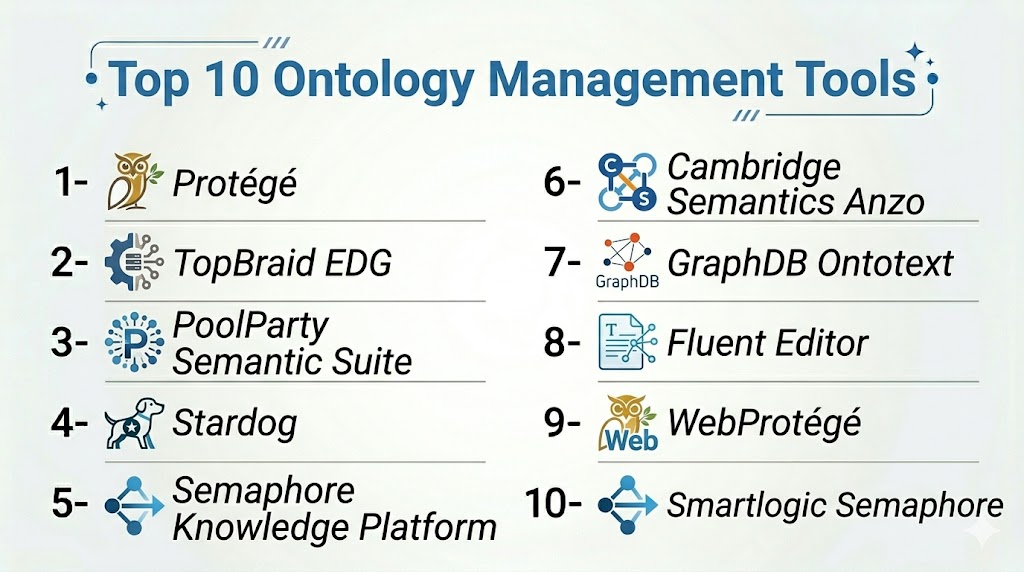
Top 10 Ontology Management Tools
1- Protégé
Short description: Protégé is one of the most widely used open-source ontology management tools for creating and editing semantic models. It supports OWL, RDF, reasoning engines, and plugin-based extensions. It is popular in academic research, healthcare informatics, AI projects, and enterprise semantic modeling. Protégé is best suited for teams that need strong ontology editing without commercial licensing complexity.
Key Features
- OWL ontology editing
- RDF and semantic web support
- Plugin-based extensibility
- Reasoner integration
- Ontology visualization
- Class and property modeling
- Knowledge model validation
Pros
- Strong open-source ecosystem
- Excellent standards support
- Widely used in research and enterprise projects
- Flexible plugin architecture
Cons
- Interface can feel dated
- Requires ontology expertise
- Limited built-in enterprise governance
- Large ontologies may need performance tuning
Platforms / Deployment
Windows / macOS / Linux
Self-hosted
Security & Compliance
Authentication and access controls vary by deployment configuration.
Formal compliance details are not publicly stated.
Integrations & Ecosystem
Protégé integrates well with semantic web tools, graph systems, and reasoning engines. It is often used as a core ontology editing environment before models are deployed into knowledge graph platforms.
- OWL support
- RDF support
- SPARQL compatibility
- Reasoner integration
- Graph database workflows
- Plugin ecosystem
Support & Community
Protégé has a very strong academic and semantic web community with extensive tutorials, plugins, documentation, and long-standing adoption.
2- TopBraid EDG
Short description: TopBraid EDG is an enterprise semantic data governance and ontology management platform designed for large organizations. It supports taxonomies, ontologies, knowledge graphs, metadata governance, and semantic interoperability. The platform is well suited for enterprises that need formal governance workflows around semantic assets. It is commonly used where data meaning, standards, and business vocabularies must be managed carefully.
Key Features
- Enterprise ontology governance
- Knowledge graph management
- Taxonomy and vocabulary management
- Semantic metadata integration
- SPARQL query support
- Workflow and approval controls
- Standards-based semantic modeling
Pros
- Strong enterprise governance features
- Good semantic standards support
- Useful collaboration workflows
- Mature enterprise semantic architecture
Cons
- Premium enterprise pricing
- Requires semantic expertise
- Implementation can be complex
- May be excessive for small teams
Platforms / Deployment
Web / Windows / Linux
Cloud / Self-hosted / Hybrid
Security & Compliance
RBAC, authentication controls, audit logging support.
Formal compliance details are not publicly stated.
Integrations & Ecosystem
TopBraid EDG integrates with semantic web standards, metadata systems, APIs, and enterprise knowledge graph environments.
- RDF support
- OWL support
- SPARQL support
- API connectivity
- Knowledge graph integration
- Metadata platform connectivity
Support & Community
TopBraid provides enterprise-focused support, documentation, and semantic technology services for complex implementations.
3- PoolParty Semantic Suite
Short description: PoolParty Semantic Suite is an enterprise semantic platform for ontology management, taxonomy management, linked data, semantic search, and knowledge graph use cases. It helps organizations improve content classification, metadata enrichment, and information discovery. The platform is especially useful for businesses that need semantic search and AI-ready knowledge organization. It works well for enterprise teams managing multilingual or domain-specific vocabularies.
Key Features
- Ontology and taxonomy management
- Linked data support
- Knowledge graph capabilities
- Semantic search enhancement
- Metadata enrichment
- AI-assisted tagging
- Multilingual semantic management
Pros
- Strong semantic search capabilities
- Good taxonomy and ontology support
- Useful metadata enrichment features
- Enterprise-ready governance options
Cons
- Requires semantic modeling knowledge
- Enterprise pricing may be high
- Advanced customization needs expertise
- New users may need training
Platforms / Deployment
Web / Linux
Cloud / Self-hosted / Hybrid
Security & Compliance
RBAC, authentication controls, governance support.
Formal compliance details are not publicly stated.
Integrations & Ecosystem
PoolParty integrates with enterprise search platforms, metadata systems, content platforms, graph tools, and semantic APIs.
- RDF support
- SPARQL connectivity
- Knowledge graph integration
- Search engine integration
- API support
- Metadata platform support
Support & Community
PoolParty offers enterprise support, semantic consulting, documentation, and implementation guidance.
4- Stardog
Short description: Stardog is an enterprise knowledge graph platform that includes ontology management, reasoning, virtualization, and semantic query capabilities. It helps organizations connect distributed data sources and create a unified semantic layer. Stardog is useful for enterprises building AI-ready knowledge graphs, semantic search systems, and governed data models. It is best for teams that need both graph performance and semantic reasoning.
Key Features
- Enterprise knowledge graph management
- Ontology modeling support
- Semantic reasoning engine
- Data virtualization capabilities
- SPARQL querying
- Graph analytics support
- AI-ready semantic integration
Pros
- Strong enterprise scalability
- Excellent reasoning capabilities
- Good semantic interoperability
- Useful for AI and graph initiatives
Cons
- Enterprise licensing costs
- Requires graph and ontology expertise
- Implementation planning can be complex
- Advanced tuning may require specialists
Platforms / Deployment
Web / Linux
Cloud / Self-hosted / Hybrid
Security & Compliance
RBAC, encryption support, authentication integration, audit controls.
Formal compliance details are not publicly stated.
Integrations & Ecosystem
Stardog integrates with databases, data lakes, analytics systems, AI workflows, and semantic technologies.
- RDF support
- OWL support
- SPARQL querying
- Knowledge graph workflows
- API connectivity
- Enterprise data integration
Support & Community
Stardog provides enterprise support, documentation, training resources, and a growing semantic AI ecosystem.
5- GraphDB
Short description: GraphDB is a semantic graph database and ontology management platform used for RDF data, linked data, semantic reasoning, and knowledge graph applications. It is suitable for organizations building semantic search, knowledge discovery, and domain-specific graph models. GraphDB is commonly used in research, life sciences, finance, publishing, and enterprise knowledge graph environments. It provides strong standards support for semantic workloads.
Key Features
- RDF graph database
- Ontology management
- Semantic reasoning support
- SPARQL query engine
- Linked data integration
- Knowledge graph support
- Enterprise graph scalability
Pros
- Strong semantic reasoning
- Good RDF and SPARQL support
- Useful for knowledge graph projects
- Suitable for large semantic datasets
Cons
- Requires semantic expertise
- Governance may need configuration
- Advanced scaling needs planning
- Beginner experience can be complex
Platforms / Deployment
Web / Windows / Linux
Cloud / Self-hosted / Hybrid
Security & Compliance
RBAC, authentication controls, encryption support.
Formal compliance details are not publicly stated.
Integrations & Ecosystem
GraphDB integrates with semantic web tools, APIs, graph workflows, and enterprise data systems.
- RDF support
- OWL integration
- SPARQL querying
- Linked data workflows
- API integration
- Knowledge graph platforms
Support & Community
GraphDB has a strong semantic technology ecosystem with enterprise support, documentation, and community resources.
6- Cambridge Semantics Anzo
Short description: Cambridge Semantics Anzo is an enterprise knowledge graph and semantic data platform designed for data integration, analytics, ontology management, and linked data use cases. It helps organizations create governed semantic layers across distributed enterprise data. Anzo is especially relevant for large organizations that need semantic analytics and knowledge graph-driven data discovery. It supports complex enterprise data environments where relationships and context are critical.
Key Features
- Enterprise knowledge graph management
- Ontology modeling
- Semantic integration
- Metadata governance
- Linked data support
- Data virtualization capabilities
- Analytics integration
Pros
- Strong enterprise semantic governance
- Good analytics integration
- Useful for large knowledge graph projects
- Supports distributed data environments
Cons
- Enterprise-focused pricing
- Requires semantic expertise
- Onboarding can be complex
- Less suitable for small teams
Platforms / Deployment
Web / Linux
Cloud / Hybrid
Security & Compliance
RBAC, governance controls, authentication integration.
Formal compliance details are not publicly stated.
Integrations & Ecosystem
Anzo connects with enterprise data systems, graph technologies, metadata tools, and analytics environments.
- RDF support
- SPARQL support
- BI platform integration
- API connectivity
- Data virtualization support
- Metadata management tools
Support & Community
Enterprise support is available through vendor documentation, implementation services, and semantic consulting resources.
7- Neo4j Bloom and Neosemantics
Short description: Neo4j with Bloom and Neosemantics enables ontology-aware graph modeling, RDF import, semantic integration, and visual exploration within the Neo4j graph ecosystem. It is best suited for teams that want to combine property graph analytics with semantic knowledge modeling. Neo4j’s ecosystem is especially strong for developers building graph applications, recommendation systems, and knowledge graph workflows. Neosemantics adds semantic web compatibility to graph projects.
Key Features
- Graph visualization
- RDF import and export
- Ontology-aware graph modeling
- Knowledge graph development
- Graph analytics support
- API and developer tools
- Visual relationship exploration
Pros
- Excellent graph visualization
- Strong developer ecosystem
- Good graph analytics performance
- Flexible graph modeling
Cons
- Semantic support depends on extensions
- Requires graph database knowledge
- Enterprise scaling requires planning
- Governance features may need configuration
Platforms / Deployment
Web / Windows / macOS / Linux
Cloud / Self-hosted / Hybrid
Security & Compliance
RBAC, authentication support, encryption controls.
Formal compliance details are not publicly stated.
Integrations & Ecosystem
Neo4j integrates with developer tools, graph analytics workflows, AI systems, and semantic web extensions.
- RDF support through extensions
- API connectivity
- Graph data science tools
- Visualization workflows
- Knowledge graph support
- Data science integrations
Support & Community
Neo4j has a large developer community, strong documentation, and enterprise support options.
8- AllegroGraph
Short description: AllegroGraph is a semantic graph database and ontology platform designed for linked data, reasoning, graph analytics, and AI-oriented knowledge management. It supports RDF, SPARQL, and semantic reasoning for organizations building large-scale knowledge graph systems. AllegroGraph is often used in technical semantic applications that require graph analytics and intelligent relationship discovery. It is best suited for teams with strong semantic and graph expertise.
Key Features
- Semantic graph database
- Ontology management
- RDF and linked data support
- SPARQL querying
- Semantic reasoning
- Graph analytics
- AI knowledge graph support
Pros
- Strong semantic graph capabilities
- Good reasoning performance
- Useful for AI knowledge systems
- Supports advanced graph analytics
Cons
- Requires specialized expertise
- Smaller ecosystem than some competitors
- Enterprise licensing costs
- Onboarding can be technical
Platforms / Deployment
Linux / Windows
Cloud / Self-hosted
Security & Compliance
Authentication controls, RBAC support, encryption capabilities.
Formal compliance details are not publicly stated.
Integrations & Ecosystem
AllegroGraph integrates with semantic web systems, AI workflows, APIs, and graph analytics environments.
- RDF support
- OWL integration
- SPARQL querying
- API support
- Knowledge graph connectivity
- AI workflow integration
Support & Community
AllegroGraph has a specialized semantic technology community with vendor support and technical documentation.
9- Semantic MediaWiki
Short description: Semantic MediaWiki adds semantic data management capabilities to MediaWiki, enabling teams to structure, query, and organize knowledge collaboratively. It is useful for documentation, research knowledge bases, collaborative taxonomies, and lightweight semantic modeling. While it is not a full enterprise ontology platform, it provides practical semantic capabilities for knowledge-sharing environments. It works well when collaboration and content management are more important than deep reasoning.
Key Features
- Semantic wiki capabilities
- Structured metadata support
- Semantic querying
- Collaborative knowledge management
- Ontology-like modeling
- Open-source extensibility
- Content-based knowledge organization
Pros
- Strong collaboration model
- Open-source flexibility
- Useful for documentation projects
- Easy knowledge contribution workflows
Cons
- Limited enterprise governance
- Not a full ontology platform
- Scaling may require customization
- Advanced semantic use cases need extensions
Platforms / Deployment
Web / Windows / Linux
Self-hosted
Security & Compliance
Authentication controls vary by deployment configuration.
Formal compliance details are not publicly stated.
Integrations & Ecosystem
Semantic MediaWiki integrates with wiki ecosystems, semantic extensions, APIs, and structured content workflows.
- MediaWiki extensions
- API integration
- Semantic querying
- Structured metadata
- Knowledge base workflows
- Open-source plugins
Support & Community
Semantic MediaWiki has an active open-source community and benefits from the wider MediaWiki ecosystem.
10- Data.world
Short description: Data.world is a cloud-based data catalog and knowledge graph platform that supports semantic metadata, collaboration, governance, and ontology-aware data discovery. It helps organizations improve data understanding and create shared business meaning across analytics environments. The platform is useful for teams that want modern metadata collaboration with semantic graph capabilities. It is best suited for organizations focused on data discovery, governance, and knowledge-driven analytics.
Key Features
- Enterprise data catalog
- Knowledge graph support
- Semantic metadata management
- Collaborative governance
- Ontology-aware discovery
- Data lineage capabilities
- API integrations
Pros
- Modern collaborative interface
- Good metadata discovery
- Strong semantic governance potential
- Cloud-native experience
Cons
- Less specialized than pure ontology editors
- Advanced ontology work may require expertise
- Enterprise pricing can vary
- Broader platform scope may need planning
Platforms / Deployment
Web
Cloud
Security & Compliance
RBAC, SSO integration, encryption support, governance controls.
Formal compliance details are not publicly stated.
Integrations & Ecosystem
Data.world integrates with analytics platforms, cloud warehouses, BI systems, and metadata environments.
- Snowflake integration
- Tableau support
- Power BI integration
- API connectivity
- Knowledge graph workflows
- Metadata platform support
Support & Community
Data.world provides onboarding resources, enterprise support, and a growing data collaboration community.
Comparison Table
| Tool Name | Best For | Platform(s) Supported | Deployment | Standout Feature | Public Rating |
|---|---|---|---|---|---|
| Protégé | Open-source ontology editing | Windows, macOS, Linux | Self-hosted | OWL ontology modeling | N/A |
| TopBraid EDG | Enterprise semantic governance | Web, Windows, Linux | Cloud, Self-hosted, Hybrid | Ontology governance workflows | N/A |
| PoolParty Semantic Suite | Semantic search and taxonomy | Web, Linux | Cloud, Self-hosted, Hybrid | Metadata enrichment | N/A |
| Stardog | Enterprise knowledge graphs | Web, Linux | Cloud, Self-hosted, Hybrid | Semantic reasoning engine | N/A |
| GraphDB | RDF graph management | Web, Windows, Linux | Cloud, Self-hosted, Hybrid | Semantic graph database | N/A |
| Cambridge Semantics Anzo | Semantic analytics | Web, Linux | Cloud, Hybrid | Enterprise linked data layer | N/A |
| Neo4j Bloom and Neosemantics | Graph-based semantic modeling | Web, Windows, macOS, Linux | Cloud, Self-hosted, Hybrid | Graph visualization | N/A |
| AllegroGraph | AI-ready semantic processing | Linux, Windows | Cloud, Self-hosted | Semantic graph analytics | N/A |
| Semantic MediaWiki | Collaborative semantic knowledge | Web, Windows, Linux | Self-hosted | Semantic wiki collaboration | N/A |
| Data.world | Metadata and semantic governance | Web | Cloud | Collaborative knowledge graph | N/A |
Evaluation & Scoring of Ontology Management Tools
| Tool Name | Core 25% | Ease 15% | Integrations 15% | Security 10% | Performance 10% | Support 10% | Value 15% | Weighted Total |
|---|---|---|---|---|---|---|---|---|
| Protégé | 9.0 | 7.0 | 8.5 | 7.0 | 8.2 | 8.8 | 9.5 | 8.3 |
| TopBraid EDG | 9.2 | 7.5 | 8.8 | 8.8 | 8.8 | 8.5 | 7.5 | 8.5 |
| PoolParty Semantic Suite | 8.8 | 7.8 | 8.5 | 8.5 | 8.5 | 8.3 | 7.8 | 8.3 |
| Stardog | 9.3 | 7.5 | 9.0 | 8.8 | 9.2 | 8.7 | 7.5 | 8.7 |
| GraphDB | 8.8 | 7.5 | 8.7 | 8.2 | 8.8 | 8.2 | 8.0 | 8.3 |
| Cambridge Semantics Anzo | 8.7 | 7.3 | 8.5 | 8.5 | 8.5 | 8.3 | 7.5 | 8.2 |
| Neo4j Bloom and Neosemantics | 8.8 | 8.0 | 8.8 | 8.2 | 9.0 | 8.7 | 8.5 | 8.6 |
| AllegroGraph | 8.5 | 7.0 | 8.2 | 8.0 | 8.8 | 7.8 | 7.8 | 8.0 |
| Semantic MediaWiki | 7.5 | 8.2 | 7.5 | 7.0 | 7.5 | 8.0 | 9.0 | 7.9 |
| Data.world | 8.5 | 8.8 | 8.8 | 8.7 | 8.2 | 8.5 | 8.2 | 8.5 |
These scores are comparative and should be interpreted based on the type of ontology work your organization needs. Enterprise tools generally score higher in governance, security, and scalability, while open-source tools often provide stronger value and flexibility. Some platforms are best for pure ontology editing, while others are stronger for knowledge graphs, semantic search, or metadata governance. Buyers should validate tools through real ontology models, integration testing, and user workflow pilots.
Which Ontology Management Tool Is Right for You?
Solo / Freelancer
Protégé and Semantic MediaWiki are practical choices for independent researchers, consultants, and semantic modeling specialists. They provide strong flexibility without heavy licensing requirements. Protégé is better for formal ontology modeling, while Semantic MediaWiki works well for collaborative knowledge documentation. Solo users should prioritize ease of setup, standards support, and export flexibility.
SMB
SMBs should focus on tools that balance usability, collaboration, and manageable implementation. Data.world and PoolParty Semantic Suite can be suitable when teams need semantic metadata, knowledge organization, and improved discovery. Protégé can also work for technical teams with ontology expertise. SMBs should avoid overbuying complex enterprise platforms before semantic governance maturity is established.
Mid-Market
Mid-market organizations often need stronger knowledge graph integration, governance, and collaboration. Stardog, GraphDB, Neo4j with Neosemantics, and PoolParty are strong candidates depending on the use case. Teams building semantic search or AI-driven knowledge systems should prioritize graph performance and API integrations. Governance workflows become more important as semantic models expand across departments.
Enterprise
Enterprises should prioritize tools with governance, security, scalability, collaboration, and integration depth. TopBraid EDG, Stardog, Cambridge Semantics Anzo, GraphDB, and Data.world are strong options for enterprise semantic architecture. Large organizations should evaluate how each platform supports ownership, approvals, access control, versioning, and integration with data catalogs or graph databases. A phased rollout is usually safer than a broad deployment.
Budget vs Premium
Open-source platforms such as Protégé and Semantic MediaWiki offer strong value for research, prototyping, and smaller deployments. Premium platforms provide enterprise governance, support, scalability, and collaboration features. Buyers should compare license cost, implementation effort, internal expertise, and long-term maintenance requirements. Low-cost tools may still require skilled semantic engineers to deliver successful outcomes.
Feature Depth vs Ease of Use
Tools with deep semantic reasoning and ontology governance capabilities are powerful but can require advanced expertise. Easier platforms may improve adoption but may not support every advanced modeling requirement. The right choice depends on whether the organization needs formal ontology engineering, knowledge graph operations, or business-friendly metadata collaboration. Teams should test usability with both technical and business users.
Integrations & Scalability
Ontology tools should integrate with graph databases, data catalogs, BI platforms, APIs, AI systems, and metadata workflows. Scalability should be evaluated based on ontology size, reasoning complexity, query volume, and user collaboration needs. Knowledge graph initiatives often require stronger integration planning than standalone ontology editing. Buyers should validate real data and real semantic relationships during pilots.
Security & Compliance Needs
Regulated organizations should prioritize RBAC, SSO, audit logs, encryption, governance workflows, and controlled publishing processes. Ontologies may contain sensitive business meaning, domain rules, and metadata relationships, so governance should not be ignored. Security requirements should be reviewed early with enterprise architecture and compliance teams. The chosen platform should support both technical control and business accountability.
Frequently Asked Questions
1. What is an ontology management tool?
An ontology management tool helps teams create, edit, govern, and maintain structured semantic models that define concepts, relationships, rules, and business meanings. These tools are used to improve consistency across data systems, knowledge graphs, AI workflows, and metadata environments. They help both humans and machines understand how information is connected. This makes them valuable for semantic search, interoperability, and enterprise knowledge management.
2. Why are ontology management tools important?
Ontology management tools are important because they reduce ambiguity in business terms, data definitions, and relationships. They help organizations create a shared understanding of information across systems and teams. This is especially useful for AI, knowledge graphs, data governance, and semantic search. Without ontology management, organizations may struggle with inconsistent meanings and disconnected knowledge structures.
3. What is the difference between taxonomy and ontology?
A taxonomy organizes concepts into categories and hierarchies, while an ontology defines richer relationships, properties, rules, and meanings between concepts. Taxonomies are useful for classification, but ontologies are better for advanced semantic modeling and reasoning. Many organizations start with taxonomies and later expand into ontologies. Ontology tools often support both approaches within one environment.
4. Are ontology tools only for technical teams?
No, but many ontology tools require some level of semantic modeling knowledge. Technical users often manage RDF, OWL, SPARQL, reasoning, and graph integrations, while business users may contribute definitions, terms, relationships, and governance approvals. Modern platforms are making ontology collaboration easier for non-technical stakeholders. Successful projects usually involve both business domain experts and technical semantic specialists.
5. What standards should ontology tools support?
Important standards include RDF, OWL, RDFS, and SPARQL. These standards help ensure interoperability across semantic tools, graph databases, and knowledge graph platforms. Standards support is important when organizations want to avoid vendor lock-in and maintain long-term portability. Buyers should confirm which standards are supported before selecting a platform.
6. How do ontologies support knowledge graphs?
Ontologies define the structure, meaning, rules, and relationships that guide how knowledge graph data is organized. A knowledge graph stores connected data, while an ontology explains what those connections mean. Together, they support smarter search, reasoning, recommendations, and AI workflows. Ontologies make knowledge graphs more consistent, explainable, and reusable across systems.
7. Can ontology management tools help with AI projects?
Yes, ontology tools can improve AI projects by providing structured context, explainable relationships, domain knowledge, and consistent terminology. They are useful for semantic search, recommendation systems, retrieval workflows, and knowledge-driven AI applications. Ontologies help AI systems understand meaning rather than just matching keywords. This can improve trust, accuracy, and explainability in enterprise AI workflows.
8. What are common mistakes when implementing ontology tools?
Common mistakes include starting with too much complexity, ignoring business users, skipping governance, failing to define ownership, and not validating integrations early. Teams may also build ontologies that are too academic and difficult for real business use. A better approach is to start with clear use cases and expand gradually. Governance, documentation, and stakeholder alignment are critical for long-term success.
9. What security features should buyers evaluate?
Buyers should evaluate RBAC, authentication, SSO, encryption, audit logs, approval workflows, and controlled publishing features. Security is important because ontologies may represent sensitive business rules, metadata, and domain structures. Enterprise teams should also check how access is managed across departments and roles. Regulated industries should involve compliance stakeholders during selection.
10. How should organizations choose the right ontology tool?
Organizations should start by identifying whether they need formal ontology editing, knowledge graph management, semantic search, metadata governance, or collaborative knowledge modeling. Then they should compare tools based on standards support, usability, integrations, security, scalability, and support maturity. A pilot using real ontology models is the best way to validate fit. The right platform should match both technical requirements and business adoption needs.
Conclusion
Ontology management tools are becoming essential for organizations that need structured meaning, trusted knowledge models, semantic interoperability, and AI-ready data foundations. The right tool depends on whether the organization needs open-source ontology editing, enterprise governance, knowledge graph management, semantic search, or metadata collaboration. Protégé is excellent for standards-based modeling, while TopBraid EDG, Stardog, GraphDB, and Cambridge Semantics Anzo are stronger for enterprise semantic architecture. PoolParty and Data.world are useful when collaboration, metadata enrichment, and semantic discovery are priorities. Neo4j with Neosemantics and AllegroGraph are strong options for graph-driven semantic applications. Buyers should shortlist a few tools, test real ontology workflows, validate integrations, and confirm governance requirements before selecting a long-term platform.

This article explains ontology management tools in a very clear and organized way with practical comparisons and useful insights. The structured breakdown made it much easier to understand the strengths and use cases of each platform.
This article clearly explains ontology management tools and how they help organize, structure, and manage complex data relationships more efficiently.
One aspect that is often underestimated when selecting an ontology management platform is lifecycle management in production environments. Many organizations successfully build their initial ontology but struggle once multiple teams start consuming it through knowledge graphs, AI applications, APIs, and data pipelines. The real challenge becomes managing ontology evolution without breaking downstream systems. Features such as semantic versioning, impact analysis, automated validation in CI/CD pipelines, and compatibility testing between ontology releases can become more important than modeling capabilities themselves. As ontology-driven architectures increasingly support LLMs, enterprise search, and decision automation, organizations should also evaluate how well these tools integrate with governance workflows, observability platforms, and data lineage systems. A technically strong ontology that lacks operational controls can quickly become a source of semantic drift and production instability as the business evolves.
Many ontology initiatives fail not because the tooling is weak, but because business concepts evolve faster than the ontology governance process. In large organizations, schema drift, conflicting domain ownership, and uncontrolled term proliferation can gradually reduce the value of a shared ontology. A practical addition would be guidance on versioning strategies, change-review workflows, and automated validation checks that help keep ontologies maintainable as teams and data sources grow.