Introduction
Directory Services like LDAP and Active Directory are identity and access management systems used to store, organize, and manage users, devices, and permissions in a centralized structure. In simple terms, they act as a “digital phonebook” for organizations where systems can quickly find who a user is, what they can access, and how authentication should be handled.
LDAP is a protocol used to communicate with directory services, while Active Directory is a full directory service developed by Microsoft that uses LDAP along with other protocols for authentication and policy management. LDAP itself does not store data, but AD does.
These systems are critical in 2026 because enterprises now operate hybrid environments with cloud, on-prem systems, SaaS applications, and remote users. Without directory services, managing identity at scale would be impossible.
Common use cases include user authentication, single sign-on, centralized access control, device management, permission enforcement, VPN authentication, application login systems, and enterprise security policy enforcement.
When evaluating directory services, organizations should consider scalability, security features, protocol support, integration capability, identity governance, high availability, multi-platform support, and ease of administration.
Best for: Enterprises, IT administrators, security teams, DevOps platforms, universities, government systems, and organizations managing large user and device populations.
Not ideal for: very small teams with no centralized infrastructure needs or single-app environments.
Key Trends in Directory Services (LDAP / AD) for 2026
- Migration from traditional AD to hybrid identity systems like cloud IAM
- Increased adoption of identity federation and single sign-on
- LDAP integration with cloud applications and SaaS platforms
- Zero Trust security models relying heavily on directory services
- Passwordless authentication replacing traditional LDAP binds
- Integration between Active Directory and cloud identity platforms
- AI-based identity anomaly detection for security monitoring
- Greater use of API-based identity access instead of legacy LDAP queries
- Automation of user provisioning and deprovisioning workflows
- Stronger focus on identity governance and compliance auditing
How We Selected These Tools and Technologies
- Focused on widely used enterprise directory technologies
- Included both protocol level LDAP and full directory services like AD
- Evaluated security, scalability, and enterprise adoption
- Considered hybrid cloud identity compatibility
- Included integration capability with modern SaaS ecosystems
- Focused on authentication and authorization capabilities
- Considered cross-platform vs Windows-specific usage
- Included real-world enterprise deployment relevance
- Avoided outdated or deprecated directory systems
- Prioritized identity management and access control importance
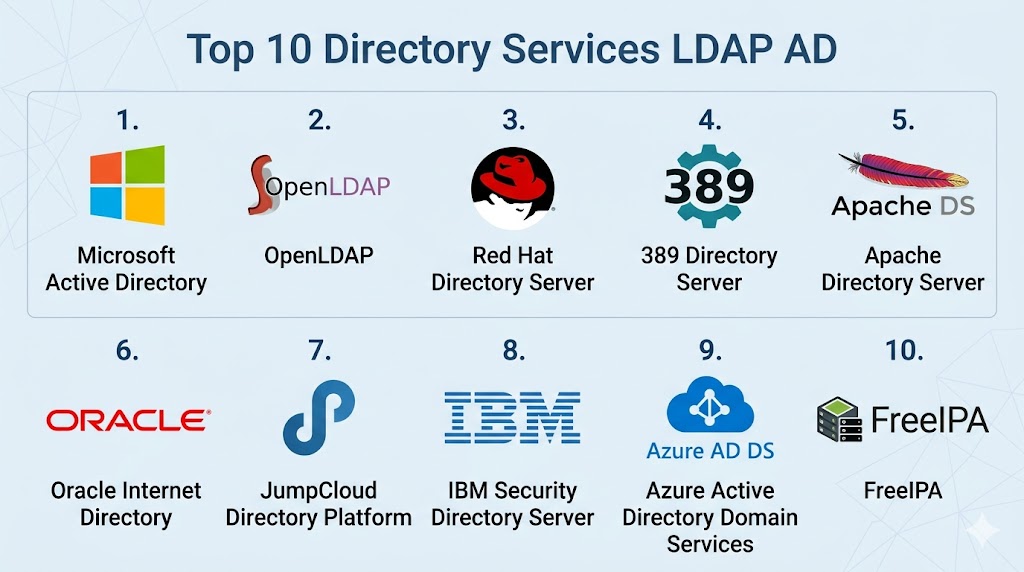
Top 10 Directory Services LDAP / AD Ecosystem Components
1- Microsoft Active Directory
Short description: Active Directory is a centralized directory service developed by Microsoft used to manage users, devices, and access permissions in Windows-based enterprise environments. It provides authentication, authorization, and policy enforcement across organizations. It is widely used in corporate IT infrastructure for identity and access management.
Key Features
- Centralized user and device management
- Authentication and authorization services
- Group Policy Object enforcement
- Domain-based access control
- Integration with Windows Server ecosystem
- LDAP and Kerberos support
- Multi-domain and forest architecture
Pros
- Strong enterprise identity management system
- Deep integration with Windows environments
- Highly scalable for large organizations
- Supports advanced policy management
Cons
- Windows-centric architecture
- Complex setup and maintenance
- Requires skilled administration
- Less flexible for non-Microsoft ecosystems
Platforms / Deployment
Windows Server. On-premise. Hybrid cloud via Azure integration.
Security & Compliance
Supports RBAC, audit logging, Kerberos authentication, and enterprise security policies. Compliance features depend on configuration.
Integrations & Ecosystem
- Microsoft Azure Active Directory
- Windows Server ecosystem
- Enterprise applications
- VPN systems
- SaaS identity providers
Support & Community
Strong enterprise support via Microsoft and global IT community resources.
2- OpenLDAP
Short description: OpenLDAP is an open-source implementation of the LDAP protocol used for managing directory services in a flexible and platform-independent way. It is commonly used in Linux and Unix environments for authentication and identity management.
Key Features
- LDAP protocol implementation
- Hierarchical directory structure support
- Cross-platform authentication support
- Custom schema configuration
- Lightweight identity management system
- TLS encryption support
- Flexible directory queries
Pros
- Open-source and highly customizable
- Platform independent
- Lightweight and efficient
- Strong Linux integration
Cons
- Requires technical expertise
- No built-in GUI by default
- Limited enterprise-level features
- Manual configuration complexity
Platforms / Deployment
Linux. Unix. Windows (limited support). On-premise.
Security & Compliance
Supports encryption, access control, and authentication policies. Compliance depends on deployment configuration.
Integrations & Ecosystem
- Linux authentication systems
- Email servers
- VPN services
- Enterprise applications
- Custom identity systems
Support & Community
Strong open-source community support.
3- Apache Directory Server
Short description: Apache Directory Server is an open-source LDAP directory service developed by the Apache Software Foundation. It provides a Java-based LDAP server with strong extensibility and enterprise-ready features.
Key Features
- Full LDAP v3 support
- Java-based architecture
- Schema extensibility
- Access control policies
- Replication support
- Embedded LDAP server capabilities
- Integration with Apache ecosystem
Pros
- Strong extensibility
- Cross-platform support
- Active open-source development
- Good for custom identity systems
Cons
- Requires Java environment
- Complex setup for beginners
- Smaller ecosystem than AD
- Limited enterprise tooling
Platforms / Deployment
Cross-platform. Java-based deployment.
Security & Compliance
Supports TLS encryption, access control lists, and authentication mechanisms.
Integrations & Ecosystem
- Java applications
- Enterprise middleware
- LDAP clients
- Web applications
Support & Community
Active Apache community support.
4- 389 Directory Server
Short description: 389 Directory Server is a Linux-based enterprise LDAP server developed by Red Hat. It is designed for high performance, scalability, and enterprise identity management.
Key Features
- High-performance LDAP directory service
- Multi-master replication
- Access control policies
- Role-based identity management
- Secure authentication support
- Large-scale directory handling
- Enterprise Linux integration
Pros
- Strong enterprise Linux support
- High scalability and performance
- Robust security features
- Actively maintained
Cons
- Linux-focused deployment
- Requires administrative expertise
- Less common in Windows environments
- Complex configuration
Platforms / Deployment
Linux. On-premise.
Security & Compliance
Supports TLS, access control, and enterprise authentication standards.
Integrations & Ecosystem
- Red Hat Enterprise Linux
- Identity management systems
- LDAP clients
- Enterprise applications
Support & Community
Enterprise support through Red Hat and community resources.
5- Azure Active Directory (Microsoft Entra ID)
Short description: Azure Active Directory, now part of Microsoft Entra ID, is a cloud-based identity and access management service that extends Active Directory capabilities to cloud applications and SaaS environments.
Key Features
- Cloud identity and access management
- Single sign-on for SaaS applications
- Multi-factor authentication support
- Conditional access policies
- Identity governance tools
- Integration with Microsoft ecosystem
- Hybrid identity support with AD
Pros
- Strong cloud identity management
- Excellent SaaS integration
- Highly scalable cloud service
- Strong security features
Cons
- Cloud-dependent architecture
- Microsoft ecosystem bias
- Complex licensing model
- Requires internet connectivity
Platforms / Deployment
Cloud SaaS. Hybrid integration with on-prem AD.
Security & Compliance
Supports enterprise-grade security controls, identity protection, and compliance frameworks.
Integrations & Ecosystem
- Microsoft 365
- Azure services
- SaaS applications
- Enterprise IAM tools
Support & Community
Strong Microsoft enterprise support ecosystem.
6- FreeIPA
Short description: FreeIPA is an open-source identity management system for Linux environments that integrates LDAP, Kerberos, DNS, and certificate services into a unified platform.
Key Features
- Integrated LDAP directory service
- Kerberos authentication
- Certificate authority integration
- DNS management
- Identity and access control
- Centralized policy management
- Linux enterprise authentication
Pros
- Complete identity management solution
- Strong Linux integration
- Open-source and free
- Secure authentication system
Cons
- Linux-only focus
- Complex setup
- Limited Windows integration
- Requires expertise
Platforms / Deployment
Linux. On-premise.
Security & Compliance
Supports Kerberos authentication, TLS encryption, and enterprise security policies.
Integrations & Ecosystem
- Linux systems
- Enterprise applications
- LDAP-based tools
- Security systems
Support & Community
Strong open-source and Red Hat ecosystem support.
7- JumpCloud Directory Platform
Short description: JumpCloud is a cloud-based directory platform that provides identity, device, and access management across multiple operating systems.
Key Features
- Cloud directory services
- Cross-platform device management
- LDAP and SSO support
- Multi-factor authentication
- Identity lifecycle management
- Cloud-based access control
- API-driven integrations
Pros
- Cross-platform identity management
- Cloud-native architecture
- Easy deployment
- Strong SaaS integration
Cons
- Subscription-based pricing
- Limited offline capabilities
- Less customizable than open LDAP
- Vendor dependency
Platforms / Deployment
Cloud SaaS.
Security & Compliance
Supports encryption, MFA, RBAC, and compliance controls.
Integrations & Ecosystem
- SaaS applications
- Cloud infrastructure
- LDAP-based systems
- DevOps tools
Support & Community
Strong SaaS support model and documentation.
8- Samba Active Directory
Short description: Samba AD is an open-source implementation that provides Active Directory compatibility on Linux systems. It enables Linux servers to function as domain controllers.
Key Features
- Active Directory domain controller functionality
- LDAP integration
- Kerberos authentication support
- File and print services
- Domain trust relationships
- Cross-platform identity support
- Windows compatibility layer
Pros
- Enables AD functionality on Linux
- Open-source and flexible
- Strong interoperability
- Cost-effective solution
Cons
- Complex configuration
- Limited enterprise tooling
- Requires Linux expertise
- Performance tuning required
Platforms / Deployment
Linux. On-premise.
Security & Compliance
Supports Kerberos, LDAP security, and domain-level authentication.
Integrations & Ecosystem
- Windows environments
- Linux servers
- Enterprise networks
- File sharing systems
Support & Community
Active open-source community support.
9- Oracle Internet Directory
Short description: Oracle Internet Directory is an enterprise LDAP directory service used for identity management in Oracle ecosystems and large-scale enterprise environments.
Key Features
- LDAP-based directory service
- Enterprise identity management
- High scalability architecture
- Security policy enforcement
- Integration with Oracle applications
- Directory replication support
- Centralized authentication
Pros
- Strong enterprise scalability
- Deep Oracle ecosystem integration
- Reliable performance
- Advanced security controls
Cons
- Oracle ecosystem dependency
- Complex licensing
- Requires specialized expertise
- High operational cost
Platforms / Deployment
Enterprise Linux. On-premise. Hybrid.
Security & Compliance
Supports enterprise authentication, encryption, and compliance controls.
Integrations & Ecosystem
- Oracle applications
- Enterprise databases
- LDAP systems
- Identity platforms
Support & Community
Enterprise Oracle support ecosystem.
10- IBM Security Directory Server
Short description: IBM Security Directory Server is a high-performance LDAP directory service designed for enterprise identity management and security environments.
Key Features
- LDAP directory service
- High availability architecture
- Secure identity management
- Policy-based access control
- Replication and scalability features
- Enterprise authentication support
- Integration with IBM security tools
Pros
- Strong enterprise-grade security
- High scalability
- Reliable performance
- Good IBM ecosystem integration
Cons
- Enterprise complexity
- High cost of deployment
- Requires IBM ecosystem dependency
- Steep learning curve
Platforms / Deployment
Enterprise Linux. On-premise. Hybrid.
Security & Compliance
Supports enterprise encryption, RBAC, and identity governance policies.
Integrations & Ecosystem
- IBM security suite
- Enterprise IAM systems
- LDAP applications
- Cloud integrations
Support & Community
Strong IBM enterprise support.
Comparison Table
| Tool Name | Best For | Platforms Supported | Deployment | Standout Feature | Public Rating |
|---|---|---|---|---|---|
| Active Directory | Windows enterprise identity | Windows Server | On-premise hybrid | Group policy management | N/A |
| OpenLDAP | Open-source LDAP systems | Linux Unix | On-premise | Lightweight LDAP protocol | N/A |
| Apache Directory | Java-based LDAP systems | Cross-platform | On-premise | Extensible LDAP server | N/A |
| 389 Directory Server | Linux enterprise identity | Linux | On-premise | High performance LDAP | N/A |
| Azure AD | Cloud identity management | Cloud | SaaS | SaaS SSO integration | N/A |
| FreeIPA | Linux identity management | Linux | On-premise | Integrated identity stack | N/A |
| JumpCloud | Cross-platform IAM | Cloud | SaaS | Cloud directory service | N/A |
| Samba AD | Linux AD compatibility | Linux Windows | On-premise | AD domain controller on Linux | N/A |
| Oracle Directory | Oracle ecosystem IAM | Enterprise Linux | Hybrid | Oracle integration | N/A |
| IBM Directory Server | Enterprise IAM | Linux | On-premise | High availability LDAP | N/A |
Evaluation and Scoring of Directory Services
| Tool Name | Core 25% | Ease 15% | Integrations 15% | Security 10% | Performance 10% | Support 10% | Value 15% | Weighted Total |
|---|---|---|---|---|---|---|---|---|
| Active Directory | 10 | 8 | 10 | 10 | 9 | 10 | 8 | 9.25 |
| OpenLDAP | 8 | 7 | 8 | 8 | 9 | 8 | 10 | 8.30 |
| Apache Directory | 7 | 7 | 8 | 8 | 8 | 7 | 9 | 7.90 |
| 389 Directory Server | 8 | 7 | 8 | 9 | 9 | 8 | 8 | 8.35 |
| Azure AD | 10 | 9 | 10 | 10 | 10 | 10 | 9 | 9.60 |
| FreeIPA | 8 | 7 | 8 | 9 | 9 | 8 | 9 | 8.25 |
| JumpCloud | 9 | 9 | 9 | 9 | 9 | 9 | 8 | 8.95 |
| Samba AD | 8 | 7 | 8 | 8 | 8 | 8 | 9 | 8.10 |
| Oracle Directory | 8 | 7 | 8 | 9 | 9 | 8 | 7 | 8.15 |
| IBM Directory Server | 8 | 7 | 8 | 9 | 9 | 9 | 7 | 8.20 |
These scores reflect identity management strength, scalability, integration depth, security capabilities, and enterprise adoption. Azure Active Directory and Microsoft Active Directory lead due to ecosystem dominance, while JumpCloud excels in cross-platform cloud identity management. OpenLDAP and FreeIPA provide strong open-source flexibility for Linux environments.
Which Directory Service Is Right for You
Solo / Freelancer
Most solo users do not need directory services unless managing local authentication systems. Lightweight LDAP tools or cloud identity platforms are sufficient.
SMB
SMBs benefit from cloud identity solutions like JumpCloud or Azure AD due to simplicity and scalability. OpenLDAP is suitable for Linux-heavy SMB environments.
Mid-Market
Mid-market organizations need hybrid identity management. Active Directory combined with Azure AD, or JumpCloud, works well for mixed environments.
Enterprise
Enterprises require full-scale identity governance. Active Directory, Azure AD, IBM Directory Server, Oracle Directory, and 389 Directory Server are leading choices.
Budget vs Premium
Open-source tools like OpenLDAP and FreeIPA offer cost-effective solutions. Enterprise tools like IBM and Oracle provide advanced governance at higher cost.
Feature Depth vs Ease of Use
Azure AD and JumpCloud offer the easiest deployment. Active Directory and IBM Directory Server provide deep enterprise features but require expertise.
Integrations & Scalability
Azure AD and Active Directory offer the strongest ecosystem integration. OpenLDAP and FreeIPA are flexible but require manual integration work.
Security & Compliance Needs
Enterprises with strict compliance requirements should prioritize Active Directory, Azure AD, IBM Directory Server, and Oracle Directory due to strong governance and audit capabilities.
Frequently Asked Questions FAQs
1. What is a directory service?
A directory service is a system that stores and manages information about users, devices, and resources in a structured format. It helps organizations centralize identity management. It is used for authentication and authorization. LDAP and Active Directory are common examples.
2. What is LDAP?
LDAP is a protocol used to access and manage directory information. It does not store data itself but communicates with directory services. It is widely used in identity systems. It supports authentication and queries.
3. What is Active Directory?
Active Directory is a Microsoft directory service that stores and manages user identities, devices, and permissions. It provides authentication and policy enforcement. It is widely used in enterprise environments. It integrates deeply with Windows systems.
4. What is the difference between LDAP and Active Directory?
LDAP is a protocol, while Active Directory is a full directory service. LDAP is used to communicate with directory systems. Active Directory stores and manages identity data. AD uses LDAP as one of its protocols.
5. Is LDAP still used in 2026?
Yes, LDAP is still widely used for authentication and directory queries. It remains important in enterprise and Linux environments. Many modern systems still rely on LDAP integration. It is often used alongside cloud identity systems.
6. Is Active Directory cloud-based?
Traditional Active Directory is on-premise. However, Azure Active Directory provides a cloud-based identity system. Many organizations use hybrid models. Cloud identity is now common in modern architectures.
7. What is a domain controller?
A domain controller is a server that manages authentication requests in Active Directory. It verifies user credentials and enforces policies. It is a core part of AD infrastructure. Multiple domain controllers improve reliability.
8. What are LDAP directories used for?
LDAP directories are used for authentication, user management, email systems, VPN access, and application login systems. They centralize identity data. They simplify access control. They are widely used in enterprise IT systems.
9. Can LDAP work with cloud systems?
Yes, LDAP can integrate with cloud systems using connectors and identity bridges. Many SaaS platforms support LDAP authentication. However, modern cloud identity systems are often preferred. LDAP is still widely supported.
10. What is the future of directory services?
The future includes cloud identity, zero trust architecture, and passwordless authentication. LDAP and Active Directory will continue to evolve. Hybrid identity systems will dominate enterprise environments. AI-driven identity security is also growing.
Conclusion
Directory services like LDAP and Active Directory form the backbone of enterprise identity and access management. LDAP provides a flexible protocol for directory access, while Active Directory delivers a full-featured identity management system for enterprise environments. In modern IT architectures, these systems are evolving toward hybrid and cloud-based identity platforms like Azure Active Directory and JumpCloud. Organizations should choose directory services based on infrastructure type, scalability needs, security requirements, and integration complexity. The best approach is often a hybrid identity strategy combining on-prem and cloud directory services to ensure flexibility, security, and scalability.

This article clearly explains directory services like LDAP and Active Directory and how they help organizations manage user authentication, access control, and network resources efficiently.
Helpful guide explaining directory services, LDAP, and Active Directory concepts in a simple way while comparing their architecture and practical use cases.
A key gap is how well directory services handle identity lifecycle sync and policy drift in hybrid environments.