Introduction
Embedded Finance Platforms help software companies, marketplaces, fintechs, ecommerce brands, vertical SaaS businesses, and digital platforms add financial services directly inside their own products. In simple terms, these platforms let non-bank businesses offer payments, cards, accounts, lending, payouts, wallets, banking-like services, and money movement without building the entire financial infrastructure from scratch.
Embedded finance matters because users increasingly expect financial services inside the tools they already use. A marketplace may want instant seller payouts, a SaaS platform may want business accounts for customers, a payroll app may want earned wage access, and an ecommerce platform may want embedded lending or cards. Common use cases include embedded payments, card issuing, business accounts, merchant financing, expense cards, wallets, payouts, banking-as-a-service, and account-to-account money movement.
Buyers should evaluate licensed partner structure, compliance support, KYC/KYB workflows, payment rails, card issuing, account infrastructure, ledger quality, API maturity, fraud controls, reconciliation, reporting, scalability, pricing, support, and regulatory risk management.
Best for: fintech startups, vertical SaaS platforms, marketplaces, ecommerce companies, payroll platforms, expense management tools, banks, lenders, payment providers, and enterprises building financial services into customer workflows. Not ideal for: teams that only need a basic payment form, early-stage founders without compliance readiness, or businesses that cannot manage onboarding, risk, fraud, customer support, reconciliation, and financial operations.
Key Trends in Embedded Finance Platforms
- Vertical SaaS platforms are becoming financial hubs: Software companies serving industries like construction, healthcare, logistics, retail, hospitality, and professional services are embedding payments, lending, cards, and accounts directly into workflows.
- Card issuing remains a high-demand use case: Businesses want virtual and physical cards for expenses, payouts, rewards, fleet spending, contractor payments, loyalty programs, and controlled purchasing.
- Embedded lending is expanding: Platforms are using transaction data, sales history, payroll data, and account activity to offer working capital, merchant cash advances, invoice financing, and credit products.
- Compliance quality is now a major buying factor: Buyers are looking closely at KYC, KYB, AML, sanctions screening, transaction monitoring, fraud controls, dispute handling, and program governance.
- Ledger infrastructure is becoming more important: Platforms need accurate balance tracking, sub-accounts, reconciliation, transaction history, settlement visibility, and audit-ready records.
- Bank partner strategy is under more scrutiny: Embedded finance buyers increasingly evaluate who holds funds, who sponsors accounts or cards, what licenses apply, and how program risk is managed.
- Payment orchestration and money movement are converging: Many platforms want one infrastructure layer for pay-ins, payouts, accounts, cards, ACH, wires, and reconciliation.
- Developer experience still matters: Clean APIs, sandbox environments, clear documentation, webhooks, testing tools, dashboards, and operational support can strongly affect launch speed.
- Fraud and risk controls are becoming platform differentiators: Embedded finance products can attract identity fraud, synthetic businesses, account takeover, mule activity, and transaction abuse.
- Embedded finance is moving from hype to operational discipline: Winning platforms are not just API wrappers; they provide compliance, operations, reconciliation, partner bank coordination, and support for real financial workflows.
How We Selected These Tools
The platforms below were selected based on practical relevance to embedded finance, banking-as-a-service, card issuing, payments, accounts, lending, money movement, and fintech infrastructure.
- Market adoption and mindshare: Preference was given to providers widely recognized by fintechs, software platforms, banks, payment companies, and financial infrastructure teams.
- Feature completeness: Platforms were evaluated for payments, issuing, accounts, lending, ledgering, compliance workflows, onboarding, and reporting.
- Developer experience: APIs, dashboards, sandbox tools, documentation quality, webhook support, and implementation patterns were considered.
- Compliance and risk support: KYB, KYC, AML, sanctions screening, fraud controls, transaction monitoring, dispute workflows, and program governance were reviewed where clearly known.
- Financial product coverage: Tools with multiple embedded finance products or strong specialization in payments, issuing, accounts, or lending were prioritized.
- Enterprise readiness: Scalability, support, operational maturity, auditability, and bank partner coordination were considered.
- Regional fit: Platforms with clear strength in North America, Europe, or global financial infrastructure were included.
- Buyer fit: The list includes options for startups, SMB platforms, mid-market companies, enterprises, banks, SaaS platforms, marketplaces, and fintech builders.
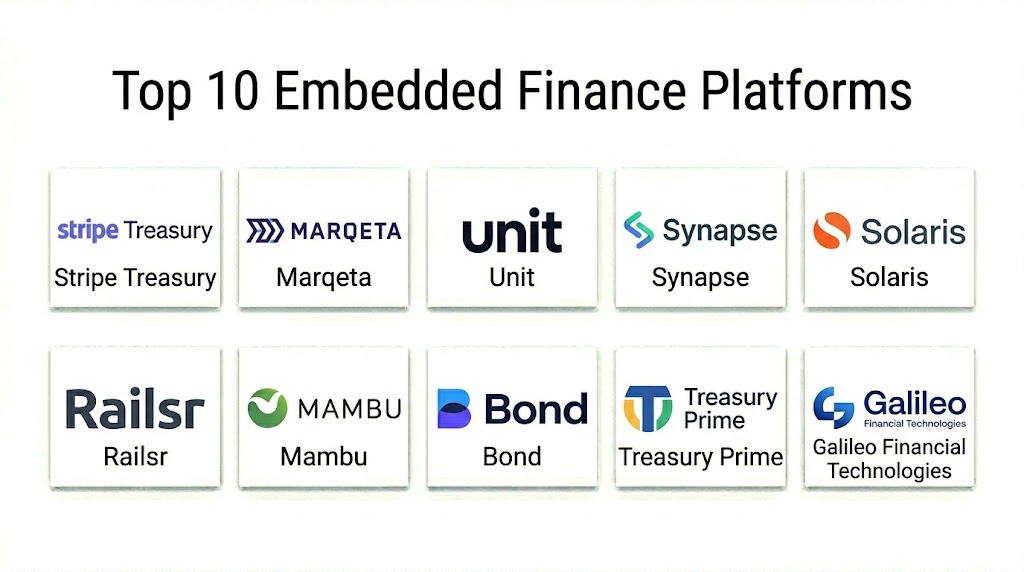
Top 10 Embedded Finance Platforms
#1 — Stripe Embedded Finance
Short description: Stripe Embedded Finance helps platforms add payments, financial accounts, card issuing, and financing experiences into their products. It is especially useful for marketplaces, SaaS companies, ecommerce platforms, and vertical software businesses that already use Stripe for payments. Stripe combines developer-friendly APIs with financial infrastructure products that can support onboarding, money movement, accounts, cards, and capital access. It is best for software platforms that want to embed financial services while reducing infrastructure complexity.
Key Features
- Embedded payments for platforms and marketplaces.
- Financial accounts and money movement capabilities depending on region and eligibility.
- Card issuing for virtual and physical card programs.
- Financing and capital products for eligible businesses.
- Developer-friendly APIs, dashboards, webhooks, and testing tools.
- Support for onboarding, payouts, and payment operations.
- Strong ecosystem for ecommerce, SaaS, marketplaces, and fintech products.
Pros
- Strong developer experience and broad platform ecosystem.
- Useful for businesses already using Stripe payments.
- Combines payments, issuing, accounts, and financing options.
- Good fit for fast-moving SaaS and marketplace teams.
Cons
- Product availability varies by region, use case, and eligibility.
- Some financial services require approval and partner-bank involvement.
- Pricing and program requirements may become complex at scale.
- Not every business model will qualify for all embedded finance products.
Platforms / Deployment
Cloud / API / Web dashboard / Developer platform.
Security & Compliance
Security and compliance support may include identity verification, onboarding controls, payment security, monitoring, and platform-level controls depending on product and configuration. Specific certifications and compliance claims should be verified directly. If uncertain, write: Not publicly stated.
Integrations & Ecosystem
Stripe fits platforms that need financial services connected to commerce, payments, subscriptions, marketplaces, and business operations. It is especially strong where embedded finance is part of a broader payment and platform strategy.
- Ecommerce platforms
- Marketplaces
- SaaS products
- Subscription billing workflows
- Card issuing programs
- Financing and payout workflows
Support & Community
Stripe provides extensive documentation, developer resources, dashboards, support options, and partner resources. Community strength is high among developers, SaaS builders, fintech teams, and ecommerce platforms.
#2 — Adyen for Platforms
Short description: Adyen for Platforms helps marketplaces, SaaS companies, and digital platforms embed payments, onboarding, risk controls, payouts, and financial services into their own products. It is especially useful for companies operating across multiple countries, currencies, and payment methods. Adyen’s platform approach supports payments acceptance, sub-merchant onboarding, compliance workflows, card issuing, and money movement capabilities. It is best for global platforms that need scalable embedded payments and financial services infrastructure.
Key Features
- Embedded payments for platforms and marketplaces.
- Sub-merchant onboarding and verification workflows.
- Multi-currency and global payment method support.
- Payouts, settlement, and reconciliation support.
- Risk management and fraud tools.
- Card issuing capabilities depending on use case and region.
- Unified platform for payments and financial operations.
Pros
- Strong fit for global platforms and marketplaces.
- Good payment method and currency coverage.
- Useful for complex merchant onboarding and payouts.
- Enterprise-ready payment infrastructure.
Cons
- Implementation may be more complex than simpler payment tools.
- Best suited to platforms with meaningful transaction volume.
- Product availability varies by region and business model.
- Pricing and onboarding may require sales-led engagement.
Platforms / Deployment
Cloud / API / Web dashboard / Global payment and platform infrastructure.
Security & Compliance
Security and compliance features may include fraud controls, merchant onboarding, risk monitoring, secure payment processing, access controls, and compliance workflows depending on configuration. Specific certifications and compliance claims should be verified directly. If uncertain, write: Not publicly stated.
Integrations & Ecosystem
Adyen works well for global commerce platforms, marketplaces, subscription businesses, travel platforms, retail platforms, and SaaS products that need embedded payments and financial operations.
- Marketplace payments
- Merchant onboarding
- Global payment methods
- Payout workflows
- Card issuing programs
- Risk and fraud systems
Support & Community
Adyen provides enterprise support, implementation resources, documentation, and account management. It is strongest for companies with serious payment operations and international growth needs.
#3 — Marqeta
Short description: Marqeta is a modern card issuing and payment infrastructure platform that helps companies create customized debit, prepaid, credit, virtual, and commercial card programs. It is widely used for expense management, on-demand payouts, digital banking, rewards, gig economy payments, and embedded card experiences. Marqeta is especially useful when a business needs flexible card controls, real-time authorization logic, and branded card programs. It is best for fintechs, enterprises, neobanks, platforms, and companies building card-led embedded finance products.
Key Features
- Modern card issuing for virtual and physical cards.
- Real-time authorization and flexible card controls.
- Support for debit, prepaid, commercial, and credit-style programs depending on eligibility.
- APIs for card creation, spend rules, transaction controls, and program operations.
- Useful for expense management, payouts, rewards, and business cards.
- Supports tokenization and digital wallet card provisioning depending on program.
- Enterprise-scale card infrastructure.
Pros
- Strong specialization in card issuing.
- Useful for customized spend controls and card programs.
- Good fit for fintechs, expense platforms, and payout products.
- Mature infrastructure for embedded card experiences.
Cons
- Not a full replacement for all banking or ledger infrastructure.
- Card programs require compliance, sponsor bank, and operational planning.
- Best suited to teams with clear card issuing use cases.
- Pricing and approval may depend on scale, region, and program type.
Platforms / Deployment
Cloud / API / Card issuing infrastructure / Web dashboard.
Security & Compliance
Security and compliance support may include card program controls, fraud tools, transaction monitoring, secure APIs, and partner-bank program requirements depending on setup. Specific certifications and compliance claims should be verified directly. If uncertain, write: Not publicly stated.
Integrations & Ecosystem
Marqeta integrates into fintech apps, expense platforms, payout systems, digital banking products, and enterprise card workflows.
- Expense management platforms
- Neobanks and fintech apps
- On-demand payout systems
- Rewards and loyalty programs
- Commercial card workflows
- Digital wallet provisioning workflows
Support & Community
Marqeta provides enterprise support, implementation resources, program management guidance, and documentation. It is strongest for organizations with serious card issuing needs and operational readiness.
#4 — Unit
Short description: Unit is a banking-as-a-service and embedded finance platform that helps companies launch accounts, cards, payments, and financial products through APIs. It is designed for fintechs, SaaS platforms, marketplaces, and businesses that want to add banking-like services without becoming a bank themselves. Unit supports program management workflows, customer onboarding, account infrastructure, card issuing, and money movement depending on use case. It is best for companies building embedded banking products with clear compliance and operational plans.
Key Features
- Embedded bank accounts and card programs.
- APIs for account creation, cards, payments, and transactions.
- Customer onboarding and compliance workflow support.
- Ledger and account infrastructure capabilities.
- Webhooks and developer tools for financial product workflows.
- Support for consumer or business-focused programs depending on eligibility.
- Banking-as-a-service model with partner-bank infrastructure.
Pros
- Strong fit for embedded banking use cases.
- Developer-friendly APIs for fintech product development.
- Useful for SaaS platforms and vertical financial products.
- Combines accounts, cards, and payments in one platform model.
Cons
- Live launch requires approval, compliance review, and program readiness.
- Not every startup or use case may qualify.
- Regulatory, fraud, and customer support responsibilities remain important.
- Product availability depends on region, bank partners, and program structure.
Platforms / Deployment
Cloud / API / Web dashboard / Banking-as-a-service platform.
Security & Compliance
Security and compliance support may include onboarding workflows, KYC/KYB, transaction controls, secure APIs, and partner-bank program oversight depending on configuration. Specific certifications and compliance claims should be verified directly. If uncertain, write: Not publicly stated.
Integrations & Ecosystem
Unit fits fintech and software products that need embedded bank accounts, cards, payments, and program operations.
- Fintech apps
- Vertical SaaS platforms
- Marketplace financial products
- Card issuing workflows
- Account and ledger systems
- Payment and transfer workflows
Support & Community
Unit provides developer documentation, implementation support, and program guidance. It is best suited for teams that understand compliance, financial operations, and customer risk management.
#5 — Galileo Financial Technologies
Short description: Galileo Financial Technologies provides financial technology infrastructure for digital banking, card issuing, payments, and embedded finance. It is used by fintechs, neobanks, enterprises, and financial institutions that need scalable account and card program capabilities. Galileo is especially relevant for companies building digital banking products, prepaid programs, debit programs, and payment experiences. It is best for organizations that need mature financial infrastructure and program support at scale.
Key Features
- Digital banking and card issuing infrastructure.
- Account processing and payment capabilities.
- Support for debit, prepaid, and account-based financial products.
- APIs for financial product development.
- Risk, fraud, and program management features depending on product.
- Useful for neobanks, fintechs, and enterprise financial programs.
- Scalable infrastructure for high-volume financial services.
Pros
- Strong fit for digital banking and card-led programs.
- Mature financial infrastructure provider.
- Useful for fintechs and enterprises with scale requirements.
- Supports complex financial product operations.
Cons
- May be more enterprise-oriented than early-stage startup-friendly.
- Implementation can require significant planning.
- Pricing and onboarding may be sales-led.
- Buyers should validate exact product fit and regional availability.
Platforms / Deployment
Cloud / API / Financial infrastructure platform.
Security & Compliance
Security and compliance capabilities may include program controls, fraud tools, secure processing, access controls, and operational support depending on product. Specific certifications and compliance claims should be verified directly. If uncertain, write: Not publicly stated.
Integrations & Ecosystem
Galileo integrates into fintech platforms, neobanks, digital banking apps, card programs, payment systems, and enterprise financial service workflows.
- Digital banking platforms
- Card issuing programs
- Payment workflows
- Fintech applications
- Fraud and risk tools
- Enterprise financial systems
Support & Community
Galileo provides enterprise support, implementation resources, and financial infrastructure expertise. It is strongest for businesses with serious digital banking or card program needs.
#6 — Solaris
Short description: Solaris is an embedded finance and banking-as-a-service platform focused on helping businesses launch banking, cards, lending, and payment products in supported European markets. It combines technology infrastructure with regulated financial services capabilities. Solaris is useful for fintechs, mobility companies, ecommerce brands, platforms, and enterprises that want to embed compliant financial services into their customer experience. It is best for European businesses needing banking infrastructure, accounts, cards, and financial product building blocks.
Key Features
- Embedded banking and financial services infrastructure.
- Digital banking account products depending on use case.
- Card issuing and payment capabilities.
- Lending and financing products depending on eligibility and region.
- APIs for integrating financial services into customer platforms.
- Regulated infrastructure model in supported markets.
- Useful for fintechs, platforms, and enterprise brands.
Pros
- Strong fit for European embedded finance.
- Combines technology and regulated financial services capabilities.
- Useful for accounts, cards, payments, and lending use cases.
- Good option for companies needing compliant financial product infrastructure.
Cons
- Best suited to supported European markets.
- Regulatory and onboarding requirements can be significant.
- Product availability varies by region and program type.
- Implementation may require careful compliance and operational planning.
Platforms / Deployment
Cloud / API / Embedded finance platform / Banking-as-a-service infrastructure.
Security & Compliance
Security and compliance support may include regulated financial services workflows, KYC/KYB, transaction controls, secure APIs, and operational oversight depending on product and market. Specific certifications should be verified directly. If uncertain, write: Not publicly stated.
Integrations & Ecosystem
Solaris fits European embedded finance products where businesses need banking, card, payment, or lending capabilities through APIs.
- Digital banking products
- Card issuing programs
- Lending workflows
- Payment systems
- Fintech platforms
- Enterprise customer experiences
Support & Community
Solaris provides implementation support, documentation, and regulated financial services expertise. It is best suited for companies prepared for compliance and operational requirements in European markets.
#7 — Treasury Prime
Short description: Treasury Prime provides banking-as-a-service infrastructure that connects fintechs and companies with bank partners through APIs. It helps businesses build financial products such as accounts, payments, cards, and money movement capabilities. Treasury Prime is especially useful for companies that want bank connectivity and financial infrastructure while working through regulated partner banks. It is best for fintechs, embedded finance companies, and enterprises that need bank-partnered financial services.
Key Features
- Banking-as-a-service APIs for financial product development.
- Bank partner connectivity for embedded finance programs.
- Account creation and money movement workflows depending on use case.
- Payments and transfer capabilities.
- Card-related capabilities may vary by program.
- Developer APIs and platform tools.
- Useful for fintechs and companies building bank-connected products.
Pros
- Strong fit for bank-partnered embedded finance.
- Useful for fintechs that need account and payment infrastructure.
- Helps connect technology platforms with regulated banks.
- Can support a range of financial product workflows.
Cons
- Program approval and bank partner requirements are important.
- Product availability depends on bank relationships and use case.
- Not every early-stage business may qualify.
- Implementation requires compliance, risk, and operations planning.
Platforms / Deployment
Cloud / API / Banking-as-a-service platform.
Security & Compliance
Security and compliance support may include bank-partner workflows, customer onboarding, transaction controls, secure APIs, and financial operations support depending on configuration. Specific certifications and compliance claims should be verified directly. If uncertain, write: Not publicly stated.
Integrations & Ecosystem
Treasury Prime fits fintech products and embedded finance programs that need banking connectivity, accounts, payments, and operational infrastructure.
- Fintech applications
- Banking partner workflows
- Account creation systems
- Payment and transfer workflows
- Compliance operations
- Embedded finance products
Support & Community
Treasury Prime provides documentation, developer resources, and business support. Buyers should evaluate bank partner alignment, implementation support, and operational responsibilities carefully.
#8 — Mambu
Short description: Mambu is a cloud banking platform that helps financial institutions, fintechs, lenders, and embedded finance providers build and launch deposit, lending, and banking products. While it is not only an embedded finance platform, it is widely used as composable banking infrastructure for organizations that need flexible product configuration. Mambu is useful for digital banks, lenders, fintech platforms, and financial institutions building modern financial services. It is best for teams that need a configurable core banking platform behind embedded or digital finance offerings.
Key Features
- Cloud-native banking and lending platform.
- Configurable product engine for deposits and lending.
- APIs for integrating with fintech and banking ecosystems.
- Supports digital banking, lending, and financial product workflows.
- Useful for composable banking architectures.
- Integration-friendly platform model.
- Strong fit for banks, fintechs, and embedded finance providers.
Pros
- Strong configurable banking product capabilities.
- Useful for lending and deposit product workflows.
- Good fit for composable financial architecture.
- Supports fintech and bank modernization use cases.
Cons
- Not a simple plug-and-play embedded finance API for every startup.
- Requires implementation planning and integration work.
- Compliance, licensing, and banking operations still need separate management.
- May be more suited to serious financial institutions and platforms.
Platforms / Deployment
Cloud / API / Banking platform.
Security & Compliance
Security capabilities may include platform access controls, data protection, configuration governance, and enterprise controls depending on deployment. Specific certifications and compliance claims should be verified directly. If uncertain, write: Not publicly stated.
Integrations & Ecosystem
Mambu fits financial institutions and fintech platforms that need core banking or lending infrastructure integrated with broader embedded finance stacks.
- Digital banking platforms
- Lending systems
- Deposit products
- Payment providers
- KYC and compliance tools
- Fintech ecosystems
Support & Community
Mambu provides enterprise support, implementation resources, partner ecosystem support, and product documentation. It is strongest for organizations building serious banking and lending products.
#9 — Swan
Short description: Swan is an embedded banking platform that helps companies create accounts, cards, and payment products in supported European markets. It is useful for SaaS platforms, fintechs, marketplaces, and businesses that want to embed financial services into their products. Swan supports account infrastructure, card issuing, payment capabilities, and compliance workflows depending on product and region. It is best for European companies looking for banking-as-a-service and embedded finance building blocks.
Key Features
- Embedded accounts and payment capabilities.
- Card issuing for supported use cases.
- APIs for integrating banking services into software products.
- KYC/KYB and compliance workflow support depending on program.
- Useful for SaaS, fintech, marketplaces, and vertical platforms.
- European market focus.
- Supports branded financial product experiences.
Pros
- Strong fit for European embedded banking.
- Useful for accounts, cards, and payments.
- Developer-friendly approach for software platforms.
- Can support fintech and vertical SaaS use cases.
Cons
- Best suited to supported European markets.
- Product availability depends on eligibility and region.
- Program launch requires compliance and operational readiness.
- Buyers should validate bank coverage, payment rails, and support.
Platforms / Deployment
Cloud / API / Embedded banking platform.
Security & Compliance
Security and compliance support may include onboarding workflows, secure APIs, transaction controls, regulated financial services workflows, and access controls depending on product. Specific certifications and compliance claims should be verified directly. If uncertain, write: Not publicly stated.
Integrations & Ecosystem
Swan fits SaaS platforms, fintech products, marketplaces, and software companies that want to embed banking services into customer workflows.
- SaaS platforms
- Embedded accounts
- Card issuing workflows
- Payment products
- Marketplace finance
- Customer onboarding flows
Support & Community
Swan provides documentation, implementation resources, and support for embedded banking programs. It is best suited for companies with European embedded finance use cases.
#10 — Railsr
Short description: Railsr is an embedded finance platform that helps businesses add banking, cards, payments, and wallet-like financial services into their products. It is designed for companies that want financial service building blocks through APIs rather than building full banking infrastructure themselves. Railsr has been associated with embedded finance, banking-as-a-service, and card issuing use cases in supported markets. It is best for teams evaluating European embedded finance options, but buyers should carefully review current product availability, regulatory position, and support fit.
Key Features
- Embedded finance APIs for accounts, cards, and payments depending on availability.
- Banking-as-a-service and wallet-like product workflows.
- Card issuing and payment capabilities for supported use cases.
- APIs for fintech and platform integration.
- Compliance workflow support depending on program and region.
- Useful for branded financial product experiences.
- Supports embedded finance product development in selected markets.
Pros
- Relevant for embedded finance and BaaS use cases.
- Useful for accounts, payments, and card program concepts.
- API-based model supports fintech product integration.
- Can fit European embedded finance evaluations where supported.
Cons
- Buyers should carefully validate current operations and support.
- Product availability may vary by market, program, and regulatory status.
- Requires strong due diligence before production selection.
- Not ideal for teams that need guaranteed global coverage or low-risk onboarding.
Platforms / Deployment
Cloud / API / Embedded finance platform / Availability varies.
Security & Compliance
Security and compliance support may vary by product, market, and program configuration. Buyers should verify current controls, regulatory status, partner structure, and compliance capabilities directly. Use: Not publicly stated where details are unclear.
Integrations & Ecosystem
Railsr may fit fintech and platform workflows where embedded accounts, payments, or cards are needed in supported markets.
- Fintech applications
- Card issuing workflows
- Account and wallet products
- Payment systems
- Embedded finance programs
- Platform financial services
Support & Community
Support, onboarding, and product maturity should be reviewed carefully during evaluation. Buyers should request current documentation, implementation references, regulatory clarity, and operational support details before committing.
Comparison Table
| Tool Name | Best For | Platform Supported | Deployment | Standout Feature | Public Rating |
|---|---|---|---|---|---|
| Stripe Embedded Finance | SaaS platforms and marketplaces | Cloud / API / Web dashboard | Cloud | Payments, accounts, issuing, and financing ecosystem | N/A |
| Adyen for Platforms | Global marketplaces and payment-led platforms | Cloud / API / Web dashboard | Cloud | Global embedded payments and financial operations | N/A |
| Marqeta | Card issuing and spend control programs | Cloud / API / Web dashboard | Cloud | Modern virtual and physical card issuing | N/A |
| Unit | Embedded banking products | Cloud / API / Web dashboard | Cloud | Accounts, cards, and banking-as-a-service APIs | N/A |
| Galileo Financial Technologies | Digital banking and card programs | Cloud / API | Cloud | Scalable financial technology infrastructure | N/A |
| Solaris | European embedded banking and finance | Cloud / API | Cloud | Banking, cards, payments, and lending infrastructure | N/A |
| Treasury Prime | Bank-partnered embedded finance | Cloud / API | Cloud | Bank connectivity for accounts and money movement | N/A |
| Mambu | Composable banking and lending platforms | Cloud / API | Cloud | Configurable cloud banking product engine | N/A |
| Swan | European embedded accounts and cards | Cloud / API | Cloud | Embedded banking for SaaS and fintech platforms | N/A |
| Railsr | Embedded finance programs in supported markets | Cloud / API | Cloud / Varies | Accounts, cards, and payments building blocks | N/A |
Evaluation & Scoring of Embedded Finance Platforms
| Tool Name | Core 25% | Ease 15% | Integrations 15% | Security 10% | Performance 10% | Support 10% | Value 15% | Weighted Total |
|---|---|---|---|---|---|---|---|---|
| Stripe Embedded Finance | 9 | 9 | 10 | 9 | 9 | 8 | 8 | 8.90 |
| Adyen for Platforms | 9 | 8 | 9 | 9 | 9 | 9 | 8 | 8.65 |
| Marqeta | 9 | 8 | 8 | 9 | 9 | 8 | 8 | 8.40 |
| Unit | 8 | 8 | 8 | 8 | 8 | 8 | 8 | 8.00 |
| Galileo Financial Technologies | 9 | 7 | 8 | 9 | 9 | 9 | 7 | 8.25 |
| Solaris | 8 | 7 | 8 | 9 | 8 | 8 | 7 | 7.75 |
| Treasury Prime | 8 | 7 | 8 | 8 | 8 | 8 | 7 | 7.60 |
| Mambu | 8 | 7 | 9 | 8 | 8 | 8 | 7 | 7.85 |
| Swan | 8 | 8 | 8 | 8 | 8 | 7 | 8 | 7.85 |
| Railsr | 7 | 6 | 7 | 7 | 7 | 6 | 7 | 6.75 |
These scores are comparative and based on embedded finance platform fit, not absolute product quality. A higher score means the platform aligns strongly with embedded finance capabilities such as APIs, compliance workflows, payments, cards, accounts, integrations, support, and scalability. Payment-led platforms score strongly when transaction acceptance and payouts are central, while card issuing specialists score higher for spend control and virtual card programs. Buyers should adjust the weights based on whether their priority is accounts, cards, payments, lending, compliance support, or core banking infrastructure.
Which Embedded Finance Platform Is Right for You?
Solo / Freelancer
Solo founders should be careful with embedded finance because live financial services require compliance, risk controls, customer support, and partner approval. For experimentation, platforms with strong sandboxes and documentation such as Stripe, Unit, or Swan may be easier to explore depending on region and use case. If the goal is only accepting payments, a basic payments platform may be enough. Solo founders should avoid launching accounts, cards, or lending until they understand KYC, KYB, fraud, and operational obligations.
SMB
SMBs should choose based on the specific financial workflow they want to embed. If the goal is payments and marketplace payouts, Stripe or Adyen may be practical. If the business needs card issuing, Marqeta is a strong specialist option. If the goal is embedded accounts and banking-like experiences, Unit, Swan, Solaris, or Treasury Prime may be better depending on region. SMBs should run a limited pilot before expanding to full financial product coverage.
Mid-Market
Mid-market platforms often need stronger compliance support, reporting, reconciliation, support SLAs, and program controls. Stripe Embedded Finance is strong for SaaS and marketplace ecosystems, while Adyen for Platforms is strong for global payment-led businesses. Marqeta fits card-led programs, and Galileo fits digital banking and scalable account or card infrastructure. Mid-market teams should evaluate implementation support, bank partner structure, fraud controls, and customer support responsibilities carefully.
Enterprise
Enterprises should prioritize platform maturity, regulatory alignment, operational support, bank partner stability, compliance controls, and scalability. Adyen, Stripe, Marqeta, Galileo, Mambu, and Solaris are strong candidates depending on product scope and region. Enterprises building full banking or lending products may need core infrastructure such as Mambu combined with payments, KYC, ledgering, and compliance tools. Enterprise buyers should involve legal, risk, compliance, finance, engineering, and operations teams from the beginning.
Budget vs Premium
Budget-conscious teams should start with a narrow use case, such as payments, payouts, or basic card issuing, rather than launching a full embedded banking suite. Platforms with easy sandbox access may reduce early experimentation cost, but live financial services often require underwriting, compliance review, and ongoing operations. Premium providers may cost more but can reduce operational risk and integration burden. Total cost should include licensing, transaction fees, program management, compliance, fraud losses, support, and reconciliation work.
Feature Depth vs Ease of Use
For ease of use and developer experience, Stripe is often a strong choice for platforms already using its ecosystem. For enterprise payment depth, Adyen is a strong fit. For card issuing depth, Marqeta is highly specialized. For banking-as-a-service depth, Unit, Solaris, Treasury Prime, and Swan are worth evaluating. For composable banking product configuration, Mambu offers depth but requires more implementation planning.
Integrations & Scalability
Integration needs depend on the financial product. Payments require checkout, settlement, refunds, reconciliation, and payout systems. Card issuing requires authorization logic, card controls, disputes, fraud monitoring, and digital wallet support. Accounts require ledgering, statements, transfers, KYC/KYB, and customer support workflows. Buyers should test APIs, webhooks, dashboards, reconciliation reports, error handling, and sandbox-to-production migration before scaling.
Security & Compliance Needs
Embedded finance requires more than technical integration. Buyers must evaluate KYC/KYB, AML, sanctions screening, fraud controls, transaction monitoring, dispute workflows, customer complaint handling, partner-bank requirements, and regulatory obligations. Stripe, Adyen, Marqeta, Unit, Galileo, Solaris, and Treasury Prime may support parts of this operating model depending on product and region. However, the platform customer still needs clear policies, trained teams, and ongoing risk oversight.
Frequently Asked Questions
1. What is an embedded finance platform?
An embedded finance platform helps non-bank businesses add financial services such as payments, cards, accounts, lending, payouts, or wallets into their own products. Instead of sending users to a separate bank or financial app, the platform embeds financial workflows directly inside the customer experience. These platforms usually provide APIs, dashboards, compliance workflows, and partner-bank infrastructure. They are commonly used by SaaS companies, marketplaces, fintechs, and ecommerce platforms.
2. How is embedded finance different from traditional banking?
Traditional banking usually requires customers to use a bank-owned interface or branch relationship. Embedded finance places financial services inside non-bank software products, apps, marketplaces, or business workflows. For example, a contractor platform may issue cards or pay workers without becoming a bank itself. The platform still needs regulated partners, compliance workflows, and operational controls behind the scenes.
3. What are common embedded finance use cases?
Common use cases include marketplace payouts, merchant cash advances, business accounts, virtual cards, expense cards, contractor payments, wallet balances, subscription billing, account-to-account transfers, lending offers, and loyalty-linked financial products. Vertical SaaS platforms often embed payments and financing to serve their users more deeply. The best use case is usually tied to an existing customer workflow where money movement already happens.
4. Are embedded finance platforms regulated?
Embedded finance platforms often work with regulated banks, payment institutions, card networks, or licensed financial entities. The exact regulatory model depends on region, product type, money flow, customer type, and program structure. Even if a provider handles parts of compliance, the platform offering the product still has operational responsibilities. Buyers should involve legal and compliance teams before launching live financial services.
5. What is banking-as-a-service?
Banking-as-a-service is a model where companies use APIs and regulated partners to offer banking-like products such as accounts, cards, payments, and money movement. It is a common foundation for embedded finance products. BaaS providers may connect businesses with partner banks, ledgers, compliance workflows, and payment rails. However, launching a BaaS product requires careful risk, compliance, fraud, and customer support planning.
6. How are embedded finance platforms priced?
Pricing varies widely by product and provider. Some platforms charge transaction fees, card issuing fees, account fees, API fees, monthly platform fees, implementation fees, or revenue-sharing arrangements. Lending and financing products may have separate economics. Enterprise plans may involve custom pricing and minimum commitments. Buyers should model total cost across transactions, support, compliance, fraud risk, reconciliation, and operational staffing.
7. What are common mistakes when choosing an embedded finance provider?
A common mistake is choosing a provider based only on API quality without understanding the legal flow of funds, compliance obligations, and operational requirements. Another mistake is launching too many financial products at once. Teams may also underestimate KYC/KYB review, fraud risk, disputes, reconciliation, and customer support. Successful buyers start with a focused use case, test operations early, and validate provider support before scaling.
8. What integrations should buyers look for?
Important integrations include KYC/KYB tools, fraud systems, accounting software, ledger infrastructure, payment rails, card networks, customer support tools, data warehouses, CRM systems, tax workflows, and reporting systems. Developers should evaluate APIs, webhooks, sandboxes, dashboards, and reconciliation files. Operations teams should test exception handling, disputes, failed payments, chargebacks, and customer complaint workflows. Integration quality often determines long-term success.
9. Can startups use embedded finance platforms?
Startups can use embedded finance platforms, but live access may require business traction, compliance readiness, funding, clear use cases, and risk controls. Providers and partner banks usually evaluate whether a startup can manage fraud, customer support, regulatory obligations, and operational risk. Early-stage teams should begin with a narrow MVP, sandbox testing, and clear documentation. It is usually easier to launch payments first than full accounts, cards, or lending.
10. What is the best embedded finance platform overall?
There is no single best embedded finance platform for every business. Stripe is strong for SaaS and marketplace ecosystems, Adyen is strong for global payment-led platforms, Marqeta is strong for card issuing, Unit and Treasury Prime fit banking-as-a-service use cases, Galileo fits digital banking infrastructure, and Solaris or Swan are strong European options. The best choice depends on region, product scope, compliance needs, customer type, and operational maturity.
Conclusion
Embedded Finance Platforms help software companies and digital businesses turn financial services into part of the product experience instead of a separate banking interaction. The right platform depends on the use case: Stripe and Adyen are strong for payments and platform monetization, Marqeta is strong for card issuing, Unit and Treasury Prime support banking-as-a-service workflows, Galileo fits digital banking and card infrastructure, Solaris and Swan are strong European embedded finance options, and Mambu supports configurable banking and lending products. Buyers should avoid selecting a provider only by API demos or brand recognition and should carefully evaluate partner-bank structure, KYC/KYB, fraud controls, ledgering, reconciliation, customer support, region, and regulatory fit. Start with one clear financial workflow, shortlist two or three providers, run a pilot with real operational scenarios, validate compliance and risk responsibilities, then scale only after the product, support, and reconciliation processes are stable.

This article clearly explains embedded finance platforms and how they help businesses integrate financial services directly into digital products and customer experiences.
A major challenge with embedded finance is managing regulatory compliance across multiple regions and partners. Scalability often depends as much on governance as on technology.