Introduction
Digital Forensics and Incident Response DFIR suites are integrated cybersecurity platforms used to investigate cyberattacks, collect digital evidence, analyze compromised systems, and respond to security incidents in a structured and legally defensible way. In simple terms, DFIR tools help organizations understand what happened during a breach, how it happened, what data was affected, and how to stop it from happening again.
These platforms combine digital forensics capabilities with incident response workflows, endpoint investigation tools, memory analysis, log correlation, and automated threat hunting. In modern cybersecurity environments, DFIR suites are essential because attacks are faster, more complex, and often spread across cloud, endpoints, and identities simultaneously.
In 2026, DFIR tools are becoming even more important due to ransomware growth, cloud breaches, AI-driven attacks, and distributed hybrid infrastructures. Organizations need tools that not only detect threats but also reconstruct timelines and provide forensic evidence for legal and compliance purposes.
Real-world use cases include ransomware investigation, malware reverse analysis, endpoint compromise detection, insider threat analysis, cloud breach investigation, forensic evidence collection, incident containment, and post-incident reporting for compliance and audits.
When evaluating DFIR suites, buyers should consider forensic depth, endpoint coverage, cloud support, memory analysis capability, automation level, integration with SIEM and SOAR, evidence integrity, scalability, reporting quality, and incident response workflows.
Best for: SOC teams, incident response teams, digital forensic investigators, enterprise security operations centers, law enforcement cyber units, and large organizations with complex IT environments.
Not ideal for: small IT environments without security operations, basic monitoring-only setups, or teams without incident response maturity.
Key Trends in DFIR Suites for 2026 and Beyond
- AI-assisted forensic analysis for faster evidence correlation
- Integration of DFIR with XDR and SIEM platforms
- Cloud-native forensic investigation for SaaS and hybrid environments
- Automated incident response workflows with SOAR integration
- Memory forensics advancements for fileless malware detection
- Unified endpoint detection and forensic platforms
- Increased focus on ransomware investigation toolkits
- Evidence chain-of-custody automation for compliance readiness
- Timeline reconstruction using AI-based event correlation
- Expansion of mobile and IoT forensic capabilities
Modern DFIR platforms are shifting from manual investigation tools toward automated intelligence systems that reduce investigation time and improve accuracy in high-scale environments.
How We Selected These Tools
- Focused on widely used DFIR and incident response platforms in enterprise environments
- Included both endpoint-based and cloud-native forensic solutions
- Prioritized tools with strong investigation and evidence collection capabilities
- Considered integration with SIEM, SOAR, and EDR ecosystems
- Included platforms supporting memory, disk, and network forensics
- Evaluated automation and AI-assisted investigation features
- Included tools used by SOC teams and forensic analysts globally
- Considered scalability across enterprise and hybrid environments
- Focused on platforms actively used in real incident response workflows
- Avoided niche-only academic or experimental tools
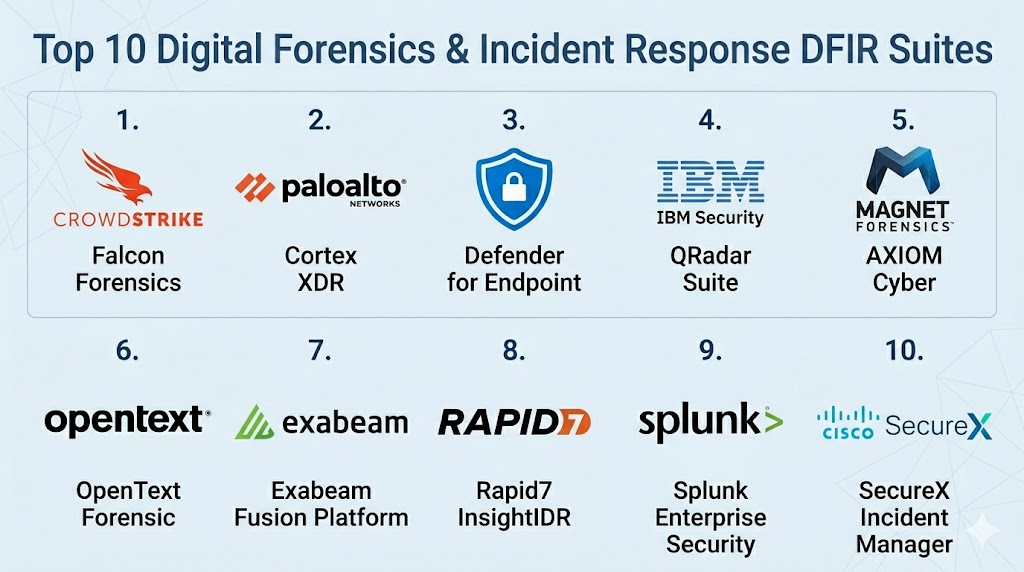
Top 10 Digital Forensics & Incident Response DFIR Suites
1- CrowdStrike Falcon Forensics
Short description: CrowdStrike Falcon Forensics is a cloud-native DFIR platform that combines endpoint detection, threat hunting, and forensic investigation into a unified system. It enables rapid identification of compromised systems and provides deep investigative context across endpoints. It is widely used in enterprise SOC environments for real-time incident response.
Key Features
- Endpoint detection and forensic analysis
- Real-time threat hunting capabilities
- Cloud-native incident response workflows
- Memory and process analysis tools
- Ransomware investigation support
- Attack timeline reconstruction
- Integration with Falcon X threat intelligence
Pros
- Extremely fast endpoint investigation capabilities
- Strong cloud-native architecture
- Excellent threat intelligence integration
- High scalability across enterprise environments
Cons
- Enterprise pricing model
- Requires platform ecosystem adoption
- Limited offline forensic capabilities
- Learning curve for advanced features
Platforms / Deployment
Cloud SaaS. Endpoint agents required.
Security & Compliance
Supports RBAC, audit logs, encryption, and enterprise compliance workflows. Not publicly stated for certifications.
Integrations & Ecosystem
- SIEM platforms
- SOAR tools
- Cloud infrastructure providers
- Threat intelligence feeds
- EDR ecosystems
Support & Community
Strong enterprise support and global SOC adoption.
2- Magnet AXIOM
Short description: Magnet AXIOM is a powerful digital forensics platform used to collect, analyze, and report evidence from computers, mobile devices, and cloud sources. It is widely used in law enforcement and enterprise investigations for deep evidence recovery.
Key Features
- Multi-source evidence collection
- Mobile, cloud, and computer forensics
- Timeline reconstruction of incidents
- Deleted file recovery and analysis
- Chat and social media artifact extraction
- Cloud data acquisition support
- Case management and reporting tools
Pros
- Excellent forensic depth across multiple data sources
- Strong evidence recovery capabilities
- Widely used in legal investigations
- Good reporting and case documentation
Cons
- Resource intensive during analysis
- Requires forensic expertise
- Enterprise licensing cost
- Longer processing time for large datasets
Platforms / Deployment
Windows. On-premise and hybrid deployment.
Security & Compliance
Supports evidence integrity, chain-of-custody tracking, and audit logging.
Integrations & Ecosystem
- Law enforcement systems
- Endpoint imaging tools
- Cloud storage providers
- Investigation workflows
Support & Community
Strong professional forensic community and enterprise support.
3- FTK Forensic Toolkit
Short description: FTK is a widely used digital forensics suite that provides powerful data indexing, analysis, and evidence visualization capabilities. It is commonly used in enterprise and legal investigations for deep forensic analysis.
Key Features
- High-speed forensic data indexing
- Email and file system analysis
- Memory and registry forensics
- Advanced search and filtering
- Data visualization tools
- Evidence management system
- Decryption and password recovery support
Pros
- Fast forensic indexing engine
- Strong data analysis capabilities
- Widely adopted in legal environments
- Reliable evidence processing
Cons
- High system resource usage
- Complex interface for beginners
- Enterprise licensing cost
- Requires training for advanced use
Platforms / Deployment
Windows. On-premise.
Security & Compliance
Supports forensic integrity, chain-of-custody, and audit logging.
Integrations & Ecosystem
- Law enforcement tools
- SIEM systems
- Endpoint forensic tools
- Data storage systems
Support & Community
Strong enterprise forensic support and training ecosystem.
4- Belkasoft X
Short description: Belkasoft X is a comprehensive DFIR platform used for mobile, cloud, and computer forensic investigations. It is known for its ability to extract and analyze data from multiple digital sources, including encrypted and locked devices.
Key Features
- Mobile and computer forensics
- Cloud data extraction and analysis
- Memory dump analysis
- Chat and messaging app recovery
- Timeline and geolocation analysis
- Evidence correlation engine
- Remote acquisition support
Pros
- Strong multi-device forensic coverage
- Excellent mobile investigation capabilities
- Good cloud forensic support
- Fast evidence extraction workflows
Cons
- Complex for beginners
- Enterprise pricing structure
- Requires forensic expertise
- Resource intensive
Platforms / Deployment
Windows. On-premise.
Security & Compliance
Supports forensic evidence integrity and secure data handling.
Integrations & Ecosystem
- Cloud platforms
- Mobile forensic tools
- Endpoint analysis systems
- Security platforms
Support & Community
Strong forensic investigator community and enterprise support.
5- Cellebrite UFED + Pathfinder
Short description: Cellebrite is a leading DFIR platform focused on mobile and digital device forensics. It is widely used in law enforcement and enterprise investigations for extracting and analyzing data from smartphones and digital devices.
Key Features
- Mobile device data extraction
- Encrypted data access support
- Cloud data acquisition
- Advanced mobile analytics
- Case management system
- Timeline reconstruction
- App data extraction
Pros
- Industry leader in mobile forensics
- Strong encryption handling capabilities
- Widely used in law enforcement
- Deep device-level access
Cons
- High cost of deployment
- Requires specialized training
- Limited general IT forensics depth
- Hardware dependency in some cases
Platforms / Deployment
Windows. On-premise hardware and software.
Security & Compliance
Supports evidence preservation, chain-of-custody, and secure forensic workflows.
Integrations & Ecosystem
- Law enforcement systems
- Mobile devices
- Cloud data sources
- Investigation platforms
Support & Community
Strong global forensic and law enforcement support network.
6- Volatility Framework
Short description: Volatility is an open-source memory forensics framework used for analyzing volatile memory dumps to detect malware, rootkits, and advanced threats. It is widely used in DFIR investigations for deep system-level analysis.
Key Features
- Memory dump analysis
- Malware detection in RAM
- Process and kernel inspection
- Plugin-based architecture
- Cross-platform memory forensics
- Timeline reconstruction from memory
- Rootkit detection capabilities
Pros
- Free and open-source
- Extremely powerful memory analysis
- Highly extensible framework
- Widely used in DFIR community
Cons
- Requires advanced expertise
- No built-in GUI by default
- Manual analysis heavy
- Limited enterprise support
Platforms / Deployment
Windows. Linux. macOS. Open-source.
Security & Compliance
Depends on implementation and usage context. Not enterprise-certified.
Integrations & Ecosystem
- DFIR toolchains
- Malware analysis platforms
- SIEM systems
- Incident response workflows
Support & Community
Strong open-source DFIR community.
7- Autopsy
Short description: Autopsy is an open-source digital forensics platform used for disk analysis, file recovery, and investigative workflows. It is widely used in education and law enforcement for forensic analysis.
Key Features
- Disk and file system analysis
- Deleted file recovery
- Keyword search and indexing
- Timeline analysis
- Browser history analysis
- Email and artifact extraction
- Case management system
Pros
- Free and open-source
- Easy to use interface
- Strong forensic capabilities
- Good for learning DFIR
Cons
- Limited enterprise features
- Slower with large datasets
- Less advanced automation
- Requires manual analysis
Platforms / Deployment
Windows. Linux. macOS.
Security & Compliance
Supports forensic integrity and case documentation.
Integrations & Ecosystem
- Sleuth Kit framework
- DFIR toolchains
- Storage systems
- Investigation workflows
Support & Community
Strong open-source forensic community.
8- SANS SIFT Workstation
Short description: SIFT Workstation is a DFIR toolkit developed by SANS Institute that provides a pre-configured environment with forensic and incident response tools for investigations.
Key Features
- Pre-configured forensic environment
- Memory and disk analysis tools
- Log analysis capabilities
- Timeline reconstruction tools
- Incident response utilities
- Open-source forensic toolkit bundle
- Integration with DFIR workflows
Pros
- Ready-to-use forensic environment
- Includes multiple DFIR tools
- Strong training ecosystem
- Free availability
Cons
- Requires technical knowledge
- Not a single unified platform
- Limited automation
- Resource intensive
Platforms / Deployment
Linux-based environment.
Security & Compliance
Depends on configuration and usage context.
Integrations & Ecosystem
- Volatility
- Autopsy
- Other DFIR tools
- SOC workflows
Support & Community
Strong cybersecurity training and DFIR community.
9- Palo Alto Cortex XDR Forensics
Short description: Cortex XDR provides integrated endpoint detection and DFIR capabilities with advanced analytics, threat hunting, and automated response features.
Key Features
- Endpoint detection and response
- Forensic investigation tools
- Threat hunting capabilities
- AI-based anomaly detection
- Incident response automation
- Malware analysis support
- Timeline reconstruction
Pros
- Strong AI-driven detection
- Unified XDR and DFIR platform
- Good enterprise scalability
- Deep threat intelligence integration
Cons
- Complex enterprise setup
- Requires platform adoption
- High cost
- Learning curve
Platforms / Deployment
Cloud SaaS.
Security & Compliance
Supports enterprise-grade security controls and compliance reporting.
Integrations & Ecosystem
- Palo Alto ecosystem
- SIEM platforms
- Cloud environments
- Security tools
Support & Community
Strong enterprise SOC support ecosystem.
10- IBM QRadar Incident Forensics
Short description: IBM QRadar Incident Forensics is an enterprise DFIR platform that integrates with SIEM to provide deep investigation capabilities, log correlation, and forensic analysis.
Key Features
- SIEM-integrated forensic analysis
- Log and event correlation
- Network traffic analysis
- Incident reconstruction
- Threat intelligence integration
- Timeline analysis tools
- Evidence collection and reporting
Pros
- Strong SIEM integration
- Good enterprise forensic capabilities
- Reliable analytics engine
- Scalable architecture
Cons
- Complex deployment
- High enterprise cost
- Requires skilled analysts
- Less user-friendly interface
Platforms / Deployment
Cloud. On-premise. Hybrid.
Security & Compliance
Supports enterprise audit logging, encryption, and compliance frameworks.
Integrations & Ecosystem
- IBM QRadar SIEM
- SOC platforms
- Network monitoring tools
- Threat intelligence systems
Support & Community
Strong IBM enterprise support ecosystem.
Comparison Table
| Tool Name | Best For | Platforms Supported | Deployment | Standout Feature | Public Rating |
|---|---|---|---|---|---|
| CrowdStrike Falcon | Endpoint DFIR | Multi-platform | Cloud SaaS | Real-time endpoint forensics | N/A |
| Magnet AXIOM | Deep forensic analysis | Windows | On-prem/hybrid | Multi-source evidence recovery | N/A |
| FTK | Enterprise forensics | Windows | On-prem | High-speed indexing | N/A |
| Belkasoft X | Multi-device investigations | Windows | On-prem | Mobile + cloud forensics | N/A |
| Cellebrite UFED | Mobile forensics | Windows | Hardware + software | Device-level extraction | N/A |
| Volatility | Memory forensics | Multi-platform | Open-source | RAM malware analysis | N/A |
| Autopsy | Disk forensics | Multi-platform | On-prem | Open-source forensic suite | N/A |
| SIFT Workstation | DFIR toolkit | Linux | On-prem | Prebuilt forensic environment | N/A |
| Cortex XDR | AI DFIR platform | Cloud | SaaS | AI-driven investigation | N/A |
| IBM QRadar | SIEM-based DFIR | Hybrid | Hybrid | Log correlation + forensics | N/A |
Evaluation and Scoring of DFIR Suites
| Tool Name | Core 25% | Ease 15% | Integrations 15% | Security 10% | Performance 10% | Support 10% | Value 15% | Weighted Total |
|---|---|---|---|---|---|---|---|---|
| CrowdStrike Falcon | 10 | 9 | 10 | 10 | 10 | 9 | 8 | 9.30 |
| Magnet AXIOM | 10 | 8 | 9 | 10 | 9 | 9 | 8 | 9.05 |
| FTK | 9 | 7 | 8 | 9 | 9 | 8 | 8 | 8.45 |
| Belkasoft X | 9 | 8 | 8 | 9 | 9 | 8 | 8 | 8.55 |
| Cellebrite | 10 | 7 | 9 | 10 | 9 | 9 | 7 | 8.80 |
| Volatility | 9 | 6 | 7 | 9 | 9 | 7 | 10 | 8.05 |
| Autopsy | 8 | 9 | 7 | 8 | 8 | 8 | 10 | 8.20 |
| SIFT | 8 | 8 | 7 | 8 | 8 | 8 | 9 | 8.05 |
| Cortex XDR | 10 | 8 | 9 | 10 | 10 | 9 | 8 | 9.05 |
| IBM QRadar | 9 | 7 | 10 | 10 | 9 | 10 | 7 | 8.75 |
These scores reflect forensic depth, incident response capabilities, automation, scalability, memory analysis strength, and enterprise readiness. CrowdStrike, Cortex XDR, and Magnet AXIOM lead due to strong integration of DFIR with endpoint detection and AI-driven investigation capabilities, while Volatility and Autopsy remain essential open-source tools.
Which DFIR Suite Is Right for You
Solo / Freelancer
Freelancers and learners should use open-source tools like Autopsy, Volatility, and SIFT Workstation for hands-on DFIR experience.
SMB
SMBs benefit from lightweight DFIR tools integrated with security platforms. CrowdStrike, Cortex XDR, and Autopsy-based workflows are suitable options.
Mid-Market
Mid-market organizations need scalable DFIR with automation. Magnet AXIOM, Belkasoft X, and CrowdStrike Falcon are strong choices.
Enterprise
Enterprises require full DFIR + SIEM + EDR integration. IBM QRadar, Cortex XDR, CrowdStrike, FTK, and Cellebrite are leading solutions.
Budget vs Premium
Open-source tools like Volatility and Autopsy offer strong forensic capabilities at no cost, while enterprise suites provide automation, scalability, and legal-grade reporting.
Feature Depth vs Ease of Use
CrowdStrike and Cortex XDR provide automation and AI-driven analysis. Magnet AXIOM and FTK offer deep forensic control but require expertise.
Integrations & Scalability
IBM QRadar and CrowdStrike lead in integration ecosystems. Belkasoft and Magnet AXIOM scale well for complex investigations.
Security & Compliance Needs
Enterprise-grade compliance needs are best met by CrowdStrike, IBM QRadar, Cortex XDR, and Cellebrite due to audit-ready reporting and structured forensic workflows.
Frequently Asked Questions FAQs
1. What is DFIR?
DFIR stands for Digital Forensics and Incident Response. It involves investigating cyber incidents and collecting digital evidence. It helps organizations understand how attacks occurred. It also supports recovery and prevention.
2. What is digital forensics?
Digital forensics is the process of collecting and analyzing digital evidence from systems. It includes files, memory, logs, and network data. It is used in cybersecurity and legal investigations. It helps identify attack sources.
3. What is incident response?
Incident response is the process of detecting, managing, and resolving cybersecurity incidents. It involves containment and recovery steps. It reduces damage from attacks. It is a key part of cybersecurity operations.
4. What tools are used in DFIR?
DFIR tools include endpoint agents, forensic analysis tools, memory analyzers, and SIEM platforms. Examples include CrowdStrike, Magnet AXIOM, Volatility, and Autopsy. These tools help investigate incidents. They support evidence collection.
5. What is memory forensics?
Memory forensics analyzes RAM data from a system. It helps detect malware and hidden processes. It is used for advanced threat detection. Tools like Volatility are commonly used.
6. Is DFIR only for enterprises?
No, DFIR is used by enterprises, governments, and also individual researchers. However, enterprise tools are more advanced. Open-source tools are available for learning. DFIR applies to all cybersecurity levels.
7. What is chain of custody in DFIR?
Chain of custody refers to tracking digital evidence from collection to analysis. It ensures evidence integrity and legal validity. It is essential in forensic investigations. It prevents tampering.
8. Can DFIR tools detect ransomware?
Yes, DFIR tools are widely used to analyze ransomware attacks. They identify how the attack happened and what data was affected. They help in recovery planning. They also support threat attribution.
9. What is the difference between EDR and DFIR?
EDR focuses on real-time detection and prevention of threats. DFIR focuses on investigation after or during an incident. EDR is proactive, DFIR is investigative. Many platforms combine both.
10. What skills are needed for DFIR?
DFIR requires skills in networking, operating systems, malware analysis, and log interpretation. Knowledge of tools like Volatility and SIEM systems is important. Analytical thinking is critical. It is a specialized cybersecurity field.
Conclusion
Digital Forensics and Incident Response DFIR suites are essential for understanding, investigating, and responding to cyberattacks in modern enterprise environments. They combine forensic analysis, incident response automation, and threat intelligence to help organizations minimize damage and recover quickly. Tools like CrowdStrike Falcon, Cortex XDR, and IBM QRadar lead in enterprise integration and AI-driven investigation, while Magnet AXIOM and FTK provide deep forensic capabilities for evidence analysis. Open-source tools like Volatility and Autopsy remain critical for learning and technical investigations. The best DFIR strategy combines endpoint detection, forensic analysis, and incident response automation to ensure complete visibility and rapid recovery across all attack scenarios.

This article clearly explains DFIR suites and how they help security teams investigate incidents, analyze threats, and respond to cyber attacks more efficiently.
Great comparison article explaining how DFIR suites help security teams streamline digital investigations, incident response, and forensic analysis more efficiently.
A critical gap often missed is how DFIR suites handle live evidence acquisition and cross-platform artifact correlation without disrupting system integrity during active incidents.