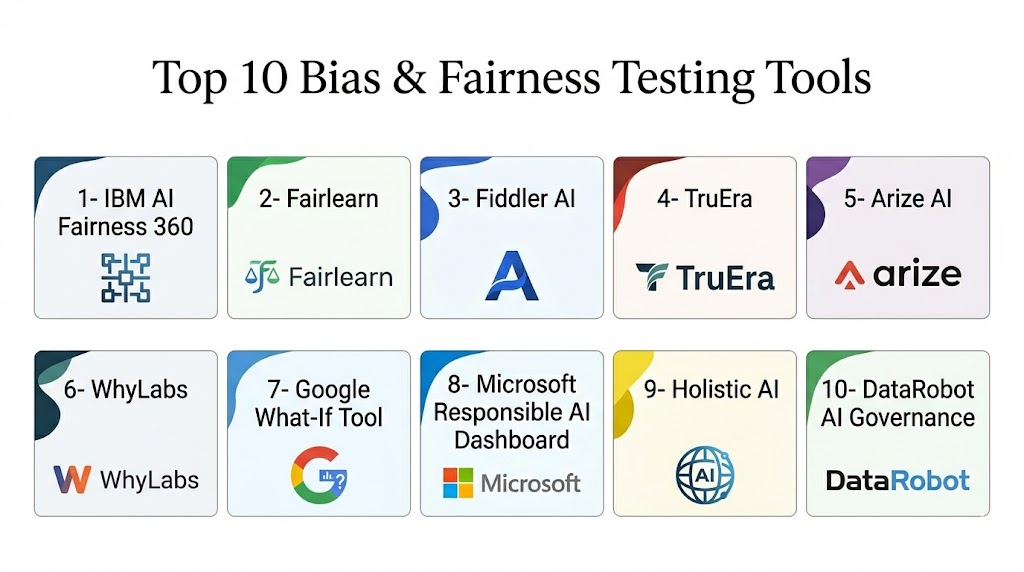
Introduction
Bias & Fairness Testing Tools help AI teams evaluate whether machine learning models produce unfair, inconsistent, or discriminatory outcomes across different user groups, datasets, or decision scenarios. These tools are used to detect hidden bias in model predictions, measure fairness metrics, compare outcomes across segments, and improve transparency before models are deployed into real-world systems.
They matter because AI is now used in hiring, lending, healthcare, insurance, education, fraud detection, customer support, public services, and automated decision-making. If an AI model produces unfair outcomes, it can damage trust, create compliance risk, and harm users. Bias and fairness testing platforms help organizations identify these issues earlier and build safer AI systems.
Common use cases include:
- Testing credit risk models for unfair outcomes
- Auditing hiring and HR AI systems
- Checking healthcare AI models for unequal performance
- Evaluating LLM outputs for harmful bias
- Monitoring deployed models for fairness drift
Key buyer evaluation criteria include:
- Fairness metric coverage
- Bias detection depth
- Explainability features
- Model monitoring capability
- Dataset analysis support
- Integration with MLOps pipelines
- Reporting and audit readiness
- Ease of use for technical and non-technical teams
- Security and access controls
- Deployment flexibility
Best for: AI governance teams, data scientists, MLOps teams, compliance leaders, risk teams, enterprise AI teams, fintech companies, healthcare organizations, HR technology vendors, and businesses deploying high-impact AI systems. Not ideal for: teams with no custom AI models, small projects using only basic automation, or organizations that do not need fairness testing, audit reporting, or AI governance workflows.
Key Trends in Bias & Fairness Testing Tools
- Fairness testing is becoming part of standard AI model validation instead of a one-time review.
- Generative AI is increasing demand for bias testing in text, prompts, and model responses.
- Enterprises are combining fairness testing with explainability, monitoring, and governance workflows.
- Model drift and fairness drift are being monitored continuously after deployment.
- Open-source toolkits remain popular for research, experimentation, and custom workflows.
- Regulated industries are demanding clearer audit trails and model accountability reports.
- Human review is being combined with automated fairness metrics for stronger validation.
- MLOps integrations are becoming important so fairness checks can run inside CI/CD pipelines.
- Organizations are focusing more on dataset bias before model training begins.
- Cross-functional review involving legal, compliance, data science, and business teams is becoming more common.
How We Selected These Tools
The tools in this list were selected using a practical evaluation approach focused on real-world AI fairness and governance needs.
Selection criteria included:
- Market visibility and adoption among AI teams
- Strength of fairness metrics and bias detection capabilities
- Support for explainability and model transparency
- Ability to work with structured, unstructured, and generative AI use cases
- Integration with machine learning and MLOps workflows
- Suitability for enterprise governance and audit needs
- Deployment flexibility for cloud, self-hosted, and open-source environments
- Documentation quality and community strength
- Practical value for different team sizes
- Usefulness across regulated and non-regulated industries
The final selection includes a balanced mix of enterprise platforms, open-source frameworks, and developer-friendly fairness testing tools.
Top 10 Bias & Fairness Testing Tools
1- IBM AI Fairness 360
Short Description:
IBM AI Fairness 360 is an open-source toolkit designed to help data scientists detect and mitigate bias in machine learning models. It provides fairness metrics, bias mitigation algorithms, and practical utilities for evaluating model behavior across different groups. It is especially useful for technical teams that want transparent fairness testing inside custom ML workflows.
Key Features
- Bias detection metrics
- Fairness mitigation algorithms
- Pre-processing, in-processing, and post-processing bias techniques
- Support for structured datasets
- Python-based workflow
- Open-source framework
- Strong research-oriented foundation
Pros
- Strong fairness metric coverage
- Free and open-source
- Useful for technical ML teams
- Good for experimentation and research
Cons
- Requires data science expertise
- Limited business-user interface
- Not a full enterprise governance platform
- Requires custom integration work
Platforms / Deployment
- Python
- Self-hosted
- Local / cloud environment depending on setup
Security & Compliance
- Self-managed security
- Not publicly stated for certifications
Integrations & Ecosystem
IBM AI Fairness 360 fits well into Python-based machine learning workflows. It is best used by data scientists who can integrate fairness testing into notebooks, model training pipelines, and validation workflows.
- Python ML workflows
- Jupyter notebooks
- Scikit-learn pipelines
- Custom model validation workflows
- Data science experimentation environments
Support & Community
Community-driven open-source support with strong documentation and research usage. Enterprise support depends on broader IBM ecosystem engagement.
2- Microsoft Fairlearn
Short Description:
Microsoft Fairlearn is an open-source fairness assessment and mitigation toolkit for machine learning models. It helps teams evaluate model performance across different groups and reduce unfair outcomes using fairness-aware techniques. It is widely useful for Python-based data science teams and organizations using Microsoft ML ecosystems.
Key Features
- Fairness assessment dashboards
- Group fairness metrics
- Bias mitigation algorithms
- Model comparison tools
- Python package support
- Integration with ML workflows
- Visualization for fairness trade-offs
Pros
- Strong fairness analysis features
- Open-source and developer-friendly
- Good documentation and examples
- Fits well with Python ML projects
Cons
- Requires ML expertise
- Limited enterprise workflow management
- Not a complete AI governance platform
- Advanced usage needs technical configuration
Platforms / Deployment
- Python
- Self-hosted
- Cloud depending on implementation
Security & Compliance
- Self-managed security
- Not publicly stated for certifications
Integrations & Ecosystem
Fairlearn works well with Python-based model development and can be used inside broader ML lifecycle workflows.
- Python
- Scikit-learn
- Jupyter
- Azure ML workflows
- Custom ML pipelines
Support & Community
Strong open-source community and documentation. Support is stronger for teams already using Microsoft AI and cloud ecosystems.
3- Aequitas
Short Description:
Aequitas is an open-source bias and fairness audit toolkit designed to evaluate decision-making systems. It helps teams assess whether model outcomes create unfair disparities across groups. It is especially useful for public sector, research, policy, and compliance-focused fairness auditing.
Key Features
- Bias audit reports
- Fairness disparity analysis
- Group-level outcome comparison
- Model accountability workflows
- Open-source framework
- Data-driven fairness assessment
- Visual fairness reporting
Pros
- Strong fairness auditing focus
- Useful for policy and compliance reviews
- Open-source flexibility
- Good for structured decision systems
Cons
- Requires technical implementation
- Limited enterprise platform features
- Smaller ecosystem than larger toolkits
- Less focused on modern LLM workflows
Platforms / Deployment
- Python
- Self-hosted
- Local / cloud environment depending on setup
Security & Compliance
- Self-managed security
- Not publicly stated for certifications
Integrations & Ecosystem
Aequitas can be integrated into data science workflows where fairness auditing is required for predictive models or decision systems.
- Python
- Jupyter notebooks
- Data analytics workflows
- Model audit pipelines
- Research environments
Support & Community
Open-source and research-driven community support. Best suited for teams comfortable managing technical workflows internally.
4- Google What-If Tool
Short Description:
Google What-If Tool helps teams inspect machine learning model behavior visually and interactively. It supports model comparison, counterfactual analysis, performance slicing, and fairness exploration. It is useful for teams that want to understand how models behave across different inputs and user groups.
Key Features
- Interactive model analysis
- Counterfactual testing
- Performance slicing
- Fairness metric exploration
- Model comparison
- Visual debugging
- TensorFlow ecosystem support
Pros
- Strong visual exploration
- Useful for model debugging
- Good for fairness experimentation
- Helpful for technical and semi-technical users
Cons
- Best suited to specific ML workflows
- Limited enterprise governance features
- Requires setup and model access
- Not a standalone compliance platform
Platforms / Deployment
- Web-based notebook environment
- Self-hosted / local depending on setup
Security & Compliance
- Self-managed security
- Not publicly stated for certifications
Integrations & Ecosystem
The tool works well with model development environments and is especially useful for interactive analysis during experimentation.
- TensorFlow workflows
- Jupyter notebooks
- Model debugging pipelines
- Data science environments
- Custom ML workflows
Support & Community
Community and documentation-based support. Best suited for technical teams familiar with model development environments.
5- Fiddler AI
Short Description:
Fiddler AI is an enterprise AI observability platform that includes model monitoring, explainability, bias detection, and fairness analysis capabilities. It helps organizations monitor model behavior in production and identify fairness-related risks over time. It is best suited for enterprises with deployed AI systems and strong governance needs.
Key Features
- Model monitoring
- Bias and fairness analysis
- Explainability dashboards
- Drift detection
- Performance monitoring
- LLM monitoring
- Alerts and root cause analysis
Pros
- Strong production monitoring
- Good enterprise governance support
- Useful explainability features
- Suitable for mature AI operations
Cons
- Enterprise pricing model
- Requires ML operations maturity
- Advanced configuration may take time
- Less suitable for small teams
Platforms / Deployment
- Web
- Cloud
- Hybrid
Security & Compliance
- SSO/SAML
- RBAC
- Encryption
- Audit logs
- Enterprise governance controls
Integrations & Ecosystem
Fiddler AI integrates with modern AI and data infrastructure to monitor production models and support operational fairness workflows.
- AWS
- Azure
- Databricks
- Snowflake
- APIs
- ML monitoring pipelines
Support & Community
Enterprise onboarding, customer success support, and professional implementation resources are typically available.
6- Arthur AI
Short Description:
Arthur AI provides model monitoring, explainability, and responsible AI capabilities for enterprise machine learning systems. It helps teams track model performance, detect drift, evaluate bias, and understand AI behavior in production. It is suitable for organizations that need fairness testing beyond the development stage.
Key Features
- Model performance monitoring
- Bias detection workflows
- Explainability analysis
- Drift monitoring
- Production alerts
- LLM observability
- Governance reporting
Pros
- Strong production monitoring
- Good explainability capabilities
- Helpful for enterprise AI governance
- Supports ongoing model risk management
Cons
- Premium enterprise positioning
- Requires operational setup
- Smaller community ecosystem
- May be more than small teams need
Platforms / Deployment
- Web
- Cloud
- Hybrid
Security & Compliance
- SSO/SAML
- RBAC
- Encryption
- Audit logging
- Enterprise governance controls
Integrations & Ecosystem
Arthur AI connects with production AI systems and model monitoring workflows to support ongoing fairness and risk evaluation.
- AWS
- Azure
- Databricks
- APIs
- ML pipelines
- Observability workflows
Support & Community
Enterprise-focused support with onboarding and implementation guidance for AI operations teams.
7- TruEra
Short Description:
TruEra is an AI quality and explainability platform that helps organizations evaluate model performance, fairness, drift, and reliability. It is designed for enterprise AI teams that need strong model transparency and operational quality management. TruEra is useful for regulated environments where explainability and bias testing matter.
Key Features
- Model explainability
- Bias analysis
- Drift detection
- AI quality monitoring
- Root cause analysis
- Model validation workflows
- Governance reporting
Pros
- Strong explainability focus
- Useful for regulated AI workflows
- Good model quality analysis
- Supports production and pre-production testing
Cons
- Enterprise-oriented pricing
- Requires mature ML workflows
- Advanced setup complexity
- Not ideal for simple AI projects
Platforms / Deployment
- Web
- Cloud
- Hybrid
Security & Compliance
- SSO/SAML
- RBAC
- Encryption
- Audit logging
- Enterprise compliance controls
Integrations & Ecosystem
TruEra integrates with enterprise data and AI systems to support model quality, fairness, and explainability workflows.
- Databricks
- Snowflake
- AWS
- Azure
- APIs
- ML lifecycle systems
Support & Community
Enterprise support and onboarding are available for teams building governed AI validation workflows.
8- Credo AI
Short Description:
Credo AI is an AI governance platform focused on responsible AI oversight, policy management, risk documentation, and compliance workflows. While it is not only a technical bias testing library, it helps organizations manage fairness risks through governance processes, reviews, documentation, and accountability frameworks.
Key Features
- AI governance workflows
- Risk and compliance management
- Policy enforcement
- AI inventory tracking
- Audit documentation
- Responsible AI reporting
- Cross-functional review workflows
Pros
- Strong governance capabilities
- Useful for compliance teams
- Good policy management structure
- Helps operationalize responsible AI programs
Cons
- Less focused on technical model debugging
- Enterprise adoption requires process maturity
- Premium pricing model
- Needs collaboration across teams
Platforms / Deployment
- Web
- Cloud
Security & Compliance
- SSO/SAML
- RBAC
- Encryption
- Audit logs
- Enterprise governance controls
Integrations & Ecosystem
Credo AI connects governance workflows with AI lifecycle processes, compliance documentation, and organizational policy management.
- APIs
- AI governance workflows
- Compliance systems
- ML lifecycle processes
- Enterprise reporting workflows
Support & Community
Enterprise onboarding and governance-focused support are typically available.
9- Holistic AI
Short Description:
Holistic AI provides AI governance, risk management, and assurance tooling for organizations building and deploying AI systems. It helps teams evaluate AI risks, including bias and fairness concerns, while supporting documentation and governance workflows. It is best suited for organizations that need a broader responsible AI management layer.
Key Features
- AI risk management
- Bias and fairness assessment support
- Governance workflows
- Audit documentation
- Compliance readiness
- AI inventory visibility
- Assurance reporting
Pros
- Broad responsible AI governance coverage
- Useful for risk and compliance teams
- Supports AI assurance workflows
- Good fit for enterprise oversight
Cons
- Less developer-first than open-source toolkits
- Requires governance process alignment
- Pricing may not suit small teams
- Technical testing depth may vary by use case
Platforms / Deployment
- Web
- Cloud
Security & Compliance
- RBAC
- Encryption
- Audit logging
- Not publicly stated for some certifications
Integrations & Ecosystem
Holistic AI supports responsible AI program management and connects with broader AI governance processes.
- APIs
- Governance workflows
- Compliance reporting
- AI risk management systems
- Enterprise review processes
Support & Community
Enterprise support and advisory-oriented assistance are generally available for AI governance programs.
10- Themis ML
Short Description:
Themis ML is an open-source fairness testing library focused on detecting discrimination and measuring fairness in machine learning models. It is designed for technical users who need programmatic fairness testing in model development workflows. It is especially useful for research and custom ML pipelines.
Key Features
- Fairness testing utilities
- Discrimination discovery
- Bias measurement
- Python-based workflows
- Open-source framework
- Model evaluation support
- Custom testing flexibility
Pros
- Open-source and flexible
- Useful for research teams
- Good for custom fairness experiments
- Lightweight implementation
Cons
- Requires technical expertise
- Smaller ecosystem
- Limited enterprise governance features
- Not designed as a full platform
Platforms / Deployment
- Python
- Self-hosted
- Local / cloud environment depending on setup
Security & Compliance
- Self-managed security
- Not publicly stated for certifications
Integrations & Ecosystem
Themis ML works best inside Python-based model development workflows where teams want custom fairness tests.
- Python
- Jupyter notebooks
- Custom ML pipelines
- Research workflows
- Data science environments
Support & Community
Open-source support with limited enterprise-style assistance. Best for technical teams comfortable with self-managed tooling.
Comparison Table
| Tool Name | Best For | Platform Supported | Deployment | Standout Feature | Public Rating |
|---|---|---|---|---|---|
| IBM AI Fairness 360 | Technical fairness testing | Python | Self-hosted | Bias mitigation algorithms | N/A |
| Microsoft Fairlearn | Python fairness workflows | Python | Self-hosted / Cloud | Fairness dashboards and mitigation | N/A |
| Aequitas | Bias audit reporting | Python | Self-hosted | Fairness audit workflows | N/A |
| Google What-If Tool | Interactive model analysis | Web / Notebook | Self-hosted | Counterfactual fairness exploration | N/A |
| Fiddler AI | Enterprise model monitoring | Web | Cloud / Hybrid | Production fairness monitoring | N/A |
| Arthur AI | AI observability and fairness | Web | Cloud / Hybrid | Drift and bias monitoring | N/A |
| TruEra | Explainability and AI quality | Web | Cloud / Hybrid | Model quality and bias analysis | N/A |
| Credo AI | AI governance teams | Web | Cloud | Policy-based AI governance | N/A |
| Holistic AI | AI risk assurance | Web | Cloud | Responsible AI assurance workflows | N/A |
| Themis ML | Custom fairness testing | Python | Self-hosted | Discrimination discovery | N/A |
Evaluation & Scoring of Bias & Fairness Testing Tools
| Tool Name | Core 25% | Ease 15% | Integrations 15% | Security 10% | Performance 10% | Support 10% | Value 15% | Weighted Total |
|---|---|---|---|---|---|---|---|---|
| IBM AI Fairness 360 | 9.0 | 7.0 | 8.0 | 6.5 | 8.0 | 7.5 | 9.5 | 8.1 |
| Microsoft Fairlearn | 8.8 | 7.5 | 8.5 | 6.5 | 8.0 | 8.0 | 9.5 | 8.2 |
| Aequitas | 8.0 | 7.0 | 7.5 | 6.5 | 7.5 | 7.0 | 9.0 | 7.6 |
| Google What-If Tool | 8.0 | 8.0 | 7.5 | 6.5 | 7.5 | 7.5 | 9.0 | 7.8 |
| Fiddler AI | 9.0 | 8.0 | 8.8 | 8.5 | 9.0 | 8.5 | 7.5 | 8.5 |
| Arthur AI | 8.5 | 8.0 | 8.5 | 8.5 | 8.5 | 8.0 | 7.5 | 8.3 |
| TruEra | 8.5 | 7.5 | 8.5 | 8.5 | 8.5 | 8.0 | 7.5 | 8.2 |
| Credo AI | 8.2 | 8.0 | 8.0 | 8.5 | 8.0 | 8.0 | 7.5 | 8.1 |
| Holistic AI | 8.0 | 8.0 | 7.8 | 8.0 | 8.0 | 8.0 | 7.5 | 7.9 |
| Themis ML | 7.5 | 6.8 | 7.0 | 6.0 | 7.0 | 6.5 | 9.0 | 7.2 |
These scores are comparative and designed to help buyers evaluate tool fit across technical fairness testing, governance, monitoring, integrations, and operational value. Open-source tools often score strongly on value and flexibility but require more technical implementation. Enterprise platforms usually score higher on governance, monitoring, support, and security controls. The best choice depends on whether your team needs a developer toolkit, a production monitoring platform, or an AI governance system.
Which Bias & Fairness Testing Tool Is Right for You?
Solo / Freelancer
Solo data scientists, researchers, and independent ML engineers should consider IBM AI Fairness 360, Fairlearn, Aequitas, or Themis ML. These tools are flexible, open-source, and useful for learning fairness concepts or adding bias tests into custom ML experiments. They require technical setup, but they provide strong control over fairness metrics and testing logic.
SMB
Small and mid-sized businesses need tools that are practical, cost-conscious, and not too complex to operate. Fairlearn and IBM AI Fairness 360 can be strong choices for technical teams, while Google What-If Tool can help with visual model debugging. If the SMB already has production AI models, WhyLabs, Fiddler AI, or Arthur AI-style monitoring may be worth evaluating depending on budget and operational maturity.
Mid-Market
Mid-market companies usually need a combination of fairness testing, explainability, governance, and production monitoring. Fiddler AI, Arthur AI, TruEra, and Credo AI can support more mature workflows where models are already deployed and need continuous oversight. These tools are useful when AI decisions affect customers, employees, or business risk.
Enterprise
Enterprises should prioritize platforms that support governance, audit trails, production monitoring, role-based access, explainability, and cross-team collaboration. Fiddler AI, Arthur AI, TruEra, Credo AI, and Holistic AI are strong candidates for enterprise programs. Technical teams may still use Fairlearn or IBM AI Fairness 360 alongside enterprise governance platforms for deeper model-level analysis.
Budget vs Premium
Budget-conscious teams should start with open-source tools such as Fairlearn, IBM AI Fairness 360, Aequitas, and Themis ML. Premium enterprise tools provide stronger workflow automation, governance reporting, alerts, integrations, and support. The right choice depends on whether you need experimentation, compliance reporting, or production risk monitoring.
Feature Depth vs Ease of Use
Developer-focused tools provide deep control but require technical expertise. Enterprise platforms offer cleaner dashboards, workflow management, and better collaboration, but may be more expensive and require onboarding. Teams should choose based on who will use the tool: data scientists, compliance teams, risk teams, or business reviewers.
Integrations & Scalability
Organizations with mature AI pipelines should prioritize tools that integrate with model registries, data warehouses, CI/CD workflows, cloud storage, and monitoring platforms. Fairness testing should not remain isolated in notebooks. The strongest long-term setup connects fairness checks directly into model validation and production monitoring workflows.
Security & Compliance Needs
Regulated industries should prioritize access controls, audit logs, encryption, governance documentation, and clear reporting workflows. Open-source tools can be secure when properly managed, but responsibility falls on the internal team. Enterprise platforms usually provide stronger built-in controls for teams with formal compliance obligations.
Frequently Asked Questions
1. What are Bias & Fairness Testing Tools?
Bias & Fairness Testing Tools help teams evaluate whether AI models produce unfair or unequal outcomes across different groups. They measure fairness metrics, compare model behavior by segment, and identify areas where a model may need improvement. These tools are important for trustworthy AI development.
2. Why is bias testing important in AI?
Bias testing is important because AI models can learn unfair patterns from historical or incomplete data. If these issues are not detected early, models may produce harmful outcomes in hiring, lending, healthcare, insurance, and public services. Fairness testing helps reduce risk and improve trust.
3. Are open-source fairness tools enough for business use?
Open-source tools can be enough for technical teams that understand ML workflows and can manage infrastructure. However, enterprises may need additional governance, dashboards, audit logs, policy workflows, and stakeholder reporting. Many organizations use open-source tools alongside enterprise platforms.
4. What is the difference between bias testing and explainability?
Bias testing checks whether model outcomes are unfair across groups or scenarios. Explainability helps users understand why a model made a certain prediction. Both are important because fairness issues are easier to fix when teams understand the factors driving model behavior.
5. Can these tools test generative AI bias?
Some tools can support generative AI bias testing, especially platforms with LLM monitoring, prompt evaluation, or responsible AI governance workflows. Traditional fairness libraries may need customization for text generation use cases. LLM bias testing often requires both automated metrics and human review.
6. How often should fairness testing be performed?
Fairness testing should happen before deployment, after major model updates, and continuously for high-impact production systems. Model behavior can change when data changes, user behavior shifts, or business rules evolve. Regular testing helps detect fairness drift before it becomes a serious issue.
7. What are common mistakes in fairness testing?
Common mistakes include testing only once, using incomplete demographic or segment data, relying on a single fairness metric, and ignoring business context. Another mistake is treating fairness as only a technical task instead of involving legal, compliance, product, and domain experts.
8. Do these tools guarantee unbiased AI?
No tool can guarantee perfectly unbiased AI. These tools help identify, measure, and reduce fairness risks, but final outcomes depend on data quality, model design, governance processes, and human oversight. Bias testing should be part of a broader responsible AI program.
9. How do Bias & Fairness Testing Tools integrate with MLOps?
Many tools integrate through Python libraries, APIs, dashboards, model monitoring systems, and CI/CD workflows. The goal is to include fairness checks during training, validation, deployment, and production monitoring. Mature teams automate fairness testing as part of their ML lifecycle.
10. What should buyers look for first?
Buyers should first define their AI risk level, data types, regulatory needs, team skills, and deployment environment. Then they should compare tools based on fairness metrics, explainability, integrations, security, reporting, and ease of adoption. A pilot project is the best way to validate fit.
Conclusion
Bias & Fairness Testing Tools are now essential for organizations that want to build AI systems with better transparency, accountability, and trust. These tools help teams identify unfair outcomes, understand model behavior, reduce governance risk, and improve model quality before and after deployment. Open-source options like IBM AI Fairness 360, Fairlearn, Aequitas, and Themis ML are excellent for technical teams that need flexibility and cost efficiency, while enterprise platforms like Fiddler AI, Arthur AI, TruEra, Credo AI, and Holistic AI provide stronger monitoring, auditability, and governance workflows. The best tool depends on your organization’s AI maturity, compliance needs, technical capacity, and use case sensitivity. Start by defining your fairness goals, shortlist two or three suitable tools, run a pilot with real datasets, validate integrations and reporting needs, and then scale fairness testing as part of your broader responsible AI program.

This article presents bias and fairness testing tools in a very simple and well-structured way. The clear comparisons and practical explanations made the topic much easier to understand.
This article clearly explains bias and fairness testing tools and how they help organizations build more transparent, balanced, and reliable machine learning systems.
Insightful comparison article highlighting bias and fairness testing tools that help organizations evaluate AI systems for equity, transparency, and responsible decision-making.