Introduction
Enterprise Service Bus (ESB) platforms are integration systems that help organizations connect applications, services, databases, and legacy systems through a centralized messaging and routing layer. In plain English, an ESB acts like a traffic controller for enterprise software, helping data move between systems without requiring every application to connect directly to every other application. ESB platforms usually handle message transformation, protocol mediation, routing, orchestration, and reliability features that are important in large IT environments.
ESB still matters for organizations with complex hybrid environments, especially where older enterprise systems, middleware, and regulated workflows are deeply embedded. While cloud-native integration, APIs, event streaming, and iPaaS have reduced ESB’s dominance in some greenfield projects, many enterprises still rely on ESB-style platforms for internal integration, service mediation, and controlled modernization. Common use cases include ERP-to-CRM integration, banking middleware, healthcare system interoperability, internal service orchestration, supply chain messaging, and B2B process coordination. Buyers should evaluate protocol support, deployment flexibility, governance, transformation tools, security controls, observability, scalability, connector breadth, developer experience, and long-term modernization fit.
Best for: large enterprises, integration teams, regulated industries, system integrators, and organizations with hybrid or legacy-heavy architectures.
Not ideal for: very small teams, SaaS-first startups, or businesses that mainly need lightweight app automation, simple API sync, or event-driven cloud integrations where iPaaS or workflow tools are a better fit.
Key Trends in Enterprise Service Bus (ESB) Platforms and Beyond
- Hybrid integration is the default. Modern ESB buyers increasingly need cloud, on-prem, container, and multi-environment deployment options rather than a single fixed runtime model.
- Classic ESB is blending with broader integration platforms. Vendors now position ESB capabilities alongside API management, application integration, event flows, and automation rather than as a standalone bus.
- AI-assisted integration design is becoming a practical feature. Some platforms now emphasize AI-powered mapping, low-code flow design, or assisted build experiences for integration developers.
- Containerized and Kubernetes-friendly runtimes matter more. Buyers increasingly prefer integration products that can run in modern DevOps environments instead of only traditional middleware stacks.
- Open-source and open standards still influence buying decisions. Apache Camel and WSO2 remain relevant where flexibility, extensibility, and portability matter.
- Security and governance remain core selection factors. ESB platforms are still often used in mission-critical environments where RBAC, transport security, auditability, and controlled deployment pipelines matter.
- Modernization pressure is real. Some older ESB and process orchestration products remain in use, but many buyers are also evaluating migration paths toward broader hybrid integration platforms.
- Low-code is growing, but expert integration skills still matter. Visual designers help, yet enterprise integrations still require architecture discipline, data modeling, testing, and governance.
How We Selected These Tools (Methodology)
- We prioritized vendors and projects with strong enterprise integration credibility.
- We looked for platforms with recognizable ESB, mediation, routing, and transformation capabilities.
- We favored tools that still show practical modern deployment relevance, not only historical importance.
- We considered whether the product supports hybrid architecture, including on-prem and cloud use.
- We reviewed connector breadth, protocol support, orchestration depth, and governance features.
- We factored in ecosystem strength, including documentation, community, and vendor support.
- We balanced commercial enterprise products with open-source integration frameworks where relevant.
- We excluded tools that are mainly simple automation products unless they have meaningful ESB-style applicability.
- We treated public ratings cautiously and used N/A where confidence was low.
Top Enterprise Service Bus (ESB) Platforms
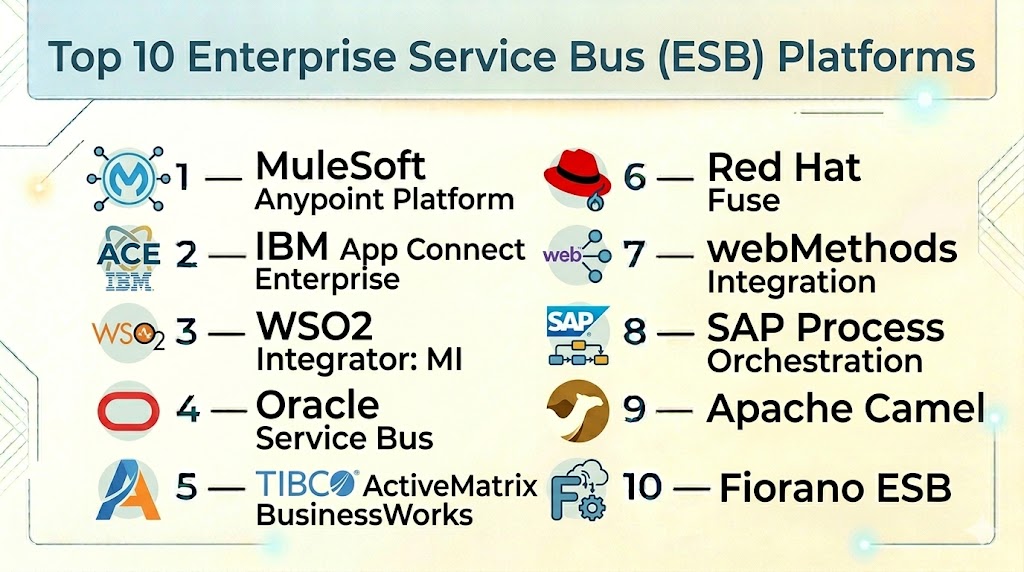
#1 — MuleSoft Anypoint Platform
Short description (2–3 lines): MuleSoft is one of the best-known enterprise integration platforms with strong ESB roots. It is best for large organizations that want API-led connectivity, robust mediation, and hybrid integration at scale.
Key Features
- API-led integration architecture
- Broad connector library
- Message routing and mediation
- Data transformation and mapping
- Hybrid deployment support
- Centralized monitoring
- Strong policy and governance tooling
Pros
- Excellent fit for complex enterprise integration programs
- Mature ecosystem with broad enterprise adoption
- Strong balance between ESB, APIs, and modernization
Cons
- Expensive for many teams
- Setup and governance can become complex
- Better suited to mature integration teams than beginners
Platforms / Deployment
Cloud / Self-hosted / Hybrid
Security & Compliance
SSO/SAML, RBAC, encryption support; additional certifications vary by product tier and deployment. Some compliance details are not publicly stated in one simple source.
Integrations & Ecosystem
MuleSoft has one of the strongest ecosystems in this category, especially for enterprise applications, APIs, and legacy modernization.
- ERP and CRM systems
- Databases and messaging systems
- SaaS applications
- API gateways
- Legacy systems
- Custom connectors and templates
Support & Community
Strong enterprise support, extensive documentation, partner ecosystem, and broad mindshare. Community resources are also substantial.
#2 — IBM App Connect Enterprise
Short description (2–3 lines): IBM App Connect Enterprise is a long-established enterprise integration platform built for transformation, routing, orchestration, and hybrid integration. It is well suited to enterprises with demanding reliability and governance needs.
Key Features
- Message transformation and enrichment
- Integration flows and routing
- App, API, and event connectivity
- Hybrid deployment flexibility
- Visual and code-oriented development
- AI-assisted mapping in broader platform messaging
- Enterprise administration tooling
Pros
- Strong fit for complex enterprise workloads
- Broad protocol and integration support
- Mature operational control
Cons
- Can feel heavy for smaller projects
- Licensing and architecture can be complex
- Requires skilled integration teams
Platforms / Deployment
Cloud / Self-hosted / Hybrid
Security & Compliance
RBAC, encryption, enterprise-grade security controls; broader certification details are not publicly stated in a simple unified product summary.
Integrations & Ecosystem
IBM’s platform supports enterprise apps, events, APIs, and data flows across mixed environments.
- Applications and databases
- Messaging and event systems
- APIs and services
- Enterprise data sources
- Hybrid cloud environments
Support & Community
Strong enterprise documentation and support, though community energy is lower than some open-source options.
#3 — WSO2 Integrator: MI
Short description (2–3 lines): WSO2 Integrator: MI is an open-source-oriented integration product that supports ESB-style and microservices-style integration. It is a strong option for teams wanting flexibility, openness, and hybrid deployment.
Key Features
- ESB-style and microservices-style integration
- Low-code graphical design experience
- Message mediation and routing
- Data transformation
- Open-source model
- Cloud, on-prem, and hybrid deployment
- AI integration positioning in current docs
Pros
- Good flexibility for architecture choices
- Attractive for teams that prefer open technology
- Strong value compared with large enterprise suites
Cons
- Enterprise polish may feel lighter than top premium vendors
- Some use cases require more hands-on engineering
- Support experience depends on subscription model
Platforms / Deployment
Cloud / Self-hosted / Hybrid
Security & Compliance
Encryption, access control, enterprise security features available; full compliance details vary and are not always publicly summarized in one place.
Integrations & Ecosystem
WSO2 supports a broad range of service, API, and data integration patterns.
- HTTP, JMS, JDBC, and web services
- APIs and microservices
- Data sources and enterprise apps
- Cloud and on-prem endpoints
Support & Community
Good documentation and a meaningful technical community, with stronger outcomes when teams have internal integration expertise.
#4 — Oracle Service Bus
Short description (2–3 lines): Oracle Service Bus is a mature ESB product used in organizations with Oracle middleware estates and traditional SOA environments. It remains relevant where Oracle stack alignment is a major factor.
Key Features
- Proxy and business services
- Pipeline-based mediation
- XQuery and XSLT transformation
- Protocol mediation
- JCA adapter support
- WS-Security configuration
- Oracle middleware alignment
Pros
- Strong choice for Oracle-centric environments
- Mature mediation and transformation capabilities
- Good fit for traditional SOA programs
Cons
- Less appealing for greenfield cloud-native projects
- Can feel legacy compared with newer integration styles
- Best value usually comes with broader Oracle adoption
Platforms / Deployment
Self-hosted / Hybrid
Security & Compliance
WS-Security support, role-based administrative security, enterprise middleware controls; broader compliance details not publicly stated in simple product materials.
Integrations & Ecosystem
Oracle Service Bus connects well into Oracle middleware, applications, and service-oriented environments.
- Oracle SOA Suite
- Oracle applications
- JCA adapters
- Web services
- Custom transports
Support & Community
Enterprise documentation is deep, but the broader community is narrower than more modern open ecosystems.
#5 — TIBCO ActiveMatrix BusinessWorks
Short description (2–3 lines): TIBCO BusinessWorks remains a recognizable enterprise integration product for workflow, service integration, and orchestration. It is often considered by organizations that already use TIBCO technologies.
Key Features
- Service creation and orchestration
- Integration process design
- Data transformation
- Enterprise connectivity
- Long-term release stream
- Strong middleware heritage
Pros
- Proven in enterprise integration scenarios
- Good fit for process-heavy use cases
- Strong heritage in complex environments
Cons
- Less mindshare than some leading competitors
- Can be costly and specialized
- May feel heavyweight for smaller teams
Platforms / Deployment
Self-hosted / Hybrid
Security & Compliance
Enterprise security controls available; detailed compliance certifications are not publicly stated in the sources reviewed.
Integrations & Ecosystem
TIBCO supports enterprise application integration and process orchestration across mixed systems.
- Enterprise apps
- APIs and services
- Data sources
- Messaging systems
Support & Community
Vendor documentation is substantial, but the public community footprint is more specialized.
#6 — Red Hat Fuse
Short description (2–3 lines): Red Hat Fuse is a distributed integration solution with strong alignment to Red Hat and Apache integration technologies. It suits teams that want cloud-aware integration with open-source foundations.
Key Features
- Distributed integration runtime
- Cloud-native deployment options
- SaaS connectors
- Debugging and monitoring tools
- OpenShift alignment
- Multiple architecture choices
Pros
- Attractive for Red Hat and OpenShift users
- Solid fit for hybrid and containerized integration
- Open technology influence is a plus
Cons
- Best fit is narrower outside Red Hat-centric shops
- Product direction and positioning can feel more specialized
- May require stronger platform engineering capability
Platforms / Deployment
Cloud / Self-hosted / Hybrid
Security & Compliance
Enterprise product security model supported through Red Hat ecosystem; specific compliance mapping varies by environment and is not publicly stated in one concise source.
Integrations & Ecosystem
Fuse benefits from Apache components and Red Hat deployment patterns.
- SaaS connectors
- Databases
- Messaging systems
- WebSocket and cloud services
- OpenShift environments
Support & Community
Good enterprise support for Red Hat customers and a useful open-source-adjacent knowledge base.
#7 — webMethods Integration
Short description (2–3 lines): webMethods remains a recognized name in enterprise integration and integration server workloads. It is best for organizations that want a broad integration suite with strong enterprise process and connectivity depth.
Key Features
- Integration server runtime
- Application and service connectivity
- Enterprise workflow support
- Secure service execution
- Broad hybrid integration positioning
- Suite-oriented architecture
Pros
- Strong enterprise integration heritage
- Broad connectivity scope
- Good fit for large, established environments
Cons
- Can be complex to govern
- Less lightweight than modern developer-first tools
- Best suited to larger organizations
Platforms / Deployment
Cloud / Self-hosted / Hybrid
Security & Compliance
Secure service execution and enterprise controls are supported; detailed compliance certifications are not publicly stated in the product summaries reviewed.
Integrations & Ecosystem
webMethods is designed for broad enterprise connectivity and large mixed estates.
- Applications and services
- APIs
- Data sources
- Enterprise process integrations
Support & Community
Good enterprise support and documentation depth, with stronger relevance in established enterprise accounts than in grassroots developer communities.
#8 — SAP Process Orchestration
Short description (2–3 lines): SAP Process Orchestration is a long-standing SAP integration product used for process and application integration in SAP-heavy environments. It remains relevant mainly for organizations with substantial existing SAP estates.
Key Features
- Process and integration modeling
- Workflow and orchestration
- SAP-centric connectivity
- Enterprise process support
- Mature SAP middleware alignment
Pros
- Strong fit for SAP-centric enterprises
- Good for structured business process integration
- Familiar choice in established SAP landscapes
Cons
- Less attractive for non-SAP-first organizations
- Seen more often in legacy or transitional environments
- Modernization planning is important
Platforms / Deployment
Self-hosted / Hybrid
Security & Compliance
Varies / Not publicly stated
Integrations & Ecosystem
Best value comes when SAP systems are central to the integration landscape.
- SAP enterprise systems
- Business process workflows
- Legacy SAP integration environments
Support & Community
Enterprise support is strong inside the SAP ecosystem, though buyers should assess long-term modernization plans carefully.
#9 — Apache Camel
Short description (2–3 lines): Apache Camel is an open-source integration framework rather than a packaged enterprise suite, but it is highly relevant for ESB-style routing and mediation. It is best for developer-led teams that want code-centric flexibility.
Key Features
- Enterprise Integration Patterns support
- Multiple DSLs
- Extensive component library
- Routes and mediation
- Flexible runtimes
- Kubernetes and Spring Boot friendliness
- Open-source portability
Pros
- Very flexible and developer-friendly
- Strong open-source ecosystem
- Good for modern custom integration architectures
Cons
- Not a turnkey enterprise suite by default
- Requires engineering discipline and platform ownership
- Commercial support depends on chosen distro or partner
Platforms / Deployment
Web / Linux / Windows / macOS
Cloud / Self-hosted / Hybrid
Security & Compliance
Varies by runtime and deployment; no single product-level compliance statement applies.
Integrations & Ecosystem
Camel has one of the broadest component ecosystems in integration.
- 300+ components
- APIs and services
- Messaging systems
- Spring Boot and Quarkus
- Kubernetes-oriented runtimes
Support & Community
Excellent open-source community and documentation, especially for technical users.
#10 — Fiorano ESB
Short description (2–3 lines): Fiorano ESB is a specialized enterprise integration platform known for event-process design and peer-to-peer flow concepts. It is best for teams wanting a focused ESB product outside the largest mainstream vendors.
Key Features
- ESB server for centralized management
- Peer-to-peer data flow model
- Event process management
- Angular-based dashboard
- Prebuilt business components
- ESB artifact administration
Pros
- Purpose-built ESB focus
- Useful for organizations that want a specialized platform
- Good visibility into managed event processes
Cons
- Smaller ecosystem than major competitors
- Lower market mindshare
- Harder to benchmark against mainstream shortlists
Platforms / Deployment
Self-hosted / Hybrid
Security & Compliance
Not publicly stated
Integrations & Ecosystem
Fiorano offers a dedicated ESB environment with business components and management services.
- ESB services
- Event processes
- Business components
- Centralized administration
Support & Community
Documentation is available and product-specific, but the community is much smaller than top-tier enterprise or open-source alternatives.
Comparison Table (Top 10)
| Tool Name | Best For | Platform(s) Supported | Deployment (Cloud/Self-hosted/Hybrid) | Standout Feature | Public Rating |
|---|---|---|---|---|---|
| MuleSoft Anypoint Platform | Large enterprise integration programs | Web | Hybrid | API-led connectivity | N/A |
| IBM App Connect Enterprise | Complex enterprise integration | Web | Hybrid | Broad hybrid integration depth | N/A |
| WSO2 Integrator: MI | Flexible open integration teams | Web / Windows / Linux / macOS | Cloud / Self-hosted / Hybrid | ESB-style and microservices-style support | N/A |
| Oracle Service Bus | Oracle-centric SOA environments | Web | Self-hosted / Hybrid | Mature proxy and pipeline mediation | N/A |
| TIBCO ActiveMatrix BusinessWorks | Process-heavy enterprise integration | Web | Self-hosted / Hybrid | Strong orchestration heritage | N/A |
| Red Hat Fuse | OpenShift and Red Hat shops | Web / Linux / Windows / macOS | Cloud / Self-hosted / Hybrid | Cloud-aware distributed integration | N/A |
| webMethods Integration | Large mixed enterprise estates | Web | Cloud / Self-hosted / Hybrid | Broad suite-based connectivity | N/A |
| SAP Process Orchestration | SAP-heavy enterprises | Web | Self-hosted / Hybrid | SAP process integration fit | N/A |
| Apache Camel | Developer-led custom integration | Linux / Windows / macOS | Cloud / Self-hosted / Hybrid | Huge component ecosystem | N/A |
| Fiorano ESB | Focused ESB deployments | Web | Self-hosted / Hybrid | Peer-to-peer event process model | N/A |
Enterprise Service Bus (ESB) Platforms Scoring
| Tool Name | Core (25%) | Ease (15%) | Integrations (15%) | Security (10%) | Performance (10%) | Support (10%) | Value (15%) | Weighted Total (0–10) |
|---|---|---|---|---|---|---|---|---|
| MuleSoft Anypoint Platform | 9.4 | 7.3 | 9.5 | 8.8 | 9.0 | 8.9 | 6.5 | 8.44 |
| IBM App Connect Enterprise | 9.1 | 7.1 | 8.9 | 8.7 | 8.8 | 8.7 | 6.8 | 8.20 |
| WSO2 Integrator: MI | 8.3 | 7.6 | 8.2 | 7.8 | 8.0 | 7.8 | 8.6 | 8.06 |
| Oracle Service Bus | 8.2 | 6.4 | 8.0 | 8.1 | 8.3 | 7.9 | 6.7 | 7.56 |
| TIBCO ActiveMatrix BusinessWorks | 8.4 | 6.8 | 8.1 | 8.0 | 8.4 | 7.8 | 6.6 | 7.72 |
| Red Hat Fuse | 8.0 | 7.0 | 8.2 | 7.8 | 8.1 | 7.7 | 8.1 | 7.85 |
| webMethods Integration | 8.5 | 6.9 | 8.4 | 8.0 | 8.3 | 8.0 | 6.8 | 7.84 |
| SAP Process Orchestration | 7.9 | 6.5 | 7.8 | 7.8 | 8.0 | 7.8 | 6.5 | 7.37 |
| Apache Camel | 8.6 | 6.9 | 9.0 | 7.2 | 8.4 | 8.5 | 9.0 | 8.21 |
| Fiorano ESB | 7.5 | 6.8 | 7.2 | 7.0 | 7.8 | 6.9 | 7.5 | 7.22 |
These scores are comparative, not absolute. A higher number does not mean a tool is universally better; it means it performs more strongly against this shortlist and weighting model. Large enterprises may care more about governance and reliability, while cost-sensitive teams may value openness and flexibility more heavily. Open-source tools can score very well on value but still require stronger internal expertise. Always test against your architecture, security standards, and team capability before choosing.
Which Enterprise Service Bus (ESB) Platform Is Right for You?
Solo / Freelancer
ESB platforms are usually not the right first choice here. A solo builder typically needs lightweight workflow automation, API integration, or event tooling rather than full enterprise middleware. If you still need ESB-style routing, Apache Camel is the most practical choice because it is flexible and open, but it assumes you are comfortable building and operating your own integration stack.
SMB
Small and midsize businesses should be careful not to overbuy. If the company has a modest number of internal systems and wants controlled integration without massive license commitments, WSO2 Integrator: MI or Red Hat Fuse can make sense. They offer flexibility and stronger value than some premium enterprise suites, but they still require technical ownership and architecture discipline.
Mid-Market
Mid-market organizations often need a balance between control and modernization. IBM App Connect Enterprise, WSO2 Integrator: MI, and Red Hat Fuse stand out here depending on budget and existing stack. Choose IBM when reliability and governance matter most, WSO2 when openness and value matter, and Red Hat Fuse when OpenShift or container alignment is strategic.
Enterprise
Large enterprises with deep integration needs should start with MuleSoft Anypoint Platform, IBM App Connect Enterprise, and webMethods Integration. Oracle Service Bus and SAP Process Orchestration are also credible if the existing enterprise stack already leans heavily in those directions. For very large organizations, the best choice is often the one that matches current architecture, governance maturity, and modernization roadmap.
Budget vs Premium
If budget is tight, Apache Camel and WSO2 Integrator: MI are the most compelling. If premium enterprise support, vendor accountability, and broad packaged capabilities matter more than price, MuleSoft and IBM App Connect Enterprise are the safer premium choices.
Feature Depth vs Ease of Use
For maximum feature depth, MuleSoft, IBM App Connect Enterprise, and webMethods lead the pack. For easier experimentation and more flexible adoption, WSO2 and Apache Camel are often friendlier to technically strong teams that prefer control over polished enterprise packaging.
Integrations & Scalability
If connector breadth, enterprise interoperability, and large-scale operations are your top concerns, shortlist MuleSoft, IBM App Connect Enterprise, and Apache Camel. If you need strong stack alignment rather than maximum ecosystem breadth, Oracle Service Bus and SAP Process Orchestration can still be effective inside their home ecosystems.
Security & Compliance Needs
For highly controlled environments, start with MuleSoft, IBM App Connect Enterprise, and Oracle Service Bus. These platforms are more naturally aligned with centralized governance, strict operations, and controlled deployment processes. Open platforms can still be secured well, but the burden often shifts more toward your internal architecture and operations teams.
Enterprise Service Bus (ESB) Platforms FAQs
What is an ESB platform?
An ESB platform connects enterprise applications through a central integration layer. It usually handles routing, transformation, mediation, orchestration, and protocol conversion so systems can communicate without hardwiring every connection.
Is ESB still relevant today?
Yes, especially in large organizations with hybrid, legacy, or regulated environments. It is less dominant in greenfield cloud-native projects, but still very relevant where controlled enterprise integration is required.
How is ESB different from iPaaS?
ESB usually emphasizes enterprise middleware, internal service mediation, and controlled runtime deployment. iPaaS is typically more cloud-managed and often easier for SaaS-centric automation and faster integration delivery.
How is ESB different from API management?
API management focuses on exposing, securing, governing, and monitoring APIs. ESB focuses more on integrating systems behind the scenes, including transformation, routing, orchestration, and connectivity between services and applications.
Are ESB platforms only for large enterprises?
Mostly, but not always. Smaller organizations can use them, especially open-source or lower-cost options, though the operational overhead usually makes them more suitable for teams with dedicated integration expertise.
How long does ESB implementation usually take?
It depends on scope. A focused integration project can start quickly, but an enterprise-wide ESB program often takes significant planning, architecture work, governance setup, and phased rollout.
What are common mistakes when adopting ESB?
Common mistakes include over-centralizing all integration logic, weak governance, poor service versioning, underestimating transformation complexity, and choosing a heavyweight suite for a lightweight use case.
Can open-source tools replace commercial ESB products?
Sometimes. Tools like Apache Camel or WSO2 can be very capable, but replacing a commercial platform usually requires stronger internal engineering, support planning, and operational maturity.
What security features should buyers look for?
Look for role-based access control, encryption in transit and at rest, secure credential handling, audit logs, policy enforcement, identity integration, and operational controls around deployment and monitoring.
Is migration away from legacy ESB common?
Yes. Many organizations are gradually moving toward hybrid integration models that combine APIs, event-driven architecture, containers, and cloud integration services. In many cases, the transition is staged rather than immediate.
What deployment model is best for ESB?
That depends on architecture and compliance needs. Regulated industries often still prefer self-hosted or hybrid deployments, while modernization programs increasingly want cloud-aware and container-friendly runtimes.
What is the best ESB platform overall?
There is no universal winner. MuleSoft is strong for broad enterprise leadership, IBM App Connect Enterprise is excellent for large controlled environments, WSO2 offers strong value and flexibility, and Apache Camel is outstanding for developer-led custom integration.
Conclusion
Enterprise Service Bus platforms remain highly relevant where integration is complex, business-critical, and tightly governed. The strongest options are not always the newest or the flashiest, but the ones that best match your architecture, team capability, and modernization goals. MuleSoft and IBM App Connect Enterprise lead for broad enterprise depth, while WSO2 and Apache Camel stand out for flexibility and value. Oracle, SAP, TIBCO, Red Hat, webMethods, and Fiorano each make the most sense in the right ecosystem or deployment context.
