Introduction
API Gateways are critical components in modern software architecture that act as a single entry point for managing, routing, and securing API traffic between clients and backend services. Instead of clients directly interacting with multiple services, the gateway handles requests, enforces policies, and ensures smooth communication.
With the rise of microservices, cloud-native applications, and distributed systems, API gateways have become essential for maintaining performance, security, and scalability. They simplify complexity by centralizing authentication, rate limiting, logging, and request transformation.
Real-world use cases:
- Managing traffic between frontend apps and microservices
- Securing APIs with authentication and authorization
- Rate limiting and throttling API usage
- Load balancing across services
- Observability and logging for API traffic
What buyers should evaluate:
- Performance and latency
- Security features (auth, rate limiting, encryption)
- Scalability and reliability
- Deployment flexibility (cloud, self-hosted, hybrid)
- Integration with Kubernetes and DevOps tools
- Plugin or extensibility support
- Monitoring and analytics capabilities
- Ease of configuration and management
- Cost and licensing model
- Community and support
Best for: Developers, DevOps teams, backend engineers, and organizations building microservices or API-first platforms.
Not ideal for: Simple applications with minimal API traffic or monolithic architectures where direct service access is sufficient.
Key Trends in API Gateways
- Kubernetes-native gateways becoming the default choice
- Service mesh convergence (e.g., gateways working with Istio/Linkerd)
- AI-driven traffic management and anomaly detection
- Edge and serverless gateway deployments
- GraphQL and gRPC support expansion
- Security-first architectures with Zero Trust principles
- Event-driven and async API handling
- Observability integration with modern monitoring tools
- Multi-cloud and hybrid deployment support
- Lightweight, high-performance gateways for edge computing
How We Selected These Tools (Methodology)
- Strong adoption in production environments
- Proven performance and scalability
- Feature completeness for API gateway use cases
- Security capabilities and policy management
- Integration with modern DevOps ecosystems
- Support for cloud-native and Kubernetes environments
- Flexibility (open-source + enterprise options)
- Ease of deployment and configuration
- Community support and ecosystem maturity
- Suitability across different business sizes
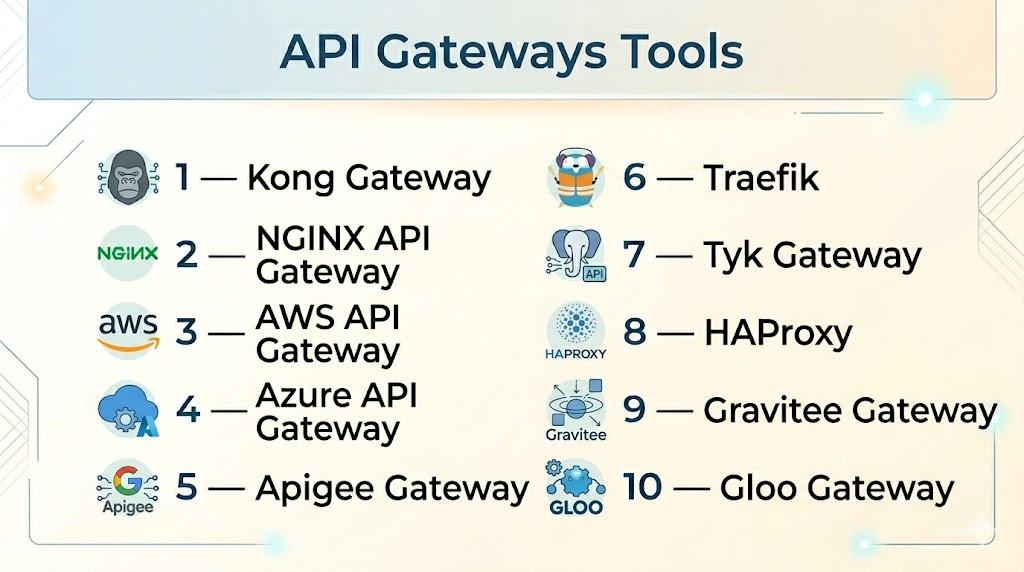
Top 10 API Gateways Tools
#1 — Kong Gateway
Short description: A high-performance, widely adopted API gateway known for its flexibility and plugin ecosystem.
Key Features
- Plugin-based architecture
- High throughput and low latency
- Kubernetes-native support
- Service mesh compatibility
- Advanced traffic control
- Authentication and rate limiting
Pros
- Extremely flexible
- Strong open-source ecosystem
Cons
- Requires configuration expertise
- Advanced features require enterprise version
Platforms / Deployment
Cloud / Self-hosted / Hybrid
Security & Compliance
RBAC, authentication plugins, encryption
Compliance: Not publicly stated
Integrations & Ecosystem
Extensive plugin ecosystem for customization.
- Kubernetes
- Prometheus
- Logging systems
Support & Community
Large global community; enterprise support available.
#2 — NGINX API Gateway
Short description: A powerful gateway built on NGINX, known for performance and reliability.
Key Features
- Reverse proxy and load balancing
- High-performance traffic handling
- TLS termination
- Rate limiting
- Caching support
Pros
- Extremely fast
- Mature and stable
Cons
- Limited native API management features
- Configuration can be complex
Platforms / Deployment
Self-hosted / Cloud
Security & Compliance
Encryption, access control
Compliance: Not publicly stated
Integrations & Ecosystem
Widely used across infrastructure stacks.
- Web servers
- Containers
- Monitoring tools
Support & Community
Massive community and extensive documentation.
#3 — AWS API Gateway
Short description: A fully managed gateway service for building and scaling APIs within cloud environments.
Key Features
- REST and WebSocket support
- Auto-scaling
- Built-in caching
- Request transformation
- Monitoring and logging
Pros
- Fully managed
- Highly scalable
Cons
- Vendor lock-in
- Pricing complexity
Platforms / Deployment
Cloud
Security & Compliance
IAM, encryption
Compliance: Varies / Not publicly stated
Integrations & Ecosystem
Deep cloud integration.
- Serverless compute
- Storage services
- Monitoring tools
Support & Community
Extensive documentation and strong community.
#4 — Azure API Gateway
Short description: A gateway solution integrated within Microsoft’s cloud ecosystem.
Key Features
- Traffic routing
- Security policies
- Developer portal
- Analytics
- Hybrid deployment
Pros
- Strong enterprise integration
- Flexible deployment
Cons
- Complex UI
- Pricing tiers
Platforms / Deployment
Cloud / Hybrid
Security & Compliance
SSO, RBAC
Compliance: Varies / Not publicly stated
Integrations & Ecosystem
Works well with enterprise systems.
- Identity services
- Cloud tools
Support & Community
Strong enterprise support.
#5 — Apigee Gateway
Short description: Enterprise-grade gateway as part of a full API management platform.
Key Features
- Traffic management
- Policy enforcement
- API analytics
- Security controls
- Developer tools
Pros
- Advanced analytics
- Enterprise-ready
Cons
- Expensive
- Complex setup
Platforms / Deployment
Cloud / Hybrid
Security & Compliance
SSO, encryption
Compliance: Varies / Not publicly stated
Integrations & Ecosystem
Integrates with enterprise platforms.
- Data tools
- Cloud services
Support & Community
Enterprise-level support.
#6 — Traefik
Short description: A modern cloud-native API gateway designed for microservices and containers.
Key Features
- Dynamic configuration
- Kubernetes integration
- Automatic service discovery
- Load balancing
- Middleware support
Pros
- Easy integration with containers
- Lightweight
Cons
- Limited enterprise features
- Less mature ecosystem
Platforms / Deployment
Cloud / Self-hosted
Security & Compliance
TLS, middleware-based security
Compliance: Not publicly stated
Integrations & Ecosystem
Strong container ecosystem support.
- Docker
- Kubernetes
- CI/CD tools
Support & Community
Active open-source community.
#7 — Tyk Gateway
Short description: A flexible and cost-effective API gateway with open-source roots.
Key Features
- API gateway
- Rate limiting
- Analytics
- GraphQL support
- Plugin system
Pros
- Affordable
- Flexible deployment
Cons
- UI improvements needed
- Setup effort required
Platforms / Deployment
Cloud / Self-hosted / Hybrid
Security & Compliance
RBAC, encryption
Compliance: Not publicly stated
Integrations & Ecosystem
Supports extensibility.
- Databases
- Containers
- CI/CD tools
Support & Community
Active community and support options.
#8 — HAProxy
Short description: A fast and reliable open-source load balancer often used as an API gateway.
Key Features
- High-performance load balancing
- Traffic routing
- SSL termination
- Health checks
- Failover support
Pros
- Extremely fast
- Proven reliability
Cons
- Not a full API management tool
- Requires manual setup
Platforms / Deployment
Self-hosted
Security & Compliance
Encryption, access control
Compliance: Not publicly stated
Integrations & Ecosystem
Works across infrastructure stacks.
- Servers
- Containers
- Monitoring tools
Support & Community
Large open-source community.
#9 — Gravitee Gateway
Short description: A modern API gateway with strong support for event-driven architectures.
Key Features
- API gateway
- Event-native support
- Policy engine
- Analytics
- Developer portal
Pros
- Supports async APIs
- Modern design
Cons
- Smaller ecosystem
- Less mature
Platforms / Deployment
Cloud / Self-hosted / Hybrid
Security & Compliance
RBAC, encryption
Compliance: Not publicly stated
Integrations & Ecosystem
Focused on modern systems.
- Messaging systems
- Containers
Support & Community
Growing community.
#10 — Gloo Gateway
Short description: A Kubernetes-native API gateway designed for cloud-native environments.
Key Features
- Kubernetes-native
- Envoy-based
- Traffic routing
- Security policies
- Observability
Pros
- Strong Kubernetes integration
- High performance
Cons
- Kubernetes knowledge required
- Smaller ecosystem
Platforms / Deployment
Cloud / Self-hosted
Security & Compliance
RBAC, encryption
Compliance: Not publicly stated
Integrations & Ecosystem
Built for cloud-native systems.
- Kubernetes
- Service mesh
- Monitoring tools
Support & Community
Active community with enterprise support.
Comparison Table (Top 10)
| Tool Name | Best For | Platform(s) Supported | Deployment | Standout Feature | Public Rating |
|---|---|---|---|---|---|
| Kong | Flexibility | Multi-platform | Hybrid | Plugin system | N/A |
| NGINX | Performance | Multi-platform | Self-hosted | Speed | N/A |
| AWS API Gateway | Cloud users | Cloud | Cloud | Managed scaling | N/A |
| Azure Gateway | Enterprise | Cloud | Hybrid | Integration | N/A |
| Apigee | Enterprises | Cloud | Hybrid | Analytics | N/A |
| Traefik | Containers | Multi-platform | Cloud | Auto discovery | N/A |
| Tyk | Budget teams | Multi-platform | Hybrid | Open-source | N/A |
| HAProxy | Performance | Multi-platform | Self-hosted | Reliability | N/A |
| Gravitee | Async APIs | Multi-platform | Hybrid | Event support | N/A |
| Gloo | Kubernetes | Multi-platform | Cloud | Envoy-based | N/A |
Evaluation & Scoring of API Gateways
| Tool Name | Core (25%) | Ease (15%) | Integrations (15%) | Security (10%) | Performance (10%) | Support (10%) | Value (15%) | Weighted Total (0–10) |
|---|---|---|---|---|---|---|---|---|
| Kong | 9 | 6 | 8 | 8 | 9 | 8 | 8 | 8.1 |
| NGINX | 8 | 6 | 7 | 7 | 10 | 8 | 8 | 7.9 |
| AWS API Gateway | 8 | 7 | 9 | 8 | 9 | 8 | 7 | 8.0 |
| Azure Gateway | 8 | 6 | 9 | 8 | 8 | 8 | 7 | 7.8 |
| Apigee | 9 | 6 | 9 | 9 | 9 | 8 | 6 | 8.2 |
| Traefik | 7 | 8 | 7 | 7 | 8 | 7 | 9 | 7.8 |
| Tyk | 8 | 7 | 7 | 7 | 8 | 7 | 8 | 7.7 |
| HAProxy | 8 | 6 | 6 | 7 | 10 | 7 | 9 | 7.8 |
| Gravitee | 8 | 7 | 7 | 7 | 8 | 7 | 8 | 7.7 |
| Gloo | 8 | 6 | 8 | 8 | 9 | 7 | 7 | 7.9 |
How to interpret scores:
- Scores are comparative across tools
- Performance-focused tools rank high but may lack ease
- Enterprise tools score high in features and security
- Choose based on your priorities (ease, cost, scalability)
Which API Gateways Tool Is Right for You?
Solo / Freelancer
- Best: Traefik, Postman (testing)
- Focus on simplicity and lightweight setup
SMB
- Best: Tyk, Kong
- Balance between cost and performance
Mid-Market
- Best: Kong, AWS API Gateway
- Need scalability and integrations
Enterprise
- Best: Apigee, Azure Gateway
- Focus on governance and security
Budget vs Premium
- Budget: Tyk, HAProxy
- Premium: Apigee
Feature Depth vs Ease of Use
- Easy: Traefik
- Advanced: Kong, Apigee
Integrations & Scalability
- Cloud: AWS API Gateway
- Kubernetes: Gloo, Kong
Security & Compliance Needs
- High: Apigee, Azure
- Moderate: Tyk, Traefik
Frequently Asked Questions (FAQs)
What is an API gateway?
An API gateway acts as a central entry point that manages API traffic between clients and backend services.
How is it different from API management?
API gateways handle traffic, while API management platforms cover the full lifecycle.
Do I need an API gateway?
If you use microservices or multiple APIs, a gateway is highly recommended.
Are API gateways expensive?
Costs vary from free open-source tools to enterprise pricing models.
Can I use open-source gateways?
Yes, many are production-ready but require setup and maintenance.
How long does setup take?
From a few hours for simple setups to weeks for complex systems.
Do API gateways support GraphQL?
Many modern gateways support GraphQL and gRPC.
What are the main security features?
Authentication, rate limiting, encryption, and logging.
Can I switch gateways later?
Yes, but migration complexity depends on configuration.
What are alternatives?
Service meshes or direct API integrations.
Conclusion
API gateways are a foundational component of modern application architecture, especially for microservices and cloud-native systems. They provide essential capabilities like security, traffic control, and scalability while simplifying how services communicate.
Choosing the right gateway depends on your technical stack, scale, and team expertise. Some tools prioritize performance, while others focus on flexibility or enterprise features.
