Introduction
GraphQL tooling refers to the ecosystem of tools, platforms, and frameworks that help developers build, manage, test, and scale GraphQL APIs efficiently. Unlike traditional REST APIs, GraphQL allows clients to request exactly the data they need, making it highly flexible and efficient for modern applications.
As organizations move toward microservices and API-first architectures, GraphQL tooling has become essential for handling schema design, federation, performance monitoring, and security. From developer IDEs to full API platforms, these tools simplify complex backend operations and improve developer productivity.
Real-world use cases:
- Building unified APIs across multiple microservices
- Creating data layers for frontend applications
- Real-time applications using subscriptions
- API orchestration across distributed systems
- Automating database-to-API generation
What buyers should evaluate:
- Schema management and federation capabilities
- Performance optimization and caching
- Developer experience (IDE, debugging tools)
- Security and access control features
- Integration with databases and services
- Observability and analytics
- Deployment flexibility
- Community and ecosystem maturity
- Ease of onboarding
- Cost and scalability
Best for: Developers, backend engineers, DevOps teams, and companies building API-first or microservices-based systems.
Not ideal for: Simple CRUD apps where REST APIs are sufficient, or teams without backend complexity.
Key Trends in GraphQL Tooling
- GraphQL federation becoming standard for microservices orchestration
- AI-assisted query optimization and debugging
- Database-to-GraphQL automation tools reducing backend effort
- Rise of supergraph architectures for unified APIs
- Increased focus on performance monitoring and tracing
- Security-first tooling for query validation and access control
- GraphQL + multi-protocol APIs (REST, gRPC, Kafka) convergence
- Low-code and no-code GraphQL builders
- Improved developer tooling (IDEs, visual schema tools)
- Cloud-native and serverless GraphQL platforms
How We Selected These Tools (Methodology)
- Widely adopted in production environments
- Coverage across the GraphQL lifecycle (design → deployment → monitoring)
- Strong developer experience and documentation
- Performance and scalability capabilities
- Security features and access control
- Integration with modern stacks (databases, cloud, CI/CD)
- Support for federation and distributed systems
- Open-source vs enterprise balance
- Active community and ecosystem
- Long-term viability and innovation
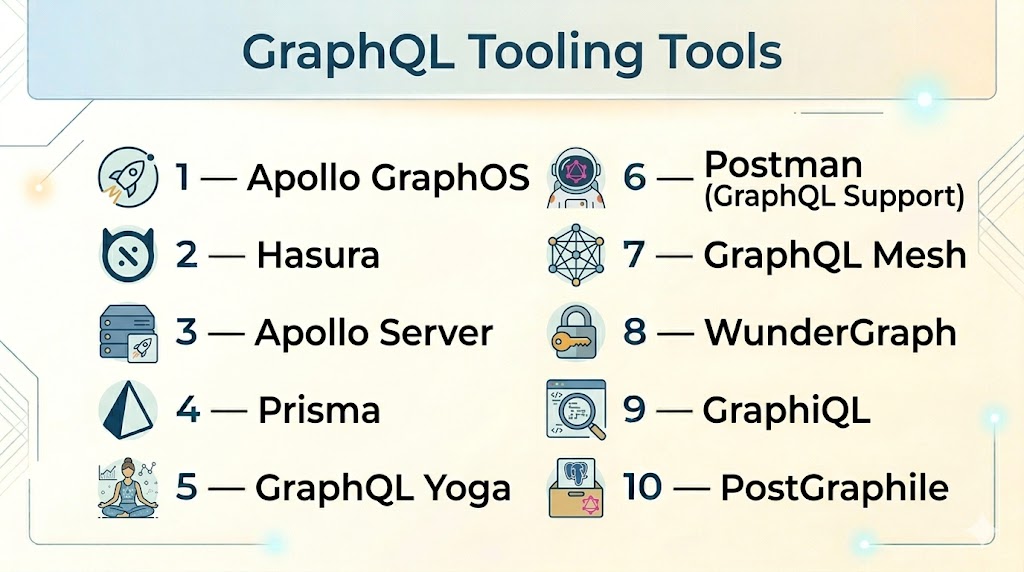
Top 10 GraphQL Tooling Tools
#1 — Apollo GraphOS
Short description: A leading GraphQL platform for building and managing federated APIs at scale.
Key Features
- GraphQL federation and supergraph support
- Schema registry and versioning
- Query analytics and performance insights
- Developer tooling and IDE
- API governance
- CI/CD integration
Pros
- Industry-leading ecosystem
- Strong enterprise features
Cons
- Pricing can be high
- Learning curve for federation
Platforms / Deployment
Cloud / Hybrid
Security & Compliance
SSO, RBAC, encryption
Compliance: Varies / Not publicly stated
Integrations & Ecosystem
Deep integration across modern stacks.
- CI/CD tools
- Cloud platforms
- Observability tools
Support & Community
Very large community and extensive documentation.
#2 — Hasura
Short description: A platform that instantly generates GraphQL APIs from databases with minimal setup.
Key Features
- Auto-generated GraphQL APIs
- Real-time subscriptions
- Fine-grained access control
- Multi-database support
- Event triggers
- Performance optimization
Pros
- Fast development
- Minimal backend coding
Cons
- Limited flexibility for complex logic
- Can become complex at scale
Platforms / Deployment
Cloud / Self-hosted
Security & Compliance
RBAC, authentication
Compliance: Not publicly stated
Integrations & Ecosystem
Strong database-centric ecosystem.
- PostgreSQL
- REST APIs
- Webhooks
Support & Community
Active community and good documentation.
#3 — Apollo Server
Short description: A popular open-source GraphQL server for building production-ready APIs.
Key Features
- Schema-first development
- Resolver-based architecture
- Caching and performance tools
- Error handling
- Federation support
Pros
- Flexible and extensible
- Strong TypeScript support
Cons
- Requires manual setup
- Performance tuning needed
Platforms / Deployment
Cloud / Self-hosted
Security & Compliance
Authentication support, RBAC
Compliance: Not publicly stated
Integrations & Ecosystem
Works across many stacks.
- Node.js
- Databases
- Cloud platforms
Support & Community
Large developer ecosystem.
#4 — Prisma
Short description: A database toolkit that integrates seamlessly with GraphQL for backend development.
Key Features
- ORM for databases
- Type-safe queries
- Schema management
- Migration tools
- Developer-friendly API
Pros
- Excellent developer experience
- Strong type safety
Cons
- Not a full GraphQL platform
- Limited API management features
Platforms / Deployment
Self-hosted / Cloud
Security & Compliance
Database-level security
Compliance: Not publicly stated
Integrations & Ecosystem
Works well with modern stacks.
- Node.js
- Databases
- GraphQL servers
Support & Community
Strong community and documentation.
#5 — GraphQL Yoga
Short description: A lightweight GraphQL server focused on simplicity and performance.
Key Features
- Easy setup
- Built-in subscriptions
- Performance optimizations
- Plugin support
- Flexible architecture
Pros
- Simple to use
- Lightweight
Cons
- Fewer enterprise features
- Smaller ecosystem
Platforms / Deployment
Self-hosted
Security & Compliance
Authentication support
Compliance: Not publicly stated
Integrations & Ecosystem
Flexible integration options.
- Node.js
- Middleware tools
Support & Community
Growing community.
#6 — Postman (GraphQL Support)
Short description: A popular API platform with strong GraphQL testing and collaboration features.
Key Features
- GraphQL query builder
- API testing
- Collaboration tools
- Monitoring
- Documentation
Pros
- Easy to use
- Great for teams
Cons
- Not a full GraphQL backend
- Limited server-side capabilities
Platforms / Deployment
Web / Desktop
Security & Compliance
SSO, encryption
Compliance: Not publicly stated
Integrations & Ecosystem
Broad API ecosystem.
- CI/CD tools
- Version control
- Team tools
Support & Community
Very large community.
#7 — GraphQL Mesh
Short description: A tool for combining multiple APIs into a single GraphQL endpoint.
Key Features
- API aggregation
- Multi-source support
- Schema stitching
- Plugin system
- Federation support
Pros
- Great for API unification
- Flexible
Cons
- Setup complexity
- Smaller ecosystem
Platforms / Deployment
Self-hosted
Security & Compliance
Authentication support
Compliance: Not publicly stated
Integrations & Ecosystem
Supports multiple API types.
- REST
- gRPC
- SOAP
Support & Community
Active open-source community.
#8 — WunderGraph
Short description: A modern GraphQL platform focused on performance and API federation.
Key Features
- API federation
- Multi-protocol support
- High performance
- Observability
- Policy enforcement
Pros
- Strong performance
- Modern architecture
Cons
- Smaller adoption
- Learning curve
Platforms / Deployment
Cloud / Self-hosted
Security & Compliance
RBAC, policy controls
Compliance: Not publicly stated
Integrations & Ecosystem
Supports multiple protocols.
- REST
- gRPC
- Kafka
Support & Community
Growing ecosystem.
#9 — GraphiQL
Short description: An interactive IDE for exploring and testing GraphQL APIs.
Key Features
- Query editor
- Schema exploration
- Auto-completion
- Debugging tools
- Visualization
Pros
- Developer-friendly
- Lightweight
Cons
- Not a backend tool
- Limited scalability features
Platforms / Deployment
Web / Self-hosted
Security & Compliance
Varies / Not publicly stated
Integrations & Ecosystem
Works with any GraphQL API.
- Browsers
- Development tools
Support & Community
Widely used in the ecosystem.
#10 — PostGraphile
Short description: A tool for generating GraphQL APIs directly from PostgreSQL databases.
Key Features
- Auto-generated schema
- High performance
- Real-time support
- Custom resolvers
- Plugin support
Pros
- Fast API generation
- Strong database integration
Cons
- PostgreSQL-focused
- Limited flexibility
Platforms / Deployment
Self-hosted
Security & Compliance
Database-level controls
Compliance: Not publicly stated
Integrations & Ecosystem
Focused on PostgreSQL ecosystem.
- Databases
- Node.js
Support & Community
Active open-source community.
Comparison Table (Top 10)
| Tool Name | Best For | Platform(s) Supported | Deployment | Standout Feature | Public Rating |
|---|---|---|---|---|---|
| Apollo GraphOS | Enterprise GraphQL | Cloud | Hybrid | Federation | N/A |
| Hasura | Rapid API creation | Multi-platform | Cloud | Auto APIs | N/A |
| Apollo Server | Backend APIs | Multi-platform | Self-hosted | Flexibility | N/A |
| Prisma | DB integration | Multi-platform | Hybrid | ORM | N/A |
| GraphQL Yoga | Lightweight apps | Multi-platform | Self-hosted | Simplicity | N/A |
| Postman | Testing | Web/Desktop | Cloud | Collaboration | N/A |
| GraphQL Mesh | API aggregation | Multi-platform | Self-hosted | Stitching | N/A |
| WunderGraph | Performance | Multi-platform | Hybrid | Federation | N/A |
| GraphiQL | IDE | Web | Self-hosted | Debugging | N/A |
| PostGraphile | PostgreSQL APIs | Multi-platform | Self-hosted | Auto schema | N/A |
Evaluation & Scoring of GraphQL Tooling
| Tool Name | Core (25%) | Ease (15%) | Integrations (15%) | Security (10%) | Performance (10%) | Support (10%) | Value (15%) | Weighted Total (0–10) |
|---|---|---|---|---|---|---|---|---|
| Apollo GraphOS | 9 | 6 | 9 | 9 | 9 | 9 | 6 | 8.3 |
| Hasura | 8 | 8 | 8 | 7 | 8 | 8 | 8 | 8.0 |
| Apollo Server | 8 | 7 | 8 | 7 | 7 | 8 | 8 | 7.8 |
| Prisma | 7 | 9 | 8 | 7 | 8 | 8 | 9 | 8.0 |
| GraphQL Yoga | 7 | 8 | 7 | 7 | 8 | 7 | 9 | 7.8 |
| Postman | 6 | 9 | 8 | 7 | 7 | 9 | 9 | 7.9 |
| GraphQL Mesh | 8 | 6 | 8 | 7 | 8 | 7 | 8 | 7.7 |
| WunderGraph | 8 | 6 | 8 | 8 | 9 | 7 | 7 | 7.9 |
| GraphiQL | 6 | 9 | 7 | 6 | 7 | 8 | 9 | 7.6 |
| PostGraphile | 8 | 7 | 7 | 7 | 8 | 7 | 8 | 7.7 |
How to interpret scores:
- Higher scores indicate stronger overall capability across criteria
- Enterprise tools score high in features but lower in ease/value
- Developer tools score high in usability but lower in depth
- Choose based on your specific use case, not just total score
Which GraphQL Tooling Is Right for You?
Solo / Freelancer
- Best: GraphiQL, Postman
- Focus on simplicity and testing
SMB
- Best: Hasura, Prisma
- Fast development and cost efficiency
Mid-Market
- Best: Apollo Server, GraphQL Mesh
- Balance of flexibility and scalability
Enterprise
- Best: Apollo GraphOS, WunderGraph
- Focus on federation and governance
Budget vs Premium
- Budget: Hasura, PostGraphile
- Premium: Apollo GraphOS
Feature Depth vs Ease of Use
- Easy: GraphiQL, Postman
- Advanced: Apollo GraphOS
Integrations & Scalability
- Multi-source APIs: GraphQL Mesh
- Enterprise scaling: Apollo GraphOS
Security & Compliance Needs
- High: Apollo GraphOS
- Moderate: Hasura, Prisma
Frequently Asked Questions (FAQs)
What is GraphQL tooling?
It refers to tools used to build, test, manage, and scale GraphQL APIs.
Is GraphQL better than REST?
It depends—GraphQL offers flexibility, while REST is simpler for basic use cases.
Do I need a GraphQL server?
Yes, a server processes queries and resolves data.
What is GraphQL federation?
It allows combining multiple APIs into a single unified schema.
Are these tools free?
Many offer open-source versions with optional paid features.
How long does setup take?
From minutes (Hasura) to weeks (enterprise platforms).
Can I use GraphQL with any database?
Yes, GraphQL is database-agnostic.
Is GraphQL secure?
It requires proper configuration; tools provide access control and validation.
What are common mistakes?
Over-fetching, poor schema design, and lack of monitoring.
Can I migrate from REST?
Yes, many teams adopt GraphQL gradually.
Conclusion
GraphQL tooling has evolved into a powerful ecosystem that supports everything from simple API testing to enterprise-scale API orchestration. The right tool depends on your needs—whether it’s rapid development, performance optimization, or large-scale federation.
Some tools focus on ease of use and speed, while others provide deep control and scalability. Understanding your architecture and team expertise is key.
