Introduction
API Management Platforms are tools that help organizations design, publish, secure, monitor, and scale APIs (Application Programming Interfaces). In simple terms, they act as a control center for how software systems communicate with each other.
Today, APIs are the backbone of digital businesses—powering everything from mobile apps and SaaS integrations to AI workflows and microservices architectures. As systems become more distributed and automation-driven, managing APIs efficiently is no longer optional—it’s essential.
Real-world use cases:
- Managing internal microservices in cloud-native applications
- Securing public APIs for partners or third-party developers
- Monetizing APIs as products
- Integrating SaaS tools and enterprise systems
- Enabling automation and AI-driven workflows
What buyers should evaluate:
- API gateway capabilities
- Security (authentication, rate limiting, encryption)
- Developer portal experience
- Analytics and monitoring
- Scalability and performance
- Deployment flexibility (cloud vs on-premise)
- Integration ecosystem
- Ease of use and onboarding
- Cost structure
- Support and community
Best for: IT managers, developers, DevOps teams, SaaS founders, and enterprises building scalable, API-driven systems.
Not ideal for: Small projects with minimal API usage, static websites, or teams that only need basic integrations where lightweight tools are sufficient.
Key Trends in API Management Platforms
- AI-powered API governance with automated traffic insights and anomaly detection
- API-as-a-product approach with monetization and usage tiers
- Event-driven architecture support (Kafka, WebSockets, async APIs)
- Security-first design with Zero Trust principles
- Multi-cloud and hybrid deployments to avoid vendor lock-in
- Support for GraphQL and gRPC beyond traditional REST APIs
- Low-code API creation tools for faster development
- Deep observability integration with monitoring tools
- Compliance-focused infrastructure with audit and data controls
- Convergence with DevOps and service mesh platforms
How We Selected These Tools (Methodology)
- Strong market adoption and brand credibility
- Full API lifecycle management capabilities
- Proven reliability and performance in production
- Security and governance features
- Rich integration ecosystems
- Developer experience and documentation quality
- Fit across SMB, mid-market, and enterprise use cases
- Support for modern API protocols and architectures
- Deployment flexibility across environments
- Community strength and long-term viability
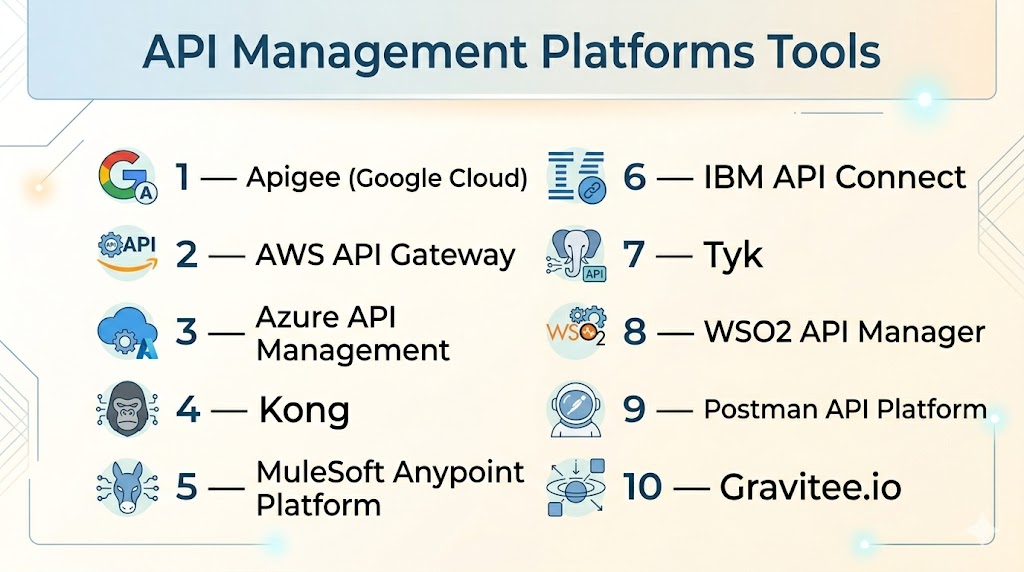
Top 10 API Management Platforms Tools
#1 — Apigee (Google Cloud)
Short description: A full-featured API management platform designed for enterprises needing scalability, analytics, and API monetization.
Key Features
- Advanced API gateway and traffic management
- API analytics and reporting
- API monetization capabilities
- Developer portal tools
- Policy-based security controls
- Traffic optimization
Pros
- Enterprise-grade scalability
- Strong analytics capabilities
Cons
- Complex setup
- Expensive for smaller teams
Platforms / Deployment
Cloud / Hybrid
Security & Compliance
SSO, RBAC, encryption, audit logs
Compliance: Varies / Not publicly stated
Integrations & Ecosystem
Integrates deeply with cloud and enterprise systems.
- Kubernetes
- Data platforms
- Serverless tools
- CI/CD pipelines
Support & Community
Strong enterprise support with detailed documentation and a mature user base.
#2 — AWS API Gateway
Short description: A managed API service for building, deploying, and scaling APIs within the AWS ecosystem.
Key Features
- REST and WebSocket APIs
- Automatic scaling
- Traffic throttling and caching
- Monitoring and logging
- Serverless integration
Pros
- Seamless cloud integration
- Highly scalable
Cons
- Vendor lock-in
- Pricing complexity
Platforms / Deployment
Cloud
Security & Compliance
IAM, encryption, RBAC
Compliance: Varies / Not publicly stated
Integrations & Ecosystem
Deep integration with cloud services.
- Serverless functions
- Storage systems
- Monitoring tools
Support & Community
Extensive documentation and a very large developer community.
#3 — Azure API Management
Short description: A comprehensive API management solution suited for organizations using Microsoft technologies.
Key Features
- API gateway and lifecycle tools
- Developer portal
- Policy-based controls
- Analytics dashboards
- Hybrid deployment
Pros
- Strong enterprise integration
- Flexible deployment
Cons
- Complex interface
- Tiered pricing structure
Platforms / Deployment
Cloud / Hybrid
Security & Compliance
SSO, RBAC, encryption
Compliance: Varies / Not publicly stated
Integrations & Ecosystem
Works well within enterprise ecosystems.
- Identity systems
- Automation tools
- Cloud services
Support & Community
Reliable enterprise support and extensive documentation.
#4 — Kong
Short description: A high-performance API gateway with both open-source and enterprise offerings.
Key Features
- Lightweight API gateway
- Plugin-based architecture
- Kubernetes-native support
- Service mesh integration
- High throughput performance
Pros
- Highly customizable
- Strong community support
Cons
- Requires technical expertise
- Advanced features are paid
Platforms / Deployment
Cloud / Self-hosted / Hybrid
Security & Compliance
RBAC, authentication plugins
Compliance: Not publicly stated
Integrations & Ecosystem
Highly extensible architecture.
- Kubernetes
- Monitoring tools
- Logging systems
Support & Community
Large open-source community and enterprise support options.
#5 — MuleSoft Anypoint Platform
Short description: A unified platform for API management and enterprise integration.
Key Features
- API lifecycle management
- Integration platform capabilities
- Prebuilt connectors
- Monitoring and analytics
- API design tools
Pros
- Strong integration ecosystem
- Enterprise-grade capabilities
Cons
- High cost
- Learning curve
Platforms / Deployment
Cloud / Hybrid
Security & Compliance
SSO, encryption
Compliance: Varies / Not publicly stated
Integrations & Ecosystem
Extensive integration capabilities.
- Enterprise systems
- CRM platforms
- Databases
Support & Community
Strong enterprise support with structured onboarding.
#6 — IBM API Connect
Short description: A secure and scalable API management solution with strong governance features.
Key Features
- API gateway
- Lifecycle management
- Developer portal
- Analytics tools
- Governance controls
Pros
- Strong security
- Enterprise reliability
Cons
- Complex setup
- Expensive
Platforms / Deployment
Cloud / Self-hosted / Hybrid
Security & Compliance
Advanced access controls
Compliance: Varies / Not publicly stated
Integrations & Ecosystem
Designed for enterprise environments.
- Enterprise systems
- Data services
- Middleware
Support & Community
Enterprise-level support; smaller community presence.
#7 — Tyk
Short description: A flexible and cost-effective API management platform with open-source roots.
Key Features
- API gateway
- Analytics dashboard
- Developer portal
- GraphQL support
- Plugin extensions
Pros
- Flexible deployment
- Affordable
Cons
- UI could be improved
- Setup required
Platforms / Deployment
Cloud / Self-hosted / Hybrid
Security & Compliance
RBAC, encryption
Compliance: Not publicly stated
Integrations & Ecosystem
Extensible with plugins.
- CI/CD tools
- Databases
- Containers
Support & Community
Active community and optional commercial support.
#8 — WSO2 API Manager
Short description: A feature-rich open-source API management platform for custom enterprise solutions.
Key Features
- Full API lifecycle management
- Developer portal
- Analytics tools
- Multi-cloud support
- Identity integration
Pros
- Open-source flexibility
- Highly customizable
Cons
- Complex deployment
- UI limitations
Platforms / Deployment
Cloud / Self-hosted / Hybrid
Security & Compliance
SSO, RBAC
Compliance: Not publicly stated
Integrations & Ecosystem
Supports a wide range of integrations.
- Identity systems
- Databases
- Middleware
Support & Community
Strong open-source community and enterprise support options.
#9 — Postman API Platform
Short description: A developer-focused platform for API design, testing, and collaboration.
Key Features
- API testing and design
- Collaboration tools
- Mock servers
- Monitoring
- Documentation tools
Pros
- Easy to use
- Excellent for team collaboration
Cons
- Limited gateway features
- Not full API lifecycle management
Platforms / Deployment
Web / Desktop
Security & Compliance
SSO, encryption
Compliance: Not publicly stated
Integrations & Ecosystem
Strong developer ecosystem.
- Version control tools
- CI/CD pipelines
- Team collaboration tools
Support & Community
Large global developer community and extensive documentation.
#10 — Gravitee.io
Short description: A modern API platform with strong support for event-driven and reactive APIs.
Key Features
- API gateway
- Event-native API support
- Developer portal
- Analytics
- Policy management
Pros
- Supports async APIs
- Modern architecture
Cons
- Smaller ecosystem
- Less mature platform
Platforms / Deployment
Cloud / Self-hosted / Hybrid
Security & Compliance
RBAC, encryption
Compliance: Not publicly stated
Integrations & Ecosystem
Growing ecosystem focused on modern architectures.
- Messaging systems
- Containers
- Monitoring tools
Support & Community
Growing community with commercial support availability.
Comparison Table (Top 10)
| Tool Name | Best For | Platform(s) Supported | Deployment | Standout Feature | Public Rating |
|---|---|---|---|---|---|
| Apigee | Enterprises | Cloud | Hybrid | API monetization | N/A |
| AWS API Gateway | Cloud-native teams | Cloud | Cloud | Native cloud integration | N/A |
| Azure API Management | Microsoft users | Cloud | Hybrid | Enterprise integration | N/A |
| Kong | DevOps teams | Multi-platform | Hybrid | Plugin architecture | N/A |
| MuleSoft | Enterprise integration | Cloud | Hybrid | Integration + API | N/A |
| IBM API Connect | Large enterprises | Multi-platform | Hybrid | Governance | N/A |
| Tyk | Budget teams | Multi-platform | Hybrid | Open-source flexibility | N/A |
| WSO2 | Custom builds | Multi-platform | Hybrid | Customization | N/A |
| Postman | Developers | Web/Desktop | Cloud | Collaboration | N/A |
| Gravitee | Event-driven APIs | Multi-platform | Hybrid | Async support | N/A |
Evaluation & Scoring of API Management Platforms
| Tool Name | Core (25%) | Ease (15%) | Integrations (15%) | Security (10%) | Performance (10%) | Support (10%) | Value (15%) | Weighted Total (0–10) |
|---|---|---|---|---|---|---|---|---|
| Apigee | 9 | 6 | 9 | 9 | 9 | 8 | 6 | 8.0 |
| AWS API Gateway | 8 | 7 | 9 | 8 | 9 | 8 | 7 | 8.0 |
| Azure API Management | 8 | 6 | 9 | 8 | 8 | 8 | 7 | 7.8 |
| Kong | 9 | 6 | 8 | 7 | 9 | 7 | 8 | 7.9 |
| MuleSoft | 9 | 6 | 9 | 9 | 8 | 8 | 6 | 8.0 |
| IBM API Connect | 9 | 5 | 8 | 9 | 8 | 8 | 6 | 7.8 |
| Tyk | 8 | 7 | 7 | 7 | 8 | 7 | 8 | 7.7 |
| WSO2 | 8 | 6 | 8 | 7 | 8 | 7 | 8 | 7.7 |
| Postman | 6 | 9 | 8 | 7 | 7 | 8 | 9 | 7.8 |
| Gravitee | 8 | 7 | 7 | 7 | 8 | 7 | 8 | 7.7 |
How to interpret scores:
- These scores are comparative, not absolute
- Enterprise tools rank higher in features and security
- Open-source tools provide better value but require effort
- Choose based on your priorities (cost, ease, scalability)
Which API Management Platforms Tool Is Right for You?
Solo / Freelancer
- Best: Postman, Tyk
- Focus on ease of use and low cost
SMB
- Best: Tyk, Kong, Gravitee
- Balance affordability with scalability
Mid-Market
- Best: Kong, Azure API Management
- Need integrations and performance
Enterprise
- Best: Apigee, MuleSoft, IBM API Connect
- Focus on governance, compliance, and scale
Budget vs Premium
- Budget: Tyk, WSO2
- Premium: Apigee, MuleSoft
Feature Depth vs Ease of Use
- Easy: Postman
- Advanced: Apigee, IBM
Integrations & Scalability
- Cloud-native: AWS API Gateway
- Enterprise ecosystems: Azure API Management
Security & Compliance Needs
- High: IBM, Apigee
- Moderate: Kong, Tyk
Frequently Asked Questions (FAQs)
What is an API management platform?
It is a system that helps manage the lifecycle of APIs including creation, security, monitoring, and scaling.
How much do API management tools cost?
Costs vary from free open-source tools to premium enterprise solutions with custom pricing.
Do small businesses need API management?
Not always. It depends on the number of APIs and integrations required.
What’s the difference between API gateway and API management?
A gateway handles requests, while management platforms handle the entire lifecycle.
Are open-source tools reliable?
Yes, but they require technical expertise for setup and maintenance.
How long does implementation take?
It can range from a few days to several months depending on complexity.
Can I migrate between tools?
Yes, but it can be complex depending on your architecture.
What security features are essential?
Authentication, rate limiting, encryption, and monitoring are key.
Do these platforms support modern APIs?
Most support REST, and many now support GraphQL and async APIs.
What are alternatives to API management platforms?
Service meshes, direct integrations, or lightweight API gateways.
Conclusion
API management platforms play a critical role in modern software architecture, helping teams build scalable, secure, and efficient systems. The right choice depends on your specific needs—whether that’s enterprise-level governance, developer-friendly tools, or cost-effective flexibility.
Some tools prioritize deep integrations and advanced features, while others focus on simplicity and ease of use. Understanding your requirements is key to making the right decision.
Instead of choosing the most popular option, shortlist a few tools that align with your goals and test them in real-world scenarios. This approach ensures you select a platform that truly fits your architecture and growth plans.
