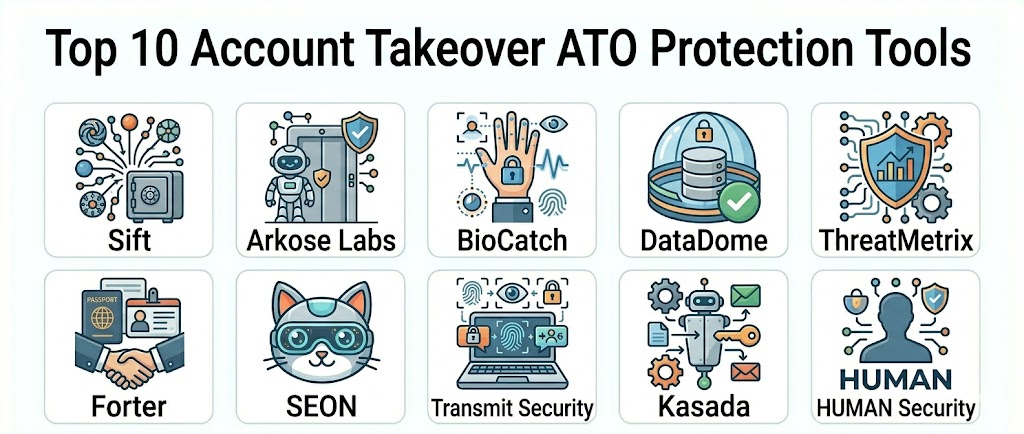
Introduction
Account Takeover ATO protection tools help organizations detect, block, and reduce unauthorized access attempts where attackers use stolen credentials, phishing, credential stuffing, bots, malware, session hijacking, or social engineering to take control of user accounts. These tools analyze login behavior, device intelligence, bot activity, IP reputation, behavioral biometrics, identity signals, leaked credentials, and transaction context to identify risky sessions before damage happens.
ATO protection is important because compromised accounts can lead to fraud, data theft, payment abuse, loyalty-point theft, privacy violations, reputational damage, and customer churn. Traditional passwords and basic login rules are no longer enough because attackers use automation, breached credentials, residential proxies, and human-assisted fraud tactics.
Common use cases include protecting customer logins, stopping credential stuffing, detecting suspicious devices, preventing bot-based attacks, securing fintech accounts, reducing ecommerce fraud, protecting SaaS user accounts, and monitoring high-risk account changes. Buyers should evaluate detection accuracy, bot protection, device fingerprinting, behavioral analytics, MFA orchestration, API coverage, fraud scoring, reporting, integrations, scalability, and false-positive management.
Best for: ecommerce companies, fintech platforms, banks, SaaS providers, marketplaces, gaming platforms, healthcare portals, identity teams, fraud teams, and security operations teams. Not ideal for: small websites with very low login volume, internal tools already protected by strong identity controls, or teams that only need basic password reset and MFA features.
Key Trends in Account Takeover ATO Protection Tools
- Credential stuffing defense is becoming a core requirement because attackers continuously test leaked username and password combinations across login pages.
- Device intelligence is now central to ATO prevention because suspicious devices, emulators, automation tools, and proxy patterns often reveal account abuse.
- Behavioral analytics is growing quickly as platforms analyze typing behavior, session patterns, navigation flow, and user intent signals.
- Bot mitigation and ATO protection are converging because many account takeover attempts start with automated login attacks.
- Risk-based authentication is replacing one-size-fits-all MFA so trusted users face less friction while suspicious sessions receive extra checks.
- Dark web and breached credential monitoring is becoming more common to detect exposed passwords before attackers exploit them.
- API login protection is more important because attackers increasingly target mobile apps, API endpoints, and backend authentication flows.
- Fraud and identity teams are working more closely as ATO attacks often lead to payments fraud, account changes, and withdrawal attempts.
- AI-driven scoring is improving detection by combining identity, device, network, transaction, and behavior signals.
- False-positive reduction is a major buying factor because blocking legitimate customers can hurt conversion, trust, and support costs.
How We Selected These Tools
This list was selected using a practical fraud prevention, identity security, bot defense, and customer account protection evaluation approach.
- We prioritized tools with strong relevance to account takeover detection, credential stuffing prevention, bot mitigation, device intelligence, or identity fraud protection.
- We included platforms suitable for ecommerce, fintech, SaaS, banking, marketplaces, and consumer applications.
- We evaluated real-time risk scoring, behavioral analytics, device fingerprinting, leaked credential detection, MFA orchestration, and session protection.
- We considered developer experience, API quality, integration flexibility, reporting workflows, and operational usability.
- We reviewed suitability for security teams, fraud teams, identity teams, and product teams.
- We prioritized tools that can reduce account abuse while minimizing friction for legitimate users.
- We included enterprise platforms, API-first tools, and specialized ATO protection solutions.
- We avoided guessing public ratings, unsupported certifications, or unverifiable compliance claims.
- We considered scalability across SMB, mid-market, and enterprise environments.
- We used “Not publicly stated” or “Varies / N/A” where details are uncertain.
Top 10 Account Takeover ATO Protection Tools
#1 — Sift
Short description: Sift is a digital trust and fraud prevention platform that helps businesses detect account takeover, payment fraud, fake accounts, and abuse across digital journeys. It analyzes behavioral signals, device data, network intelligence, transaction patterns, and user activity to produce risk insights. Sift is especially useful for marketplaces, fintech platforms, ecommerce businesses, and gaming companies dealing with complex fraud patterns. It is best suited for organizations that need cross-channel fraud visibility rather than only login protection.
Key Features
- Account takeover detection and prevention workflows
- Behavioral analytics and machine learning risk scoring
- Device, network, and identity signal analysis
- Payment fraud and account abuse detection
- Case management and investigation workflows
- Custom rules and fraud decisioning
- Cross-channel fraud intelligence
Pros
- Strong fit for ecommerce, fintech, marketplaces, and gaming
- Good behavioral analytics and risk scoring capabilities
- Useful for fraud teams managing multiple abuse types
- Helps reduce false positives through contextual scoring
Cons
- May require tuning for best results
- Enterprise workflows can take time to configure
- Pricing may scale with transaction or event volume
- Smaller businesses may not need full platform depth
Platforms / Deployment
Web / APIs / SDKs.
Cloud.
Security & Compliance
Supports fraud investigation workflows, access controls, event monitoring, and operational risk decisioning. Buyers should verify SSO, audit logs, data retention, encryption, and compliance documentation directly.
Integrations & Ecosystem
Sift integrates into digital commerce, fintech, marketplace, and fraud operations environments.
- Payment systems
- Ecommerce platforms
- Marketplace workflows
- Mobile and web applications
- Fraud operations systems
- Identity and onboarding workflows
Support & Community
Vendor-led support, documentation, onboarding resources, and fraud operations guidance are available. Best suited for teams with dedicated fraud or risk operations.
#2 — DataDome
Short description: DataDome is a bot and online fraud protection platform that helps protect websites, mobile apps, and APIs from automated attacks, credential stuffing, scraping, fake account creation, and account takeover attempts. It is especially useful for businesses with high login traffic and bot-driven abuse. DataDome focuses on real-time detection and mitigation of automated threats while preserving user experience. It is best suited for ecommerce, travel, ticketing, marketplaces, and digital platforms.
Key Features
- Bot detection and mitigation
- Credential stuffing protection
- Account takeover attack detection
- API and mobile app protection
- Device and browser fingerprinting
- Real-time traffic risk scoring
- Automated challenge and blocking workflows
Pros
- Strong bot-focused ATO defense
- Useful for high-traffic websites and apps
- Good real-time mitigation capabilities
- Helps protect APIs, mobile apps, and web properties
Cons
- Broader fraud investigation workflows may require additional tools
- Best suited for automated attack prevention rather than full identity governance
- Advanced policies may require careful tuning
- Pricing may vary based on traffic volume
Platforms / Deployment
Web / Mobile / APIs / Edge integrations.
Cloud.
Security & Compliance
Supports bot protection, traffic inspection, access controls, and operational security workflows. Buyers should validate compliance and data handling requirements directly.
Integrations & Ecosystem
DataDome integrates into online platforms where automated abuse and login attacks are major concerns.
- Web applications
- Mobile applications
- APIs
- Ecommerce platforms
- CDN and edge workflows
- Security operations systems
Support & Community
Vendor-led onboarding, technical support, documentation, and implementation guidance are available for production security teams.
#3 — Arkose Labs
Short description: Arkose Labs helps businesses stop account takeover, credential stuffing, bot attacks, fake account creation, and online abuse through risk-based challenges and fraud defense workflows. It is known for making attacks more expensive and difficult while reducing friction for legitimate users. Arkose Labs is especially useful for large consumer platforms, fintech companies, gaming businesses, and marketplaces. It is best for organizations facing automated and human-assisted attacks at scale.
Key Features
- Account takeover prevention
- Credential stuffing defense
- Bot and abuse mitigation
- Risk-based challenge workflows
- Fraud attack intelligence
- User friction management
- Protection for login, signup, and transaction flows
Pros
- Strong defense against automated and human-assisted attacks
- Useful for large-scale consumer applications
- Helps reduce attacker ROI
- Good fit for login and signup protection
Cons
- Challenge-based workflows require careful user experience design
- May be more than smaller businesses need
- Advanced deployment may require technical support
- Pricing may be enterprise-focused
Platforms / Deployment
Web / APIs / SDKs.
Cloud.
Security & Compliance
Supports risk-based fraud defense, access management workflows, and abuse mitigation. Buyers should verify enterprise security controls and compliance documentation directly.
Integrations & Ecosystem
Arkose Labs integrates into high-risk digital journeys where attackers target user accounts and platform workflows.
- Login flows
- Signup flows
- Transaction workflows
- Gaming platforms
- Fintech apps
- Marketplaces
Support & Community
Enterprise-focused onboarding, technical support, and fraud strategy resources are available. Strong fit for businesses facing sophisticated abuse campaigns.
#4 — SpyCloud
Short description: SpyCloud helps organizations prevent account takeover by identifying exposed credentials, malware-compromised data, session cookies, and identity intelligence from criminal sources. It is especially useful for stopping attacks before stolen credentials are used against customer or employee accounts. SpyCloud is best suited for security teams, fraud teams, and identity teams that need upstream intelligence about compromised accounts.
Key Features
- Breached credential monitoring
- Malware-exfiltrated data intelligence
- Account takeover prevention workflows
- Password reset and remediation triggers
- Identity exposure intelligence
- Session and cookie compromise insights
- Fraud and security team workflows
Pros
- Strong upstream ATO prevention approach
- Useful for detecting compromised credentials early
- Good fit for identity and fraud teams
- Helps reduce credential stuffing risk
Cons
- Runtime login defense may require pairing with other tools
- Value depends on remediation workflows
- Requires integration with identity and security systems
- Not a full bot mitigation platform by itself
Platforms / Deployment
Web / APIs / Security integrations.
Cloud.
Security & Compliance
Supports breached credential intelligence and remediation workflows. Buyers should verify access controls, audit logs, encryption, and compliance documentation directly.
Integrations & Ecosystem
SpyCloud integrates into identity, security operations, and fraud prevention workflows.
- Identity providers
- SIEM platforms
- SOAR workflows
- Password reset systems
- Fraud operations
- Security monitoring tools
Support & Community
Vendor-led support, documentation, and implementation guidance are available. Best suited for mature security teams that can act on compromised credential intelligence.
#5 — Fingerprint
Short description: Fingerprint provides device intelligence and visitor identification capabilities that help businesses detect suspicious logins, account sharing, credential stuffing, fraud, and account takeover patterns. It is developer-friendly and works well as a risk signal layer within broader fraud and identity workflows. Fingerprint is especially useful for teams that need accurate device identification across web and mobile sessions. It is best suited for developers, fraud teams, and product teams building custom risk decisioning.
Key Features
- Device fingerprinting and visitor identification
- VPN, proxy, and suspicious signal detection
- Account takeover risk signals
- Fraud scoring support
- API-first developer experience
- Web and mobile support
- Useful for custom risk engines
Pros
- Strong device intelligence capabilities
- Developer-friendly APIs
- Useful as a risk signal layer
- Good fit for custom ATO workflows
Cons
- Not a complete fraud platform by itself
- Requires internal decisioning logic or orchestration
- Privacy and consent requirements must be managed carefully
- Advanced use cases may require tuning
Platforms / Deployment
Web / APIs / SDKs.
Cloud.
Security & Compliance
Supports secure API workflows and device intelligence features. Buyers should verify privacy, consent, data handling, and compliance requirements directly.
Integrations & Ecosystem
Fingerprint integrates into custom fraud, identity, and authentication workflows.
- Web applications
- Mobile applications
- Login flows
- Fraud scoring systems
- Identity platforms
- Risk engines
Support & Community
Strong developer documentation and support resources are available. Best suited for teams with engineering capacity to build custom workflows.
#6 — BioCatch
Short description: BioCatch is a behavioral biometric and digital fraud detection platform that helps identify account takeover, social engineering, mule activity, and suspicious user behavior. It analyzes how users interact with digital systems, including mouse movement, typing rhythm, navigation patterns, and session behavior. BioCatch is especially useful for banks, fintech companies, and financial institutions dealing with sophisticated fraud. It is best suited for high-risk financial workflows.
Key Features
- Behavioral biometric analysis
- Account takeover detection
- Social engineering and scam detection support
- Mule account risk signals
- Device and session intelligence
- Real-time risk scoring
- Financial fraud workflow support
Pros
- Strong behavioral analytics depth
- Good fit for banking and fintech use cases
- Helps detect fraud even when credentials are valid
- Useful for scam and social engineering detection
Cons
- Enterprise implementation may require planning
- Best suited for high-risk financial environments
- Pricing may be premium-focused
- Requires operational workflows to act on risk signals
Platforms / Deployment
Web / APIs / Enterprise fraud infrastructure.
Cloud / Hybrid / Varies.
Security & Compliance
Supports behavioral fraud monitoring and enterprise risk workflows. Buyers should verify access controls, auditability, data handling, and compliance documentation directly.
Integrations & Ecosystem
BioCatch integrates into banking, fintech, fraud operations, and transaction monitoring workflows.
- Digital banking platforms
- Payment systems
- Fraud operations
- Transaction monitoring tools
- Identity platforms
- Risk decisioning systems
Support & Community
Enterprise support, onboarding, and fraud strategy guidance are available. Best suited for organizations with mature fraud operations.
#7 — Okta Customer Identity
Short description: Okta Customer Identity helps businesses protect customer accounts through identity management, adaptive authentication, MFA, bot detection, suspicious login detection, and risk-based access policies. It is especially useful for SaaS platforms, customer portals, and digital businesses that want identity security embedded into authentication workflows. Okta is best suited for organizations that need scalable customer identity and access management with ATO prevention controls.
Key Features
- Customer identity and access management
- Adaptive authentication
- MFA and passwordless authentication support
- Suspicious login detection
- Bot and credential stuffing protection features
- Policy-based access controls
- Integration with apps and identity workflows
Pros
- Strong identity platform ecosystem
- Useful for customer login protection
- Good MFA and adaptive access support
- Scales well for SaaS and enterprise applications
Cons
- Not a dedicated fraud platform
- Advanced fraud detection may require additional tools
- Implementation can require identity architecture planning
- Pricing may vary by user volume and features
Platforms / Deployment
Web / APIs / SDKs.
Cloud.
Security & Compliance
Supports MFA, SSO, adaptive access, encryption, audit logging, identity policies, and access governance workflows. Buyers should verify requirements directly.
Integrations & Ecosystem
Okta integrates broadly into authentication, identity, and SaaS application environments.
- Web applications
- Mobile applications
- Customer portals
- SaaS platforms
- Identity providers
- Security workflows
Support & Community
Strong enterprise support, documentation, integrations marketplace, and identity ecosystem adoption.
#8 — Microsoft Entra ID Protection
Short description: Microsoft Entra ID Protection helps organizations detect identity risks, suspicious sign-ins, leaked credentials, and risky users across Microsoft identity environments. It is especially useful for enterprises using Microsoft cloud and identity infrastructure. While more focused on workforce identity than consumer fraud, it is highly relevant for preventing account takeover inside enterprise environments. It is best suited for organizations standardized on Microsoft identity.
Key Features
- Risky sign-in detection
- Leaked credential detection
- Conditional access integration
- MFA enforcement workflows
- Identity risk scoring
- User risk policy controls
- Microsoft security ecosystem integration
Pros
- Strong fit for Microsoft environments
- Useful for workforce ATO prevention
- Integrates with conditional access and MFA
- Good enterprise identity risk visibility
Cons
- Best suited for Microsoft identity ecosystems
- Less focused on ecommerce or consumer fraud
- Advanced configurations require identity expertise
- May need pairing with fraud tools for customer-facing apps
Platforms / Deployment
Web / Microsoft cloud services.
Cloud / Hybrid depending on identity architecture.
Security & Compliance
Supports identity risk policies, conditional access, MFA, audit logs, and enterprise identity security workflows.
Integrations & Ecosystem
Microsoft Entra ID Protection integrates into Microsoft identity and security environments.
- Microsoft Entra ID
- Conditional Access
- Microsoft Defender ecosystem
- Microsoft Sentinel
- Microsoft cloud apps
- Enterprise identity workflows
Support & Community
Strong Microsoft documentation, enterprise support plans, partner ecosystem, and security community adoption.
#9 — Cloudflare Bot Management
Short description: Cloudflare Bot Management helps protect websites, applications, and APIs from malicious bots, credential stuffing, scraping, and automated account takeover attempts. It sits at the edge to analyze traffic patterns, bot signals, device characteristics, and request behavior before attackers reach origin systems. Cloudflare is especially useful for organizations already using Cloudflare for CDN, WAF, DDoS protection, and application security. It is best suited for high-traffic web applications and API-driven businesses.
Key Features
- Bot detection and mitigation
- Credential stuffing protection support
- Edge-based traffic analysis
- API and web application protection
- Machine learning bot scoring
- WAF and security ecosystem integration
- Rules and challenge workflows
Pros
- Strong edge security ecosystem
- Useful for high-volume automated attack prevention
- Good fit for web and API protection
- Integrates with broader Cloudflare services
Cons
- Not a full fraud investigation platform
- ATO workflows may require additional identity or fraud tools
- Advanced tuning may be needed to reduce friction
- Best suited for web and API traffic protection
Platforms / Deployment
Web / Edge / APIs.
Cloud.
Security & Compliance
Supports WAF, DDoS protection, bot mitigation, access controls, logging, and traffic security workflows. Buyers should verify compliance needs directly.
Integrations & Ecosystem
Cloudflare integrates into application security, edge delivery, and infrastructure protection workflows.
- Web applications
- APIs
- CDN workflows
- WAF policies
- Security operations
- Zero trust workflows
Support & Community
Strong documentation, enterprise support options, and broad security ecosystem adoption.
#10 — HUMAN Security
Short description: HUMAN Security protects digital businesses from bot attacks, credential stuffing, account takeover, scraping, ad fraud, and automated abuse. It focuses on identifying and disrupting malicious automated activity across web, mobile, and API environments. HUMAN Security is especially useful for large digital platforms, ecommerce companies, media businesses, and marketplaces facing sophisticated bot-driven fraud. It is best suited for organizations needing strong bot intelligence and fraud defense.
Key Features
- Bot detection and mitigation
- Credential stuffing and ATO protection
- Web, mobile, and API protection
- Behavioral and machine learning analysis
- Fraud and abuse intelligence
- Real-time decisioning workflows
- Protection against automated digital attacks
Pros
- Strong bot intelligence capabilities
- Good fit for large-scale digital platforms
- Useful for multiple fraud and abuse types
- Helps protect login, payment, and content workflows
Cons
- Enterprise-focused deployment may require planning
- Not primarily an identity provider
- Pricing may be premium for smaller businesses
- Advanced policies may need tuning and monitoring
Platforms / Deployment
Web / Mobile / APIs / Security infrastructure.
Cloud.
Security & Compliance
Supports bot mitigation, traffic analysis, account protection, and operational security workflows. Buyers should verify enterprise controls and compliance documentation directly.
Integrations & Ecosystem
HUMAN Security integrates into web, mobile, API, and digital fraud protection environments.
- Ecommerce platforms
- Web applications
- Mobile apps
- APIs
- Security operations
- Fraud prevention workflows
Support & Community
Enterprise support, onboarding, documentation, and threat intelligence resources are available for large digital businesses.
Comparison Table
| Tool Name | Best For | Platform Supported | Deployment | Standout Feature | Public Rating |
|---|---|---|---|---|---|
| Sift | Cross-channel fraud and ATO detection | Web / APIs / SDKs | Cloud | Behavioral fraud scoring and decisioning | N/A |
| DataDome | Bot-driven ATO prevention | Web / Mobile / APIs | Cloud | Real-time bot and credential stuffing defense | N/A |
| Arkose Labs | Large-scale abuse and ATO defense | Web / APIs / SDKs | Cloud | Risk-based challenge workflows | N/A |
| SpyCloud | Breached credential intelligence | Web / APIs | Cloud | Upstream compromised credential detection | N/A |
| Fingerprint | Device intelligence for ATO workflows | Web / APIs / SDKs | Cloud | Accurate device and visitor identification | N/A |
| BioCatch | Behavioral biometric fraud detection | Web / APIs | Cloud / Hybrid / Varies | Behavioral analytics for valid-credential fraud | N/A |
| Okta Customer Identity | Customer identity and adaptive authentication | Web / APIs / SDKs | Cloud | CIAM with adaptive access controls | N/A |
| Microsoft Entra ID Protection | Enterprise identity risk protection | Microsoft cloud services | Cloud / Hybrid | Risky sign-in and user risk detection | N/A |
| Cloudflare Bot Management | Edge-based bot and login attack defense | Web / Edge / APIs | Cloud | Edge-level bot scoring and mitigation | N/A |
| HUMAN Security | Sophisticated bot and digital abuse defense | Web / Mobile / APIs | Cloud | Bot intelligence across digital journeys | N/A |
Evaluation & Scoring of Account Takeover ATO Protection Tools
| Tool Name | Core | Ease | Integrations | Security | Performance | Support | Value | Weighted Total |
|---|---|---|---|---|---|---|---|---|
| Sift | 9 | 8 | 8 | 8 | 8 | 8 | 7 | 8.00 |
| DataDome | 9 | 8 | 8 | 8 | 9 | 8 | 7 | 8.15 |
| Arkose Labs | 9 | 7 | 8 | 8 | 8 | 8 | 7 | 7.90 |
| SpyCloud | 8 | 8 | 8 | 8 | 8 | 8 | 8 | 8.00 |
| Fingerprint | 8 | 9 | 8 | 8 | 9 | 8 | 8 | 8.30 |
| BioCatch | 9 | 7 | 8 | 9 | 8 | 8 | 7 | 8.05 |
| Okta Customer Identity | 8 | 8 | 9 | 9 | 8 | 9 | 7 | 8.25 |
| Microsoft Entra ID Protection | 8 | 8 | 9 | 9 | 8 | 9 | 8 | 8.40 |
| Cloudflare Bot Management | 8 | 8 | 9 | 9 | 9 | 8 | 8 | 8.45 |
| HUMAN Security | 9 | 7 | 8 | 9 | 9 | 8 | 7 | 8.15 |
These scores are comparative and should be used as a shortlist guide, not a universal ranking. Bot-focused tools are strong for credential stuffing and automated abuse, while identity platforms are better for adaptive authentication and workforce protection. Fraud platforms provide broader cross-channel decisioning, while device intelligence tools are best used as risk signals inside a custom workflow. Buyers should validate false-positive rates, latency, integration effort, and coverage across web, mobile, and API channels before production rollout.
Which Account Takeover ATO Protection Tool Is Right for You?
Solo / Freelancer
Solo developers and small product builders should prioritize tools that are easy to integrate and do not require a large fraud operations team. Fingerprint, Cloudflare Bot Management, and basic identity protections from Okta or Microsoft environments can be practical starting points. For very small projects, strong MFA, rate limiting, password hygiene, and bot protection may be enough before investing in a full enterprise fraud platform.
SMB
SMBs should focus on fast deployment, low operational complexity, and strong protection against credential stuffing and suspicious logins. DataDome, Fingerprint, Cloudflare Bot Management, Sift, and Okta Customer Identity can be strong options depending on whether the business needs bot defense, device intelligence, fraud scoring, or identity controls. SMBs should avoid overly complex enterprise systems unless fraud losses justify the investment.
Mid-Market
Mid-market businesses often need layered ATO protection across login, signup, password reset, payment, and account-change workflows. Sift, Arkose Labs, SpyCloud, DataDome, BioCatch, and HUMAN Security can be strong choices depending on attack patterns. Teams should prioritize tools that support APIs, mobile apps, investigation workflows, and risk-based authentication.
Enterprise
Enterprises should combine identity security, bot mitigation, fraud intelligence, breached credential monitoring, and behavioral analytics. Microsoft Entra ID Protection and Okta Customer Identity are strong for identity-centric protection, while DataDome, HUMAN Security, Arkose Labs, Sift, BioCatch, and SpyCloud provide additional fraud and abuse coverage. Large organizations should prioritize audit logs, policy management, SIEM integration, compliance workflows, and operational response.
Budget vs Premium
Budget-focused teams should start with strong identity controls, MFA, rate limiting, Cloudflare-style bot defenses, and device intelligence APIs. Premium platforms provide broader risk scoring, case management, behavioral analytics, credential intelligence, and enterprise support. The right investment depends on account value, fraud exposure, login volume, and customer friction tolerance.
Feature Depth vs Ease of Use
Fingerprint and Cloudflare are relatively easy to operationalize for focused risk signals and traffic protection. Sift, BioCatch, Arkose Labs, HUMAN Security, and DataDome provide deeper fraud and abuse capabilities but may require more configuration. Okta and Microsoft are strong when account takeover protection needs to be built into identity architecture.
Integrations & Scalability
ATO protection should integrate with login systems, identity providers, payment platforms, fraud tools, SIEM systems, customer support workflows, and mobile apps. Scalability depends on traffic volume, latency, API reliability, event ingestion, and case management. Teams should test across real login traffic, not only demo environments.
Security & Compliance Needs
ATO tools often process sensitive login, device, identity, and behavioral data. Buyers should evaluate encryption, access controls, audit logs, data retention, regional data handling, privacy requirements, and incident response support. Regulated businesses should also verify how risk decisions are logged and explained.
Frequently Asked Questions
1. What are Account Takeover ATO protection tools?
Account Takeover ATO protection tools help detect and block unauthorized attempts to access user accounts. They analyze login behavior, device signals, IP reputation, bot activity, leaked credentials, and user behavior to identify suspicious sessions. These tools help reduce fraud, data theft, account abuse, and customer trust issues. They are widely used in ecommerce, fintech, SaaS, banking, and consumer applications.
2. How do attackers take over accounts?
Attackers commonly use stolen passwords, credential stuffing, phishing, malware, social engineering, SIM swap attacks, session hijacking, and automated bots. They may also use residential proxies and real devices to bypass simple security checks. Once inside an account, they can steal data, change payment details, make purchases, or move funds. ATO protection tools help identify suspicious patterns before damage occurs.
3. Is MFA enough to stop account takeover?
MFA significantly improves security, but it is not enough by itself. Attackers can bypass weak MFA through phishing, push fatigue, SIM swap attacks, malware, or session theft. Strong ATO prevention combines MFA with device intelligence, behavioral analytics, bot protection, risk-based authentication, and breached credential monitoring. The best approach is layered defense.
4. What is credential stuffing?
Credential stuffing is an attack where criminals use leaked username and password combinations from previous breaches to try logging into other services. Since many users reuse passwords, these attacks can be highly effective. Bots often automate credential stuffing at large scale. ATO tools detect suspicious login patterns, abnormal velocity, and reused compromised credentials.
5. What is device fingerprinting in ATO prevention?
Device fingerprinting identifies characteristics of a user’s browser, device, network, and environment to recognize returning or suspicious devices. It helps detect account access from new, spoofed, automated, or risky devices. Device intelligence is especially useful when credentials appear valid but the session context looks suspicious. It is often used as one signal inside a broader fraud scoring model.
6. What is behavioral biometrics?
Behavioral biometrics analyzes how users interact with digital systems, including typing rhythm, mouse movement, touchscreen behavior, navigation flow, and session patterns. It can help detect fraud even when attackers have valid credentials. This is useful for banking, fintech, and high-risk account workflows. Behavioral signals are strongest when combined with other identity and transaction data.
7. Can ATO protection tools reduce customer friction?
Yes, good ATO tools reduce friction by applying extra checks only when risk is high. Trusted users can continue with normal login experiences, while suspicious sessions may face MFA, CAPTCHA, step-up verification, or blocking. This risk-based approach improves both security and customer experience. False-positive management is a key buying factor.
8. Do ATO tools protect APIs and mobile apps?
Many modern ATO tools protect web applications, mobile apps, and APIs. API and mobile protection are important because attackers often target backend authentication endpoints directly. Buyers should confirm SDK support, API coverage, mobile telemetry, and session-level visibility. Web-only protection may not be enough for modern digital platforms.
9. What are common mistakes in ATO prevention?
Common mistakes include relying only on passwords, deploying MFA without risk scoring, ignoring mobile and API login flows, and failing to monitor breached credentials. Another mistake is blocking too aggressively and frustrating legitimate users. Successful ATO prevention requires layered controls, clear response workflows, and continuous tuning. Teams should review both security outcomes and customer experience metrics.
10. How should organizations choose the right ATO protection tool?
Organizations should start by identifying their main attack patterns, such as credential stuffing, bot traffic, phishing, session hijacking, or insider misuse. They should evaluate device intelligence, behavioral analytics, identity integrations, bot mitigation, breached credential monitoring, reporting, and operational workflows. A pilot using real login traffic is the best way to measure accuracy and false positives. The right tool depends on business model, traffic volume, risk level, and existing identity stack.
Conclusion
Account Takeover ATO protection tools are essential for organizations that depend on trusted digital accounts, customer logins, payment workflows, and secure user experiences. Tools such as Sift, DataDome, Arkose Labs, SpyCloud, Fingerprint, BioCatch, Okta Customer Identity, Microsoft Entra ID Protection, Cloudflare Bot Management, and HUMAN Security all address different parts of the ATO problem, from breached credential intelligence and bot mitigation to behavioral analytics and adaptive authentication. The best solution depends on your threat model, login volume, user friction tolerance, fraud exposure, and existing identity architecture. No single platform solves every ATO scenario, so layered defense is usually the strongest approach. Start by shortlisting two or three tools, test them against real login and account-change traffic, validate false-positive rates and response workflows, then scale the chosen protections across web, mobile, and API channels.

This article clearly explains account takeover protection tools and how they help organizations prevent unauthorized access and strengthen account security.
This article clearly explains account takeover protection tools and how they help organizations prevent unauthorized access and improve overall account security.
Account takeover prevention is most effective when combined with strong identity verification and continuous monitoring. Attack patterns evolve quickly, making adaptive defenses essential.