Introduction
Edge Device Management Tools help organizations monitor, configure, secure, and maintain distributed edge devices such as IoT gateways, industrial systems, retail kiosks, smart sensors, and remote computing infrastructure. These platforms centralize edge operations, making it easier to deploy updates, monitor performance, automate provisioning, enforce security policies, and manage device lifecycles across geographically distributed environments. As edge computing adoption grows, enterprises increasingly depend on these tools to reduce operational complexity and improve visibility across remote infrastructure.
Real-world use cases include managing industrial IoT gateways in manufacturing plants, remotely updating retail POS and kiosk devices, securing smart city infrastructure, monitoring edge AI devices in logistics operations, and orchestrating firmware updates for healthcare or telecom edge systems. Modern edge management tools increasingly incorporate AI-assisted monitoring, Zero Trust security, remote diagnostics, telemetry analytics, and automated remediation to support large-scale deployments.
Evaluation Criteria for Buyers:
- Device provisioning and lifecycle management
- Remote monitoring and telemetry visibility
- Security and compliance controls
- Firmware and software update automation
- Scalability across distributed edge environments
- Integration with IoT, cloud, and observability platforms
- AI-assisted monitoring and anomaly detection
- Remote troubleshooting and diagnostics
- Cross-platform and hardware compatibility
- Vendor support and ecosystem maturity
Best for: IoT operations teams, industrial organizations, telecom providers, smart infrastructure operators, retail chains, and enterprises managing distributed edge environments.
Not ideal for: Small organizations with minimal device infrastructure, businesses relying entirely on centralized cloud workloads, or environments with limited remote device management requirements.
Key Trends in Edge Device Management Tools
- AI-driven predictive maintenance and anomaly detection
- Unified cloud-to-edge visibility and orchestration
- Zero Trust security for edge infrastructure
- Remote firmware and OTA update automation
- Edge AI workload monitoring and optimization
- Integration with observability and SIEM platforms
- Containerized edge application management
- Real-time telemetry analytics from distributed devices
- Policy-based device compliance enforcement
- Hybrid cloud and multi-edge deployment support
How We Selected These Tools (Methodology)
- Evaluated enterprise adoption and ecosystem maturity
- Reviewed edge lifecycle and provisioning capabilities
- Assessed remote monitoring and telemetry features
- Analyzed firmware management and OTA update workflows
- Reviewed integration support with IoT, cloud, and observability systems
- Assessed scalability across distributed infrastructures
- Compared security controls and compliance capabilities
- Evaluated usability, automation, and deployment workflows
- Considered vendor support quality and community engagement
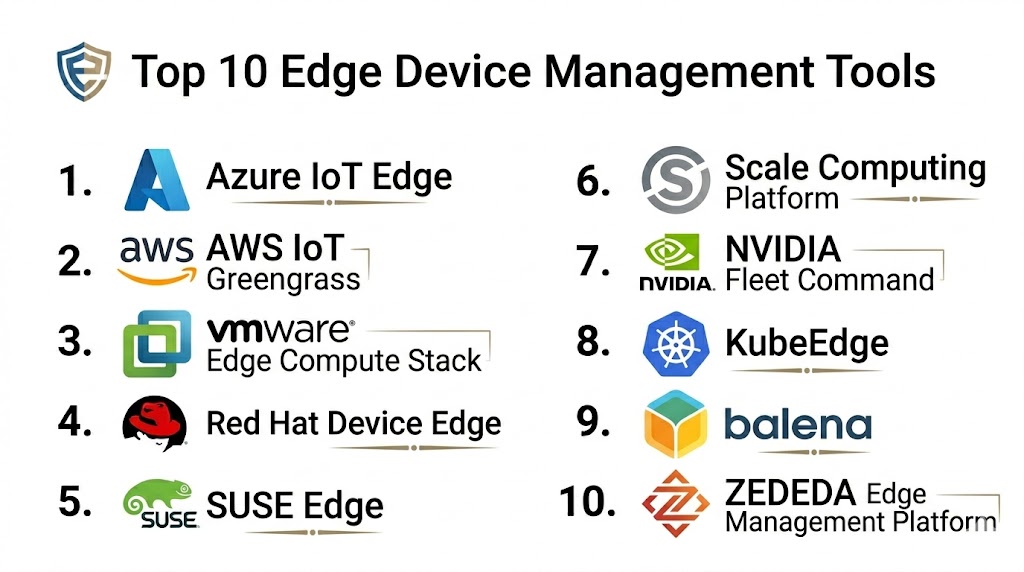
Top 10 Edge Device Management Tools
1 — AWS IoT Device Management
Short description: AWS IoT Device Management helps organizations securely onboard, organize, monitor, and remotely manage IoT and edge devices at scale across distributed environments.
Key Features
- Secure device onboarding and provisioning
- Remote device management and OTA updates
- Fleet indexing and device grouping
- Real-time monitoring and telemetry
- Integration with AWS IoT ecosystem
- Device job scheduling and automation
Pros
- Highly scalable cloud-native architecture
- Strong AWS ecosystem integrations
- Secure device lifecycle management
Cons
- Best suited for AWS-centric environments
- Advanced workflows require AWS expertise
- Pricing complexity for large fleets
Platforms / Deployment
- Web / Cloud
Security & Compliance
- IAM integration, encryption, audit logs
- Device authentication and policy enforcement
Integrations & Ecosystem
Integrates deeply with AWS IoT and analytics services.
- AWS Greengrass
- AWS Lambda
- CloudWatch, IoT Analytics
Support & Community
Enterprise AWS support, documentation, and large cloud community ecosystem.
2 — Microsoft Azure IoT Hub
Short description: Azure IoT Hub provides centralized edge device connectivity, management, telemetry processing, and remote update orchestration for enterprise IoT deployments.
Key Features
- Device provisioning and authentication
- Remote monitoring and diagnostics
- OTA firmware and configuration updates
- Device twins for state management
- Integration with Azure edge services
- Telemetry ingestion and analytics
Pros
- Strong Microsoft cloud integration
- Enterprise-scale device orchestration
- Good analytics and monitoring support
Cons
- Complex deployment for beginners
- Best fit for Azure-centric ecosystems
- Pricing can scale with telemetry volume
Platforms / Deployment
- Cloud / Hybrid
Security & Compliance
- MFA, encryption, RBAC
- Azure security compliance frameworks
Integrations & Ecosystem
Works with Azure cloud, analytics, and observability tools.
- Azure IoT Edge
- Defender for IoT
- Azure Monitor
Support & Community
Microsoft enterprise support and extensive documentation ecosystem.
3 — Balena
Short description: Balena provides container-based edge device management for IoT fleets with remote updates, monitoring, and application orchestration.
Key Features
- Containerized edge application deployment
- Remote OTA updates
- Fleet dashboards and telemetry
- Device health monitoring
- Git-based deployment workflows
- Cross-device fleet management
Pros
- Strong developer-friendly workflows
- Excellent for containerized edge apps
- Flexible deployment automation
Cons
- Requires containerization knowledge
- Smaller enterprise ecosystem
- Less suited for legacy device environments
Platforms / Deployment
- Linux-based edge devices
- Cloud / Hybrid
Security & Compliance
- Secure device communication
- Encryption and authentication controls
Integrations & Ecosystem
Integrates with CI/CD, container, and cloud workflows.
- Docker
- GitHub
- Cloud IoT integrations
Support & Community
Active developer community and enterprise support options.
4 — Siemens Industrial Edge Management
Short description: Siemens Industrial Edge Management focuses on industrial edge infrastructure with centralized orchestration, analytics, and lifecycle management for manufacturing environments.
Key Features
- Industrial edge orchestration
- Device provisioning and updates
- Centralized monitoring dashboards
- Edge analytics integration
- Secure industrial connectivity
- Containerized application management
Pros
- Strong industrial IoT focus
- Integration with Siemens automation ecosystem
- Good manufacturing visibility
Cons
- Best fit for Siemens-heavy environments
- Enterprise pricing model
- Specialized industrial learning curve
Platforms / Deployment
- Industrial edge systems
- Cloud / Hybrid
Security & Compliance
- Industrial security controls
- Access management and encryption
Integrations & Ecosystem
Integrates with Siemens automation and industrial systems.
- MindSphere
- Industrial automation tools
- Analytics platforms
Support & Community
Industrial enterprise support and partner ecosystem.
5 — Red Hat Device Edge
Short description: Red Hat Device Edge provides lightweight Kubernetes and Linux management for edge environments with centralized orchestration and automation.
Key Features
- Edge Kubernetes management
- Device provisioning and automation
- OTA updates and policy enforcement
- Lightweight Linux footprint
- Fleet telemetry visibility
- Integration with Red Hat ecosystem
Pros
- Strong open-source ecosystem
- Kubernetes-native management
- Good for distributed infrastructure
Cons
- Requires Kubernetes familiarity
- Enterprise features tied to Red Hat ecosystem
- Learning curve for smaller teams
Platforms / Deployment
- Linux edge systems
- Cloud / Hybrid
Security & Compliance
- RBAC, encryption, policy enforcement
- Compliance-focused Linux controls
Integrations & Ecosystem
Integrates with Red Hat OpenShift and automation stack.
- OpenShift
- Ansible
- Red Hat Insights
Support & Community
Enterprise support and large open-source ecosystem.
6 — VMware Edge Compute Stack
Short description: VMware Edge Compute Stack delivers edge infrastructure management with Kubernetes orchestration, virtualization, and centralized monitoring.
Key Features
- Edge infrastructure orchestration
- Kubernetes and VM support
- Remote monitoring and telemetry
- Policy-driven automation
- Secure workload management
- Lifecycle management workflows
Pros
- Strong virtualization ecosystem
- Unified cloud-to-edge management
- Enterprise-grade scalability
Cons
- Complex deployment architecture
- Best suited for VMware environments
- Premium enterprise pricing
Platforms / Deployment
- Edge servers / Hybrid cloud
Security & Compliance
- Encryption, RBAC, audit logs
- VMware security integration
Integrations & Ecosystem
Integrates with VMware infrastructure and cloud tools.
- Tanzu
- vSphere
- NSX
Support & Community
Enterprise support and VMware ecosystem resources.
7 — Cisco IoT Operations Dashboard
Short description: Cisco IoT Operations Dashboard provides centralized visibility, monitoring, and lifecycle management for industrial and enterprise edge devices.
Key Features
- Remote device monitoring
- Edge telemetry dashboards
- OTA firmware updates
- Secure device onboarding
- Policy management
- Integration with Cisco networking ecosystem
Pros
- Strong networking integration
- Good industrial and enterprise visibility
- Centralized fleet dashboards
Cons
- Best for Cisco-heavy infrastructures
- Enterprise licensing costs
- Some advanced workflows require customization
Platforms / Deployment
- Cloud / Hybrid
Security & Compliance
- Encryption, RBAC, audit logging
- Cisco security integration
Integrations & Ecosystem
Integrates with Cisco networking and security platforms.
- Cisco SecureX
- Meraki
- Industrial networking tools
Support & Community
Cisco enterprise support and knowledge base ecosystem.
8 — Mender
Short description: Mender focuses on secure OTA software updates and lifecycle management for Linux-based edge and IoT devices.
Key Features
- Secure OTA software updates
- Rollback protection for failed updates
- Device inventory management
- Remote troubleshooting
- Device grouping and monitoring
- API-driven automation
Pros
- Strong OTA update workflows
- Open-source flexibility
- Reliable rollback capabilities
Cons
- Focused mainly on update management
- Limited broader observability features
- Requires Linux expertise
Platforms / Deployment
- Linux-based devices
- Cloud / On-prem
Security & Compliance
- Secure update delivery
- Authentication and encryption controls
Integrations & Ecosystem
Works with Linux and DevOps ecosystems.
- CI/CD tools
- Embedded Linux workflows
- Cloud integrations
Support & Community
Active open-source community and enterprise support plans.
9 — Kaa IoT Platform
Short description: Kaa IoT Platform provides device management, telemetry monitoring, and analytics for distributed edge and IoT environments.
Key Features
- Device provisioning and onboarding
- Telemetry analytics and dashboards
- Remote monitoring
- Firmware update automation
- Integration APIs
- Fleet lifecycle management
Pros
- Flexible IoT platform architecture
- Good telemetry visibility
- API-friendly integrations
Cons
- Smaller ecosystem than hyperscalers
- Advanced workflows require customization
- Enterprise features may require additional setup
Platforms / Deployment
- Cloud / Hybrid
Security & Compliance
- Encryption and secure device communication
- Access management controls
Integrations & Ecosystem
Integrates with cloud and analytics systems.
- Cloud APIs
- IoT telemetry tools
- Analytics platforms
Support & Community
Vendor support and growing developer ecosystem.
10 — FoundriesFactory
Short description: FoundriesFactory provides secure Linux and edge device lifecycle management with OTA updates, observability, and DevSecOps integration.
Key Features
- Secure Linux edge management
- OTA updates and rollback controls
- Device telemetry and observability
- CI/CD integration
- Secure boot and signing workflows
- Fleet lifecycle automation
Pros
- Strong security-focused workflows
- DevSecOps integration capabilities
- Good Linux edge lifecycle management
Cons
- Linux-focused platform
- Requires DevOps familiarity
- Smaller ecosystem than major cloud vendors
Platforms / Deployment
- Linux edge devices
- Cloud / Hybrid
Security & Compliance
- Secure boot, encryption, signing workflows
- Policy and access controls
Integrations & Ecosystem
Integrates with Linux, CI/CD, and observability ecosystems.
- GitOps workflows
- Cloud integrations
- Linux build systems
Support & Community
Documentation, enterprise support, and developer community.
Comparison Table (Top 10)
| Tool Name | Best For | Platform(s) Supported | Deployment | Standout Feature | Public Rating |
|---|---|---|---|---|---|
| AWS IoT Device Management | Cloud IoT fleets | IoT / Edge devices | Cloud | Large-scale device orchestration | N/A |
| Azure IoT Hub | Enterprise IoT | Hybrid IoT systems | Cloud / Hybrid | Device twins & telemetry | N/A |
| Balena | Containerized edge apps | Linux edge devices | Cloud / Hybrid | Container deployment | N/A |
| Siemens Industrial Edge | Manufacturing | Industrial edge systems | Hybrid | Industrial edge orchestration | N/A |
| Red Hat Device Edge | Kubernetes edge | Linux edge devices | Cloud / Hybrid | Kubernetes-native edge mgmt | N/A |
| VMware Edge Compute | Enterprise edge infra | Edge servers | Hybrid | Unified virtualization & edge | N/A |
| Cisco IoT Dashboard | Industrial networking | Enterprise edge systems | Cloud / Hybrid | Networking integration | N/A |
| Mender | OTA updates | Linux devices | Cloud / On-prem | Secure OTA workflows | N/A |
| Kaa IoT Platform | Flexible IoT fleets | IoT devices | Cloud / Hybrid | Telemetry analytics | N/A |
| FoundriesFactory | Secure Linux edge | Linux edge devices | Cloud / Hybrid | Secure lifecycle automation | N/A |
Evaluation & Scoring
| Tool Name | Core (25%) | Ease (15%) | Integrations (15%) | Security (10%) | Performance (10%) | Support (10%) | Value (15%) | Weighted Total (0–10) |
|---|---|---|---|---|---|---|---|---|
| AWS IoT Device Mgmt | 9 | 8 | 9 | 9 | 9 | 8 | 7 | 8.6 |
| Azure IoT Hub | 9 | 8 | 9 | 9 | 8 | 8 | 7 | 8.5 |
| Balena | 8 | 8 | 8 | 8 | 8 | 7 | 8 | 8.0 |
| Siemens Industrial Edge | 9 | 7 | 8 | 9 | 8 | 8 | 6 | 8.0 |
| Red Hat Device Edge | 8 | 7 | 8 | 8 | 8 | 8 | 7 | 7.9 |
| VMware Edge Compute | 9 | 7 | 9 | 9 | 8 | 8 | 6 | 8.2 |
| Cisco IoT Dashboard | 8 | 7 | 8 | 8 | 8 | 8 | 7 | 7.8 |
| Mender | 7 | 8 | 7 | 8 | 8 | 7 | 8 | 7.6 |
| Kaa IoT Platform | 7 | 8 | 7 | 7 | 8 | 7 | 8 | 7.5 |
| FoundriesFactory | 8 | 7 | 8 | 9 | 8 | 7 | 7 | 7.9 |
Which Edge Device Management Tool Is Right for You?
Solo / Freelancer
Mender or Balena provide lightweight and developer-friendly edge management for small Linux or IoT deployments without enterprise complexity.
SMB
Balena, Kaa IoT Platform, or Mender offer affordable edge lifecycle management, OTA updates, and telemetry visibility for growing device fleets.
Mid-Market
Red Hat Device Edge and Cisco IoT Operations Dashboard provide scalable orchestration, monitoring, and policy management for expanding distributed infrastructures.
Enterprise
AWS IoT Device Management, Azure IoT Hub, VMware Edge Compute Stack, and Siemens Industrial Edge deliver enterprise-scale orchestration, security, telemetry analytics, and hybrid cloud integration.
Budget vs Premium
Budget-friendly options include Mender and Balena for Linux-based edge operations. Premium platforms such as AWS IoT, Azure IoT Hub, and VMware Edge Compute Stack focus on enterprise scalability and deep cloud integrations.
Feature Depth vs Ease of Use
AWS and Azure provide broad capabilities but require cloud expertise, while Balena and Mender prioritize simpler deployment workflows and developer-focused operations.
Integrations & Scalability
Organizations managing large-scale industrial or telecom deployments should prioritize tools with strong integrations into observability, cloud infrastructure, and security ecosystems. AWS, Azure, Cisco, and VMware perform strongly in enterprise integration scenarios.
Security & Compliance Needs
Industries handling sensitive infrastructure or regulated environments should prioritize secure OTA updates, policy enforcement, encryption, telemetry auditing, and Zero Trust support available in platforms like FoundriesFactory, AWS IoT, and Azure IoT Hub.
Frequently Asked Questions
1. What is edge device management?
Edge device management refers to centrally monitoring, securing, updating, and maintaining distributed edge and IoT devices from a unified management platform.
2. Why are edge management tools important?
They reduce operational complexity, improve visibility, automate updates, strengthen security, and simplify managing thousands of distributed devices.
3. What types of devices are managed?
These platforms manage IoT gateways, industrial systems, edge servers, retail kiosks, smart sensors, telecom devices, and AI edge hardware.
4. How do OTA updates work?
OTA (Over-the-Air) updates allow administrators to remotely deploy firmware, software, and configuration changes without physically accessing devices.
5. Are these platforms cloud-based?
Most modern edge management tools are cloud-managed, though several also support hybrid and on-premises deployment models.
6. How do edge management tools improve security?
They provide secure onboarding, encrypted communication, access controls, firmware signing, policy enforcement, and telemetry monitoring for threat detection.
7. Can these tools integrate with observability platforms?
Yes. Many integrate with monitoring, SIEM, analytics, and observability systems to centralize telemetry and alerts.
8. Are Linux devices commonly supported?
Yes. Linux is one of the most common operating systems in edge environments, and most platforms provide strong Linux support.
9. What industries benefit most from edge management?
Manufacturing, telecom, logistics, healthcare, retail, energy, and smart city operations commonly rely on edge management platforms.
10. What challenges should organizations expect?
Organizations should prepare for device compatibility issues, connectivity limitations, OTA testing, telemetry scaling, and security policy management during deployment.
Conclusion
Edge Device Management Tools are becoming essential for enterprises operating distributed IoT, industrial, retail, telecom, and edge AI environments. SMBs and developer-focused teams can leverage platforms like Balena or Mender for efficient Linux-based edge management and OTA updates, while enterprises often rely on AWS IoT Device Management, Azure IoT Hub, VMware Edge Compute Stack, or Siemens Industrial Edge for large-scale orchestration, telemetry visibility, automation, and security. The right platform depends on deployment scale, cloud strategy, device diversity, observability requirements, and security maturity. Organizations should shortlist a few tools, conduct pilot deployments across representative edge environments, validate OTA and telemetry workflows, and then scale gradually to ensure secure, reliable, and efficient edge operations.

This article gives a very clear breakdown of edge device management tools and makes it easier to understand their real-world advantages and limitations. The comparison format was especially useful and easy to follow.
This article gives a very clear and practical overview of edge device management tools with well-structured comparisons and useful insights. The simple explanations made it easier to understand the strengths and real-world use cases of each platform.
One operational challenge that is often underestimated in edge device management is configuration drift across geographically distributed fleets. Most comparisons focus on provisioning, monitoring, and updates, but large-scale edge environments frequently suffer from devices running slightly different configurations, certificates, container versions, or hardware-specific overrides that accumulate over time. The real test of an edge management platform is not just whether it can deploy changes, but whether it can continuously verify and enforce the intended state while operating under intermittent connectivity conditions. A useful evaluation would include drift detection, policy compliance reporting, automated remediation, and GitOps-style configuration management. Without these capabilities, organizations can end up spending more effort troubleshooting environment inconsistencies than managing the actual applications running at the edge.
Edge environments rarely operate under ideal conditions, which makes resilience a critical factor when evaluating device management solutions. Devices may experience prolonged offline periods, limited bandwidth, or inconsistent hardware configurations across locations. Examining how platforms handle state synchronization, policy enforcement during disconnections, and recovery after extended outages would provide a more realistic perspective on managing distributed edge infrastructure at scale.