Introduction
Revenue Operations Platforms help businesses align sales, marketing, customer success, finance, and leadership around one shared revenue process. In simple terms, these platforms connect customer data, pipeline visibility, forecasting, workflow automation, deal intelligence, and performance reporting into one operational layer. Instead of each team working with separate tools, different dashboards, and inconsistent numbers, RevOps platforms create a more unified view of revenue performance.
They matter because modern revenue teams face longer sales cycles, complex buying committees, tighter budgets, higher pressure on forecast accuracy, and growing demand for automation. Common use cases include pipeline inspection, sales forecasting, lead routing, territory planning, revenue analytics, quote-to-cash workflows, customer lifecycle tracking, and renewal visibility. Buyers should evaluate CRM depth, forecasting accuracy, AI capabilities, integrations, workflow flexibility, data quality, security controls, scalability, reporting, and total cost of ownership.
Best for: Revenue leaders, RevOps teams, sales operations teams, marketing operations teams, customer success leaders, B2B SaaS companies, enterprise sales teams, and fast-growing companies that need better pipeline control and cross-functional revenue visibility.
Not ideal for: Very small teams with simple sales cycles, businesses that only need basic contact management, or companies that are not ready to clean CRM data and standardize revenue processes.
Key Trends in Revenue Operations Platforms
- AI-assisted forecasting is becoming more common: RevOps teams are moving from manual spreadsheet forecasting to AI-supported deal scoring, risk detection, and pipeline prediction.
- Unified revenue data is a top priority: Businesses want one trusted view of leads, accounts, opportunities, activities, renewals, expansion, and churn risk.
- Conversation intelligence is merging with RevOps: Calls, meetings, emails, and buyer interactions are increasingly used as signals for deal health and coaching.
- CRM-native workflows remain critical: Tools that work deeply with Salesforce, HubSpot, Microsoft Dynamics, and other CRMs are easier for revenue teams to adopt.
- Automation is shifting toward decision support: Modern platforms do not just automate reminders; they recommend next steps, identify risk, and guide revenue execution.
- Security and governance expectations are higher: Buyers expect SSO, role-based access, audit logs, encryption, permission controls, and enterprise-grade admin features.
- Revenue lifecycle coverage is expanding: RevOps now includes new sales, renewals, expansion, customer success handoffs, billing visibility, and retention analytics.
- No-code configuration matters: RevOps teams want flexible workflows, dashboards, routing rules, and process automation without heavy engineering dependency.
- Integration depth is a major buying factor: Platforms that connect with CRM, marketing automation, sales engagement, BI, support, and billing systems are more valuable.
- Value-based buying is increasing: Buyers are more careful about overlap, adoption effort, seat cost, and measurable impact on revenue productivity.
How We Selected These Tools
The tools below were selected using a practical SaaS buyer-focused evaluation approach:
- Market adoption and mindshare: Preference was given to platforms widely recognized in RevOps, revenue intelligence, forecasting, sales engagement, and revenue lifecycle management.
- Feature completeness: Tools were evaluated for forecasting, pipeline management, analytics, automation, routing, data quality, reporting, and revenue visibility.
- Revenue team fit: The list balances enterprise, mid-market, and SMB-focused options rather than selecting only large enterprise platforms.
- Integration ecosystem: Strong CRM, marketing automation, sales engagement, customer success, BI, and data warehouse integrations were prioritized.
- Operational usefulness: Tools were assessed based on how well they reduce manual work, improve data accuracy, and support repeatable revenue processes.
- AI and automation relevance: Platforms with useful AI, orchestration, conversation analysis, or automation capabilities were considered more relevant.
- Security posture signals: Tools with visible enterprise admin controls, access management, auditability, and compliance posture were favored where confidently known.
- Scalability: The list includes platforms that can support growing sales teams, multi-region operations, complex reporting, and multi-team workflows.
- Ecosystem maturity: Documentation, onboarding, partner network, and marketplace strength were considered.
- Category balance: Since Revenue Operations Platforms is broad, the list includes CRM-centered platforms, revenue intelligence tools, forecasting platforms, routing tools, and lifecycle platforms.
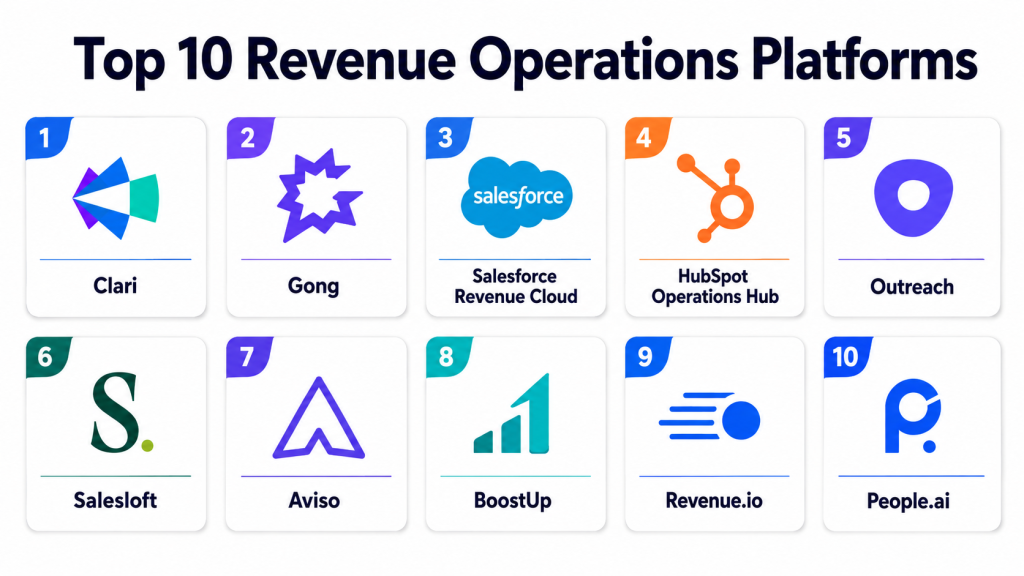
Top 10 Revenue Operations Platforms Tools
#1 — Salesforce Revenue Cloud
Short description: Salesforce Revenue Cloud is an enterprise-grade revenue platform built around CRM, quoting, pricing, contracts, billing, and revenue lifecycle management. It is best suited for organizations already using Salesforce as their core sales and customer system. Revenue teams use it to connect sales processes with pricing, approvals, product configuration, and revenue workflows. It is especially useful for complex B2B companies with multi-product sales motions and enterprise governance needs.
Key Features
- Quote-to-cash and revenue lifecycle management
- CRM-native pipeline and opportunity visibility
- Pricing, quoting, and approval workflow support
- Integration with Salesforce Sales Cloud and related Salesforce products
- Revenue analytics and forecasting through the Salesforce ecosystem
- Enterprise workflow automation and process controls
- Customization options for complex revenue models
Pros
- Strong fit for Salesforce-centric organizations
- Highly scalable for enterprise revenue operations
- Broad ecosystem of apps, partners, and integrations
- Useful for complex sales, pricing, and approval processes
Cons
- Can be expensive for smaller teams
- Implementation may require consultants or dedicated admins
- Customization can become complex if governance is weak
- Best value is usually achieved inside the Salesforce ecosystem
Platforms / Deployment
Web / iOS / Android
Cloud
Security & Compliance
Salesforce generally supports enterprise security features such as SSO, MFA, encryption, audit trails, role-based access controls, and advanced admin controls. Specific compliance coverage depends on product edition, configuration, region, and contract. Certifications should be verified during procurement.
Integrations & Ecosystem
Salesforce has one of the strongest ecosystems in the revenue operations market. It connects with sales, marketing, finance, support, analytics, data, and automation tools through native integrations, marketplace apps, APIs, and implementation partners.
- Salesforce Sales Cloud
- Salesforce Service Cloud
- Marketing automation platforms
- CPQ and billing tools
- BI and data warehouse tools
- Third-party workflow and integration platforms
Support & Community
Salesforce offers extensive documentation, training resources, partner support, implementation consultants, user groups, and enterprise support plans. The community is large, but successful adoption often depends on strong internal admins and governance.
#2 — HubSpot Operations Hub
Short description: HubSpot Operations Hub is designed for companies that want to connect apps, automate processes, clean customer data, and improve operational alignment across marketing, sales, and service teams. It is a strong fit for SMB and mid-market teams already using HubSpot CRM. RevOps teams use it to manage data sync, automation, workflow logic, reporting, and customer lifecycle visibility. It is easier to adopt than many enterprise-heavy platforms.
Key Features
- Two-way data sync between business apps
- Workflow automation for sales, marketing, and service operations
- Customer data quality tools
- Programmable automation for advanced use cases
- CRM reporting and lifecycle visibility
- Native integration with HubSpot CRM
- Data management and operational process automation
Pros
- User-friendly for SMB and mid-market teams
- Strong fit for companies already using HubSpot
- Good balance of automation and ease of use
- Helpful for improving customer data cleanliness
Cons
- Advanced enterprise use cases may require higher tiers
- Less flexible than heavily customized enterprise CRM stacks
- Best value depends on broader HubSpot adoption
- Complex custom reporting may still need BI tools
Platforms / Deployment
Web / iOS / Android
Cloud
Security & Compliance
HubSpot supports common security controls such as SSO options, MFA, team permissions, access controls, and data protection features depending on plan. Specific certifications and compliance requirements should be verified based on edition and region.
Integrations & Ecosystem
HubSpot has a large app marketplace and connects well with sales, marketing, service, finance, analytics, webinar, calling, and productivity tools. It is especially strong for teams that want a unified CRM and operations layer without heavy customization.
- HubSpot CRM
- Marketing automation tools
- Sales engagement tools
- Customer support tools
- Data sync apps
- Reporting and analytics platforms
Support & Community
HubSpot has strong documentation, academy-style learning, active community resources, onboarding partners, and support plans. It is known for being accessible to non-technical operations teams.
#3 — Clari
Short description: Clari is a revenue orchestration and forecasting platform focused on pipeline visibility, forecast accuracy, deal inspection, and revenue process execution. It is widely used by B2B sales organizations that need better control over forecast calls, opportunity risk, and pipeline health. RevOps teams use Clari to create more predictable revenue processes and reduce reliance on manual spreadsheets. It is best suited for mid-market and enterprise revenue teams.
Key Features
- Revenue forecasting and forecast rollups
- Pipeline inspection and deal risk visibility
- Sales activity and engagement signal tracking
- Revenue cadence and operating rhythm support
- AI-assisted insights for deal health and execution
- CRM integration and opportunity data analysis
- Sales leadership dashboards and reporting
Pros
- Strong focus on forecasting and pipeline governance
- Useful for sales leaders and RevOps teams
- Helps reduce manual forecast spreadsheet work
- Good fit for complex B2B sales organizations
Cons
- May be more than smaller teams need
- Requires clean CRM data and disciplined sales process adoption
- Implementation effort can be meaningful for complex teams
- Pricing details are usually not transparent publicly
Platforms / Deployment
Web
Cloud
Security & Compliance
Clari commonly supports enterprise-grade security expectations such as role-based access, admin controls, and secure integrations. Specific certifications, SSO, audit logs, and compliance details should be verified directly during vendor evaluation.
Integrations & Ecosystem
Clari is designed to work closely with CRM and revenue data sources. Its ecosystem is strongest for sales organizations that depend on CRM accuracy, activity signals, forecasting workflows, and executive pipeline review.
- Salesforce
- CRM and opportunity data sources
- Sales engagement tools
- Email and calendar systems
- Conversation intelligence tools
- BI and analytics workflows
Support & Community
Clari provides enterprise-focused onboarding, customer success, documentation, and enablement resources. Support experience may vary by contract size, implementation scope, and package.
#4 — Gong
Short description: Gong is a revenue intelligence platform focused on capturing and analyzing sales conversations, emails, meetings, and buyer interactions. It helps sales leaders, RevOps teams, and managers understand deal risk, rep behavior, customer sentiment, competitive mentions, and pipeline movement. Gong is especially useful for teams that want conversation intelligence connected to revenue execution. It is widely recognized in revenue intelligence and sales coaching use cases.
Key Features
- Conversation recording and transcription
- AI-based call and meeting analysis
- Deal risk and pipeline signal detection
- Sales coaching and rep performance insights
- Customer interaction analytics
- CRM activity capture and enrichment
- Revenue intelligence dashboards
Pros
- Strong conversation intelligence capabilities
- Helpful for coaching, deal review, and pipeline inspection
- Captures valuable buyer signals from calls and emails
- Useful for both managers and RevOps teams
Cons
- May overlap with other sales engagement or CRM intelligence tools
- Requires careful change management with sales teams
- Call recording compliance must be handled properly by region
- Pricing is generally not simple for public comparison
Platforms / Deployment
Web / iOS / Android
Cloud
Security & Compliance
Gong supports enterprise security features such as access controls, encryption, and administrative governance. Specific compliance certifications, data residency, retention settings, and recording consent workflows should be verified based on contract and region.
Integrations & Ecosystem
Gong integrates with CRM, email, calendar, sales engagement, and collaboration tools to connect customer conversations with pipeline activity. It is strongest when paired with a well-maintained CRM and clear sales process.
- Salesforce
- HubSpot
- Email and calendar systems
- Video meeting platforms
- Sales engagement platforms
- Collaboration and analytics workflows
Support & Community
Gong offers customer onboarding, documentation, training, and customer success support. The platform has strong market awareness, but adoption success depends on manager enablement and consistent coaching workflows.
#5 — LeanData
Short description: LeanData is a revenue operations platform focused on lead-to-account matching, routing, territory management, and go-to-market orchestration. It is especially valuable for companies with complex inbound demand, account-based marketing, sales territories, and handoff workflows. RevOps teams use LeanData to ensure leads, contacts, accounts, and opportunities reach the right owners quickly. It is a strong fit for Salesforce-based B2B teams.
Key Features
- Lead-to-account matching
- Lead, contact, account, and opportunity routing
- Territory and ownership workflow management
- Visual routing flow builder
- Account-based marketing and sales alignment support
- SLA tracking and operational visibility
- Salesforce-native process orchestration
Pros
- Strong for routing and matching complexity
- Helps reduce manual assignment errors
- Useful for ABM and enterprise sales motions
- Improves speed-to-lead and ownership clarity
Cons
- Most valuable for teams with meaningful routing complexity
- Salesforce-centric approach may not fit every CRM stack
- Requires clean account and ownership data
- Setup needs careful planning to avoid routing conflicts
Platforms / Deployment
Web
Cloud
Security & Compliance
LeanData supports enterprise-oriented access and admin controls. Specific certifications, SSO, audit logging, encryption details, and compliance coverage should be verified directly during procurement.
Integrations & Ecosystem
LeanData is closely aligned with Salesforce-based revenue operations and commonly connects with marketing automation, sales engagement, and data enrichment tools. Its value increases when lead routing and territory logic are central to go-to-market execution.
- Salesforce
- Marketing automation platforms
- Sales engagement tools
- Data enrichment tools
- ABM platforms
- Workflow and notification tools
Support & Community
LeanData provides onboarding, customer success resources, documentation, and enablement support. It is strongest for teams that have a dedicated RevOps owner managing routing logic and governance.
#6 — DealHub
Short description: DealHub is a revenue platform focused on CPQ, quote-to-cash, deal room collaboration, contract workflows, and subscription revenue processes. It helps revenue teams manage complex pricing, approvals, proposals, and buyer interactions in one structured flow. RevOps teams use it to improve deal velocity, standardize quote workflows, and connect sales execution with revenue operations. It is best for B2B companies with complex quoting and deal management needs.
Key Features
- Configure, price, quote workflows
- Deal room and buyer collaboration tools
- Contract and approval workflow support
- Subscription management and quote-to-cash support
- Guided selling and playbook-driven sales process
- CRM integration for sales teams
- Revenue workflow analytics
Pros
- Strong fit for complex B2B quoting
- Helps standardize deal approval processes
- Useful for subscription and recurring revenue models
- Buyer-facing deal room features can improve collaboration
Cons
- May be unnecessary for simple pricing models
- Requires process design before rollout
- Advanced CPQ workflows may need admin expertise
- Pricing details are usually not fully public
Platforms / Deployment
Web
Cloud
Security & Compliance
DealHub supports business-grade security and access management features. Specific compliance certifications, SSO, audit logs, encryption, and enterprise controls should be verified directly with the vendor.
Integrations & Ecosystem
DealHub integrates with CRM and business systems that support quoting, contracting, billing, and sales operations. It is most valuable when quote-to-cash processes need structure and automation.
- Salesforce
- HubSpot
- Microsoft Dynamics
- E-signature tools
- Billing and subscription systems
- Document and contract workflows
Support & Community
DealHub provides onboarding, documentation, customer support, and implementation guidance. Support quality may vary by plan and implementation complexity.
#7 — BoostUp
Short description: BoostUp is a revenue intelligence and forecasting platform focused on pipeline visibility, forecast management, deal inspection, and sales execution insights. It helps RevOps and sales leadership teams identify risk, improve forecast accuracy, and inspect revenue activity. BoostUp is suited for B2B companies that want a forecasting and revenue intelligence layer on top of their CRM. It is especially relevant for teams that need clearer revenue predictability.
Key Features
- Sales forecasting and forecast rollups
- Pipeline analytics and deal inspection
- Revenue intelligence and activity insights
- Risk detection and opportunity health scoring
- Sales performance dashboards
- CRM and activity data synchronization
- Executive revenue visibility
Pros
- Strong focus on revenue predictability
- Useful for sales leadership and RevOps teams
- Helps identify pipeline gaps and deal risk
- Can reduce manual forecast consolidation
Cons
- Requires reliable CRM and activity data
- May overlap with broader revenue intelligence tools
- Smaller teams may not need advanced forecasting workflows
- Public pricing and ratings may not be easy to verify
Platforms / Deployment
Web
Cloud
Security & Compliance
BoostUp provides enterprise-oriented controls and secure data handling expectations. Specific certifications, SSO, audit logging, encryption, and compliance details should be verified during evaluation.
Integrations & Ecosystem
BoostUp connects with CRM, email, calendar, activity, and sales systems to create a more complete revenue view. It is most useful when connected deeply to opportunity and activity data.
- Salesforce
- CRM systems
- Email and calendar tools
- Sales engagement platforms
- Conversation intelligence tools
- BI and analytics workflows
Support & Community
BoostUp provides customer onboarding, documentation, and support resources. Community visibility is more limited than some larger platforms, so buyers should evaluate onboarding quality and customer success coverage.
#8 — People.ai
Short description: People.ai is a revenue intelligence and sales productivity platform focused on capturing activity data, improving account visibility, and helping revenue teams understand seller engagement. It is designed for organizations that want better insight into how sales teams spend time and how activities connect to pipeline outcomes. RevOps teams use it to improve CRM completeness, account planning, and sales execution measurement. It is best suited for data-driven B2B revenue organizations.
Key Features
- Sales activity capture
- Account and opportunity engagement visibility
- Revenue intelligence and productivity analytics
- CRM data enrichment and activity mapping
- Seller performance insights
- Account planning support
- Executive dashboards for revenue activity
Pros
- Helps improve visibility into sales activity
- Useful for account-based sales teams
- Can reduce manual CRM activity logging
- Supports data-driven sales productivity analysis
Cons
- Depends heavily on data quality and system integration
- May require cultural adoption from sales teams
- Value is strongest in larger or more mature sales organizations
- Some compliance and configuration details require vendor verification
Platforms / Deployment
Web
Cloud
Security & Compliance
People.ai supports enterprise security expectations such as access control and secure data handling. Specific certifications, SSO, audit trails, encryption, and compliance coverage should be verified directly with the vendor.
Integrations & Ecosystem
People.ai integrates with systems where sales activities, CRM records, accounts, and opportunities live. It is most valuable when connected to CRM and communication tools used daily by sellers.
- Salesforce
- Microsoft Dynamics
- Email and calendar platforms
- Sales engagement systems
- BI and analytics tools
- Account planning workflows
Support & Community
People.ai offers onboarding, enterprise support, and customer success resources. Buyers should confirm implementation assistance, admin training, and ongoing support tiers during procurement.
#9 — Revenue.io
Short description: Revenue.io is a revenue operations and sales engagement platform focused on conversation intelligence, guided selling, activity capture, coaching, and Salesforce-native revenue workflows. It helps sales teams improve rep execution, pipeline visibility, and engagement quality. RevOps teams use it to connect communication activity with CRM data and revenue insights. It is especially relevant for Salesforce-centric sales teams that want AI-assisted coaching and execution support.
Key Features
- Conversation intelligence and call analytics
- Sales engagement and guided selling workflows
- Activity capture and CRM synchronization
- Real-time coaching and revenue insights
- Salesforce-native sales workflow support
- Pipeline visibility and deal intelligence
- Rep productivity analytics
Pros
- Strong fit for Salesforce-focused teams
- Combines coaching, activity capture, and revenue intelligence
- Useful for sales managers and RevOps teams
- Helps improve process consistency across reps
Cons
- Best suited for teams with active outbound or sales engagement needs
- May overlap with standalone conversation intelligence platforms
- Public pricing information may be limited
- Requires CRM discipline to unlock full value
Platforms / Deployment
Web
Cloud
Security & Compliance
Revenue.io supports business security expectations and Salesforce-connected workflows. Specific controls such as SSO, audit logs, encryption, and compliance certifications should be verified directly with the vendor.
Integrations & Ecosystem
Revenue.io is closely aligned with Salesforce-based revenue operations and commonly connects with communication, sales engagement, and analytics workflows. It is strongest when sellers work heavily inside Salesforce.
- Salesforce
- Calling and communication systems
- Email and calendar tools
- Sales engagement workflows
- Analytics tools
- Coaching and enablement processes
Support & Community
Revenue.io provides documentation, onboarding, and customer support resources. Buyers should evaluate support tiers, implementation services, and enablement quality based on team size and rollout complexity.
#10 — Outreach
Short description: Outreach is a sales execution and revenue workflow platform focused on sales engagement, pipeline generation, sequence automation, deal management, and seller productivity. While traditionally known for sales engagement, it plays an important RevOps role by standardizing outbound workflows, activity tracking, buyer communication, and revenue execution. It is useful for sales teams that need structured engagement and better operational visibility. RevOps teams use it to improve process consistency and connect activity with pipeline outcomes.
Key Features
- Sales sequence automation
- Email, call, and task workflow management
- Pipeline generation and engagement analytics
- Buyer communication tracking
- Sales process standardization
- CRM synchronization
- AI-assisted selling and productivity features
Pros
- Strong for sales engagement and outbound execution
- Helps standardize seller workflows
- Useful analytics for sales management and RevOps
- Integrates with major CRM and sales systems
Cons
- Not a complete RevOps platform by itself
- May require additional forecasting or data tools
- Adoption depends on strong sales process discipline
- Can become complex if sequences are poorly governed
Platforms / Deployment
Web / iOS / Android
Cloud
Security & Compliance
Outreach supports enterprise security features such as SSO, permissions, and administrative controls depending on plan. Specific compliance certifications, audit logging, data retention, and regional requirements should be verified directly.
Integrations & Ecosystem
Outreach integrates with CRM, email, calendar, sales intelligence, conversation intelligence, and productivity tools. It is most valuable when used as a structured sales execution layer within a broader RevOps stack.
- Salesforce
- Microsoft Dynamics
- Email and calendar systems
- Sales intelligence tools
- Conversation intelligence platforms
- Workflow and analytics tools
Support & Community
Outreach provides documentation, training, customer success, and support resources. Its community and enablement ecosystem are strong among sales operations and sales engagement teams.
Comparison Table
| Tool Name | Best For | Platform Supported | Deployment | Standout Feature | Public Rating |
|---|---|---|---|---|---|
| Salesforce Revenue Cloud | Enterprise quote-to-cash and CRM-based revenue operations | Web, iOS, Android | Cloud | Deep Salesforce revenue lifecycle coverage | N/A |
| HubSpot Operations Hub | SMB and mid-market CRM operations | Web, iOS, Android | Cloud | Data sync and easy workflow automation | N/A |
| Clari | Forecasting and pipeline governance | Web | Cloud | Revenue forecasting and pipeline inspection | N/A |
| Gong | Conversation intelligence and deal insights | Web, iOS, Android | Cloud | AI-driven sales conversation analysis | N/A |
| LeanData | Lead routing and account-based RevOps | Web | Cloud | Lead-to-account matching and routing | N/A |
| DealHub | CPQ and quote-to-cash workflows | Web | Cloud | Deal rooms and guided CPQ workflows | N/A |
| BoostUp | Revenue intelligence and forecast management | Web | Cloud | Forecast rollups and pipeline risk visibility | N/A |
| People.ai | Activity capture and seller productivity analytics | Web | Cloud | Sales activity intelligence | N/A |
| Revenue.io | Salesforce-native revenue engagement | Web | Cloud | Conversation intelligence and guided selling | N/A |
| Outreach | Sales engagement and revenue execution | Web, iOS, Android | Cloud | Sequencing and sales execution workflows | N/A |
Evaluation & Scoring of Revenue Operations Platforms
| Tool Name | Core 25% | Ease 15% | Integrations 15% | Security 10% | Performance 10% | Support 10% | Value 15% | Weighted Total |
|---|---|---|---|---|---|---|---|---|
| Salesforce Revenue Cloud | 9.5 | 7.0 | 9.5 | 9.0 | 9.0 | 9.0 | 7.5 | 8.65 |
| HubSpot Operations Hub | 8.0 | 9.0 | 8.5 | 8.0 | 8.5 | 8.5 | 8.5 | 8.35 |
| Clari | 9.0 | 8.0 | 8.5 | 8.0 | 8.5 | 8.5 | 8.0 | 8.45 |
| Gong | 8.5 | 8.5 | 8.5 | 8.0 | 8.5 | 8.5 | 7.5 | 8.25 |
| LeanData | 8.0 | 8.0 | 8.5 | 8.0 | 8.0 | 8.0 | 8.0 | 8.08 |
| DealHub | 8.5 | 8.0 | 8.0 | 8.0 | 8.0 | 8.0 | 8.0 | 8.15 |
| BoostUp | 8.5 | 8.0 | 8.0 | 7.5 | 8.0 | 7.5 | 8.0 | 8.03 |
| People.ai | 8.0 | 7.5 | 8.0 | 7.5 | 8.0 | 7.5 | 7.5 | 7.75 |
| Revenue.io | 8.0 | 8.0 | 8.0 | 7.5 | 8.0 | 7.5 | 8.0 | 7.90 |
| Outreach | 8.0 | 8.0 | 8.5 | 8.0 | 8.5 | 8.0 | 8.0 | 8.15 |
These scores are comparative and should be treated as directional, not absolute. A higher score means the platform has stronger overall fit across common RevOps buying criteria, but it does not mean it is the best choice for every business. Salesforce Revenue Cloud scores strongly for enterprise depth, while HubSpot Operations Hub scores well for ease of use. Clari is strong for forecasting, Gong for conversation intelligence, and LeanData for routing. Buyers should adjust the weights based on tech stack, budget, compliance needs, process maturity, and implementation capacity.
Which Revenue Operations Platforms Tool Is Right for You?
Solo / Freelancer
Solo consultants and very small teams usually do not need a full enterprise RevOps platform. A lightweight CRM with basic automation, reporting, and pipeline tracking may be enough. HubSpot Operations Hub can be useful if the business already uses HubSpot and needs better data sync or workflow automation. Outreach or Revenue.io may only make sense if outbound sales execution is a major part of the business model.
SMB
SMBs should prioritize ease of use, fast setup, clear pricing, and low admin complexity. HubSpot Operations Hub is often a practical choice for SMBs because it combines CRM, automation, and data operations in a user-friendly environment. DealHub may be useful for SMBs with complex quoting, while Outreach can help teams standardize prospecting and sales engagement. The key is to avoid overbuying a platform that requires more process maturity than the team currently has.
Mid-Market
Mid-market companies usually need stronger forecasting, better pipeline visibility, cleaner handoffs, and more automation across sales and marketing. Clari, Gong, LeanData, DealHub, BoostUp, and People.ai become more relevant at this stage. A mid-market team should evaluate whether its biggest issue is forecasting, lead routing, deal execution, activity capture, or quote-to-cash complexity. Choosing the right platform depends on the revenue bottleneck rather than brand popularity.
Enterprise
Enterprise teams need governance, scalability, security, integrations, admin controls, and advanced reporting. Salesforce Revenue Cloud is a strong fit when Salesforce is already the operational backbone. Clari is useful for enterprise forecasting and revenue cadence. Gong helps with conversation intelligence and deal inspection. LeanData supports complex routing and ownership rules. Enterprises should also evaluate implementation partners, data residency, auditability, access controls, and cross-region support.
Budget vs Premium
Budget-conscious teams should start with the RevOps capabilities already available in their CRM before buying a specialized platform. HubSpot Operations Hub can offer strong value for teams already using HubSpot. Premium buyers should consider Salesforce Revenue Cloud, Clari, Gong, DealHub, and LeanData when revenue complexity justifies deeper functionality. The right decision should be based on measurable improvement in productivity, forecast accuracy, conversion rates, deal velocity, or data quality.
Feature Depth vs Ease of Use
Feature-rich platforms often require more planning, governance, and admin ownership. Salesforce Revenue Cloud, Clari, and DealHub can support complex workflows, but they need thoughtful implementation. HubSpot Operations Hub is easier for business teams to adopt but may not satisfy every enterprise customization requirement. Gong and Outreach are easier to understand from a user workflow perspective, but they still require process discipline to produce consistent value.
Integrations & Scalability
Integration quality is one of the most important RevOps buying factors. If the company runs on Salesforce, platforms such as Salesforce Revenue Cloud, Clari, LeanData, Gong, Outreach, Revenue.io, and DealHub may fit well depending on use case. HubSpot-centric teams should prioritize HubSpot Operations Hub and tools with strong HubSpot integrations. Larger organizations should evaluate API access, data warehouse connectivity, sync reliability, permission mapping, and workflow extensibility.
Security & Compliance Needs
Security-sensitive buyers should verify SSO, SAML, MFA, encryption, audit logs, RBAC, data retention, vendor risk documentation, and compliance certifications before signing a contract. Revenue platforms often store sensitive customer, pipeline, contract, pricing, and communication data. Enterprises and regulated industries should involve security, legal, finance, and IT early in the buying process. Do not rely on assumptions; confirm controls directly with the vendor.
Frequently Asked Questions
1. What is a Revenue Operations Platform?
A Revenue Operations Platform helps align sales, marketing, customer success, and finance around shared revenue data and workflows. It may include forecasting, pipeline analytics, workflow automation, lead routing, CPQ, activity capture, and revenue intelligence. The main goal is to reduce silos and create a more predictable revenue process. Different tools focus on different parts of the revenue lifecycle.
2. How is a Revenue Operations Platform different from a CRM?
A CRM stores customer, account, contact, and opportunity records, while a RevOps platform improves how teams operate around that data. RevOps tools often add forecasting, routing, automation, conversation intelligence, quote workflows, and performance reporting. Many RevOps platforms integrate deeply with CRM systems instead of replacing them. In most companies, the CRM remains the system of record.
3. How much do Revenue Operations Platforms cost?
Pricing varies widely depending on users, modules, data volume, CRM integration, enterprise controls, and support level. Some vendors use per-seat pricing, while others price by package, usage, or contract scope. Public pricing is often unavailable for enterprise-focused tools. Buyers should request a full quote that includes implementation, support, admin effort, and renewal terms.
4. How long does implementation usually take?
Implementation can range from a few weeks for simpler workflow tools to several months for enterprise revenue platforms. The timeline depends on CRM cleanliness, process complexity, integrations, user training, data migration, and approval workflows. Forecasting and quote-to-cash platforms usually require more planning than simple data sync tools. A phased rollout is often safer than launching everything at once.
5. What are the most common mistakes when buying a RevOps platform?
The most common mistake is buying software before fixing process and data quality issues. Another mistake is choosing a tool based on brand popularity instead of the company’s actual revenue bottleneck. Teams also fail when they do not define ownership, adoption goals, governance rules, or success metrics. A RevOps platform works best when people, process, data, and technology are aligned.
6. Are Revenue Operations Platforms secure?
Many mature RevOps platforms offer enterprise security features such as SSO, MFA, encryption, role-based permissions, and audit controls. However, security varies by vendor, product tier, configuration, and region. Buyers should verify security documentation, compliance certifications, data retention policies, and access controls directly. This is important because RevOps tools often process sensitive customer and revenue data.
7. Can small businesses use Revenue Operations Platforms?
Yes, but small businesses should avoid overcomplicated tools. SMBs usually benefit most from CRM-based automation, clean reporting, simple workflow rules, and basic data sync. HubSpot Operations Hub or similar lightweight operational tools may be a better fit than enterprise forecasting or quote-to-cash platforms. The best choice depends on team size, sales complexity, and growth plans.
8. Which integrations are most important?
The most important integrations usually include CRM, email, calendar, marketing automation, sales engagement, customer success, billing, support, BI, and data warehouse systems. Salesforce, HubSpot, Microsoft Dynamics, Gmail, Outlook, video meeting platforms, and analytics tools are often part of the RevOps stack. Integration depth matters more than the number of connected apps. Buyers should test real workflows before finalizing a platform.
9. When should a company switch RevOps tools?
A company should consider switching when the current stack creates data silos, poor forecast accuracy, slow handoffs, manual reporting, routing errors, or low seller adoption. Switching may also make sense after major CRM changes, business model shifts, mergers, or international expansion. However, switching tools without fixing process design can repeat the same problems. A clear migration and adoption plan is essential.
10. What are alternatives to a dedicated RevOps platform?
Alternatives include CRM-native automation, BI dashboards, spreadsheets, workflow automation tools, data warehouses, sales engagement platforms, or customer success platforms. Smaller companies may not need a dedicated RevOps platform until revenue processes become more complex. Larger companies often need specialized tools for forecasting, routing, CPQ, and conversation intelligence. The right alternative depends on the specific operational gap.
Conclusion
Revenue Operations Platforms are becoming essential for companies that want predictable growth, cleaner data, stronger forecasting, and better alignment across sales, marketing, customer success, and finance. The best platform depends on your business model, current CRM, revenue process maturity, sales cycle complexity, integration requirements, and security expectations. Salesforce Revenue Cloud is strong for enterprise revenue lifecycle management, HubSpot Operations Hub is practical for SMB and mid-market operations, Clari is powerful for forecasting, Gong is valuable for conversation intelligence, and LeanData is useful for routing and go-to-market orchestration. DealHub, BoostUp, People.ai, Revenue.io, and Outreach each serve important RevOps needs depending on where your revenue process needs improvement. The right next step is to shortlist two or three tools, run a focused pilot with real CRM data, validate integrations and security requirements, and then scale only after adoption and measurable business value are clear.

This article gives a very informative overview of revenue operations platforms with clear comparisons and practical insights. The simple explanations made the topic easy to understand and follow.
Revenue Operations platforms promise greater alignment across sales, marketing, and customer success, but maintaining a single source of truth is often the toughest challenge. Differences in data definitions, attribution models, and ownership responsibilities can create conflicting insights across teams. Discussing data governance frameworks, cross-functional accountability, and methods for preventing metric inconsistencies would add practical value for organizations pursuing RevOps maturity.
RevOps platforms are most effective when they eliminate friction between teams, not just centralize data. As businesses grow, differences in pipeline definitions, forecasting methods, and customer lifecycle stages can lead to conflicting decisions despite using the same platform. Exploring master data governance, metric standardization, and continuous data quality monitoring would provide practical guidance for organizations aiming to build a truly unified revenue operation.