Introduction
Knowledge Graph Construction Tools are platforms used to build, manage, and query interconnected data structures where entities (people, objects, concepts) are linked through relationships. Unlike traditional databases, knowledge graphs focus on relationships and context, making them essential for AI, search, and analytics.
In modern AI systems, especially those using RAG and LLMs, knowledge graphs act as a structured memory layer, enabling better reasoning, explainability, and accuracy. They help unify data from multiple sources into a connected system, making insights easier to discover and use.
Common use cases include:
- Enterprise knowledge management and data unification
- AI assistants and semantic search systems
- Fraud detection and risk analysis
- Recommendation engines
- Data integration across silos
Key evaluation criteria:
- Graph database performance and scalability
- RDF/SPARQL or property graph support
- Data ingestion and transformation capabilities
- Query performance and flexibility
- Integration with AI/ML pipelines
- Visualization and analytics tools
- Security and access control
- Ease of deployment and maintenance
Best for: Data engineers, AI teams, enterprises, research organizations, and companies building data-driven AI systems.
Not ideal for: Simple datasets without complex relationships or teams that only need basic storage and querying.
Key Trends in Knowledge Graph Construction Tools
- Integration with LLMs for automated knowledge extraction
- Rise of GraphRAG architectures combining graphs + generative AI
- Increased adoption of multi-model databases (graph + vector)
- Growth of real-time graph analytics and streaming ingestion
- Expansion of low-code/no-code graph builders
- Stronger data governance and lineage tracking
- Use of AI for entity extraction and relationship prediction
- Adoption of hybrid search (graph + semantic search)
- Focus on enterprise-scale graph processing
- Increasing demand for explainable AI using knowledge graphs
How We Selected These Tools (Methodology)
- Evaluated industry adoption and enterprise usage
- Assessed graph modeling capabilities (RDF, property graph)
- Reviewed integration with AI and data ecosystems
- Considered performance, scalability, and query speed
- Included both open-source and enterprise tools
- Analyzed developer experience and ecosystem support
- Focused on real-world production readiness
- Balanced flexibility and ease of use
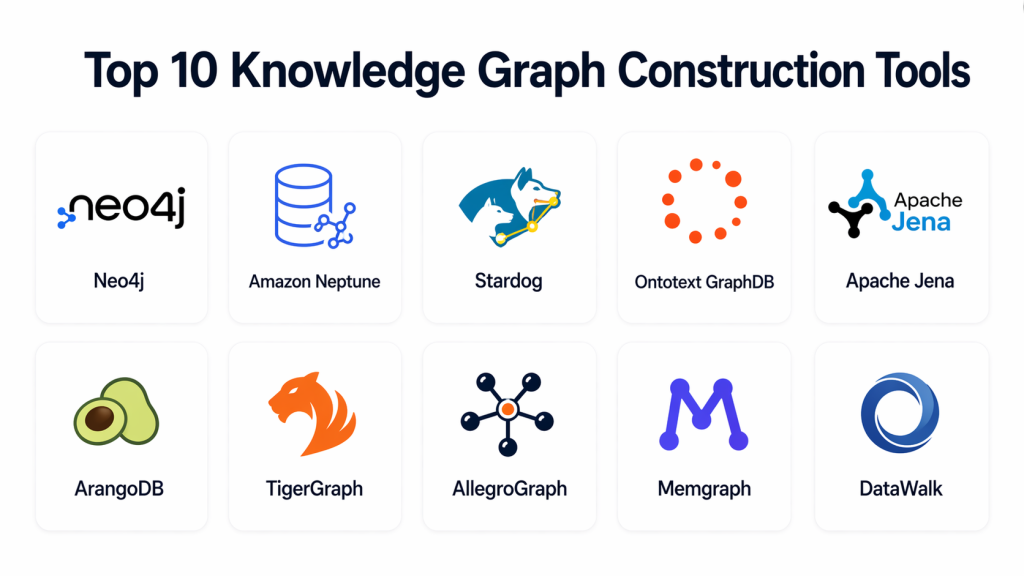
Top 10 Knowledge Graph Construction Tools
#1 — Neo4j
Short description: A leading graph database platform widely used for building scalable knowledge graphs and powering AI-driven applications.
Key Features
- Native graph database engine
- Cypher query language
- Graph Data Science library
- Visualization tools
- High scalability
- Real-time analytics
Pros
- Industry-leading performance
- Strong ecosystem
Cons
- Licensing costs
- Learning curve
Platforms / Deployment
Cloud / Self-hosted
Security & Compliance
Enterprise-grade security features; details not publicly stated
Integrations & Ecosystem
Extensive ecosystem for AI and analytics.
- APIs
- Data pipelines
- AI frameworks
Support & Community
Very large global community and enterprise support.
#2 — Amazon Neptune
Short description: A fully managed graph database service designed for building large-scale knowledge graphs within AWS.
Key Features
- RDF and property graph support
- SPARQL and Gremlin queries
- High availability
- Automatic scaling
- Managed infrastructure
Pros
- Fully managed
- Scalable
Cons
- AWS dependency
- Pricing complexity
Platforms / Deployment
Cloud
Security & Compliance
Enterprise-grade cloud security; details vary
Integrations & Ecosystem
Deep integration with AWS ecosystem.
- AWS services
- APIs
Support & Community
Strong cloud support and documentation.
#3 — Stardog
Short description: An enterprise knowledge graph platform focused on data virtualization and semantic reasoning.
Key Features
- Virtual knowledge graphs
- Semantic reasoning
- Data integration
- Query federation
- Graph analytics
Pros
- Strong enterprise features
- Data unification
Cons
- Complex setup
- Enterprise pricing
Platforms / Deployment
Cloud / On-prem
Security & Compliance
Not publicly stated
Integrations & Ecosystem
Integrates with enterprise systems and data sources.
Support & Community
Enterprise support model.
#4 — Ontotext GraphDB
Short description: A semantic graph database optimized for RDF data and knowledge graph construction.
Key Features
- RDF and SPARQL support
- Semantic reasoning engine
- High-performance queries
- Data linking tools
- Scalable architecture
Pros
- Strong semantic capabilities
- High performance
Cons
- Requires expertise
- Limited beginner support
Platforms / Deployment
Cloud / On-prem
Security & Compliance
Not publicly stated
Integrations & Ecosystem
Supports semantic web tools and APIs.
Support & Community
Enterprise and developer support.
#5 — Apache Jena
Short description: An open-source framework for building semantic web and RDF-based knowledge graphs.
Key Features
- RDF data modeling
- SPARQL query engine
- Ontology support
- Triple store management
- Java APIs
Pros
- Free and open-source
- Standards-based
Cons
- Developer-focused
- Limited UI
Platforms / Deployment
Self-hosted
Security & Compliance
Varies
Integrations & Ecosystem
Works with semantic web and Java ecosystems.
Support & Community
Strong open-source community.
#6 — ArangoDB
Short description: A multi-model database supporting graph, document, and key-value data for flexible knowledge graph construction.
Key Features
- Multi-model support
- Graph queries
- Scalability
- Distributed architecture
- Real-time analytics
Pros
- Flexible data model
- Scalable
Cons
- Complex setup
- Learning curve
Platforms / Deployment
Cloud / Self-hosted
Security & Compliance
Not publicly stated
Integrations & Ecosystem
Supports APIs and enterprise systems.
Support & Community
Active developer community.
#7 — Memgraph
Short description: A real-time graph database optimized for streaming data and dynamic knowledge graph construction.
Key Features
- Real-time processing
- Graph analytics
- Cypher query support
- Streaming integration
- High performance
Pros
- Real-time capabilities
- Fast performance
Cons
- Smaller ecosystem
- Limited enterprise features
Platforms / Deployment
Cloud / Self-hosted
Security & Compliance
Not publicly stated
Integrations & Ecosystem
Works with data pipelines and AI tools.
Support & Community
Growing community.
#8 — DataWalk
Short description: A no-code knowledge graph platform focused on analytics, investigations, and enterprise data exploration.
Key Features
- No-code graph building
- Link analysis
- Data integration
- Visualization tools
- Analytics dashboards
Pros
- Easy to use
- Strong analytics
Cons
- Enterprise-focused
- Limited flexibility
Platforms / Deployment
Cloud / On-prem
Security & Compliance
Not publicly stated
Integrations & Ecosystem
Supports enterprise data sources.
Support & Community
Enterprise support.
#9 — Actian Data Intelligence Platform
Short description: A platform combining data cataloging and knowledge graph capabilities for enterprise data governance.
Key Features
- Metadata management
- Data lineage
- Semantic graph layer
- Data discovery
- Integration tools
Pros
- Strong governance features
- Enterprise-ready
Cons
- Complex deployment
- High cost
Platforms / Deployment
Cloud / On-prem
Security & Compliance
Not publicly stated
Integrations & Ecosystem
Works with enterprise data systems.
Support & Community
Enterprise support.
#10 — Graphwise
Short description: An enterprise-grade platform designed to transform siloed data into trusted knowledge graphs for AI applications.
Key Features
- Data unification
- Knowledge graph creation
- AI integration
- Semantic search
- Data governance
Pros
- Strong enterprise focus
- Reliable data integration
Cons
- Limited public documentation
- Enterprise pricing
Platforms / Deployment
Cloud
Security & Compliance
Not publicly stated
Integrations & Ecosystem
Supports enterprise AI and analytics tools.
Support & Community
Enterprise-focused support.
Comparison Table (Top 10)
| Tool Name | Best For | Platform(s) Supported | Deployment | Standout Feature | Public Rating |
|---|---|---|---|---|---|
| Neo4j | General-purpose graphs | Multi-platform | Hybrid | Graph analytics | N/A |
| Amazon Neptune | AWS users | Web | Cloud | Managed service | N/A |
| Stardog | Data unification | Multi-platform | Hybrid | Virtual graphs | N/A |
| Ontotext GraphDB | Semantic graphs | Multi-platform | Hybrid | RDF reasoning | N/A |
| Apache Jena | Open-source devs | Multi-platform | Self-hosted | RDF toolkit | N/A |
| ArangoDB | Multi-model DB | Multi-platform | Hybrid | Multi-model support | N/A |
| Memgraph | Real-time graphs | Multi-platform | Hybrid | Streaming graphs | N/A |
| DataWalk | Analytics | Multi-platform | Hybrid | No-code graph | N/A |
| Actian Platform | Data governance | Multi-platform | Hybrid | Metadata graph | N/A |
| Graphwise | Enterprise AI | Web | Cloud | Data unification | N/A |
Evaluation & Scoring of Knowledge Graph Construction Tools
| Tool Name | Core | Ease | Integrations | Security | Performance | Support | Value | Weighted Total |
|---|---|---|---|---|---|---|---|---|
| Neo4j | 9 | 7 | 9 | 8 | 9 | 9 | 7 | 8.6 |
| Amazon Neptune | 8 | 8 | 9 | 8 | 9 | 8 | 7 | 8.3 |
| Stardog | 8 | 6 | 8 | 8 | 8 | 8 | 6 | 7.8 |
| Ontotext GraphDB | 8 | 6 | 7 | 7 | 8 | 7 | 6 | 7.5 |
| Apache Jena | 7 | 6 | 7 | 6 | 7 | 7 | 9 | 7.2 |
| ArangoDB | 8 | 7 | 8 | 7 | 8 | 7 | 7 | 7.7 |
| Memgraph | 8 | 7 | 7 | 6 | 9 | 7 | 7 | 7.6 |
| DataWalk | 7 | 8 | 6 | 7 | 7 | 7 | 6 | 7.0 |
| Actian Platform | 8 | 6 | 7 | 8 | 7 | 7 | 6 | 7.4 |
| Graphwise | 8 | 7 | 7 | 7 | 7 | 7 | 6 | 7.3 |
How to interpret scores:
These scores provide a comparative overview of capabilities across tools. Higher scores indicate stronger overall performance, but the best tool depends on your use case. Enterprise users may prioritize security and scalability, while developers may prefer flexibility and cost efficiency.
Which Knowledge Graph Construction Tool Is Right for You?
Solo / Freelancer
Apache Jena or lightweight graph tools are suitable for experimentation and learning.
SMB
ArangoDB and Memgraph provide a balance of flexibility and performance.
Mid-Market
Stardog and Ontotext GraphDB offer strong semantic capabilities and scalability.
Enterprise
Neo4j, Amazon Neptune, and Actian Platform are ideal for large-scale deployments.
Budget vs Premium
Open-source tools reduce cost, while enterprise platforms provide advanced features and support.
Feature Depth vs Ease of Use
Advanced tools offer deep capabilities but require expertise; simpler tools focus on usability.
Integrations & Scalability
Neo4j and Amazon Neptune excel in integration-heavy environments.
Security & Compliance Needs
Enterprises should prioritize tools with governance, audit logs, and compliance features.
Frequently Asked Questions (FAQs)
1. What is a knowledge graph?
A knowledge graph is a structured representation of data where entities are connected through relationships, enabling better understanding and reasoning.
2. Why use knowledge graph tools?
They help unify data from multiple sources and reveal relationships, making insights easier to discover and analyze.
3. Are these tools only for enterprises?
No, there are open-source tools available for developers and smaller teams.
4. Do knowledge graphs work with AI?
Yes, they are widely used in AI systems to improve reasoning and context awareness.
5. How are knowledge graphs built?
They are built by extracting entities and relationships from data and organizing them into graph structures.
6. Do they support real-time data?
Many modern tools support real-time data ingestion and updates.
7. Are they scalable?
Yes, most enterprise tools are designed to scale with large datasets.
8. What are common challenges?
Data integration, schema design, and performance optimization are common challenges.
9. Can they integrate with ML pipelines?
Yes, most tools support integration with machine learning workflows.
10. Are there alternatives?
Traditional databases can be used, but they lack relationship-focused capabilities.
Conclusion
Knowledge Graph Construction Tools are becoming a foundational layer for modern AI systems, enabling organizations to transform disconnected data into meaningful, structured knowledge. By capturing relationships between entities, these tools unlock deeper insights and improve decision-making across applications. There is no single “best” tool for every use case. Enterprise organizations may benefit from platforms like Neo4j or Amazon Neptune for scalability and performance, while developers and smaller teams can leverage tools like Apache Jena or ArangoDB for flexibility and cost efficiency. The right choice depends on your data complexity, integration requirements, and long-term goals. Focus on tools that align with your architecture and can scale as your data grows. Start by selecting two or three tools, building a prototype, and testing performance. Validate data integration, query efficiency, and scalability before moving to production. This ensures your knowledge graph delivers real value and supports future AI initiatives.
