Introduction
KYB Know Your Business tools are compliance platforms that help organizations verify the legitimacy, ownership, and risk profile of companies they work with. Instead of focusing on individuals, these tools validate businesses by checking registration records, ownership structures, and regulatory status across jurisdictions.
As regulatory expectations grow and financial crime becomes more complex, KYB tools have become essential for fintech companies, banks, marketplaces, and B2B platforms. They help automate onboarding, reduce fraud risks, and ensure compliance with AML and regulatory standards while improving operational efficiency.
Common use cases include:
- Business onboarding and merchant verification
- Vendor and supplier due diligence
- Marketplace seller validation
- Fraud prevention and risk scoring
- Regulatory compliance and audit readiness
Key evaluation criteria:
- Global data coverage and registry access
- Automation and AI-driven verification
- UBO discovery and ownership mapping
- API availability and integration flexibility
- Real-time monitoring and alerts
- User experience and onboarding flow
- Scalability for large volumes
- Pricing flexibility and transparency
Best for: Fintech companies, financial institutions, marketplaces, and enterprises handling high-volume business onboarding and compliance workflows.
Not ideal for: Individual-only verification needs or small businesses with minimal regulatory exposure where basic identity checks are sufficient.
Key Trends in KYB Know Your Business Tools
- AI-driven entity resolution improving accuracy in complex ownership structures
- Real-time verification using global business registries
- Unified compliance platforms combining KYC and KYB workflows
- Automated UBO discovery using graph-based intelligence
- Continuous monitoring replacing one-time verification processes
- API-first platforms enabling embedded compliance workflows
- Low-code workflow automation for faster onboarding
- Expanded sanctions screening with frequent updates
- Machine learning-based risk scoring systems
- Increased focus on data privacy and regional compliance
How We Selected These Tools Methodology
- Evaluated market adoption and industry credibility
- Assessed completeness of KYB-specific features
- Reviewed reliability and performance indicators
- Considered security posture and compliance readiness
- Analyzed integration capabilities and API flexibility
- Included tools suitable for different company sizes
- Focused on global data coverage and scalability
- Evaluated ease of use and onboarding experience
- Balanced enterprise-grade and developer-friendly platforms
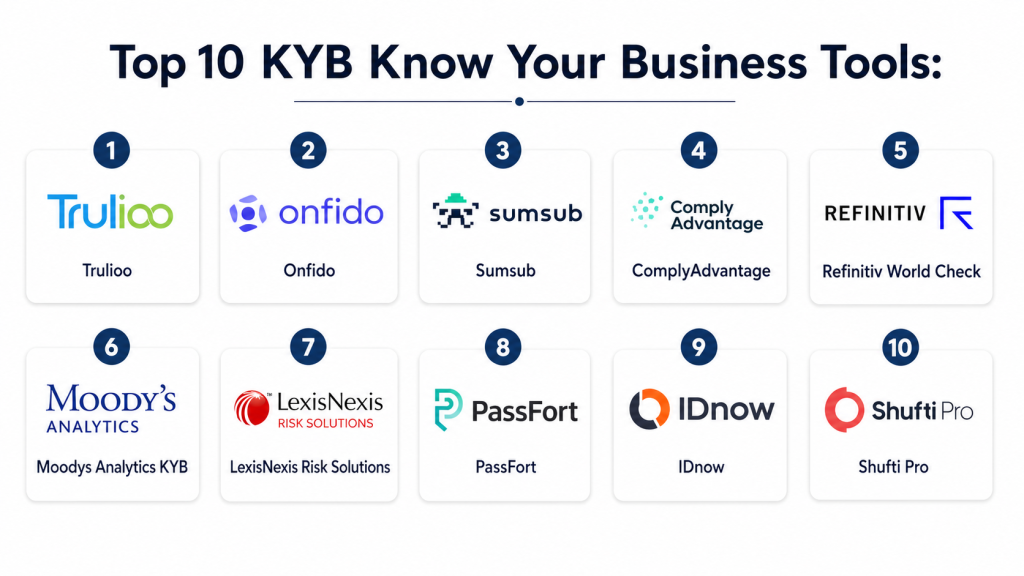
Top 10 KYB Know Your Business Tools Tools
#1 — Trulioo
Short description:
Trulioo is a global identity verification platform designed for large-scale business verification across multiple regions. It provides extensive KYB capabilities with strong data coverage and real-time validation. The platform is widely used by enterprises needing scalable onboarding solutions. It supports automated compliance workflows and integrates easily with digital platforms.
Key Features
- Global business verification data
- UBO identification and validation
- Sanctions and watchlist screening
- Real-time API access
- Risk scoring engine
- Continuous monitoring
- Multi-region compliance support
Pros
- Strong global coverage
- Scalable for large organizations
- Reliable performance
Cons
- Pricing complexity
- Requires technical setup
- Less suited for small teams
Platforms / Deployment
Cloud
Security & Compliance
Encryption, audit logs, GDPR support
Integrations & Ecosystem
API-first platform designed for seamless integration with onboarding systems and compliance tools.
- REST APIs
- Webhooks
- SDK support
Support & Community
Enterprise-level support with structured onboarding and documentation
#2 — Onfido
Short description:
Onfido is a digital identity platform offering business verification alongside strong identity validation capabilities. It is widely used by fintech companies to streamline onboarding and compliance workflows. The platform leverages AI to enhance verification accuracy. It is known for its user-friendly experience and flexible integrations.
Key Features
- Business verification workflows
- AI-based verification
- Fraud detection tools
- AML screening
- API-first architecture
- Real-time checks
Pros
- Easy to integrate
- Strong AI capabilities
- Smooth user experience
Cons
- Limited advanced KYB depth
- Pricing varies
- Customization limitations
Platforms / Deployment
Cloud
Security & Compliance
Encryption and GDPR support
Integrations & Ecosystem
Integrates with fintech platforms and onboarding systems using flexible APIs.
- APIs
- SDKs
- CRM integrations
Support & Community
Good documentation with enterprise support options
#3 — Sumsub
Short description:
Sumsub provides a unified compliance platform combining KYB and KYC capabilities in one solution. It is designed for businesses seeking automation and flexibility in onboarding workflows. The platform supports global verification and risk scoring. It is popular among startups and mid-sized companies.
Key Features
- Business verification workflows
- UBO discovery
- Sanctions screening
- Risk scoring
- Fraud detection
- Continuous monitoring
- Custom workflows
Pros
- All-in-one platform
- Flexible configuration
- Strong automation
Cons
- Interface complexity
- Pricing not transparent
- Setup effort required
Platforms / Deployment
Cloud
Security & Compliance
Encryption and GDPR support
Integrations & Ecosystem
API-driven platform supporting integrations with onboarding and compliance tools.
- REST APIs
- Webhooks
- SDKs
Support & Community
Responsive support with growing adoption
#4 — ComplyAdvantage
Short description:
ComplyAdvantage focuses on risk intelligence and AML compliance with strong KYB capabilities. It provides real-time insights and monitoring for businesses. The platform is ideal for organizations needing continuous compliance oversight. It is widely used in financial services.
Key Features
- Business verification
- AML risk detection
- Sanctions screening
- Real-time monitoring
- Risk scoring
- Data intelligence
Pros
- Strong AML capabilities
- Real-time updates
- Reliable data
Cons
- KYB is secondary focus
- Requires configuration
- Pricing not transparent
Platforms / Deployment
Cloud
Security & Compliance
Encryption and audit logs
Integrations & Ecosystem
Integrates with compliance systems and financial platforms.
- APIs
- Data feeds
Support & Community
Enterprise support with documentation
#5 — Refinitiv World Check
Short description:
Refinitiv World Check is a well-established risk intelligence database used for compliance and business verification. It provides detailed risk profiling and sanctions data. The platform is trusted by large enterprises globally. It is ideal for organizations requiring deep compliance insights.
Key Features
- Global sanctions database
- Business risk profiling
- Watchlist screening
- UBO insights
- Continuous monitoring
- Data intelligence
Pros
- Trusted data source
- High accuracy
- Strong compliance coverage
Cons
- Expensive
- Limited automation
- Less developer-friendly
Platforms / Deployment
Cloud / Hybrid
Security & Compliance
Not publicly stated
Integrations & Ecosystem
Integrates with enterprise compliance and risk management systems.
- APIs
- Data feeds
Support & Community
Strong enterprise support
#6 — Moodys Analytics KYB
Short description:
Moodys Analytics offers business intelligence and risk assessment tools for compliance teams. It provides financial insights and ownership data for better decision-making. The platform is widely used by large financial institutions. It supports advanced analytics and reporting.
Key Features
- Business registry data
- Risk scoring
- Financial insights
- UBO tracking
- Compliance tools
- Data analytics
Pros
- Strong financial data
- Enterprise-grade solution
- Trusted provider
Cons
- Complex setup
- Expensive
- Limited flexibility
Platforms / Deployment
Cloud / Hybrid
Security & Compliance
Not publicly stated
Integrations & Ecosystem
Integrates with enterprise systems and analytics platforms.
- APIs
- Data services
Support & Community
Enterprise support
#7 — LexisNexis Risk Solutions
Short description:
LexisNexis provides data-driven KYB solutions with extensive global coverage. It helps businesses assess risk and verify company legitimacy. The platform is known for its deep data sources. It is widely used in financial services and compliance teams.
Key Features
- Business verification
- Risk scoring
- Data enrichment
- Fraud detection
- AML screening
- Global data access
Pros
- Extensive data coverage
- Reliable insights
- Scalable solution
Cons
- Complex pricing
- Setup requires expertise
- Limited UI flexibility
Platforms / Deployment
Cloud
Security & Compliance
Not publicly stated
Integrations & Ecosystem
Strong integration capabilities with financial and compliance tools.
- APIs
- Data services
Support & Community
Enterprise support
#8 — PassFort
Short description:
PassFort is a compliance automation platform focused on KYB workflows and onboarding efficiency. It enables businesses to create flexible verification processes. The platform is known for its ease of use. It is suitable for growing fintech companies.
Key Features
- Business verification
- Workflow automation
- Risk scoring
- AML screening
- API integration
- Case management
Pros
- Easy to use
- Flexible workflows
- Good automation
Cons
- Limited global data
- Smaller ecosystem
- Pricing varies
Platforms / Deployment
Cloud
Security & Compliance
Not publicly stated
Integrations & Ecosystem
API-first integrations with onboarding systems.
- REST APIs
- Webhooks
Support & Community
Good support with smaller community
#9 — IDnow
Short description:
IDnow provides identity and business verification solutions for onboarding processes. It offers simple KYB capabilities combined with identity verification. The platform is known for its usability. It is suitable for companies needing quick deployment.
Key Features
- Business verification
- Identity checks
- Fraud prevention
- Compliance workflows
- API integrations
Pros
- Easy to use
- Fast onboarding
- Reliable performance
Cons
- Limited advanced features
- Regional limitations
- Pricing varies
Platforms / Deployment
Cloud
Security & Compliance
Not publicly stated
Integrations & Ecosystem
Integrates with fintech and onboarding systems.
- APIs
- SDKs
Support & Community
Standard support
#10 — Shufti Pro
Short description:
Shufti Pro is a verification platform offering KYB and KYC services globally. It provides fast verification and fraud detection capabilities. The platform is developer-friendly and easy to integrate. It is suitable for businesses needing quick deployment.
Key Features
- Business verification
- AML screening
- Fraud detection
- Real-time verification
- API integration
Pros
- Global coverage
- Fast processing
- Developer-friendly
Cons
- Limited analytics
- Basic interface
- Pricing not transparent
Platforms / Deployment
Cloud
Security & Compliance
Not publicly stated
Integrations & Ecosystem
API-based integrations for onboarding systems.
- REST APIs
- SDKs
Support & Community
Documentation available with variable support
Comparison Table
| Tool Name | Best For | Platform Supported | Deployment | Standout Feature | Public Rating |
|---|---|---|---|---|---|
| Trulioo | Enterprise verification | Web | Cloud | Global data coverage | N/A |
| Onfido | Fintech onboarding | Web | Cloud | AI verification | N/A |
| Sumsub | Unified compliance | Web | Cloud | All-in-one platform | N/A |
| ComplyAdvantage | AML monitoring | Web | Cloud | Risk intelligence | N/A |
| Refinitiv World Check | Enterprise compliance | Web | Hybrid | Trusted data | N/A |
| Moodys Analytics | Financial institutions | Web | Hybrid | Financial insights | N/A |
| LexisNexis | Risk intelligence | Web | Cloud | Data enrichment | N/A |
| PassFort | Workflow automation | Web | Cloud | Flexible workflows | N/A |
| IDnow | Easy onboarding | Web | Cloud | Simplicity | N/A |
| Shufti Pro | Fast verification | Web | Cloud | Real-time KYB | N/A |
Evaluation and Scoring of KYB Know Your Business Tools
| Tool Name | Core | Ease | Integrations | Security | Performance | Support | Value | Weighted Total |
|---|---|---|---|---|---|---|---|---|
| Trulioo | 9 | 7 | 9 | 8 | 9 | 8 | 7 | 8.4 |
| Onfido | 8 | 8 | 8 | 8 | 8 | 7 | 7 | 7.9 |
| Sumsub | 9 | 7 | 8 | 8 | 8 | 8 | 8 | 8.2 |
| ComplyAdvantage | 8 | 7 | 8 | 9 | 8 | 8 | 7 | 8.0 |
| Refinitiv | 9 | 6 | 7 | 9 | 9 | 8 | 6 | 8.1 |
| Moodys Analytics | 9 | 6 | 7 | 9 | 8 | 8 | 6 | 8.0 |
| LexisNexis | 9 | 6 | 8 | 9 | 8 | 8 | 6 | 8.1 |
| PassFort | 7 | 8 | 7 | 7 | 7 | 7 | 8 | 7.4 |
| IDnow | 7 | 8 | 7 | 7 | 7 | 7 | 7 | 7.3 |
| Shufti Pro | 7 | 8 | 8 | 7 | 8 | 7 | 8 | 7.6 |
How to interpret these scores:
This scoring model compares tools across multiple weighted criteria rather than ranking them in isolation. Higher scores indicate stronger overall capability, but the importance of each category depends on your business needs. Enterprise platforms typically score higher in security, integrations, and feature depth, while SMB-focused tools often perform better in ease of use and value. The weighted total helps identify balanced solutions, but decision-makers should prioritize specific criteria such as compliance or cost based on their operational priorities. Always treat these scores as guidance rather than absolute rankings and validate them through real-world testing.
Which KYB Tool Is Right for You
Solo Freelancer
Choose simple and cost-effective tools like Shufti Pro or IDnow for basic verification needs and quick setup.
SMB
Go for balanced platforms like Sumsub or PassFort that offer automation and flexibility without enterprise complexity.
Mid Market
Consider Onfido or ComplyAdvantage for scalability, integrations, and improved compliance workflows.
Enterprise
Opt for Trulioo, Refinitiv, or Moodys Analytics for global coverage, deep data insights, and advanced compliance features.
Budget vs Premium
Budget solutions focus on ease and cost efficiency while premium tools provide deeper data and compliance capabilities.
Feature Depth vs Ease of Use
Advanced tools offer more features but may require training, while simpler tools prioritize usability and faster onboarding.
Integrations and Scalability
API-first platforms are ideal for scaling operations and integrating with existing systems.
Security and Compliance Needs
High-risk industries should prioritize tools with strong compliance, monitoring, and risk intelligence capabilities.
Frequently Asked Questions
1 What is KYB and why is it important
KYB is the process of verifying businesses before establishing partnerships or transactions. It helps organizations confirm legitimacy, ownership, and compliance status. This reduces the risk of fraud and ensures regulatory compliance. It is especially important in industries like fintech, banking, and marketplaces where financial risk is high.
2 How much do KYB tools cost
KYB tools typically use usage-based or subscription pricing models depending on verification volume. Costs vary based on features, data access, and geographic coverage. Enterprise solutions tend to be more expensive due to advanced capabilities. Smaller tools may offer more affordable entry-level pricing.
3 How long does implementation take
Implementation timelines depend on the complexity of integrations and customization requirements. Simple setups can take a few days while enterprise deployments may take several weeks. API-first tools usually speed up integration. Planning and testing are critical for smooth onboarding.
4 Do KYB tools support global verification
Most leading KYB platforms provide global coverage by accessing business registries across countries. However, data availability can vary depending on the region. Some tools specialize in specific markets. Businesses should verify coverage for their target regions.
5 Are KYB tools mandatory for compliance
In many regulated industries, KYB is a requirement for compliance with AML and financial regulations. It helps organizations avoid penalties and legal risks. Even where not mandatory, it is considered a best practice. It enhances trust and risk management.
6 Can KYB tools integrate with existing systems
Yes, most modern KYB tools offer APIs and SDKs for seamless integration. They can connect with onboarding systems, CRMs, and compliance workflows. Integration capabilities are a key selection factor. API-first platforms offer greater flexibility.
7 What challenges do businesses face with KYB
Common challenges include incomplete data, complex ownership structures, and cross-border verification issues. Manual processes can slow down onboarding. Automated tools help address these challenges. Choosing the right platform reduces friction.
8 Can KYB tools detect fraud
Many KYB tools include fraud detection features such as risk scoring and anomaly detection. They analyze business data and ownership structures. Continuous monitoring improves fraud detection over time. This helps organizations respond quickly to risks.
9 Which industries use KYB tools the most
KYB tools are widely used in fintech, banking, insurance, and marketplaces. Any business dealing with B2B transactions can benefit. They are also used in supply chain and procurement processes. Compliance-driven industries rely on them heavily.
10 Is it easy to switch KYB providers
Switching providers is possible but may require re-integration and data migration. It depends on the complexity of the existing system. Businesses should evaluate flexibility before choosing a tool. Planning reduces transition challenges.
Conclusion
KYB Know Your Business tools have become essential for organizations managing compliance, risk, and onboarding in an increasingly complex regulatory environment. These platforms help businesses verify partners efficiently, reduce fraud risks, and streamline operations through automation and data intelligence. While enterprise solutions offer deep insights and global coverage, smaller platforms provide simplicity and faster implementation for growing teams. The right choice depends on factors such as business size, compliance requirements, and integration needs. Instead of selecting a single best tool, organizations should shortlist a few options, test their capabilities in real scenarios, and evaluate how well they align with operational workflows. A structured evaluation combined with pilot testing ensures better long-term outcomes and reduces implementation risks.

The comparison simplifies the process of evaluating KYB tools and highlights the key features businesses should consider when choosing a reliable solution.