Introduction
Fraud Case Management tools are specialized platforms designed to help organizations detect, investigate, manage, and resolve fraud incidents efficiently. These tools centralize alerts, automate workflows, and provide investigators with the context needed to make faster and more accurate decisions. They are widely used in banking, fintech, insurance, e-commerce, and telecom sectors where fraud risk is high.
With the rise of digital transactions and sophisticated fraud techniques, organizations can no longer rely on manual processes. Modern fraud case management solutions use automation, analytics, and AI to streamline investigations, reduce false positives, and improve compliance reporting. They also help teams collaborate better and maintain audit trails for regulatory requirements.
Common use cases include:
- Financial fraud investigations in banks and fintech
- Transaction monitoring and alert management
- Insurance fraud detection and claims investigation
- E-commerce fraud and chargeback handling
- Compliance reporting and audit tracking
Key evaluation criteria:
- Case workflow automation and customization
- Integration with fraud detection systems
- Data aggregation and visualization
- Investigation tools and audit trails
- Scalability and performance
- User experience for investigators
- Reporting and compliance capabilities
- Pricing and deployment flexibility
Best for: Banks, fintech companies, insurance firms, payment providers, and enterprises with dedicated fraud investigation teams.
Not ideal for: Small businesses with minimal fraud risk or organizations that only need basic transaction monitoring without full case management workflows.
Key Trends in Fraud Case Management Tools
- AI-driven fraud detection integrated with case management workflows
- Real-time alert prioritization using machine learning
- Automation of investigation workflows to reduce manual effort
- Centralized dashboards for fraud intelligence and analytics
- Integration with external data sources and identity systems
- Cloud-native deployments for scalability and flexibility
- Low-code customization for workflow design
- Enhanced collaboration tools for investigation teams
- Continuous monitoring and proactive risk management
- Increased focus on regulatory reporting and audit readiness
How We Selected These Tools Methodology
- Evaluated market adoption and enterprise usage
- Assessed feature depth for fraud case management
- Reviewed performance and scalability capabilities
- Considered security and compliance readiness
- Analyzed integration flexibility with fraud detection systems
- Included tools suitable for different business sizes
- Focused on usability for investigators
- Balanced enterprise platforms with flexible solutions
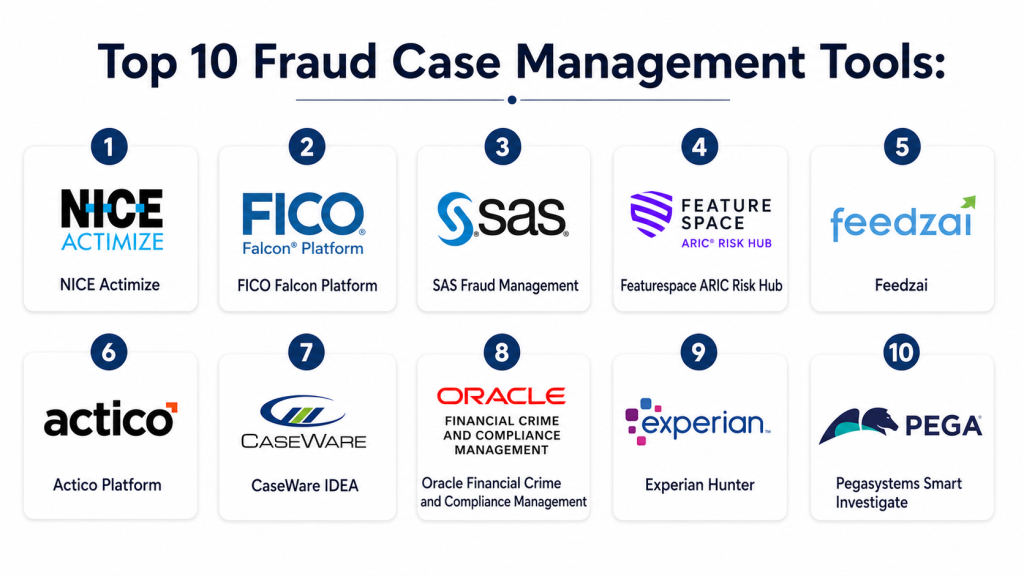
Top 10 Fraud Case Management Tools Tools
#1 — NICE Actimize
Short description:
NICE Actimize is a leading enterprise fraud and financial crime management platform used by large banks and financial institutions. It provides advanced case management capabilities with strong analytics and workflow automation. The platform supports complex investigations and regulatory compliance. It is known for its scalability and deep fraud intelligence.
Key Features
- Advanced case management workflows
- Fraud detection integration
- Risk scoring and prioritization
- Real-time alert handling
- Data analytics and reporting
- Audit trails
- Compliance management
Pros
- Enterprise-grade capabilities
- Strong analytics
- Scalable architecture
Cons
- Complex implementation
- High cost
- Requires training
Platforms / Deployment
Cloud / Hybrid
Security & Compliance
Encryption, audit logs, role-based access
Integrations & Ecosystem
Integrates with banking systems and fraud detection platforms through APIs and data pipelines.
- APIs
- Data connectors
- Third-party integrations
Support & Community
Enterprise support with strong documentation
#2 — FICO Falcon Platform
Short description:
FICO Falcon Platform is a well-known fraud detection and case management solution used by financial institutions globally. It combines analytics, AI, and case workflows to manage fraud investigations efficiently. The platform is trusted for its accuracy and performance. It is suitable for large-scale fraud operations.
Key Features
- Fraud detection analytics
- Case management workflows
- AI-based risk scoring
- Real-time alerts
- Investigation tools
- Reporting dashboards
Pros
- Proven fraud detection accuracy
- Strong analytics engine
- Trusted by banks
Cons
- Expensive
- Complex setup
- Limited flexibility
Platforms / Deployment
Cloud / On-premise
Security & Compliance
Not publicly stated
Integrations & Ecosystem
Supports integration with transaction systems and data sources.
- APIs
- Data feeds
Support & Community
Enterprise-level support
#3 — SAS Fraud Management
Short description:
SAS Fraud Management offers a comprehensive suite for fraud detection and case management. It combines analytics with investigation tools for better decision-making. The platform is designed for large enterprises. It provides deep insights into fraud patterns.
Key Features
- Case management workflows
- Fraud analytics
- Risk scoring
- Alert management
- Data visualization
- Reporting tools
Pros
- Strong analytics capabilities
- Flexible workflows
- Enterprise-grade
Cons
- High cost
- Complex interface
- Long implementation time
Platforms / Deployment
Cloud / Hybrid
Security & Compliance
Not publicly stated
Integrations & Ecosystem
Integrates with enterprise systems and analytics platforms.
- APIs
- Data integration tools
Support & Community
Strong enterprise support
#4 — Featurespace ARIC Risk Hub
Short description:
Featurespace ARIC Risk Hub is an AI-driven fraud platform designed for real-time detection and case management. It uses adaptive behavioral analytics to identify fraud patterns. The platform is suitable for financial institutions. It offers strong automation and accuracy.
Key Features
- Behavioral analytics
- Real-time fraud detection
- Case management
- Risk scoring
- Alert prioritization
- Machine learning models
Pros
- Advanced AI capabilities
- High accuracy
- Real-time processing
Cons
- Requires expertise
- Pricing not transparent
- Complex deployment
Platforms / Deployment
Cloud
Security & Compliance
Not publicly stated
Integrations & Ecosystem
Integrates with banking systems and fraud detection tools.
- APIs
- Data connectors
Support & Community
Enterprise support
#5 — Feedzai
Short description:
Feedzai is a cloud-based fraud prevention platform with strong case management features. It uses machine learning to detect fraud in real time. The platform is widely used in payments and banking. It provides scalable and flexible solutions.
Key Features
- AI-based fraud detection
- Case management workflows
- Risk scoring
- Real-time monitoring
- Data analytics
- Reporting tools
Pros
- Strong AI capabilities
- Scalable cloud platform
- Flexible integrations
Cons
- Pricing varies
- Requires configuration
- Learning curve
Platforms / Deployment
Cloud
Security & Compliance
Not publicly stated
Integrations & Ecosystem
API-driven integrations with payment systems and fintech platforms.
- APIs
- Data pipelines
Support & Community
Good support with enterprise focus
#6 — Actico Platform
Short description:
Actico Platform provides decision automation and fraud case management capabilities. It enables organizations to design workflows and manage investigations efficiently. The platform is flexible and scalable. It is suitable for financial services.
Key Features
- Workflow automation
- Case management
- Decision engine
- Risk scoring
- Data processing
- Reporting tools
Pros
- Flexible workflows
- Strong automation
- Scalable
Cons
- Complex setup
- Limited UI flexibility
- Pricing not transparent
Platforms / Deployment
Cloud / Hybrid
Security & Compliance
Not publicly stated
Integrations & Ecosystem
Supports integration with enterprise systems and data sources.
- APIs
- Data connectors
Support & Community
Enterprise support
#7 — CaseWare IDEA
Short description:
CaseWare IDEA is a data analysis tool used for auditing and fraud investigation. It supports case management workflows and data analysis. The platform is widely used by auditors. It helps detect anomalies and fraud patterns.
Key Features
- Data analysis tools
- Fraud detection
- Case workflows
- Reporting capabilities
- Audit support
Pros
- Strong data analysis
- Easy to use
- Useful for audits
Cons
- Limited automation
- Not full-scale case management
- Less scalable
Platforms / Deployment
Windows
Security & Compliance
Not publicly stated
Integrations & Ecosystem
Integrates with audit and data systems.
- Data imports
- File integrations
Support & Community
Good documentation and community
#8 — Oracle Financial Crime and Compliance Management
Short description:
Oracle offers a comprehensive platform for fraud and financial crime management. It includes case management, analytics, and compliance tools. The platform is designed for large enterprises. It supports complex workflows and reporting.
Key Features
- Case management
- Fraud detection
- Risk scoring
- Reporting tools
- Compliance workflows
- Data analytics
Pros
- Enterprise-grade solution
- Strong analytics
- Scalable
Cons
- Expensive
- Complex deployment
- Requires expertise
Platforms / Deployment
Cloud / On-premise
Security & Compliance
Not publicly stated
Integrations & Ecosystem
Integrates with Oracle ecosystem and enterprise systems.
- APIs
- Data services
Support & Community
Enterprise support
#9 — Experian Hunter
Short description:
Experian Hunter is a fraud prevention and case management tool used for identity and application fraud detection. It helps organizations identify suspicious patterns. The platform is widely used in financial services. It supports efficient investigations.
Key Features
- Fraud detection
- Case management
- Data matching
- Risk scoring
- Reporting tools
Pros
- Strong data insights
- Reliable performance
- Easy integration
Cons
- Limited customization
- Pricing varies
- Smaller feature set
Platforms / Deployment
Cloud
Security & Compliance
Not publicly stated
Integrations & Ecosystem
Integrates with financial and identity systems.
- APIs
- Data feeds
Support & Community
Standard support
#10 — Pegasystems Smart Investigate
Short description:
Pegasystems Smart Investigate provides case management for fraud and dispute resolution. It enables organizations to automate workflows and improve investigation efficiency. The platform is highly customizable. It is suitable for enterprises.
Key Features
- Case management workflows
- Dispute resolution
- Automation tools
- Reporting and analytics
- Integration capabilities
Pros
- Highly customizable
- Strong workflow automation
- Enterprise-ready
Cons
- Complex setup
- Requires training
- High cost
Platforms / Deployment
Cloud / Hybrid
Security & Compliance
Not publicly stated
Integrations & Ecosystem
Integrates with enterprise systems and CRM platforms.
- APIs
- Workflow integrations
Support & Community
Enterprise support with documentation
Comparison Table
| Tool Name | Best For | Platform Supported | Deployment | Standout Feature | Public Rating |
|---|---|---|---|---|---|
| NICE Actimize | Enterprise fraud teams | Web | Hybrid | Advanced analytics | N/A |
| FICO Falcon | Banking fraud detection | Web | Cloud | AI scoring | N/A |
| SAS Fraud Management | Large enterprises | Web | Hybrid | Analytics depth | N/A |
| Featurespace | Real-time fraud | Web | Cloud | Behavioral AI | N/A |
| Feedzai | Payment fraud | Web | Cloud | Machine learning | N/A |
| Actico | Workflow automation | Web | Hybrid | Decision engine | N/A |
| CaseWare IDEA | Audit analysis | Windows | On-premise | Data analysis | N/A |
| Oracle FCCM | Enterprise compliance | Web | Hybrid | Integrated platform | N/A |
| Experian Hunter | Identity fraud | Web | Cloud | Data matching | N/A |
| Pegasystems | Case workflows | Web | Hybrid | Custom workflows | N/A |
Evaluation and Scoring of Fraud Case Management Tools
| Tool Name | Core | Ease | Integrations | Security | Performance | Support | Value | Weighted Total |
|---|---|---|---|---|---|---|---|---|
| NICE Actimize | 9 | 6 | 9 | 9 | 9 | 8 | 6 | 8.3 |
| FICO Falcon | 9 | 6 | 8 | 9 | 9 | 8 | 6 | 8.2 |
| SAS | 9 | 6 | 8 | 9 | 8 | 8 | 6 | 8.1 |
| Featurespace | 9 | 7 | 8 | 8 | 9 | 7 | 7 | 8.2 |
| Feedzai | 9 | 7 | 9 | 8 | 9 | 7 | 7 | 8.3 |
| Actico | 8 | 7 | 8 | 8 | 8 | 7 | 7 | 7.9 |
| CaseWare | 7 | 8 | 6 | 7 | 7 | 7 | 8 | 7.3 |
| Oracle | 9 | 6 | 9 | 9 | 9 | 8 | 6 | 8.3 |
| Experian | 8 | 7 | 8 | 8 | 8 | 7 | 7 | 7.9 |
| Pegasystems | 9 | 6 | 9 | 9 | 8 | 8 | 6 | 8.2 |
How to interpret these scores:
These scores provide a comparative view of how each tool performs across critical categories such as features, usability, integrations, and value. Higher scores indicate stronger capabilities overall, but the best choice depends on your specific needs. Enterprise tools typically score higher in core features and security but may rank lower in ease of use and pricing flexibility. Mid-market and flexible platforms often offer better usability and value but may lack advanced capabilities. The weighted total helps balance these trade-offs by factoring in importance across all categories. Decision-makers should focus on the criteria that matter most to their use case, such as compliance depth, scalability, or ease of deployment, rather than relying solely on the final score.
Which Fraud Case Management Tool Is Right for You
Solo Freelancer
Lightweight tools are sufficient if fraud risk is minimal, and basic analysis tools may be enough.
SMB
Choose user-friendly platforms like Feedzai or Actico that balance automation and cost efficiency.
Mid Market
Platforms like Featurespace or Experian provide better scalability and integration capabilities.
Enterprise
NICE Actimize, FICO Falcon, SAS, and Oracle offer deep analytics and enterprise-grade compliance.
Budget vs Premium
Budget solutions prioritize ease of use, while premium tools offer advanced analytics and compliance features.
Feature Depth vs Ease of Use
Advanced tools provide deeper insights but require training, while simpler tools focus on usability.
Integrations and Scalability
API-driven tools are better suited for scaling operations and connecting multiple systems.
Security and Compliance Needs
Highly regulated industries should prioritize tools with strong compliance and audit capabilities.
Frequently Asked Questions
1 What is a fraud case management tool
A fraud case management tool helps organizations track, investigate, and resolve fraud incidents in a structured way. It centralizes alerts and provides workflows for investigators to manage cases efficiently. These tools improve decision-making by providing data insights and audit trails. They are essential for organizations dealing with high volumes of transactions and fraud risks.
2 How do these tools differ from fraud detection systems
Fraud detection systems identify suspicious activities, while case management tools handle the investigation process. Detection systems generate alerts, and case management tools organize and track those alerts. Both systems work together to provide a complete fraud prevention solution. Organizations typically use them as part of a unified platform.
3 How much do fraud case management tools cost
Pricing varies depending on features, deployment model, and usage volume. Enterprise platforms are generally more expensive due to advanced analytics and scalability. Some vendors offer modular pricing based on functionality. Businesses should evaluate cost against operational needs.
4 How long does implementation take
Implementation can take anywhere from a few weeks to several months depending on system complexity. Integration with existing systems is a major factor. Proper planning and testing are important for success. Cloud-based tools typically deploy faster.
5 Can these tools integrate with existing systems
Most modern tools offer APIs and connectors for integration with banking systems, CRMs, and fraud detection platforms. Integration allows seamless data flow and improved efficiency. API-first platforms provide more flexibility. This is a critical factor when choosing a solution.
6 Are these tools suitable for small businesses
Some tools are designed for enterprises and may be too complex for small businesses. However, there are flexible options that cater to SMB needs. Smaller organizations should focus on ease of use and cost. Choosing the right scale is important.
7 Do these tools use AI
Yes, many tools use AI and machine learning to detect patterns and prioritize cases. AI helps reduce false positives and improve accuracy. It also enables real-time decision-making. Advanced tools rely heavily on AI for efficiency.
8 What industries use fraud case management tools
These tools are widely used in banking, fintech, insurance, telecom, and e-commerce. Any organization handling financial transactions can benefit. They are especially important in regulated industries. Fraud prevention is a critical business function.
9 What are common challenges in fraud case management
Challenges include handling large volumes of alerts, reducing false positives, and integrating multiple systems. Manual processes can slow down investigations. Automation and AI help address these issues. Proper tool selection is key.
10 Is it easy to switch tools later
Switching tools is possible but may require data migration and reconfiguration. It can be complex depending on integrations. Businesses should evaluate long-term needs before choosing a platform. Planning helps reduce transition risks.
Conclusion
Fraud case management tools play a critical role in helping organizations manage investigations, reduce fraud risks, and maintain compliance in an increasingly complex digital landscape. These platforms bring together data, workflows, and analytics to streamline operations and improve decision-making across fraud teams. While enterprise solutions offer deep capabilities and scalability, mid-market and flexible tools provide better usability and faster implementation for growing businesses. The right choice depends on factors such as organization size, fraud exposure, integration needs, and compliance requirements. Instead of focusing on a single best option, businesses should shortlist a few tools, evaluate them based on real-world scenarios, and test their performance through pilot deployments. A well-planned selection process ensures long-term efficiency, reduced risk, and better operational outcomes.

The article clearly outlines the strengths and limitations of each fraud case management tool, making it easier to evaluate the right solution for investigation and compliance needs.