Introduction
iOS app builders are platforms that allow users to create, design, and publish apps for Apple devices (iPhone, iPad) with minimal or no coding. These tools range from no-code builders for beginners to low-code platforms for more advanced customization, enabling faster app development and deployment to the App Store.
With the growing demand for mobile-first experiences, iOS app builders help businesses and creators launch apps quickly, reduce development costs, and reach premium user segments. Many modern platforms now support cross-platform builds, AI-assisted creation, and cloud-based compilation, making iOS app development more accessible than ever.
Common Use Cases
- Building iPhone apps for startups and businesses
- Creating MVPs without hiring developers
- Converting websites into iOS apps
- Developing internal tools for teams
- Launching apps on the Apple App Store
What Buyers Should Evaluate
- Ease of use (no-code vs low-code)
- Native vs hybrid app performance
- App Store publishing support
- Backend and database capabilities
- Integration with APIs and services
- Customization flexibility
- Scalability and performance
- Security features
- Pricing and licensing
Best for: Entrepreneurs, startups, designers, marketers, and SMBs looking to build and launch iOS apps quickly.
Not ideal for: Complex enterprise-grade applications requiring deep backend architecture or full native development control.
Key Trends in iOS App Builders
- AI-powered app generation: Build apps from prompts or templates
- Cloud-based iOS compilation: No need for Mac hardware to publish apps
- Cross-platform development: Single build for iOS and Android
- No-code adoption: Increasing accessibility for non-developers
- Design-to-app workflows: Converting UI designs into live apps
- Backend integration: Connecting with databases and APIs easily
- Faster MVP development: Rapid prototyping and deployment
- Automation features: Built-in workflows and logic builders
- Scalability improvements: Supporting larger user bases
How We Selected These Tools (Methodology)
- Popularity among iOS app creators and startups
- Feature completeness across design, logic, and deployment
- Ease of use for beginners and flexibility for developers
- Ability to publish apps to the Apple App Store
- Integration capabilities with APIs and backend systems
- Performance and scalability indicators
- Community and ecosystem strength
- Pricing accessibility across segments
- Innovation in AI and automation
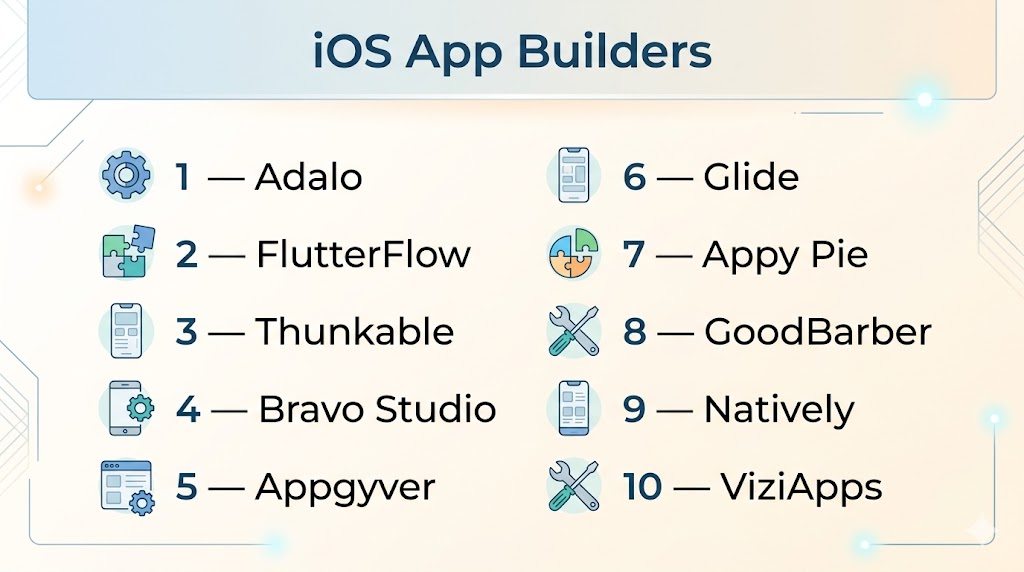
Top 10 iOS App Builders
#1 — Adalo
Short description: A no-code platform for building fully functional iOS apps with built-in database and App Store publishing.
Key Features
- Drag-and-drop builder
- Built-in relational database
- Native iOS app publishing
- AI-assisted app creation
- Templates and components
- User authentication
Pros
- Beginner-friendly with strong features
- Supports native app publishing
Cons
- Limited customization for advanced apps
- Performance may vary at scale
Platforms / Deployment
Web / iOS / Android
Security & Compliance
Not publicly stated
Integrations & Ecosystem
- APIs
- Zapier integrations
- Backend services
Support & Community
Large community and extensive tutorials
#2 — FlutterFlow
Short description: A low-code builder based on Flutter for creating high-performance iOS apps with code export.
Key Features
- Visual builder
- Code export
- Firebase integration
- Real-time preview
- UI customization
- Cross-platform support
Pros
- High performance
- Developer-friendly
Cons
- Requires technical understanding
- Pricing can scale
Platforms / Deployment
Web / iOS / Android
Security & Compliance
Not publicly stated
Integrations & Ecosystem
- Firebase
- APIs
Support & Community
Growing developer community
#3 — Thunkable
Short description: A no-code platform that enables users to build and publish iOS apps using visual logic blocks.
Key Features
- Drag-and-drop builder
- Logic blocks
- Native app publishing
- API integrations
- Live testing
Pros
- Easy for beginners
- Cross-platform capabilities
Cons
- Limited advanced features
- Performance constraints
Platforms / Deployment
Web / iOS / Android
Security & Compliance
Not publicly stated
Integrations & Ecosystem
- APIs
- Third-party tools
Support & Community
Active community and tutorials
#4 — Bravo Studio
Short description: A design-first platform that converts Figma designs into native iOS apps.
Key Features
- Design-to-app workflow
- Native app output
- API integration
- Visual builder
- App publishing tools
Pros
- Ideal for designers
- Fast prototyping
Cons
- Limited backend features
- Smaller ecosystem
Platforms / Deployment
Web / iOS
Security & Compliance
Not publicly stated
Integrations & Ecosystem
- Design tools
- APIs
Support & Community
Moderate support
#5 — Appgyver
Short description: A no-code platform for building cross-platform apps with strong logic capabilities.
Key Features
- Visual builder
- Logic editor
- API integration
- UI components
- Cross-platform apps
Pros
- Flexible logic system
- Free usage options
Cons
- Learning curve
- Smaller ecosystem
Platforms / Deployment
Web / iOS / Android
Security & Compliance
Not publicly stated
Integrations & Ecosystem
- APIs
- Third-party tools
Support & Community
Growing community
#6 — Glide
Short description: A simple platform for building iOS apps from spreadsheets and data sources.
Key Features
- Spreadsheet-based backend
- Drag-and-drop UI
- Mobile-first apps
- Templates
- Real-time updates
Pros
- Extremely easy to use
- Fast setup
Cons
- Limited customization
- Not suitable for complex apps
Platforms / Deployment
Web / iOS / Android
Security & Compliance
Not publicly stated
Integrations & Ecosystem
- Google Sheets
- APIs
Support & Community
Strong community
#7 — Appy Pie
Short description: A no-code builder offering AI-powered app creation and publishing for iOS apps.
Key Features
- AI app generator
- Templates
- Push notifications
- App publishing
- Drag-and-drop builder
Pros
- Easy to use
- Quick deployment
Cons
- Limited flexibility
- Performance limitations
Platforms / Deployment
Web / iOS / Android
Security & Compliance
Not publicly stated
Integrations & Ecosystem
- APIs
- Business tools
Support & Community
Good support
#8 — GoodBarber
Short description: A no-code platform for building iOS apps with strong design and monetization features.
Key Features
- Drag-and-drop builder
- Native app creation
- Monetization tools
- Templates
- Push notifications
Pros
- Strong design capabilities
- Easy to use
Cons
- Limited advanced customization
- Pricing tiers
Platforms / Deployment
Web / iOS / Android
Security & Compliance
Not publicly stated
Integrations & Ecosystem
- APIs
- Marketing tools
Support & Community
Good documentation
#9 — Natively
Short description: An AI-powered platform that generates iOS apps from simple text prompts.
Key Features
- AI app generation
- Native app output
- Cross-platform support
- Cloud-based build
- Rapid prototyping
Pros
- Extremely fast app creation
- No coding required
Cons
- Limited control
- Emerging platform
Platforms / Deployment
Web / iOS / Android
Security & Compliance
Not publicly stated
Integrations & Ecosystem
- APIs
- AI tools
Support & Community
Emerging ecosystem
#10 — ViziApps
Short description: A no-code platform for building and deploying mobile apps with ease.
Key Features
- Drag-and-drop builder
- Templates
- API integration
- Database support
- Mobile deployment
Pros
- Easy to learn
- Good for SMB apps
Cons
- Limited advanced features
- Smaller ecosystem
Platforms / Deployment
Web / iOS / Android
Security & Compliance
Not publicly stated
Integrations & Ecosystem
- APIs
- Backend tools
Support & Community
Moderate support
Comparison Table (Top 10)
| Tool Name | Best For | Platform(s) Supported | Deployment | Standout Feature | Public Rating |
|---|---|---|---|---|---|
| Adalo | Beginners | Web/iOS/Android | Cloud | Native app publishing | N/A |
| FlutterFlow | Developers | Web/iOS/Android | Cloud | Code export | N/A |
| Thunkable | No-code apps | Web/iOS/Android | Cloud | Logic blocks | N/A |
| Bravo Studio | Designers | Web/iOS | Cloud | Design-to-app workflow | N/A |
| Appgyver | Logic apps | Web/iOS/Android | Cloud | Visual logic builder | N/A |
| Glide | Beginners | Web/iOS/Android | Cloud | Spreadsheet apps | N/A |
| Appy Pie | Quick apps | Web/iOS/Android | Cloud | AI builder | N/A |
| GoodBarber | Content apps | Web/iOS/Android | Cloud | Monetization tools | N/A |
| Natively | AI apps | Web/iOS/Android | Cloud | Prompt-based creation | N/A |
| ViziApps | SMB apps | Web/iOS/Android | Cloud | Simple builder | N/A |
Evaluation & Scoring of iOS App Builders
| Tool Name | Core | Ease | Integrations | Security | Performance | Support | Value | Weighted Total |
|---|---|---|---|---|---|---|---|---|
| Adalo | 8 | 9 | 7 | 6 | 7 | 8 | 8 | 7.8 |
| FlutterFlow | 9 | 7 | 8 | 7 | 9 | 8 | 7 | 8.2 |
| Thunkable | 7 | 9 | 7 | 6 | 7 | 8 | 8 | 7.7 |
| Bravo Studio | 7 | 8 | 6 | 6 | 7 | 7 | 7 | 7.2 |
| Appgyver | 8 | 7 | 7 | 6 | 8 | 7 | 8 | 7.7 |
| Glide | 6 | 10 | 6 | 6 | 7 | 7 | 9 | 7.5 |
| Appy Pie | 7 | 9 | 6 | 6 | 7 | 7 | 8 | 7.5 |
| GoodBarber | 7 | 8 | 7 | 6 | 7 | 7 | 7 | 7.3 |
| Natively | 7 | 9 | 6 | 6 | 7 | 6 | 8 | 7.4 |
| ViziApps | 7 | 8 | 7 | 6 | 7 | 7 | 7 | 7.4 |
How to interpret scores:
- Scores are comparative across tools
- Higher scores indicate better overall balance
- No-code tools rank higher in ease of use
- Low-code tools rank higher in flexibility
- Choose based on your app complexity and goals
Which iOS App Builder Is Right for You?
Solo / Freelancer
- Best: Glide, Appy Pie
- Focus on simplicity and speed
SMB
- Best: Adalo, Thunkable
- Balanced features and usability
Mid-Market
- Best: FlutterFlow, Appgyver
- Need scalability and integrations
Enterprise
- Best: FlutterFlow, ViziApps
- Advanced features and performance
Budget vs Premium
- Budget: Glide, Appy Pie
- Premium: FlutterFlow
Feature Depth vs Ease of Use
- Deep features: FlutterFlow
- Easy to use: Glide, Adalo
Integrations & Scalability
- Strong integrations: FlutterFlow
- Moderate: Adalo
Security & Compliance Needs
- Enterprise-ready: FlutterFlow
- Basic: Glide
Frequently Asked Questions (FAQs)
What is an iOS app builder?
A tool that helps create apps for iPhone and iPad without deep coding.
Do I need a Mac to build iOS apps?
Not always—many platforms use cloud-based compilation.
Can I publish apps to the App Store?
Yes, most builders support App Store publishing.
Are iOS app builders free?
Some offer free plans, but publishing usually requires payment.
Can I build complex apps?
Yes, but low-code tools are better for complexity.
Are iOS apps scalable?
Depends on the platform used.
Can I integrate APIs?
Yes, most tools support API integrations.
How long does it take to build an app?
From hours to weeks depending on complexity.
Are these apps secure?
Security varies by platform.
Which builder is best for beginners?
Adalo and Glide are good starting points.
Conclusion
iOS app builders have made app development more accessible by enabling faster creation, reduced costs, and simplified publishing workflows. They allow businesses and individuals to bring ideas to life without heavy technical investment.
There is no single best tool—the right choice depends on your technical skills, app complexity, and scalability needs. Beginners can start with tools like Adalo or Glide, while more advanced users may prefer FlutterFlow.
