Introduction
Enterprise Search Platforms are software solutions designed to help organizations search, discover, and retrieve information across multiple systems, tools, and data sources—including documents, emails, databases, cloud apps, and internal platforms.
In simple terms, enterprise search acts like a central intelligence layer that connects all your company’s data and makes it searchable from one place. Instead of digging through multiple tools, employees can find what they need instantly.
As organizations grow, data becomes fragmented across systems. Modern enterprise search platforms solve this by using AI, natural language processing, and machine learning to deliver faster, more relevant, and context-aware results.
Why it matters now
- Organizations use dozens of tools and data sources
- Employees waste time searching for information
- AI-driven insights are becoming critical
- Knowledge accessibility impacts productivity
Common use cases
- Internal knowledge discovery across tools
- Document and file search across repositories
- Customer support and service knowledge retrieval
- Ecommerce product search optimization
- Data-driven decision-making
What buyers should evaluate
- Search relevance and accuracy
- AI and semantic search capabilities
- Integration with enterprise tools
- Data indexing and scalability
- Security and permission-based access
- Real-time search and indexing
- Customization and tuning options
- Analytics and usage insights
- Deployment flexibility
Best for: Enterprises, large teams, IT departments, and organizations dealing with large volumes of structured and unstructured data.
Not ideal for: Small teams with minimal tools or organizations that only need basic search within a single platform.
Key Trends in Enterprise Search Platforms
- AI-powered semantic search: Understanding intent, not just keywords
- Conversational search interfaces: Chat-like querying of enterprise data
- Unified data indexing: Bringing together structured and unstructured data
- Personalized search results: Based on roles, permissions, and behavior
- Integration-first architecture: Connecting dozens of enterprise tools
- Real-time indexing: Instant updates across systems
- Retrieval-Augmented Generation (RAG): Combining search with AI answers
- Security-aware search: Respecting permissions and data access policies
- Cloud-native deployment: Scalable and flexible infrastructure
- Analytics-driven optimization: Improving search performance over time
How We Selected These Tools (Methodology)
- Market adoption and enterprise usage
- AI and search relevance capabilities
- Integration ecosystem and connectors
- Scalability and performance
- Security and compliance features
- Developer and admin flexibility
- Deployment options (cloud, hybrid, self-hosted)
- Customer support and documentation
- Suitability across industries and use cases
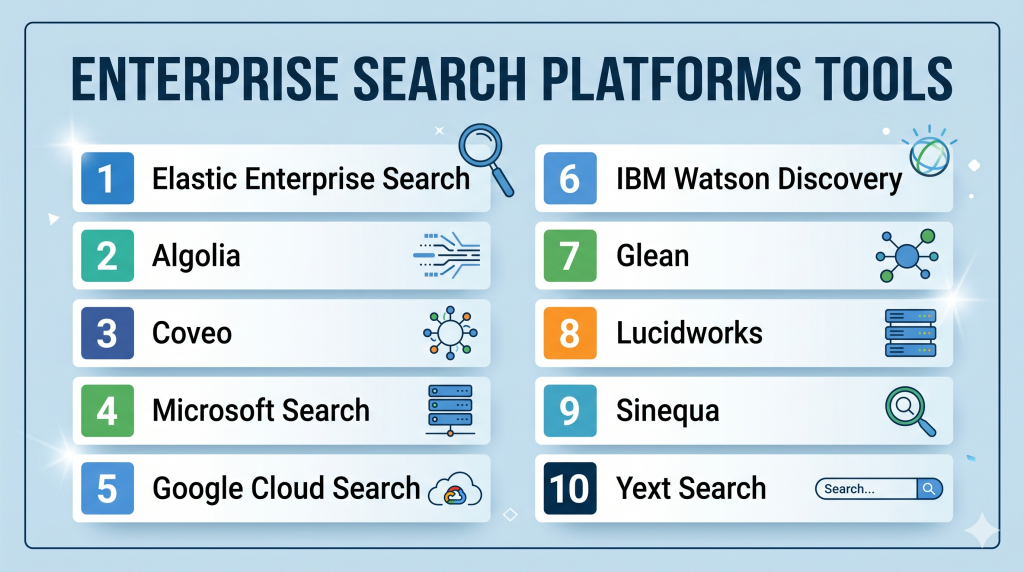
Top 10 Enterprise Search Platforms Tools
#1 — Elastic Enterprise Search
Short description: A powerful search platform built on Elasticsearch, widely used for scalable and customizable enterprise search solutions.
Key Features
- Full-text and semantic search
- Real-time indexing
- Relevance tuning
- Distributed architecture
- Analytics and dashboards
- API-first approach
Pros
- Highly scalable
- Flexible and customizable
- Strong developer ecosystem
Cons
- Requires technical expertise
- Setup complexity
Platforms / Deployment
Web
Cloud / Self-hosted / Hybrid
Security & Compliance
Encryption, RBAC
Varies / Not publicly stated
Integrations & Ecosystem
Highly extensible ecosystem.
- APIs
- Developer tools
- Data pipelines
Support & Community
Large open-source community and strong documentation.
#2 — Algolia
Short description: A fast, API-driven search platform optimized for user-facing and enterprise applications.
Key Features
- AI-powered search relevance
- Typo tolerance
- Real-time indexing
- Personalization
- Analytics
- API-based integration
Pros
- Extremely fast performance
- Easy to integrate
- Great for frontend experiences
Cons
- Pricing scales with usage
- Limited deep customization
Platforms / Deployment
Web
Cloud
Security & Compliance
Varies / Not publicly stated
Integrations & Ecosystem
- APIs
- Ecommerce platforms
- Frontend frameworks
Support & Community
Good documentation and developer support.
#3 — Coveo
Short description: An AI-powered enterprise search platform focused on personalization and relevance.
Key Features
- Machine learning-based search
- Personalization engine
- Real-time indexing
- Analytics
- Omnichannel search
- Recommendations
Pros
- Strong personalization
- Enterprise-ready
- Scalable
Cons
- Pricing varies
- Implementation complexity
Platforms / Deployment
Web
Cloud
Security & Compliance
Varies / Not publicly stated
Integrations & Ecosystem
- CRM tools
- Ecommerce platforms
- APIs
Support & Community
Enterprise-level support.
#4 — Microsoft Search
Short description: A search solution integrated across Microsoft ecosystem tools like Office and enterprise apps.
Key Features
- AI-powered search
- Integration with Microsoft tools
- Personalized results
- Graph-based insights
- Security-aware search
- Unified experience
Pros
- Seamless Microsoft integration
- Easy adoption for existing users
- Strong security
Cons
- Limited outside ecosystem
- Less flexible
Platforms / Deployment
Web
Cloud
Security & Compliance
Enterprise-grade controls
Varies / Not publicly stated
Integrations & Ecosystem
- Microsoft 365
- APIs
- Enterprise apps
Support & Community
Strong enterprise support.
#5 — Google Cloud Search
Short description: A cloud-based enterprise search tool that integrates with Google Workspace.
Key Features
- AI-powered search
- Natural language queries
- Integration with Google tools
- Smart suggestions
- Indexing capabilities
- Secure search
Pros
- Easy to use
- Strong AI capabilities
- Seamless Google integration
Cons
- Limited outside Google ecosystem
- Customization constraints
Platforms / Deployment
Web
Cloud
Security & Compliance
Varies / Not publicly stated
Integrations & Ecosystem
- Google Workspace
- APIs
- Cloud services
Support & Community
Strong documentation.
#6 — IBM Watson Discovery
Short description: An AI-driven enterprise search platform focused on extracting insights from complex data.
Key Features
- Natural language processing
- Document understanding
- AI-powered insights
- Data enrichment
- Custom models
- Analytics
Pros
- Strong AI capabilities
- Good for complex data
- Enterprise-ready
Cons
- Complex setup
- Higher cost
Platforms / Deployment
Web
Cloud / Hybrid
Security & Compliance
Enterprise-grade controls
Varies / Not publicly stated
Integrations & Ecosystem
- APIs
- AI tools
- Enterprise systems
Support & Community
Enterprise support.
#7 — Glean
Short description: An AI-first enterprise search platform designed for workplace productivity and knowledge discovery.
Key Features
- AI-powered search
- Personalized results
- Integration with multiple tools
- Real-time indexing
- Conversational search
- Knowledge graph
Pros
- Easy setup
- Strong personalization
- Modern AI features
Cons
- Pricing varies
- Newer compared to legacy tools
Platforms / Deployment
Web
Cloud
Security & Compliance
Varies / Not publicly stated
Integrations & Ecosystem
- Workplace tools
- APIs
- SaaS apps
Support & Community
Growing ecosystem.
#8 — Lucidworks
Short description: A search platform built on Apache Solr, offering enterprise-grade search and analytics.
Key Features
- AI-powered search
- Relevance tuning
- Analytics
- Scalable architecture
- Data integration
- Custom workflows
Pros
- Highly customizable
- Enterprise-ready
- Scalable
Cons
- Requires expertise
- Complex implementation
Platforms / Deployment
Web
Cloud / Self-hosted
Security & Compliance
Varies / Not publicly stated
Integrations & Ecosystem
- APIs
- Data platforms
- Developer tools
Support & Community
Strong enterprise support.
#9 — Sinequa
Short description: An advanced enterprise search platform focused on knowledge discovery and analytics.
Key Features
- AI-powered search
- Natural language processing
- Data integration
- Analytics dashboards
- Personalization
- Knowledge graphs
Pros
- Strong analytics
- Deep enterprise capabilities
- Scalable
Cons
- Complex setup
- Enterprise-focused pricing
Platforms / Deployment
Web
Cloud / Hybrid
Security & Compliance
Varies / Not publicly stated
Integrations & Ecosystem
- APIs
- Enterprise systems
- Data sources
Support & Community
Enterprise support.
#10 — Yext Search
Short description: A search platform focused on delivering search experiences across websites and enterprise data.
Key Features
- AI-powered search
- Structured data management
- Content indexing
- Analytics
- Customizable UI
- API-first approach
Pros
- Easy deployment
- Good for customer-facing search
- Strong UI customization
Cons
- Limited deep enterprise features
- Pricing varies
Platforms / Deployment
Web
Cloud
Security & Compliance
Varies / Not publicly stated
Integrations & Ecosystem
- APIs
- Marketing tools
- CMS platforms
Support & Community
Good documentation and support.
Comparison Table (Top 10)
| Tool Name | Best For | Platform(s) Supported | Deployment | Standout Feature | Public Rating |
|---|---|---|---|---|---|
| Elastic | Developers | Web | Hybrid | Scalability | N/A |
| Algolia | Fast search | Web | Cloud | Speed | N/A |
| Coveo | Personalization | Web | Cloud | AI relevance | N/A |
| Microsoft Search | Microsoft users | Web | Cloud | Ecosystem integration | N/A |
| Google Cloud Search | Google users | Web | Cloud | AI search | N/A |
| IBM Watson | AI insights | Web | Hybrid | NLP | N/A |
| Glean | Workplace search | Web | Cloud | Personalization | N/A |
| Lucidworks | Enterprise search | Web | Hybrid | Solr-based | N/A |
| Sinequa | Analytics | Web | Hybrid | Knowledge graphs | N/A |
| Yext | Customer search | Web | Cloud | UI customization | N/A |
Evaluation & Scoring of Enterprise Search Platforms
| Tool Name | Core (25%) | Ease (15%) | Integrations (15%) | Security (10%) | Performance (10%) | Support (10%) | Value (15%) | Weighted Total |
|---|---|---|---|---|---|---|---|---|
| Elastic | 10 | 6 | 9 | 8 | 9 | 8 | 8 | 8.6 |
| Algolia | 8 | 9 | 8 | 7 | 10 | 8 | 7 | 8.4 |
| Coveo | 9 | 7 | 9 | 8 | 9 | 8 | 7 | 8.3 |
| Microsoft | 8 | 9 | 8 | 9 | 8 | 8 | 8 | 8.3 |
| 8 | 9 | 8 | 8 | 8 | 8 | 8 | 8.2 | |
| IBM Watson | 9 | 6 | 8 | 9 | 8 | 8 | 7 | 8.1 |
| Glean | 8 | 9 | 9 | 8 | 8 | 7 | 7 | 8.2 |
| Lucidworks | 9 | 6 | 8 | 8 | 9 | 7 | 7 | 8.0 |
| Sinequa | 9 | 6 | 8 | 9 | 8 | 7 | 7 | 8.0 |
| Yext | 7 | 9 | 7 | 7 | 8 | 7 | 8 | 7.8 |
How to interpret scores:
- Scores are comparative across tools
- Higher scores indicate stronger enterprise capabilities
- Developer tools score higher in flexibility and performance
- SaaS tools score higher in ease of use
Which Enterprise Search Platform Is Right for You?
Solo / Freelancer
- Not ideal; consider simpler tools or built-in search
SMB
- Best: Algolia, Yext
- Focus on ease of use and quick setup
Mid-Market
- Best: Glean, Coveo
- Need personalization and integrations
Enterprise
- Best: Elastic, IBM Watson, Sinequa
- Focus on scalability, AI, and data integration
Budget vs Premium
- Budget: Elastic (self-hosted)
- Premium: Coveo, IBM Watson
Feature Depth vs Ease of Use
- Advanced: Elastic, Sinequa
- Easy: Algolia, Google Cloud Search
Integrations & Scalability
- Best: Glean, Elastic
Security & Compliance Needs
- High: Microsoft, IBM Watson
- Standard: Algolia, Yext
Frequently Asked Questions (FAQs)
What is enterprise search?
It is a system that allows users to search across multiple organizational data sources.
How is it different from regular search?
Enterprise search includes permissions, integrations, and internal data indexing.
Does it use AI?
Yes, modern platforms use AI for relevance and personalization.
Is it secure?
Yes, most platforms respect user permissions and access controls.
Can it integrate with multiple tools?
Yes, integrations are a core feature.
Is enterprise search scalable?
Yes, it is designed for large datasets.
What industries use it?
All industries including tech, finance, healthcare, and retail.
Is it expensive?
Costs vary depending on scale and features.
What are common challenges?
Data silos and integration complexity.
Can it improve productivity?
Yes, it significantly reduces time spent searching for information.
Conclusion
Enterprise Search Platforms are becoming essential for organizations dealing with large and complex data ecosystems. By unifying information access and leveraging AI, these tools help teams work faster, smarter, and more efficiently.
