Introduction
Device fingerprinting tools help businesses identify, recognize, and assess devices by analyzing attributes such as browser configuration, hardware characteristics, IP signals, network behavior, OS settings, device metadata, and behavioral patterns. These tools create persistent device identities that help organizations detect fraud, account takeover attempts, bots, multi-account abuse, suspicious logins, and risky transactions. In simple terms, device fingerprinting helps businesses understand whether a device should be trusted or flagged as suspicious.
Device fingerprinting has become essential for fintech, ecommerce, banking, gaming, marketplaces, and digital platforms because attackers increasingly use credential stuffing, bots, emulators, spoofing tools, VPNs, and device farms to bypass traditional authentication systems. Modern device intelligence solutions now combine fingerprinting with behavioral analytics, AI-based risk scoring, and fraud orchestration workflows to improve accuracy while reducing false positives.
Common use cases include account takeover prevention, fraud detection, device trust scoring, bot mitigation, multi-account detection, onboarding risk assessment, payment fraud prevention, and suspicious login analysis. Buyers should evaluate device persistence, spoofing resistance, API flexibility, SDK quality, privacy considerations, behavioral analytics, integration quality, scalability, latency, and fraud intelligence capabilities.
Best for: fintech companies, ecommerce businesses, SaaS providers, gaming platforms, marketplaces, fraud teams, identity teams, and enterprises handling high-risk digital transactions. Not ideal for: organizations with minimal online risk exposure or businesses needing only basic authentication workflows without fraud intelligence requirements.
Key Trends in Device Fingerprinting Tools
- Device intelligence is replacing static fingerprinting models because attackers increasingly spoof simple identifiers.
- Behavioral analytics is being combined with device signals to improve fraud detection accuracy.
- Credential stuffing and account takeover defense are major growth drivers for device intelligence adoption.
- Mobile SDK-based fingerprinting is becoming more important as fraud increasingly targets mobile apps.
- Persistent device IDs are evolving beyond cookies and local storage to survive browser resets and privacy changes.
- AI-driven fraud scoring is improving risk decisioning using device, network, and behavioral signals together.
- Privacy-aware fingerprinting approaches are becoming more important due to stricter global privacy regulations.
- Bot detection and device fingerprinting are converging as automated abuse attacks continue growing.
- Fraud orchestration platforms increasingly embed device intelligence rather than treating it as a standalone tool.
- Real-time device risk scoring is becoming mandatory for modern fintech and ecommerce workflows.
How We Selected These Tools
This list was selected using a practical fraud prevention, identity security, and device intelligence evaluation framework.
- We prioritized platforms with strong device fingerprinting and device intelligence capabilities.
- We included enterprise fraud platforms, API-first tools, and specialized device intelligence vendors.
- We evaluated spoofing resistance, persistent identification, and behavioral analysis capabilities.
- We considered API quality, SDK availability, developer experience, and integration flexibility.
- We reviewed suitability for fintech, ecommerce, SaaS, gaming, and enterprise environments.
- We evaluated bot mitigation, account takeover prevention, and fraud scoring workflows.
- We considered scalability for SMB, mid-market, and enterprise organizations.
- We reviewed ecosystem integrations and operational usability.
- We avoided unsupported compliance claims or invented ratings.
- We used “Not publicly stated” or “Varies / N/A” where details were uncertain.
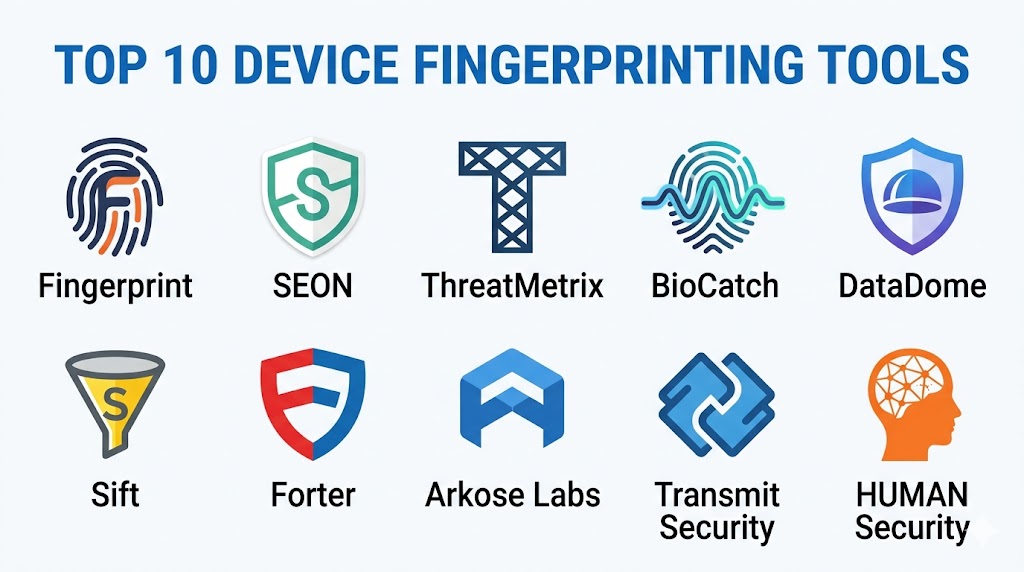
Top 10 Device Fingerprinting Tools
#1 — Fingerprint
Short description: Fingerprint is one of the most recognized device intelligence platforms for identifying visitors, devices, bots, and suspicious sessions across web and mobile applications. It helps businesses prevent account takeover, fraud, fake account creation, and abuse by generating persistent device identities. Fingerprint is especially useful for fintech, ecommerce, SaaS, and fraud prevention teams building custom risk workflows. It is best suited for developer-first organizations needing strong device intelligence APIs.
Key Features
- Persistent device identification
- Browser and device fingerprinting
- Visitor recognition across sessions
- VPN and proxy detection
- Fraud and bot risk signals
- API-first architecture
- Web and mobile SDK support
Pros
- Strong developer experience
- Useful for custom fraud workflows
- Good persistent device recognition
- Flexible APIs and SDKs
Cons
- Not a full fraud orchestration platform by itself
- Requires internal decisioning workflows
- Advanced implementations may require tuning
- Privacy requirements must be managed carefully
Platforms / Deployment
Web / Mobile / APIs / SDKs.
Cloud.
Security & Compliance
Supports secure APIs, operational fraud workflows, and access management. Buyers should verify encryption, logging, privacy, and compliance requirements directly.
Integrations & Ecosystem
Fingerprint integrates into fraud prevention, identity, authentication, and analytics ecosystems.
- Web applications
- Mobile apps
- Fraud engines
- Identity platforms
- Authentication workflows
- Risk scoring systems
Support & Community
Strong documentation, SDK support, developer resources, and broad fraud prevention ecosystem adoption.
#2 — SEON
Short description: SEON is a fraud prevention platform that combines device fingerprinting, behavioral analysis, digital footprint intelligence, and risk scoring into a centralized fraud detection system. It helps businesses identify suspicious devices, emulators, multi-account abuse, and account takeover attempts. SEON is especially useful for fintech, gaming, ecommerce, and digital platforms handling high-risk transactions.
Key Features
- Device intelligence and fingerprinting
- Emulator and spoofing detection
- Behavioral analytics
- Persistent device identification
- Fraud scoring and orchestration
- Multi-account detection
- API and SDK integrations
Pros
- Strong fraud-focused device intelligence
- Good fit for fintech and gaming
- Useful risk scoring workflows
- Broad fraud signal coverage
Cons
- Advanced setups may require tuning
- Smaller teams may not use full platform depth
- Pricing may vary with scale
- Some workflows require operational fraud expertise
Platforms / Deployment
Web / Mobile / APIs / SDKs.
Cloud.
Security & Compliance
Supports operational fraud controls, device risk analysis, and secure API workflows. Buyers should validate compliance documentation directly.
Integrations & Ecosystem
SEON integrates into fraud, payments, identity, and risk ecosystems.
- Ecommerce platforms
- Payment systems
- Gaming platforms
- Fintech apps
- Fraud operations
- Risk decisioning engines
Support & Community
Strong documentation, onboarding support, and fraud prevention guidance for digital businesses.
#3 — ThreatMetrix
Short description: ThreatMetrix, part of LexisNexis Risk Solutions, provides digital identity intelligence and device fingerprinting capabilities for fraud prevention, authentication, and risk management. It combines device identity, network analysis, location intelligence, and behavioral analytics to identify suspicious activity. ThreatMetrix is especially useful for enterprises and financial institutions requiring large-scale identity risk analysis.
Key Features
- Device fingerprinting and identity intelligence
- Behavioral analytics
- Network and geolocation analysis
- Account takeover prevention
- Risk scoring and authentication support
- Fraud and trust decisioning
- Enterprise fraud workflows
Pros
- Strong enterprise fraud capabilities
- Good identity intelligence depth
- Useful for financial services environments
- Broad digital trust workflows
Cons
- Enterprise-focused deployment complexity
- Smaller businesses may find it excessive
- Pricing may be premium-focused
- Implementation may require dedicated teams
Platforms / Deployment
Web / APIs / Enterprise fraud systems.
Cloud / Hybrid / Varies.
Security & Compliance
Supports enterprise fraud operations, identity workflows, and risk decisioning. Buyers should verify auditability, encryption, and compliance documentation directly.
Integrations & Ecosystem
ThreatMetrix integrates into enterprise identity and fraud ecosystems.
- Banking systems
- Authentication platforms
- Fraud operations
- Risk engines
- Identity workflows
- Enterprise applications
Support & Community
Enterprise implementation support and fraud operations guidance are available for large organizations.
#4 — HUMAN Security
Short description: HUMAN Security provides bot defense, device intelligence, account takeover protection, and fraud prevention capabilities for web, mobile, and API environments. It identifies automated abuse, suspicious devices, and malicious traffic patterns in real time. HUMAN Security is especially useful for large digital platforms and ecommerce environments facing sophisticated bot attacks.
Key Features
- Device fingerprinting and risk scoring
- Bot and automated abuse detection
- Credential stuffing defense
- API and mobile app protection
- Real-time fraud analysis
- Behavioral analytics
- Threat intelligence workflows
Pros
- Strong bot intelligence capabilities
- Good fit for high-scale digital platforms
- Useful ATO protection workflows
- Broad digital abuse coverage
Cons
- Enterprise-oriented deployment
- Pricing may not suit smaller businesses
- Complex workflows may require tuning
- Not primarily an identity platform
Platforms / Deployment
Web / Mobile / APIs.
Cloud.
Security & Compliance
Supports fraud operations, automated abuse mitigation, and operational monitoring workflows.
Integrations & Ecosystem
HUMAN Security integrates into web security and fraud ecosystems.
- APIs
- Ecommerce systems
- Mobile apps
- Security operations
- Fraud platforms
- Traffic analysis systems
Support & Community
Enterprise onboarding, operational guidance, and fraud defense support are available.
#5 — Incognia
Short description: Incognia focuses on location intelligence and device recognition for fraud prevention and seamless user verification. It uses location behavior and device trust analysis to identify suspicious activity while minimizing friction for legitimate users. Incognia is especially useful for mobile-first fintech, delivery, mobility, and ecommerce applications.
Key Features
- Device recognition and trust scoring
- Location intelligence analysis
- Mobile-first fraud detection
- Risk-based authentication support
- Account takeover prevention
- Low-friction identity verification
- Fraud signal enrichment
Pros
- Strong mobile-first approach
- Useful low-friction verification workflows
- Good fit for mobility and fintech apps
- Helps reduce unnecessary authentication friction
Cons
- More specialized than broad fraud platforms
- Location privacy considerations must be managed
- Best suited for mobile-centric workflows
- Advanced orchestration may require additional systems
Platforms / Deployment
Mobile / APIs / SDKs.
Cloud.
Security & Compliance
Supports secure device and location-based risk workflows. Buyers should validate privacy, consent, and compliance requirements directly.
Integrations & Ecosystem
Incognia integrates into mobile identity and fraud prevention environments.
- Fintech applications
- Delivery apps
- Mobility platforms
- Ecommerce systems
- Authentication workflows
- Fraud scoring systems
Support & Community
Developer documentation and onboarding support are available for mobile-focused teams.
#6 — BioCatch
Short description: BioCatch combines behavioral biometrics and device intelligence to identify account takeover attempts, scams, suspicious sessions, and digital fraud. It analyzes user interaction patterns, session behavior, and device context to detect anomalies. BioCatch is especially useful for banks, fintechs, and high-risk financial environments.
Key Features
- Behavioral biometric analysis
- Device and session intelligence
- Account takeover detection
- Fraud scoring workflows
- Real-time risk analysis
- Scam and mule detection support
- Enterprise fraud orchestration
Pros
- Strong behavioral analysis capabilities
- Useful for banking and fintech
- Detects fraud beyond static credentials
- Good enterprise fraud workflows
Cons
- Enterprise-focused implementation
- Premium pricing potential
- Requires operational fraud expertise
- Smaller businesses may not need full feature scope
Platforms / Deployment
Web / APIs / Enterprise fraud systems.
Cloud / Hybrid / Varies.
Security & Compliance
Supports fraud analytics, operational monitoring, and enterprise risk workflows. Buyers should validate compliance requirements directly.
Integrations & Ecosystem
BioCatch integrates into banking and financial fraud ecosystems.
- Digital banking
- Payment systems
- Fraud operations
- Risk engines
- Identity systems
- Transaction monitoring
Support & Community
Enterprise onboarding and fraud operations support are available for financial organizations.
#7 — Shufti Device Fingerprinting
Short description: Shufti provides AI-powered device fingerprinting and identity verification workflows for fraud prevention, account takeover detection, and transaction risk analysis. It combines device signals, behavioral analysis, and identity verification into layered fraud detection workflows. Shufti is especially useful for fintech, ecommerce, and regulated digital businesses.
Key Features
- AI-powered device fingerprinting
- Account takeover detection
- Identity verification integration
- Behavioral analysis
- Fraud scoring support
- API-driven workflows
- Risk-based authentication support
Pros
- Useful combination of identity and device intelligence
- Good fintech and ecommerce fit
- API-first integrations
- Supports layered fraud workflows
Cons
- Broader orchestration may require additional systems
- Enterprise customizations may require planning
- Device-only workflows may be less specialized
- Operational tuning may be necessary
Platforms / Deployment
Web / Mobile / APIs / SDKs.
Cloud.
Security & Compliance
Supports identity verification and fraud monitoring workflows. Buyers should verify compliance and operational controls directly.
Integrations & Ecosystem
Shufti integrates into identity verification and fraud prevention workflows.
- Fintech applications
- Ecommerce systems
- KYC workflows
- Authentication systems
- Fraud operations
- Transaction monitoring
Support & Community
Developer resources and onboarding support are available for digital businesses.
#8 — Group-IB Fraud Protection
Short description: Group-IB Fraud Protection uses AI-driven behavioral analysis and device intelligence to identify malware, suspicious activity, account takeover, and fraudulent user behavior. It focuses heavily on banking and digital fraud environments. Group-IB is especially useful for financial institutions needing advanced fraud analytics.
Key Features
- Behavioral and device intelligence
- Malware and fraud detection
- Session and interaction analysis
- Fraud scoring workflows
- Banking fraud protection
- Real-time monitoring
- AI-based anomaly detection
Pros
- Strong financial fraud focus
- Useful malware detection workflows
- Good behavioral analytics depth
- Real-time monitoring capabilities
Cons
- Enterprise-focused deployments
- Smaller businesses may not need full capabilities
- Advanced tuning may be required
- Pricing and implementation complexity may vary
Platforms / Deployment
Web / APIs / Enterprise fraud infrastructure.
Cloud / Hybrid / Varies.
Security & Compliance
Supports enterprise fraud operations, monitoring, and digital banking workflows.
Integrations & Ecosystem
Group-IB integrates into banking and enterprise fraud environments.
- Digital banking
- Fraud operations
- Risk engines
- Security monitoring
- Payment systems
- Financial applications
Support & Community
Enterprise onboarding and operational fraud guidance are available for financial organizations.
#9 — Sardine
Short description: Sardine is an AI-based fraud prevention platform that combines device intelligence, behavioral biometrics, compliance workflows, and transaction risk analysis into a unified fraud prevention stack. It is especially useful for fintechs, crypto platforms, and payment businesses.
Key Features
- Device and behavior intelligence
- Payment fraud detection
- Behavioral biometrics
- Risk scoring workflows
- Fraud orchestration support
- Compliance and onboarding workflows
- Real-time transaction analysis
Pros
- Strong fintech and payments focus
- Good behavioral analytics support
- Useful unified fraud workflows
- Modern API-first platform
Cons
- Best suited for fraud-focused environments
- Enterprise workflows may require customization
- Newer ecosystem compared to legacy vendors
- Pricing may scale with usage
Platforms / Deployment
Web / APIs / SDKs.
Cloud.
Security & Compliance
Supports fraud monitoring, operational workflows, and transaction analysis systems. Buyers should verify compliance requirements directly.
Integrations & Ecosystem
Sardine integrates into fintech and payments ecosystems.
- Payment platforms
- Crypto systems
- Fintech applications
- Fraud operations
- Compliance workflows
- Risk engines
Support & Community
Developer-friendly documentation and onboarding resources are available for fintech teams.
#10 — Sumsub Device Intelligence
Short description: Sumsub Device Intelligence helps businesses detect fraud, suspicious devices, onboarding abuse, and risky account behavior using fingerprinting, behavioral analysis, and network intelligence. It is especially useful for regulated fintech, crypto, and identity verification environments.
Key Features
- Device fingerprinting
- Behavioral analysis
- Network intelligence
- Fraud prevention workflows
- Identity verification integration
- Account takeover prevention
- Real-time risk scoring
Pros
- Strong identity verification ecosystem
- Useful onboarding fraud detection
- Good fintech and crypto fit
- Layered fraud intelligence approach
Cons
- Device intelligence is part of a broader platform
- Enterprise custom workflows may require tuning
- Some use cases may require additional integrations
- Pricing may vary with scale
Platforms / Deployment
Web / APIs / SDKs.
Cloud.
Security & Compliance
Supports fraud monitoring, onboarding risk analysis, and identity workflows. Buyers should verify operational and compliance requirements directly.
Integrations & Ecosystem
Sumsub integrates into KYC, onboarding, and fraud prevention environments.
- KYC systems
- Fintech applications
- Crypto platforms
- Identity verification workflows
- Fraud operations
- Transaction monitoring
Support & Community
Implementation support and developer documentation are available for regulated digital businesses.
Comparison Table
| Tool Name | Best For | Platform Supported | Deployment | Standout Feature | Public Rating |
|---|---|---|---|---|---|
| Fingerprint | Developer-first device intelligence | Web / Mobile / APIs | Cloud | Persistent visitor identification | N/A |
| SEON | Fraud-focused device intelligence | Web / Mobile / APIs | Cloud | Emulator and spoofing detection | N/A |
| ThreatMetrix | Enterprise digital identity intelligence | Web / APIs | Cloud / Hybrid | Enterprise risk and identity analysis | N/A |
| HUMAN Security | Bot and digital abuse prevention | Web / Mobile / APIs | Cloud | Large-scale bot mitigation | N/A |
| Incognia | Mobile location intelligence | Mobile / APIs | Cloud | Low-friction device trust scoring | N/A |
| BioCatch | Behavioral biometric fraud detection | Web / APIs | Cloud / Hybrid | Behavioral analytics for fraud detection | N/A |
| Shufti | AI-powered fraud and identity workflows | Web / Mobile / APIs | Cloud | Layered identity and device intelligence | N/A |
| Group-IB Fraud Protection | Banking fraud analytics | Web / APIs | Cloud / Hybrid | Behavioral and malware analysis | N/A |
| Sardine | Fintech fraud orchestration | Web / APIs | Cloud | Unified fraud and compliance workflows | N/A |
| Sumsub Device Intelligence | KYC and onboarding fraud detection | Web / APIs | Cloud | Device intelligence plus identity verification | N/A |
Evaluation & Scoring of Device Fingerprinting Tools
| Tool Name | Core | Ease | Integrations | Security | Performance | Support | Value | Weighted Total |
|---|---|---|---|---|---|---|---|---|
| Fingerprint | 9 | 9 | 8 | 8 | 9 | 8 | 8 | 8.45 |
| SEON | 9 | 8 | 8 | 8 | 8 | 8 | 8 | 8.20 |
| ThreatMetrix | 9 | 6 | 9 | 9 | 8 | 8 | 6 | 7.95 |
| HUMAN Security | 8 | 7 | 8 | 9 | 9 | 8 | 7 | 8.00 |
| Incognia | 8 | 8 | 7 | 8 | 8 | 7 | 8 | 7.80 |
| BioCatch | 9 | 7 | 8 | 9 | 8 | 8 | 7 | 8.05 |
| Shufti | 8 | 8 | 8 | 8 | 8 | 7 | 8 | 7.95 |
| Group-IB Fraud Protection | 8 | 6 | 8 | 9 | 8 | 8 | 7 | 7.75 |
| Sardine | 8 | 8 | 8 | 8 | 8 | 8 | 8 | 8.00 |
| Sumsub Device Intelligence | 8 | 8 | 8 | 8 | 8 | 8 | 8 | 8.00 |
These scores are comparative and intended as a practical evaluation framework rather than absolute rankings. Some tools specialize in device intelligence only, while others combine device signals with fraud orchestration, behavioral analytics, identity verification, or bot mitigation. Buyers should validate spoofing resistance, API latency, false-positive rates, privacy controls, and operational workflows before deployment.
Which Device Fingerprinting Tool Is Right for You?
Solo / Freelancer
Small teams and independent developers usually benefit from lightweight, API-first platforms such as Fingerprint or basic fraud tooling from Cloudflare-style ecosystems. The focus should be ease of integration, low operational overhead, and quick deployment. Strong MFA and rate limiting should still be combined with device intelligence.
SMB
SMBs should prioritize ease of deployment, fraud visibility, and flexible APIs. Fingerprint, SEON, Sardine, and Sumsub are strong choices depending on whether the business prioritizes payments, onboarding, ecommerce fraud, or custom risk scoring. SMBs should avoid overcomplicated enterprise platforms unless fraud losses justify the investment.
Mid-Market
Mid-market companies often require broader fraud workflows, account takeover detection, device trust scoring, and behavioral analytics. SEON, BioCatch, Sardine, HUMAN Security, and ThreatMetrix can support more advanced fraud operations. Teams should evaluate operational dashboards, alerting, and orchestration flexibility carefully.
Enterprise
Large enterprises should combine device intelligence with identity security, fraud orchestration, behavioral analytics, and bot mitigation. ThreatMetrix, BioCatch, Group-IB, HUMAN Security, and SEON are strong candidates depending on industry requirements. Enterprises should also prioritize audit logs, governance, SIEM integrations, and incident response support.
Budget vs Premium
Developer-first device fingerprinting APIs provide strong value for startups and growing platforms, while enterprise fraud systems deliver broader operational governance and fraud analytics. The right investment depends on transaction risk, fraud exposure, compliance obligations, and internal fraud operations maturity.
Feature Depth vs Ease of Use
Fingerprint and Incognia are relatively easy to operationalize, while ThreatMetrix, BioCatch, and Group-IB provide deeper enterprise fraud capabilities. SEON and Sardine balance developer usability with broader fraud intelligence. Businesses should choose based on operational complexity and fraud sophistication.
Integrations & Scalability
Device fingerprinting systems should integrate with fraud engines, identity providers, payment platforms, mobile apps, analytics systems, SIEM tools, and authentication workflows. Scalability depends on latency, event processing, API reliability, and risk scoring architecture. Teams should validate performance under real traffic conditions.
Security & Compliance Needs
Device fingerprinting involves identity, behavioral, and device-level data, so privacy and security are critical. Buyers should evaluate encryption, consent workflows, audit logs, data retention, regional data handling, and compliance support. Regulated industries should carefully review operational governance and privacy implications.
Frequently Asked Questions
1. What is device fingerprinting?
Device fingerprinting is the process of identifying a device using attributes such as browser settings, hardware characteristics, OS configuration, IP signals, network behavior, and software metadata. These attributes help generate a persistent device identity that can be used for fraud prevention and risk analysis. It is widely used in fintech, ecommerce, and digital security workflows.
2. Why are device fingerprinting tools important?
These tools help businesses detect account takeover, bots, multi-account abuse, payment fraud, and suspicious login behavior. Attackers increasingly use VPNs, emulators, device farms, and spoofing tools to bypass traditional authentication systems. Device intelligence helps identify risk signals that passwords alone cannot detect.
3. How is device intelligence different from device fingerprinting?
Device fingerprinting focuses mainly on identifying a device, while device intelligence combines device signals with behavioral analytics, risk scoring, and contextual fraud analysis. Modern fraud platforms increasingly use device intelligence rather than static fingerprints alone. This improves detection accuracy against advanced fraud attacks.
4. Can device fingerprinting stop account takeover attacks?
Yes, device fingerprinting can help identify suspicious logins from unfamiliar, spoofed, or risky devices. It is especially effective when combined with behavioral analytics, MFA, and risk-based authentication. However, it should be part of a layered security strategy rather than the only defense mechanism.
5. Do device fingerprinting tools work on mobile apps?
Many modern platforms support mobile SDKs and mobile device intelligence workflows. Mobile fraud detection is increasingly important because many fintech and ecommerce attacks target mobile applications. Buyers should verify Android and iOS SDK quality before deployment.
6. Are device fingerprinting tools privacy compliant?
Privacy compliance depends on implementation, consent handling, regional regulations, and how device data is processed. Organizations should evaluate GDPR, CCPA, and regional privacy requirements carefully. Transparent disclosure and appropriate governance are important for compliant deployments.
7. What types of fraud can device fingerprinting detect?
Device fingerprinting can help detect account takeover, credential stuffing, bot attacks, synthetic identity fraud, payment fraud, multi-account abuse, and suspicious onboarding behavior. Combined with behavioral analytics, it becomes more effective against sophisticated fraud campaigns.
8. Can attackers bypass device fingerprinting?
Sophisticated attackers can attempt spoofing, emulation, browser resets, or device obfuscation techniques. Modern device intelligence platforms counter these tactics using behavioral analysis, persistent identifiers, and AI-driven risk scoring. No single signal is perfect, which is why layered fraud defense is important.
9. Which industries benefit most from device intelligence?
Fintech, ecommerce, banking, gaming, crypto, marketplaces, delivery apps, and SaaS platforms commonly benefit from device intelligence. Any digital business exposed to fraud, account abuse, or suspicious logins can use device fingerprinting to improve risk visibility. High-transaction industries typically see the strongest value.
10. How should businesses choose a device fingerprinting tool?
Businesses should evaluate spoofing resistance, device persistence, behavioral analytics, mobile support, API quality, fraud workflows, scalability, privacy controls, and integration flexibility. Real-world testing with production traffic is important because fraud patterns vary significantly across industries. The best platform depends on the organization’s fraud maturity and operational requirements.
Conclusion
Device fingerprinting tools have become critical infrastructure for fraud prevention, account security, identity intelligence, and digital trust because attackers increasingly use automation, spoofing, and credential abuse to bypass traditional authentication controls. Platforms such as Fingerprint, SEON, ThreatMetrix, HUMAN Security, Incognia, BioCatch, Shufti, Group-IB, Sardine, and Sumsub all offer different strengths depending on whether the organization prioritizes device persistence, behavioral analytics, fraud orchestration, bot mitigation, onboarding security, or identity intelligence. The best solution depends on industry requirements, transaction volume, fraud exposure, privacy considerations, and operational maturity. Businesses should evaluate not only fingerprinting accuracy but also spoofing resistance, latency, integrations, and false-positive reduction. Start by shortlisting two or three platforms, run controlled traffic and fraud testing, validate integration performance and privacy requirements, then scale the strongest device intelligence strategy across web, mobile, and API environments.

This article clearly explains device fingerprinting tools and how they help improve security, fraud detection, and user identification across digital platforms.
This article clearly explains device fingerprinting tools and how they help organizations strengthen fraud prevention, user authentication, and digital security management.
Device fingerprinting accuracy can decline as privacy protections and browser restrictions continue to evolve. Balancing fraud detection with user privacy remains a growing challenge.