Introduction
Threat Intelligence Platforms (TIPs) help organizations collect, analyze, and act on threat data from multiple sources. These platforms transform raw threat feeds into actionable insights, enabling security teams to proactively detect, prevent, and respond to cyber threats. By centralizing threat intelligence, TIPs improve visibility and decision-making across the security ecosystem.
With increasing cyber threats and growing attack surfaces, organizations need better ways to understand adversaries, vulnerabilities, and risks. Threat Intelligence Platforms provide context to alerts, reduce false positives, and enhance incident response through enriched intelligence.
Use Cases:
- Aggregating threat intelligence feeds from multiple sources
- Enriching security alerts with contextual data
- Identifying indicators of compromise (IOCs)
- Supporting incident response and threat hunting
- Improving vulnerability management strategies
What buyers should evaluate:
- Intelligence aggregation and correlation capabilities
- Integration with SIEM, EDR, and SOAR tools
- Data enrichment and automation features
- Ease of use and dashboard clarity
- Threat feed quality and relevance
- Scalability and performance
- Security and compliance features
- Support and documentation
Best for: Security analysts, SOC teams, threat hunters, and organizations seeking proactive cybersecurity strategies.
Not ideal for: Very small teams without dedicated security operations or organizations relying only on basic antivirus and firewall solutions.
Key Trends in Threat Intelligence Platforms
- Increased use of AI for threat prediction and prioritization
- Integration with SOAR and SIEM for automated response
- Growth of real-time intelligence feeds
- Focus on contextual and actionable intelligence
- Expansion of external attack surface monitoring
- Greater emphasis on automation and enrichment
- Integration with DevSecOps pipelines
- Cloud-native deployment models
- Collaborative intelligence sharing across organizations
- Subscription-based intelligence services
How We Selected These Tools (Methodology)
- Market presence and industry adoption
- Breadth and depth of intelligence capabilities
- Reliability and performance signals
- Integration ecosystem strength
- Security and compliance features
- Scalability across environments
- Ease of use and onboarding
- Innovation in threat detection and analytics
- Customer fit across organization sizes
- Support quality and documentation
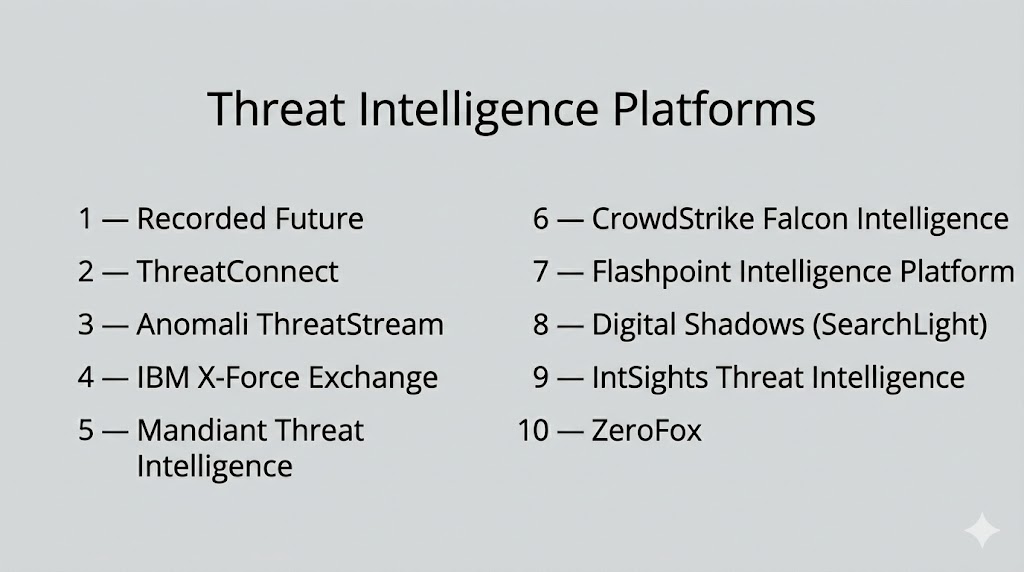
Top 10 Threat Intelligence Platforms
#1 — Recorded Future
Short description: A leading threat intelligence platform that uses machine learning to deliver real-time insights into cyber threats, vulnerabilities, and risks.
Key Features
- Real-time threat intelligence
- Risk scoring and prioritization
- Automated data collection
- Dark web monitoring
- Threat analytics dashboards
Pros
- High-quality intelligence data
- Strong analytics capabilities
Cons
- Premium pricing
- Requires training for full utilization
Platforms / Deployment
- Web
- Cloud
Security & Compliance
- SSO, MFA, encryption
- Not publicly stated
Integrations & Ecosystem
Integrates with SIEM, SOAR, and security tools.
- Splunk
- ServiceNow
- CrowdStrike
Support & Community
Enterprise support with strong documentation and onboarding.
#2 — ThreatConnect
Short description: A platform combining threat intelligence and orchestration, enabling organizations to manage intelligence and automate response workflows.
Key Features
- Intelligence aggregation
- Workflow automation
- Case management
- Threat enrichment
- Collaboration tools
Pros
- Flexible workflows
- Strong integration capabilities
Cons
- Learning curve
- Requires configuration
Platforms / Deployment
- Web
- Cloud / Hybrid
Security & Compliance
- SSO, MFA, RBAC
- SOC 2
Integrations & Ecosystem
- SIEM, EDR, ITSM tools
Support & Community
Good support and onboarding resources.
#3 — Anomali ThreatStream
Short description: A threat intelligence platform that aggregates and analyzes large volumes of threat data to deliver actionable insights.
Key Features
- Threat feed aggregation
- Intelligence enrichment
- IOC management
- Analytics dashboards
- Integration capabilities
Pros
- Large intelligence database
- Strong analytics
Cons
- Complex setup
- Requires tuning
Platforms / Deployment
- Web
- Cloud
Security & Compliance
- SSO, MFA
- Not publicly stated
Integrations & Ecosystem
- SIEM, SOAR, EDR tools
Support & Community
Vendor support and documentation available.
#4 — IBM X-Force Exchange
Short description: A threat intelligence sharing platform providing insights into global threats, vulnerabilities, and attack trends.
Key Features
- Threat intelligence sharing
- Vulnerability insights
- Analytics dashboards
- Threat research access
- Collaboration tools
Pros
- Strong research-backed intelligence
- Global threat visibility
Cons
- Limited customization
- Requires integration for full value
Platforms / Deployment
- Web
- Cloud
Security & Compliance
- SSO, MFA
- Not publicly stated
Integrations & Ecosystem
- IBM security ecosystem
Support & Community
Community-driven platform with enterprise support.
#5 — Mandiant Threat Intelligence
Short description: A platform delivering detailed intelligence on threat actors, campaigns, and vulnerabilities to support proactive defense.
Key Features
- Threat actor profiles
- Campaign tracking
- Vulnerability insights
- Intelligence reports
- Risk analysis
Pros
- High-quality intelligence
- Strong threat research
Cons
- Premium pricing
- Limited customization
Platforms / Deployment
- Web
- Cloud
Security & Compliance
- SSO, MFA
- Not publicly stated
Integrations & Ecosystem
- Security tools and platforms
Support & Community
Professional support and expert insights.
#6 — CrowdStrike Falcon Intelligence
Short description: A threat intelligence module within the Falcon platform providing insights into adversaries and attack techniques.
Key Features
- Threat intelligence reports
- Adversary tracking
- IOC identification
- Integration with endpoint security
- Real-time insights
Pros
- Strong integration with endpoint security
- High-quality intelligence
Cons
- Requires Falcon platform
- Cost considerations
Platforms / Deployment
- Web
- Cloud
Security & Compliance
- SSO, MFA, encryption
- Not publicly stated
Integrations & Ecosystem
- CrowdStrike ecosystem
Support & Community
Enterprise support and documentation.
#7 — Flashpoint Intelligence Platform
Short description: A platform focused on external threat intelligence, including dark web monitoring and risk intelligence.
Key Features
- Dark web monitoring
- Threat intelligence feeds
- Risk analysis
- Analytics dashboards
- Intelligence reports
Pros
- Strong external intelligence
- Deep threat visibility
Cons
- Expensive
- Complex setup
Platforms / Deployment
- Web
- Cloud
Security & Compliance
- SSO, MFA
- Not publicly stated
Integrations & Ecosystem
- Security tools and APIs
Support & Community
Vendor support and training resources.
#8 — Digital Shadows (SearchLight)
Short description: A threat intelligence platform focused on digital risk protection and external threat monitoring.
Key Features
- External threat monitoring
- Risk detection
- Threat intelligence feeds
- Analytics dashboards
- Alerting system
Pros
- Strong digital risk visibility
- Easy to use
Cons
- Limited advanced features
- Integration limitations
Platforms / Deployment
- Web
- Cloud
Security & Compliance
- SSO, MFA
- Not publicly stated
Integrations & Ecosystem
- SIEM and security tools
Support & Community
Responsive support and onboarding.
#9 — IntSights Threat Intelligence
Short description: A platform delivering real-time intelligence and risk monitoring across external attack surfaces.
Key Features
- Threat monitoring
- Risk scoring
- Intelligence feeds
- Alerting system
- Dashboard analytics
Pros
- Real-time monitoring
- User-friendly interface
Cons
- Limited customization
- Smaller ecosystem
Platforms / Deployment
- Web
- Cloud
Security & Compliance
- SSO, MFA
- Not publicly stated
Integrations & Ecosystem
- SIEM and security tools
Support & Community
Vendor support and documentation.
#10 — ZeroFox
Short description: A platform focused on social media and digital threat intelligence, helping organizations detect and mitigate external risks.
Key Features
- Social media monitoring
- Threat detection
- Risk intelligence
- Analytics dashboards
- Alerting system
Pros
- Strong social media intelligence
- Real-time alerts
Cons
- Niche focus
- Limited general threat intelligence
Platforms / Deployment
- Web
- Cloud
Security & Compliance
- SSO, MFA
- Not publicly stated
Integrations & Ecosystem
- Security tools and APIs
Support & Community
Enterprise support and onboarding.
Comparison Table (Top 10)
| Tool Name | Best For | Platform(s) Supported | Deployment | Standout Feature | Public Rating |
|---|---|---|---|---|---|
| Recorded Future | Enterprise | Web | Cloud | Real-time intelligence | N/A |
| ThreatConnect | Enterprise | Web | Cloud / Hybrid | Workflow automation | N/A |
| Anomali ThreatStream | Enterprise | Web | Cloud | Intelligence aggregation | N/A |
| IBM X-Force Exchange | Enterprise | Web | Cloud | Threat sharing | N/A |
| Mandiant TI | Enterprise | Web | Cloud | Threat actor insights | N/A |
| CrowdStrike Falcon | Enterprise | Web | Cloud | Endpoint integration | N/A |
| Flashpoint | Enterprise | Web | Cloud | Dark web monitoring | N/A |
| Digital Shadows | SMB/Enterprise | Web | Cloud | Risk monitoring | N/A |
| IntSights | SMB/Enterprise | Web | Cloud | Real-time intelligence | N/A |
| ZeroFox | Enterprise | Web | Cloud | Social intelligence | N/A |
Evaluation & Scoring of Threat Intelligence Platforms
| Tool Name | Core (25%) | Ease (15%) | Integrations (15%) | Security (10%) | Performance (10%) | Support (10%) | Value (15%) | Weighted Total (0–10) |
|---|---|---|---|---|---|---|---|---|
| Recorded Future | 9 | 7 | 8 | 8 | 9 | 8 | 7 | 8.3 |
| ThreatConnect | 8 | 7 | 8 | 8 | 8 | 7 | 7 | 7.8 |
| Anomali | 8 | 6 | 8 | 8 | 8 | 7 | 7 | 7.7 |
| IBM X-Force | 7 | 7 | 7 | 7 | 7 | 7 | 7 | 7.1 |
| Mandiant | 9 | 7 | 7 | 8 | 9 | 8 | 7 | 8.1 |
| CrowdStrike | 8 | 8 | 7 | 8 | 8 | 8 | 7 | 7.9 |
| Flashpoint | 8 | 6 | 7 | 8 | 8 | 7 | 6 | 7.4 |
| Digital Shadows | 7 | 8 | 6 | 7 | 7 | 7 | 7 | 7.2 |
| IntSights | 7 | 8 | 6 | 7 | 7 | 7 | 7 | 7.2 |
| ZeroFox | 7 | 8 | 6 | 7 | 7 | 7 | 7 | 7.2 |
Scores are comparative and based on feature strength, usability, integration capabilities, and value. Higher scores indicate stronger enterprise readiness.
Which Threat Intelligence Platform Is Right for You?
Solo / Freelancer
Basic security tools are sufficient; TIPs may not be required.
SMB
Digital Shadows or IntSights provide ease of use and quick deployment.
Mid-Market
ThreatConnect and Anomali offer balanced features and scalability.
Enterprise
Recorded Future, Mandiant, and CrowdStrike provide advanced intelligence capabilities.
Budget vs Premium
Budget tools offer essential monitoring; premium tools deliver deeper intelligence insights.
Feature Depth vs Ease of Use
Advanced platforms provide detailed intelligence but require training.
Integrations & Scalability
Ensure compatibility with your existing security stack.
Security & Compliance Needs
Select platforms that align with compliance requirements.
Frequently Asked Questions (FAQs)
What is a Threat Intelligence Platform?
It is a system that collects, analyzes, and delivers actionable threat data to improve security operations.
How does it differ from SIEM?
SIEM analyzes logs, while TIPs provide external threat context and intelligence.
Are TIPs necessary for small businesses?
Not always, unless they face advanced threats.
How long does implementation take?
It varies depending on integrations and data sources.
Do these platforms require expertise?
Yes, analysts are needed to interpret intelligence effectively.
Can TIPs integrate with existing tools?
Yes, most platforms support integrations with SIEM, SOAR, and EDR.
What are common mistakes?
Relying on raw data without analysis and poor integration planning.
Are TIPs secure?
Most include strong security controls like MFA and encryption.
Can they scale with growth?
Yes, most platforms are designed for scalability.
What alternatives exist?
Alternatives include basic threat feeds and manual analysis tools.
Conclusion
Threat Intelligence Platforms play a critical role in strengthening modern cybersecurity strategies by providing actionable insights into threats, vulnerabilities, and adversaries. They help organizations move from reactive to proactive security by enriching alerts and enabling faster, informed decision-making.
The right platform depends on your organization’s size, threat exposure, and existing security infrastructure. Enterprise teams often require deep intelligence and advanced analytics, while smaller teams benefit from simpler, easy-to-use platforms.
It is important to evaluate integration capabilities, intelligence quality, and automation features before selecting a solution. Each platform has unique strengths, and the best choice depends on your operational needs.
A practical approach is to shortlist a few platforms, test them in real scenarios, and validate how well they align with your workflows and security strategy.
