Introduction
Treasury Management Systems (TMS) are software platforms that help organizations manage cash flow, liquidity, financial risk, payments, and banking relationships in a centralized and automated way. Instead of relying on spreadsheets and manual processes, these systems provide real-time visibility into financial positions and enable better decision-making.
In modern finance environments, treasury operations are no longer just about tracking cash—they involve managing global liquidity, mitigating financial risks, optimizing working capital, and ensuring compliance. A robust TMS helps businesses automate workflows, connect with banks, and forecast cash accurately.
Common use cases include:
- Cash and liquidity management across multiple accounts
- Financial risk management (FX, interest rate, credit risk)
- Payment processing and bank connectivity
- Cash flow forecasting and scenario planning
- Managing debt, investments, and working capital
What buyers should evaluate:
- Cash visibility and forecasting accuracy
- Bank connectivity and payment automation
- Risk management capabilities
- Integration with ERP and financial systems
- Reporting and analytics dashboards
- Scalability across regions and entities
- Security and compliance features
- Ease of implementation and usability
- Automation and workflow capabilities
Best for: CFOs, treasury teams, enterprises, and organizations with complex financial operations or global banking structures.
Not ideal for: Small businesses with simple cash management needs where accounting software may be sufficient.
Key Trends in Treasury Management Systems
- AI-driven cash forecasting: Improved accuracy using predictive analytics
- Real-time cash visibility: Instant insights across global accounts
- API-based bank connectivity: Faster and more secure integrations
- Automation of treasury workflows: Reduced manual effort
- Integrated risk management: Managing FX and interest rate exposure
- Cloud-native platforms: Scalable and accessible solutions
- Payment hub centralization: Unified payment processing systems
- Fraud prevention controls: Enhanced security in payment workflows
- Multi-entity financial management: Supporting global operations
- Data-driven decision-making: Advanced analytics and dashboards
How We Selected These Tools (Methodology)
- Evaluated market adoption and enterprise usage
- Assessed cash management and forecasting capabilities
- Reviewed risk management and compliance features
- Analyzed integration with ERP and banking systems
- Considered ease of use and implementation complexity
- Checked automation and workflow capabilities
- Compared scalability across business sizes
- Reviewed performance and reliability indicators
- Ensured coverage across enterprise and mid-market solutions
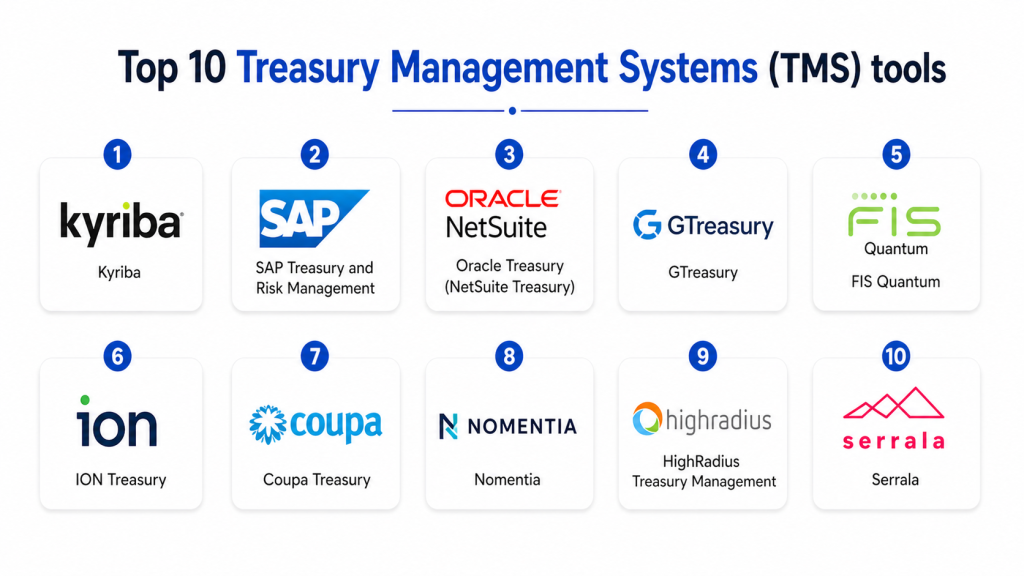
Top 10 Treasury Management Systems
#1 — Kyriba
Short description: Kyriba is a leading cloud-based TMS offering comprehensive cash, liquidity, and risk management capabilities for global enterprises.
Key Features
- Cash and liquidity management
- Bank connectivity
- Risk management (FX, interest rates)
- Payment automation
- Forecasting tools
- Fraud prevention
Pros
- Enterprise-grade solution
- Strong bank connectivity
- Scalable globally
Cons
- Expensive
- Complex setup
- Requires training
Platforms / Deployment
Cloud
Security & Compliance
Encryption, audit logs; certifications not publicly stated
Integrations & Ecosystem
Integrates with ERP and banking systems.
- API integrations
- Financial systems
Support & Community
Strong enterprise support
#2 — SAP Treasury and Risk Management
Short description: SAP Treasury is designed for large enterprises needing integrated treasury and risk management within SAP ERP environments.
Key Features
- Cash management
- Risk analysis (FX, IR)
- Liquidity planning
- Debt and investment management
- Compliance workflows
Pros
- Deep SAP integration
- Strong risk management
- Scalable
Cons
- Requires SAP ecosystem
- Complex implementation
- High cost
Platforms / Deployment
Cloud / Hybrid
Security & Compliance
Encryption, compliance controls
Integrations & Ecosystem
Native SAP integration.
Support & Community
Enterprise-level support
#3 — Oracle Treasury (NetSuite Treasury)
Short description: Oracle Treasury integrates treasury operations within its ERP ecosystem, providing real-time financial insights.
Key Features
- Cash positioning
- Liquidity management
- Risk management
- Reporting dashboards
- Workflow automation
Pros
- Strong ERP integration
- Reliable performance
- Scalable
Cons
- Requires Oracle ecosystem
- Expensive
- Learning curve
Platforms / Deployment
Cloud
Security & Compliance
Encryption, RBAC
Integrations & Ecosystem
Integrates with Oracle ERP systems.
Support & Community
Strong enterprise support
#4 — GTreasury
Short description: GTreasury focuses on cash visibility, forecasting, and risk management for enterprises.
Key Features
- Cash forecasting
- Risk management
- Payment processing
- Reporting dashboards
- Workflow automation
Pros
- Strong forecasting tools
- User-friendly
- Flexible
Cons
- Limited SMB focus
- Setup required
- Pricing varies
Platforms / Deployment
Cloud
Security & Compliance
Not publicly stated
Integrations & Ecosystem
Integrates with ERP and banking systems.
Support & Community
Good support
#5 — FIS Treasury (Integrity / Quantum)
Short description: FIS offers treasury solutions focused on cash, risk, and payments for large organizations.
Key Features
- Cash management
- Risk management
- Payment automation
- Liquidity forecasting
- Reporting tools
Pros
- Enterprise-ready
- Strong risk capabilities
- Reliable
Cons
- Complex implementation
- Expensive
- Requires expertise
Platforms / Deployment
Cloud
Security & Compliance
Not publicly stated
Integrations & Ecosystem
Integrates with financial systems.
Support & Community
Enterprise support
#6 — ION Treasury
Short description: ION Treasury provides advanced risk management and analytics for complex treasury operations.
Key Features
- Risk modeling
- Cash management
- Liquidity forecasting
- Analytics dashboards
- Workflow automation
Pros
- Strong analytics
- Scalable
- Enterprise-focused
Cons
- Complex
- Expensive
- Requires expertise
Platforms / Deployment
Cloud / Hybrid
Security & Compliance
Not publicly stated
Integrations & Ecosystem
Integrates with enterprise systems.
Support & Community
Enterprise-level support
#7 — Coupa Treasury
Short description: Coupa Treasury integrates treasury management with spend management and procurement workflows.
Key Features
- Cash management
- Payment automation
- Risk management
- Spend visibility
- Forecasting tools
Pros
- Integrated platform
- Strong spend insights
- Scalable
Cons
- Requires Coupa ecosystem
- Setup complexity
- Pricing varies
Platforms / Deployment
Cloud
Security & Compliance
Not publicly stated
Integrations & Ecosystem
Integrates with Coupa platform and ERP systems.
Support & Community
Good support
#8 — Trovata
Short description: Trovata is a modern API-first treasury platform focused on real-time cash visibility and automation.
Key Features
- Real-time cash visibility
- Bank API integrations
- Cash forecasting
- Analytics dashboards
- Workflow automation
Pros
- Modern interface
- Easy integration
- Fast setup
Cons
- Limited enterprise features
- Smaller ecosystem
- Less mature
Platforms / Deployment
Cloud
Security & Compliance
Not publicly stated
Integrations & Ecosystem
API-first integrations with banks and ERP systems.
Support & Community
Growing support ecosystem
#9 — Nomentia
Short description: Nomentia provides treasury and cash management solutions with strong automation and bank connectivity.
Key Features
- Cash visibility
- Payment automation
- Bank connectivity
- Risk management
- Reporting dashboards
Pros
- Strong bank connectivity
- Flexible modules
- Scalable
Cons
- Limited brand awareness
- Setup complexity
- Pricing varies
Platforms / Deployment
Cloud
Security & Compliance
Not publicly stated
Integrations & Ecosystem
Integrates with ERP and banking systems.
Support & Community
Moderate support
#10 — HighRadius Treasury Management
Short description: HighRadius offers AI-powered treasury solutions focusing on cash forecasting and automation.
Key Features
- AI-driven forecasting
- Cash management
- Payment automation
- Risk analysis
- Real-time dashboards
Pros
- Strong AI capabilities
- Easy automation
- Scalable
Cons
- Requires setup
- Pricing varies
- Limited SMB focus
Platforms / Deployment
Cloud
Security & Compliance
Not publicly stated
Integrations & Ecosystem
Integrates with ERP and financial systems.
Support & Community
Good support
Comparison Table
| Tool Name | Best For | Platform(s) Supported | Deployment | Standout Feature | Public Rating |
|---|---|---|---|---|---|
| Kyriba | Enterprise | Web | Cloud | Bank connectivity | N/A |
| SAP Treasury | Enterprise | Web | Cloud/Hybrid | Risk management | N/A |
| Oracle Treasury | Enterprise | Web | Cloud | ERP integration | N/A |
| GTreasury | Enterprise | Web | Cloud | Cash forecasting | N/A |
| FIS Treasury | Enterprise | Web | Cloud | Risk management | N/A |
| ION Treasury | Enterprise | Web | Cloud/Hybrid | Analytics | N/A |
| Coupa Treasury | Enterprise | Web | Cloud | Spend integration | N/A |
| Trovata | SMB/Mid | Web | Cloud | API-first design | N/A |
| Nomentia | Mid-market | Web | Cloud | Bank connectivity | N/A |
| HighRadius | Enterprise | Web | Cloud | AI forecasting | N/A |
Evaluation & Scoring of Treasury Management Systems
| Tool | Core | Ease | Integrations | Security | Performance | Support | Value | Weighted Total |
|---|---|---|---|---|---|---|---|---|
| Kyriba | 9 | 6 | 9 | 8 | 9 | 8 | 6 | 8.1 |
| SAP | 9 | 5 | 9 | 9 | 9 | 8 | 6 | 8.2 |
| Oracle | 9 | 6 | 9 | 8 | 8 | 8 | 6 | 8.0 |
| GTreasury | 8 | 7 | 8 | 7 | 8 | 7 | 7 | 7.7 |
| FIS | 9 | 5 | 8 | 8 | 9 | 8 | 6 | 8.0 |
| ION | 9 | 5 | 8 | 8 | 9 | 8 | 6 | 8.0 |
| Coupa | 8 | 7 | 8 | 7 | 8 | 7 | 7 | 7.7 |
| Trovata | 7 | 8 | 8 | 7 | 7 | 7 | 8 | 7.6 |
| Nomentia | 7 | 7 | 8 | 7 | 7 | 7 | 7 | 7.3 |
| HighRadius | 8 | 7 | 8 | 7 | 8 | 7 | 7 | 7.7 |
Scores are comparative and reflect relative strengths across features, usability, and value.
Which Treasury Management System Is Right for You?
Solo / Freelancer
Not required; basic accounting tools are sufficient.
SMB
Trovata and Nomentia offer simplicity and affordability.
Mid-Market
GTreasury and Coupa provide balanced features and scalability.
Enterprise
Kyriba, SAP, Oracle, and FIS offer advanced capabilities.
Budget vs Premium
- Budget: Trovata
- Premium: SAP, Kyriba
Feature Depth vs Ease of Use
- Feature-rich: SAP, Kyriba
- Easy-to-use: Trovata
Integrations & Scalability
Choose tools with strong bank and ERP integrations.
Security & Compliance Needs
Enterprises should prioritize compliance-ready platforms.
Frequently Asked Questions (FAQs)
1. What is a Treasury Management System?
A TMS is software that helps manage cash flow, liquidity, payments, and financial risk. It centralizes financial data and automates treasury operations. This improves visibility and control.
2. Who should use treasury software?
Large enterprises and organizations with complex financial operations benefit the most. CFOs and treasury teams use it for managing liquidity and risk.
3. What features are most important?
Cash visibility, forecasting, risk management, and bank connectivity are key features. Automation and reporting are also essential.
4. How does a TMS improve cash flow?
It provides real-time visibility into cash positions and automates forecasting. This helps businesses optimize working capital and avoid liquidity issues.
5. Can TMS integrate with ERP systems?
Yes, most modern TMS platforms integrate with ERP and financial systems. This ensures seamless data flow across operations.
6. Are TMS platforms secure?
Most offer encryption and access controls. Security features vary depending on the vendor.
7. How long does implementation take?
Implementation can take weeks to months depending on complexity and integrations.
8. What pricing models are used?
Pricing is usually subscription-based or enterprise licensing.
9. Can TMS handle global operations?
Yes, most systems support multi-currency and multi-entity operations.
10. What mistakes should be avoided?
Choosing tools without considering scalability and integrations is a common mistake.
Conclusion
Treasury Management Systems are critical for organizations that need to manage cash, liquidity, and financial risk efficiently in today’s complex business environment. These platforms provide real-time visibility, automation, and advanced analytics, enabling finance teams to move from manual processes to strategic decision-making. From enterprise solutions like SAP and Kyriba to modern platforms like Trovata, businesses have a wide range of options based on their needs. The right choice depends on financial complexity, integration requirements, and scalability. Companies should prioritize automation, forecasting accuracy, and security when selecting a system. It is also important to ensure seamless integration with existing financial systems. Instead of choosing based on popularity, organizations should evaluate how well a platform fits their workflows. Running pilot implementations is the best way to validate performance. This ensures long-term efficiency and better financial control.
