Introduction
Security Analytics Platforms are advanced cybersecurity systems that collect, correlate, and analyze massive volumes of security data such as logs, network traffic, user behavior, and cloud activity to detect threats and support faster incident response. In simple terms, they help security teams understand “what is happening in the environment” and identify hidden attacks that traditional monitoring tools might miss.
These platforms are essential in 2026 because modern cyberattacks are faster, AI-driven, and spread across cloud, endpoints, identities, and SaaS applications. Traditional SIEM systems alone are no longer enough, so security analytics platforms now combine SIEM, UEBA, XDR, and AI-driven detection to provide deeper visibility and faster response.
Security analytics has evolved into a core SOC capability, enabling organizations to detect anomalies in real time, automate investigations, reduce alert fatigue, and improve compliance reporting. Modern platforms increasingly use AI and machine learning to identify unknown threats and predict attack behavior before damage occurs.
Common real-world use cases include threat detection, insider threat monitoring, ransomware analysis, cloud security monitoring, compliance reporting, incident investigation, anomaly detection, and automated SOC workflows.
When evaluating security analytics platforms, buyers should consider data ingestion capability, real-time analytics, AI and machine learning strength, integration ecosystem, detection accuracy, scalability, cloud and hybrid support, incident response automation, dashboard usability, and compliance readiness.
Best for: SOC teams, cybersecurity analysts, enterprise security architects, MSSPs, cloud security teams, and organizations managing large-scale hybrid or multi-cloud environments.
Not ideal for: small IT teams without security operations maturity or environments with minimal security monitoring needs.
Key Trends in Security Analytics Platforms for 2026 and Beyond
- AI-driven threat detection and autonomous SOC capabilities
- Convergence of SIEM, XDR, and security analytics into unified platforms
- Real-time streaming analytics for faster threat detection
- Behavioral analytics using UEBA for insider threat detection
- Cloud-native security analytics replacing legacy on-prem SIEM stacks
- Automated incident response with SOAR integration
- Increased focus on identity-based security analytics
- Predictive threat modeling using machine learning
- Cost-optimized data lake architectures for security telemetry
- Generative AI for SOC investigation and alert summarization
Security analytics is shifting from reactive log analysis to proactive and predictive defense systems powered by AI and behavioral intelligence.
How We Selected These Tools
- Focused on widely adopted enterprise security analytics platforms
- Included SIEM-based and next-generation AI security analytics tools
- Evaluated real-time detection and correlation capabilities
- Prioritized AI and machine learning integration
- Considered cloud, hybrid, and on-prem deployment flexibility
- Included platforms used in modern SOC environments
- Focused on integration with EDR, XDR, and SOAR ecosystems
- Assessed scalability for large enterprise data environments
- Evaluated alert accuracy and reduction of false positives
- Avoided basic logging tools without analytics depth
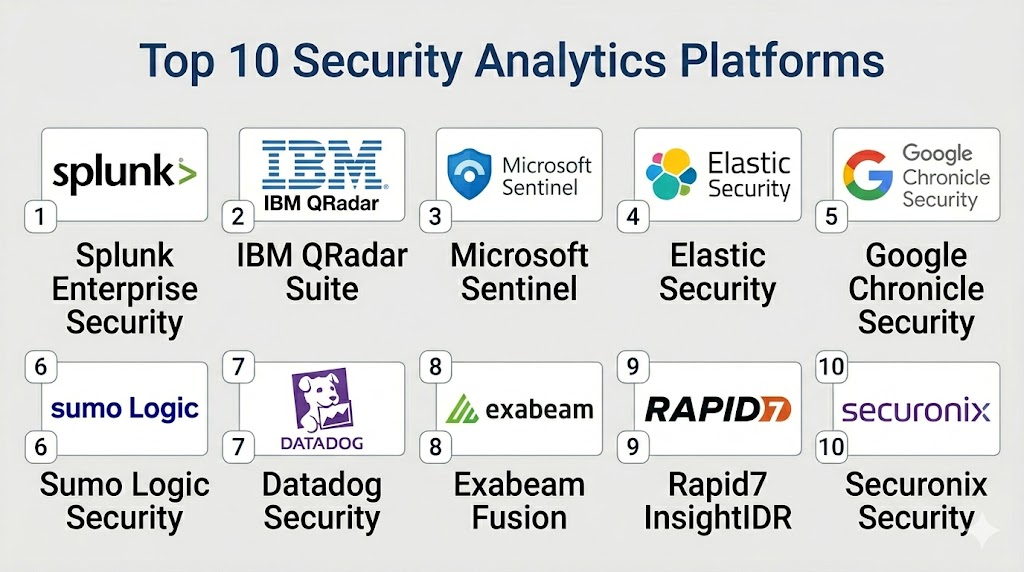
Top 10 Security Analytics Platforms
1- Splunk Enterprise Security
Short description: Splunk Enterprise Security is one of the most widely used security analytics platforms, providing advanced log analysis, threat detection, and incident investigation capabilities. It helps SOC teams correlate data across systems and identify threats in real time using powerful analytics engines.
Key Features
- Real-time security event monitoring
- Advanced log correlation and analytics
- Threat intelligence integration
- Incident investigation dashboards
- AI-assisted anomaly detection
- Security risk scoring
- Custom detection rules and workflows
Pros
- Extremely powerful data analytics engine
- Strong enterprise adoption
- Highly customizable dashboards
- Deep integration ecosystem
Cons
- High cost for enterprise usage
- Complex setup and tuning
- Requires skilled analysts
- Resource intensive
Platforms / Deployment
Cloud. On-premise. Hybrid.
Security & Compliance
Supports RBAC, encryption, audit logging, and compliance frameworks depending on deployment.
Integrations & Ecosystem
- SIEM and SOAR tools
- Cloud platforms
- Threat intelligence feeds
- EDR and XDR systems
- IT operations tools
Support & Community
Strong enterprise support and large global security community.
2- Microsoft Sentinel
Short description: Microsoft Sentinel is a cloud-native security analytics platform that provides intelligent threat detection, investigation, and response across Microsoft and multi-cloud environments. It uses AI and automation to enhance SOC efficiency.
Key Features
- Cloud-native SIEM and security analytics
- AI-driven threat detection
- Automated incident response workflows
- Log ingestion from multiple sources
- Built-in security analytics rules
- UEBA behavioral analytics
- Integration with Microsoft Defender
Pros
- Strong cloud-native architecture
- Easy integration with Microsoft ecosystem
- AI-driven automation capabilities
- Scalable and flexible
Cons
- Best suited for Azure environments
- Complex pricing model
- Requires cloud expertise
- Limited offline/on-prem flexibility
Platforms / Deployment
Cloud SaaS Azure.
Security & Compliance
Supports enterprise-grade RBAC, encryption, and compliance frameworks.
Integrations & Ecosystem
- Microsoft Defender
- Azure services
- Third-party security tools
- SIEM and SOAR integrations
Support & Community
Strong Microsoft enterprise support ecosystem.
3- IBM Security QRadar
Short description: IBM QRadar is a mature security intelligence platform that collects and analyzes security data across enterprise environments to detect threats and support compliance and incident response workflows.
Key Features
- Log and event data correlation
- Threat detection and prioritization
- AI-assisted anomaly detection
- Network flow analysis
- Security dashboards and reporting
- Compliance reporting tools
- Offense-based incident grouping
Pros
- Strong enterprise adoption
- Reliable correlation engine
- Good compliance support
- Scalable architecture
Cons
- Complex deployment
- Requires skilled analysts
- High enterprise cost
- Less modern UI compared to newer tools
Platforms / Deployment
Cloud. On-premise. Hybrid.
Security & Compliance
Supports RBAC, audit logging, encryption, and enterprise compliance standards.
Integrations & Ecosystem
- SIEM tools
- Threat intelligence platforms
- Cloud systems
- Security tools ecosystem
Support & Community
Strong IBM enterprise support and global SOC adoption.
4- Google Chronicle Security Operations
Short description: Google Chronicle is a cloud-native security analytics platform designed to store and analyze massive volumes of security telemetry at high speed using Google infrastructure.
Key Features
- Massive-scale log storage and analysis
- AI-driven threat detection
- Fast search and investigation capabilities
- Security data normalization
- Cloud-native architecture
- Threat intelligence integration
- Incident timeline reconstruction
Pros
- Extremely scalable architecture
- Fast data search and analysis
- Strong cloud-native design
- Built on Google infrastructure
Cons
- Requires Google Cloud ecosystem
- Complex onboarding
- Limited on-prem capabilities
- Enterprise-focused pricing
Platforms / Deployment
Cloud SaaS Google Cloud.
Security & Compliance
Supports enterprise security controls and compliance frameworks.
Integrations & Ecosystem
- Google Cloud Security
- SIEM and SOAR platforms
- Threat intelligence feeds
- Security APIs
Support & Community
Strong Google Cloud enterprise support.
5- Palo Alto Cortex XSIAM
Short description: Cortex XSIAM is an AI-driven security operations platform that combines security analytics, automation, and incident response into a unified SOC solution.
Key Features
- AI-driven security analytics engine
- Automated threat detection and response
- Unified SOC data platform
- Behavioral analytics and anomaly detection
- Endpoint and cloud security integration
- Incident lifecycle automation
- Threat intelligence correlation
Pros
- Highly automated SOC capabilities
- Strong AI-driven analytics
- Excellent integration with Palo Alto ecosystem
- Reduces manual SOC workload
Cons
- High enterprise cost
- Requires ecosystem adoption
- Complex setup
- Limited flexibility outside Palo Alto stack
Platforms / Deployment
Cloud SaaS.
Security & Compliance
Supports enterprise-grade RBAC, encryption, and audit logging.
Integrations & Ecosystem
- Palo Alto security tools
- SIEM and XDR systems
- Cloud environments
- Threat intelligence systems
Support & Community
Strong enterprise SOC support ecosystem.
6- Elastic Security Analytics
Short description: Elastic Security provides security analytics capabilities built on the Elastic Stack, enabling log analysis, threat detection, and observability for security operations.
Key Features
- Log analytics and search capabilities
- Security event correlation
- Machine learning anomaly detection
- Endpoint security integration
- Dashboard visualization tools
- Threat hunting workflows
- Kubernetes and cloud monitoring
Pros
- Open-source foundation
- Highly flexible and scalable
- Strong search capabilities
- Cost-effective deployment options
Cons
- Requires technical expertise
- Complex setup and tuning
- Resource intensive at scale
- Limited turnkey SOC features
Platforms / Deployment
Cloud SaaS. Self-hosted. Hybrid.
Security & Compliance
Supports encryption, RBAC, and enterprise security controls.
Integrations & Ecosystem
- Cloud platforms
- DevOps tools
- SIEM systems
- Security tools ecosystem
Support & Community
Strong open-source and enterprise support ecosystem.
7- Sumo Logic Cloud SIEM
Short description: Sumo Logic is a cloud-native security analytics platform that provides continuous monitoring, log analytics, and threat detection for modern cloud environments.
Key Features
- Cloud-native SIEM analytics
- Real-time log processing
- Threat detection and correlation
- Machine learning anomaly detection
- Security dashboards
- Incident investigation tools
- Cloud workload monitoring
Pros
- Easy cloud deployment
- Strong scalability
- Good for hybrid environments
- Real-time analytics
Cons
- Pricing complexity
- Requires tuning for alert noise
- Less advanced than enterprise SIEMs
- Limited deep customization
Platforms / Deployment
Cloud SaaS.
Security & Compliance
Supports RBAC, encryption, and compliance reporting features.
Integrations & Ecosystem
- AWS
- Azure
- Kubernetes
- DevOps tools
- Security APIs
Support & Community
Strong enterprise cloud support.
8- LogRhythm NextGen SIEM
Short description: LogRhythm is a security analytics and SIEM platform that provides advanced threat detection, behavioral analytics, and incident response capabilities for enterprise SOC environments.
Key Features
- Security event correlation engine
- Behavioral analytics and UEBA
- Incident response workflows
- Log management and analysis
- Threat intelligence integration
- Compliance reporting tools
- Automated alerting
Pros
- Strong behavioral analytics
- Good SOC workflows
- Reliable correlation engine
- Strong compliance support
Cons
- Complex deployment
- Requires skilled analysts
- High enterprise cost
- Less modern interface
Platforms / Deployment
Cloud. On-premise.
Security & Compliance
Supports enterprise security policies, audit logging, and compliance frameworks.
Integrations & Ecosystem
- SIEM tools
- Cloud platforms
- Security systems
- Threat intelligence feeds
Support & Community
Strong enterprise SOC support ecosystem.
9- Exabeam Security Analytics
Short description: Exabeam is an AI-driven security analytics platform focused on user and entity behavior analytics to detect advanced threats and insider risks.
Key Features
- UEBA-based threat detection
- Automated incident timelines
- AI-driven anomaly detection
- Log correlation engine
- Security dashboards
- Behavioral modeling
- Threat hunting tools
Pros
- Strong behavioral analytics focus
- Good for insider threat detection
- Automated investigation timelines
- AI-driven insights
Cons
- Requires tuning for accuracy
- Enterprise pricing model
- Limited flexibility outside core use cases
- Complex configuration
Platforms / Deployment
Cloud SaaS. Hybrid.
Security & Compliance
Supports RBAC, encryption, and audit logging.
Integrations & Ecosystem
- SIEM systems
- Cloud platforms
- Security tools
- Identity systems
Support & Community
Strong enterprise SOC support.
10- Graylog Security Analytics
Short description: Graylog is an open-source security analytics and log management platform that provides centralized log processing, threat detection, and monitoring capabilities.
Key Features
- Centralized log management
- Security event correlation
- Real-time alerting
- Threat detection rules
- Dashboard visualization
- Log ingestion pipelines
- Scalable architecture
Pros
- Open-source flexibility
- Cost-effective deployment
- Easy log management
- Good for small to mid environments
Cons
- Limited advanced AI capabilities
- Requires manual configuration
- Less enterprise-ready than leaders
- Limited SOC automation
Platforms / Deployment
Cloud. On-premise.
Security & Compliance
Supports encryption, RBAC, and basic audit logging.
Integrations & Ecosystem
- DevOps tools
- Cloud systems
- SIEM integrations
- Security APIs
Support & Community
Strong open-source community support.
Comparison Table
| Tool Name | Best For | Platforms Supported | Deployment | Standout Feature | Public Rating |
|---|---|---|---|---|---|
| Splunk ES | Enterprise SOC analytics | Multi-platform | Hybrid | Powerful analytics engine | N/A |
| Microsoft Sentinel | Cloud security analytics | Azure cloud | SaaS | AI-driven SOC automation | N/A |
| IBM QRadar | Enterprise SIEM | Multi-platform | Hybrid | Offense-based correlation | N/A |
| Google Chronicle | Large-scale log analytics | Cloud | SaaS | Massive data scalability | N/A |
| Cortex XSIAM | Autonomous SOC | Multi-platform | SaaS | AI-driven automation | N/A |
| Elastic Security | Flexible log analytics | Multi-platform | Hybrid | Open-source foundation | N/A |
| Sumo Logic | Cloud-native SIEM | Cloud | SaaS | Real-time analytics | N/A |
| LogRhythm | Behavioral analytics SIEM | Multi-platform | Hybrid | UEBA capabilities | N/A |
| Exabeam | Insider threat detection | Multi-platform | Hybrid | UEBA-driven insights | N/A |
| Graylog | Open-source log analytics | Multi-platform | Hybrid | Cost-effective SIEM | N/A |
Evaluation and Scoring of Security Analytics Platforms
| Tool Name | Core 25% | Ease 15% | Integrations 15% | Security 10% | Performance 10% | Support 10% | Value 15% | Weighted Total |
|---|---|---|---|---|---|---|---|---|
| Splunk ES | 10 | 7 | 10 | 10 | 9 | 10 | 7 | 8.85 |
| Microsoft Sentinel | 9 | 9 | 9 | 10 | 9 | 9 | 9 | 9.05 |
| IBM QRadar | 9 | 7 | 9 | 10 | 9 | 9 | 8 | 8.75 |
| Google Chronicle | 10 | 8 | 9 | 10 | 10 | 9 | 8 | 9.10 |
| Cortex XSIAM | 10 | 8 | 10 | 10 | 10 | 9 | 8 | 9.25 |
| Elastic Security | 9 | 7 | 9 | 9 | 9 | 8 | 9 | 8.55 |
| Sumo Logic | 8 | 9 | 9 | 9 | 9 | 8 | 8 | 8.55 |
| LogRhythm | 8 | 7 | 8 | 9 | 8 | 8 | 8 | 8.10 |
| Exabeam | 9 | 8 | 8 | 9 | 9 | 8 | 8 | 8.55 |
| Graylog | 7 | 9 | 7 | 8 | 8 | 8 | 10 | 8.10 |
These scores reflect detection accuracy, analytics depth, AI capabilities, integration strength, scalability, and enterprise readiness. Cortex XSIAM and Google Chronicle lead in AI-driven and large-scale analytics, while Splunk remains dominant in enterprise log correlation. Microsoft Sentinel offers strong cloud-native performance, and Elastic and Graylog provide flexible open approaches.
Which Security Analytics Platform Is Right for You
Solo / Freelancer
Freelancers and learners should use Graylog or Elastic Security for learning log analysis and threat detection fundamentals.
SMB
SMBs benefit from easy cloud-native platforms like Microsoft Sentinel, Sumo Logic, and Elastic Security.
Mid-Market
Mid-market organizations need scalable analytics and automation. Sumo Logic, Exabeam, and LogRhythm are strong choices.
Enterprise
Enterprises require full SOC analytics and AI-driven detection. Splunk ES, IBM QRadar, Cortex XSIAM, and Google Chronicle are leading solutions.
Budget vs Premium
Open-source tools like Elastic and Graylog are cost-effective. Enterprise platforms provide advanced AI, automation, and compliance features.
Feature Depth vs Ease of Use
Splunk and Cortex XSIAM offer deep capabilities. Microsoft Sentinel and Sumo Logic are easier to adopt.
Integrations & Scalability
Google Chronicle, Splunk, and Microsoft Sentinel offer the strongest scalability and integration ecosystems.
Security & Compliance Needs
Highly regulated environments should prioritize Splunk, IBM QRadar, Microsoft Sentinel, and Cortex XSIAM due to strong governance and audit capabilities.
Frequently Asked Questions FAQs
1. What is a security analytics platform?
A security analytics platform is a system that collects and analyzes security data to detect threats and support incident response. It uses logs, metrics, and behavioral data. It helps identify attacks early. It improves security visibility.
2. What is the difference between SIEM and security analytics?
SIEM focuses on log collection and rule-based detection. Security analytics uses AI and behavior analysis for deeper insights. Security analytics is more advanced. It improves threat detection accuracy.
3. Why are security analytics tools important?
They help organizations detect threats faster and reduce risk. They analyze large volumes of security data. They improve incident response. They support compliance requirements.
4. Do these platforms use AI?
Yes, most modern platforms use AI and machine learning. They detect anomalies and predict threats. AI reduces false positives. It improves SOC efficiency.
5. What data do they analyze?
They analyze logs, network traffic, user behavior, cloud activity, and endpoint data. They also use threat intelligence feeds. This creates full visibility. It helps detect hidden threats.
6. Are security analytics platforms cloud-based?
Many modern platforms are cloud-native. Some also support hybrid and on-prem deployments. Cloud platforms are becoming more common. Hybrid environments are still widely used.
7. Can they detect insider threats?
Yes, many platforms use behavioral analytics to detect insider threats. They identify unusual user activity patterns. This helps prevent data leaks. UEBA is commonly used.
8. What is UEBA?
UEBA stands for User and Entity Behavior Analytics. It analyzes user behavior to detect anomalies. It helps identify insider threats and compromised accounts. It is a key feature in modern platforms.
9. Can small businesses use these tools?
Yes, SMBs can use cloud-native or open-source solutions. However, advanced enterprise tools may be complex. SMB-friendly platforms include Microsoft Sentinel and Sumo Logic. Elastic and Graylog are cost-effective options.
10. What is the future of security analytics?
The future includes AI-driven SOCs, autonomous threat detection, and unified XDR platforms. Security analytics will become more predictive. Automation will increase. AI will reduce manual investigation.
Conclusion
Security analytics platforms are essential for modern cybersecurity operations, enabling organizations to detect threats faster, analyze behavior patterns, and respond to incidents with greater accuracy. Platforms like Splunk, Microsoft Sentinel, and IBM QRadar remain strong enterprise leaders, while Google Chronicle and Cortex XSIAM are driving AI-powered transformation in security operations. Elastic and Graylog provide flexible and cost-effective alternatives, while Exabeam and LogRhythm focus on behavioral analytics and UEBA-driven insights. The future of security analytics is deeply AI-driven, highly automated, and centered around real-time, cross-platform visibility across cloud, endpoint, identity, and network environments.

This article clearly explains security analytics platforms and how they help organizations detect threats faster, improve visibility across systems, and strengthen overall cybersecurity protection.
Useful comparison post highlighting different security analytics platforms and how they help organizations improve threat detection, monitoring, and incident analysis.
Beyond feature comparison, it’s crucial to evaluate how each platform handles alert fatigue, false-positive tuning, and real-time correlation at scale in production environments.