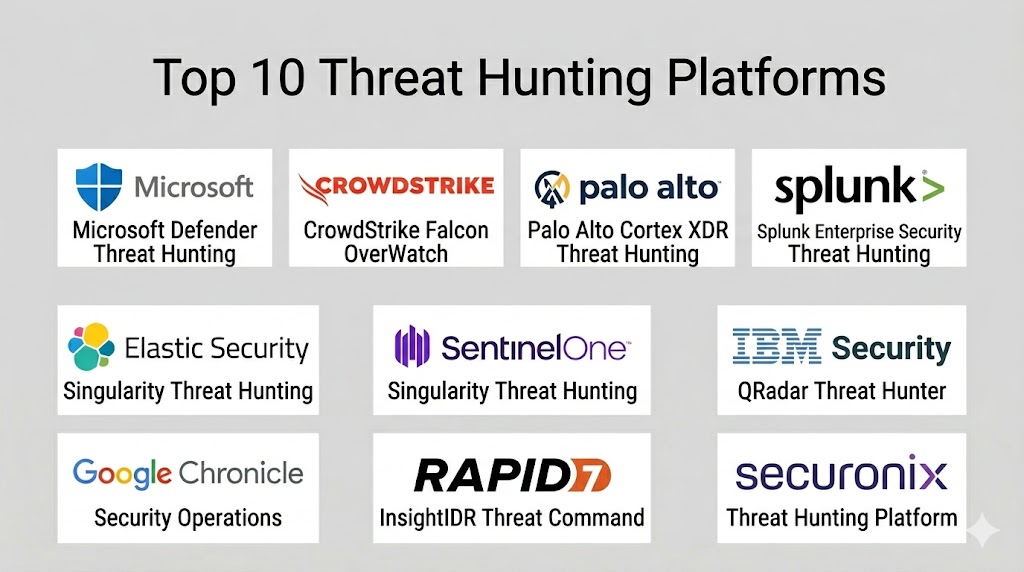
Introduction
Threat hunting platforms are advanced cybersecurity tools that help security teams proactively search for hidden threats, attacker behavior, and suspicious activity across networks, endpoints, cloud workloads, and SaaS environments. Unlike traditional security tools that wait for alerts, threat hunting platforms assume something may already be compromised and actively look for evidence.
In 2026 and beyond, threat hunting has become essential due to AI-powered attacks, ransomware evolution, distributed cloud environments, and increased dwell time of attackers inside systems. Modern attackers often bypass perimeter defenses and remain undetected for weeks, making proactive hunting critical for enterprise resilience.
Typical use cases include identifying advanced persistent threats (APTs), detecting lateral movement in networks, investigating suspicious logins, hunting malware behavior, analyzing endpoint anomalies, and correlating security events across SIEM, EDR, and cloud systems.
Buyers should evaluate detection depth, behavioral analytics, MITRE ATT&CK coverage, automation level, data correlation strength, integration ecosystem, cloud readiness, incident response workflows, and analyst usability.
Best for: SOC teams, threat intelligence teams, cybersecurity analysts, enterprise security operations centers, MDR providers, and large cloud-first organizations.
Not ideal for: very small IT teams, organizations without centralized logging, or environments with minimal security telemetry.
Key Trends in Threat Hunting Platforms
- AI-driven threat hunting (AIOps + SecOps convergence) is becoming standard
- Automated hypothesis generation is reducing manual analyst workload
- MITRE ATT&CK mapping is now core to detection strategies
- Unified telemetry ingestion (logs, metrics, traces, endpoints) is essential
- Graph-based attack path visualization is improving investigation speed
- Behavioral analytics is replacing signature-based detection models
- Agentic AI SOC workflows are emerging for autonomous hunting
- Cross-domain hunting across cloud + endpoint + identity is increasing
- Real-time threat intelligence enrichment is becoming mandatory
- Security data lakes are replacing siloed SIEM-only architectures
How We Selected These Tools
- Focused on platforms offering true threat hunting or hunting-enabled capabilities
- Included SIEM, EDR, XDR, and AIOps-driven platforms
- Prioritized behavioral detection and anomaly hunting features
- Evaluated MITRE ATT&CK alignment and coverage depth
- Considered integration with cloud, endpoint, and identity systems
- Included enterprise and mid-market solutions
- Ensured support for real-time telemetry analysis
- Reviewed automation and AI-assisted investigation capabilities
- Included tools used in SOC and MDR environments
- Used Not publicly stated where compliance or ratings are unknown
Top 10 Threat Hunting Platforms
1- Microsoft Defender for Endpoint
Short description: Microsoft Defender for Endpoint is a cloud-native endpoint security platform that includes powerful threat hunting capabilities using advanced analytics, behavioral detection, and AI-driven investigation tools. It allows security teams to proactively hunt threats across Windows, macOS, Linux, and cloud-connected environments.
Key Features
- Advanced threat hunting queries (KQL-based)
- Endpoint behavioral analytics
- Attack surface reduction tools
- Automated investigation and response
- Threat intelligence integration
- Cloud-based telemetry collection
- MITRE ATT&CK mapping
Pros
- Deep integration with Microsoft ecosystem
- Strong endpoint visibility
- Powerful AI-based detections
- Scalable enterprise solution
Cons
- Complex query language for beginners
- Best value within Microsoft ecosystem
- Requires tuning for optimal results
- Limited non-Microsoft optimization
Platforms / Deployment
Cloud-based SaaS platform
Security & Compliance
Includes encryption, RBAC, audit logging, and enterprise security controls. Compliance details are Not publicly stated.
Integrations & Ecosystem
- Microsoft Sentinel
- Azure Security Center
- SIEM platforms
- Identity systems
- Cloud workloads
Support & Community
Strong enterprise support and large global adoption.
2- CrowdStrike Falcon Insight
Short description: CrowdStrike Falcon Insight is a leading EDR and threat hunting platform that provides deep endpoint visibility and real-time behavioral analysis for proactive threat detection.
Key Features
- Real-time endpoint threat hunting
- Behavioral detection engine
- AI-driven anomaly detection
- Threat intelligence integration
- MITRE ATT&CK framework mapping
- Incident investigation timeline
- Cloud-native architecture
Pros
- Extremely strong endpoint visibility
- Lightweight agent design
- Fast threat detection
- Excellent threat intelligence integration
Cons
- Premium pricing
- Limited deep customization in some areas
- Requires mature SOC workflows
- Cloud dependency
Platforms / Deployment
Cloud-based SaaS platform
Security & Compliance
Enterprise-grade controls including encryption and audit logs. Compliance is Not publicly stated.
Integrations & Ecosystem
- SIEM systems
- Cloud platforms
- Identity providers
- SOAR tools
- Threat intelligence feeds
Support & Community
Strong enterprise support and global SOC adoption.
3- SentinelOne Singularity
Short description: SentinelOne Singularity is an AI-powered autonomous endpoint security platform that provides real-time threat hunting, detection, and automated response capabilities.
Key Features
- Autonomous AI threat hunting
- Endpoint behavioral analysis
- Storyline-based attack reconstruction
- Real-time threat detection
- Automated remediation
- Threat intelligence correlation
- MITRE ATT&CK alignment
Pros
- Strong autonomous detection
- Excellent attack visualization
- Fast incident response
- Minimal manual effort required
Cons
- High resource usage in large environments
- Requires tuning for precision
- Enterprise pricing model
- Learning curve for analysts
Platforms / Deployment
Cloud and hybrid environments
Security & Compliance
Includes encryption, RBAC, and auditing features. Compliance details are Not publicly stated.
Integrations & Ecosystem
- SIEM platforms
- Cloud environments
- SOAR tools
- Identity providers
- Security orchestration systems
Support & Community
Strong enterprise SOC adoption and support.
4- Splunk Enterprise Security (ES)
Short description: Splunk ES is a powerful SIEM platform with advanced threat hunting capabilities using search-based analytics, correlation rules, and behavioral detection models.
Key Features
- Advanced search-based threat hunting (SPL queries)
- Event correlation engine
- Risk-based alerting
- Security dashboards
- Threat intelligence integration
- MITRE ATT&CK mapping
- Incident investigation workflows
Pros
- Extremely powerful data analysis engine
- Strong enterprise scalability
- Deep log correlation capabilities
- Highly customizable hunting queries
Cons
- Expensive at scale
- Requires expertise in SPL
- Complex setup and tuning
- Resource-heavy deployments
Platforms / Deployment
Cloud and hybrid environments
Security & Compliance
Enterprise security controls included. Compliance details are Not publicly stated.
Integrations & Ecosystem
- SIEM tools
- Cloud platforms
- EDR systems
- APIs
- Security orchestration tools
Support & Community
Strong enterprise ecosystem and analyst community.
5- Palo Alto Cortex XDR
Short description: Cortex XDR is an extended detection and response platform that combines endpoint, network, and cloud data for advanced threat hunting and investigation.
Key Features
- Cross-domain threat hunting
- Behavioral analytics engine
- Endpoint + network correlation
- Automated investigation workflows
- AI-driven anomaly detection
- Attack path reconstruction
- Threat intelligence integration
Pros
- Strong cross-layer visibility
- Excellent correlation capabilities
- Good automation features
- Integrated security ecosystem
Cons
- Complex deployment in hybrid environments
- Requires Palo Alto ecosystem alignment
- Premium pricing
- Learning curve
Platforms / Deployment
Cloud-based SaaS platform
Security & Compliance
Enterprise-grade controls available. Compliance is Not publicly stated.
Integrations & Ecosystem
- Palo Alto security stack
- SIEM platforms
- Cloud providers
- SOAR systems
- Identity tools
Support & Community
Strong enterprise SOC support ecosystem.
6- IBM QRadar SIEM
Short description: IBM QRadar is an enterprise SIEM platform that provides threat hunting through log correlation, behavioral analytics, and security event investigation.
Key Features
- Log-based threat hunting
- Event correlation engine
- User behavior analytics (UBA)
- Threat intelligence integration
- Incident investigation workflows
- MITRE ATT&CK mapping
- Security dashboards
Pros
- Strong log correlation capabilities
- Mature enterprise SIEM
- Scalable architecture
- Good compliance reporting
Cons
- Complex configuration
- High operational cost
- Requires skilled analysts
- Resource-intensive
Platforms / Deployment
Cloud and hybrid environments
Security & Compliance
Enterprise security features included. Compliance is Not publicly stated.
Integrations & Ecosystem
- SIEM ecosystems
- Cloud platforms
- EDR tools
- Threat intelligence feeds
- APIs
Support & Community
Strong enterprise support.
7- Elastic Security (ELK Stack)
Short description: Elastic Security provides open and scalable threat hunting capabilities using the ELK stack (Elasticsearch, Logstash, Kibana) for analyzing logs, detecting anomalies, and investigating threats.
Key Features
- Query-based threat hunting
- Log analytics and correlation
- Behavioral detection rules
- Security dashboards
- Endpoint security integration
- MITRE ATT&CK mapping
- Custom alerting rules
Pros
- Highly flexible and scalable
- Open-source foundation
- Strong search capabilities
- Cost-effective at scale
Cons
- Requires setup and tuning
- Complex architecture
- Operational overhead
- Needs skilled engineers
Platforms / Deployment
Self-hosted and cloud options
Security & Compliance
Security depends on deployment configuration. Compliance is Not publicly stated.
Integrations & Ecosystem
- Cloud platforms
- SIEM systems
- DevOps tools
- APIs
- Security tools
Support & Community
Strong open-source community and enterprise support options.
8- Sumo Logic
Short description: Sumo Logic is a cloud-native SIEM and observability platform that includes threat hunting capabilities using real-time log analytics and behavioral detection.
Key Features
- Cloud-native log analytics
- Threat hunting queries
- Behavioral anomaly detection
- Security dashboards
- Incident correlation
- MITRE ATT&CK mapping
- Cloud monitoring integration
Pros
- Strong cloud-native architecture
- Easy scalability
- Good real-time analytics
- Simplified deployment
Cons
- Limited deep customization
- Data ingestion cost considerations
- Requires tuning for accuracy
- Less flexible than Elastic
Platforms / Deployment
Cloud-based SaaS platform
Security & Compliance
Includes encryption and audit logging. Compliance is Not publicly stated.
Integrations & Ecosystem
- Cloud platforms
- SIEM tools
- DevOps pipelines
- APIs
- Security monitoring systems
Support & Community
Good enterprise support.
9- Vectra AI Platform
Short description: Vectra AI is a network detection and response (NDR) platform that uses AI to hunt threats across network traffic and cloud environments.
Key Features
- AI-driven threat detection
- Network traffic analysis
- Behavioral anomaly detection
- Attack surface monitoring
- MITRE ATT&CK mapping
- Threat hunting dashboards
- Real-time alerting
Pros
- Strong network visibility
- Excellent AI detection capabilities
- Good for lateral movement detection
- Low false positive rate
Cons
- Limited endpoint visibility
- Requires network deployment setup
- Enterprise pricing model
- Needs tuning for complex environments
Platforms / Deployment
Cloud and hybrid environments
Security & Compliance
Enterprise-grade security controls included. Compliance is Not publicly stated.
Integrations & Ecosystem
- SIEM platforms
- Cloud environments
- EDR systems
- Network tools
- APIs
Support & Community
Strong enterprise security support.
10- Chronicle Security (Google Cloud Chronicle)
Short description: Chronicle Security is a cloud-native SIEM and threat hunting platform built for large-scale security data analysis using Google’s infrastructure.
Key Features
- Massive-scale log analysis
- AI-driven threat hunting
- Security telemetry correlation
- Fast search across security data
- Threat intelligence integration
- Incident investigation tools
- MITRE ATT&CK mapping
Pros
- Extremely scalable architecture
- Fast search capabilities
- Strong AI-driven analytics
- Deep Google Cloud integration
Cons
- Enterprise-focused pricing
- Requires cloud maturity
- Complex onboarding
- Limited SMB suitability
Platforms / Deployment
Cloud-native SaaS platform
Security & Compliance
Enterprise security controls included. Compliance is Not publicly stated.
Integrations & Ecosystem
- Google Cloud Platform
- SIEM tools
- APIs
- Security ecosystems
- DevOps pipelines
Support & Community
Strong enterprise-level support.
Comparison Table
| Tool Name | Best For | Platforms Supported | Deployment | Standout Feature | Public Rating |
|---|---|---|---|---|---|
| Microsoft Defender | Endpoint hunting | Cloud | Cloud | Deep Windows integration | N/A |
| CrowdStrike | Endpoint security | Cloud | Cloud | Real-time behavioral detection | N/A |
| SentinelOne | Autonomous hunting | Cloud | Cloud | AI-driven remediation | N/A |
| Splunk ES | Log-heavy SOCs | Cloud + Hybrid | Cloud/Hybrid | Powerful search engine | N/A |
| Cortex XDR | Cross-domain hunting | Cloud | Cloud | Unified detection engine | N/A |
| IBM QRadar | Enterprise SIEM | Cloud + Hybrid | Hybrid | Log correlation strength | N/A |
| Elastic Security | Flexible hunting | Multi-source | Self/Cloud | Open-source flexibility | N/A |
| Sumo Logic | Cloud-native SOC | Cloud | Cloud | Real-time analytics | N/A |
| Vectra AI | Network hunting | Cloud + Hybrid | Cloud | Network detection AI | N/A |
| Chronicle | Large-scale SOCs | Cloud | Cloud | Massive log processing | N/A |
Evaluation & Scoring of Threat Hunting Platforms
| Tool Name | Core 25% | Ease 15% | Integrations 15% | Security 10% | Performance 10% | Support 10% | Value 15% | Weighted Total |
|---|---|---|---|---|---|---|---|---|
| Microsoft Defender | 9.3 | 8.8 | 9.2 | 9.3 | 9.0 | 9.0 | 8.8 | 9.0 |
| CrowdStrike | 9.4 | 9.0 | 9.2 | 9.3 | 9.2 | 9.0 | 8.7 | 9.1 |
| SentinelOne | 9.2 | 8.8 | 9.0 | 9.2 | 9.1 | 8.8 | 8.6 | 8.9 |
| Splunk ES | 9.1 | 7.8 | 9.3 | 9.3 | 9.0 | 9.0 | 8.0 | 8.8 |
| Cortex XDR | 9.0 | 8.0 | 9.0 | 9.2 | 9.0 | 8.8 | 8.4 | 8.8 |
| IBM QRadar | 9.0 | 7.5 | 9.0 | 9.3 | 9.0 | 9.0 | 8.2 | 8.8 |
| Elastic Security | 8.8 | 8.8 | 9.0 | 8.5 | 8.8 | 8.7 | 9.2 | 8.8 |
| Sumo Logic | 8.7 | 8.7 | 8.8 | 8.6 | 8.7 | 8.6 | 8.8 | 8.7 |
| Vectra AI | 8.9 | 8.2 | 8.8 | 9.0 | 9.0 | 8.8 | 8.4 | 8.8 |
| Chronicle | 9.1 | 8.0 | 9.2 | 9.2 | 9.3 | 9.0 | 8.3 | 8.9 |
Which Threat Hunting Platform Is Right for You?
Solo / Freelancer
Elastic Security is best for learning and experimenting with threat hunting.
SMB
Microsoft Defender, Sumo Logic, and CrowdStrike offer balanced threat hunting capabilities.
Mid-Market
CrowdStrike, Cortex XDR, and SentinelOne provide strong AI-driven hunting.
Enterprise
Splunk, IBM QRadar, Chronicle, and Microsoft Defender dominate large-scale SOC environments.
Budget vs Premium
Elastic Security is cost-effective, while Splunk and Chronicle are premium solutions.
Feature Depth vs Ease of Use
Elastic is flexible but complex, while CrowdStrike and SentinelOne are easier to adopt.
Integrations & Scalability
Enterprise tools should integrate with SIEM, cloud platforms, and EDR systems.
Security & Compliance Needs
Organizations should prioritize MITRE ATT&CK coverage, audit logs, and behavioral analytics.
Frequently Asked Questions
1. What is a threat hunting platform?
A threat hunting platform is a cybersecurity tool that helps security teams proactively search for hidden threats in systems. It analyzes logs, endpoints, and network data. It identifies suspicious behavior that traditional alerts may miss. It is used in SOC environments.
2. Why is threat hunting important?
Threat hunting is important because attackers often remain undetected in systems for long periods. It helps identify advanced persistent threats. It improves security posture. It reduces dwell time.
3. How does threat hunting work?
Threat hunting works by analyzing telemetry data such as logs, metrics, and endpoint activity. Analysts or AI models search for anomalies. They investigate suspicious patterns. They validate potential threats.
4. What is AIOps in threat hunting?
AIOps uses artificial intelligence to automate threat detection and analysis. It helps correlate security events faster. It reduces manual workload. It improves accuracy of detection.
5. What data is used in threat hunting?
Threat hunting uses logs, network traffic, endpoint data, and cloud telemetry. It may also use threat intelligence feeds. This data is correlated to detect anomalies. It provides full visibility into systems.
6. Is threat hunting automated?
Partially. Many platforms use AI to automate detection and correlation. However, human analysts still play a key role. Fully autonomous hunting is still evolving.
7. What is the difference between SIEM and threat hunting tools?
SIEM collects and analyzes security logs. Threat hunting tools actively search for hidden threats. SIEM is reactive, while threat hunting is proactive. Many platforms combine both functions.
8. Can small businesses use threat hunting tools?
Yes, but simpler tools like Microsoft Defender or Elastic Security are more suitable. Advanced platforms may be too complex. SMBs benefit from cloud-native solutions. Cost is also a factor.
9. Do threat hunting tools improve security?
Yes, they significantly improve detection of hidden threats. They reduce response time. They enhance SOC efficiency. They improve overall security visibility.
10. What is the best threat hunting platform?
There is no single best platform. CrowdStrike and Microsoft Defender are leaders for enterprise hunting. Elastic Security is best for flexibility. The choice depends on infrastructure and budget.
Conclusion
Threat hunting platforms are essential in modern cybersecurity because they enable organizations to proactively detect hidden threats that traditional security tools often miss. As cyberattacks become more advanced and stealthy, tools like CrowdStrike, Microsoft Defender, SentinelOne, and Splunk provide deep behavioral analytics and AI-powered investigation capabilities. Elastic Security offers flexibility for teams building custom hunting workflows, while enterprise platforms like Chronicle and IBM QRadar deliver large-scale threat intelligence and correlation. The best platform depends on security maturity, data complexity, and operational needs, but every organization benefits from adopting proactive threat hunting capabilities.

This article clearly explains threat hunting platforms and how they help security teams proactively detect hidden threats, analyze suspicious activity, and strengthen overall cybersecurity defense.
Nice breakdown of threat hunting platforms, making it easier to compare tools for proactive monitoring, investigation, and faster security response.
An often-missed factor is how effectively the platform supports iterative hypothesis-driven hunting with strong context enrichment, without overwhelming analysts with fragmented or low-confidence signals.