Introduction
Root Cause Analysis (RCA) tools are platforms that help IT teams identify the underlying cause of incidents, failures, or performance issues across complex systems. Instead of just showing what broke, RCA tools explain why it broke and often suggest how to fix it.
In 2026 and beyond, RCA has become a core part of AIOps, observability, and DevSecOps ecosystems, because modern infrastructure is highly distributed across cloud, microservices, APIs, and third-party SaaS systems. Without RCA automation, teams struggle with alert overload and slow incident resolution.
Common use cases include incident investigation, outage analysis, performance degradation detection, dependency mapping, log correlation, change impact analysis, and automated troubleshooting across cloud-native environments.
Buyers should evaluate data correlation accuracy, AI-driven analysis capabilities, integration with observability tools, automation level, root cause precision, MTTR reduction, scalability, multi-cloud support, and ease of adoption.
Best for: SRE teams, DevOps engineers, IT operations teams, cloud platform teams, enterprise observability teams, and cybersecurity operations centers.
Not ideal for: very small static IT environments, single-application systems, or teams without monitoring/telemetry data sources.
Key Trends in Root Cause Analysis Tools
- AI-driven RCA (AIOps-powered diagnostics) is replacing manual troubleshooting
- Automated incident correlation across logs, metrics, and traces is becoming standard
- Shift from reactive RCA to predictive RCA using anomaly detection models
- GenAI-powered incident summarization is reducing investigation time
- Graph-based dependency mapping is improving root cause precision
- Self-healing infrastructure integrations are emerging in advanced platforms
- Real-time observability pipelines are enabling faster root cause detection
- Cross-domain RCA (infra + app + security) is becoming unified
- Event correlation engines are reducing alert noise significantly
- Open-source RCA frameworks are growing in AIOps ecosystems
How We Selected These Tools
- Focused on platforms with RCA or RCA-like capabilities (native or AIOps-based)
- Included observability and incident intelligence tools
- Prioritized AI-driven correlation and automation features
- Evaluated integration with logs, metrics, traces, and cloud telemetry
- Included enterprise and open-source ecosystems
- Considered scalability for microservices and distributed systems
- Focused on tools with incident analysis and root cause detection
- Reviewed adoption in DevOps, SRE, and AIOps environments
- Balanced between full-stack observability and specialized RCA tools
- Used Not publicly stated where compliance or ratings are unknown
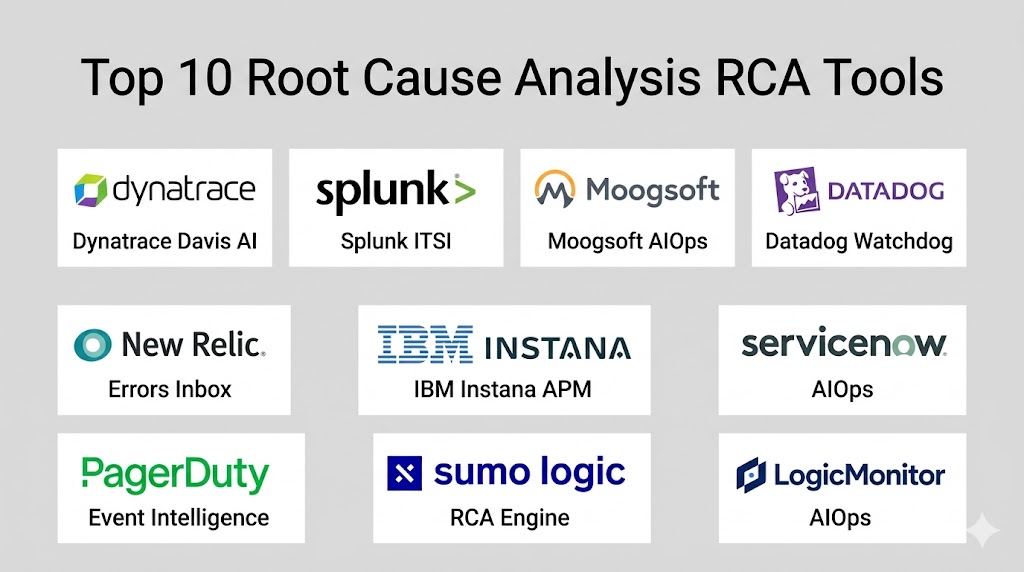
Top 10 Root Cause Analysis Tools
1- Dynatrace
Short description: Dynatrace is an AI-powered observability platform that provides automated root cause analysis across applications, infrastructure, and user experience layers. It uses Davis AI engine to identify problems and explain root causes in real time, making it widely used in enterprise SRE environments.
Key Features
- AI-driven root cause detection
- Full-stack observability (infra + app + UX)
- Automatic dependency mapping
- Real-user monitoring (RUM)
- Anomaly detection engine
- Kubernetes monitoring
- Smart alert correlation
Pros
- Highly accurate automated RCA
- Strong AI-powered insights
- Minimal manual configuration required
- Excellent enterprise scalability
Cons
- Expensive for large-scale deployments
- Complex initial setup
- Less customizable for advanced users
- Requires training for full utilization
Platforms / Deployment
Cloud and hybrid enterprise environments
Security & Compliance
Enterprise-grade security controls including RBAC, encryption, and audit logs. Compliance details are Not publicly stated.
Integrations & Ecosystem
- AWS, Azure, GCP
- Kubernetes
- CI/CD pipelines
- DevOps tools
- Security platforms
Support & Community
Strong enterprise support and global user base.
2- Datadog
Short description: Datadog is a unified observability platform that includes strong RCA capabilities through APM, log correlation, and AIOps-based incident analysis. It helps teams quickly identify root causes across distributed systems.
Key Features
- AIOps-based anomaly detection
- Log, metric, and trace correlation
- Distributed tracing for RCA
- Service dependency mapping
- Incident timeline reconstruction
- Real-time dashboards
- Alert correlation engine
Pros
- Strong multi-source data correlation
- Wide integration ecosystem
- Good cloud-native support
- Fast incident investigation
Cons
- Can become expensive at scale
- Requires tuning for alert noise
- Complex configuration in large systems
- Data ingestion cost considerations
Platforms / Deployment
Cloud-based SaaS platform
Security & Compliance
Includes encryption, access control, and audit logging. Compliance is Not publicly stated.
Integrations & Ecosystem
- Cloud platforms
- Kubernetes
- DevOps pipelines
- Security tools
- APIs and databases
Support & Community
Strong enterprise support and large developer community.
3- Splunk IT Service Intelligence (ITSI)
Short description: Splunk ITSI provides AI-driven service monitoring and RCA capabilities using event correlation and predictive analytics across IT environments.
Key Features
- Event correlation engine
- AI-based service health scoring
- Root cause identification
- Predictive analytics
- Incident investigation dashboards
- Log and metric correlation
- Dependency mapping
Pros
- Strong log analytics capability
- Excellent enterprise scalability
- Powerful search and correlation engine
- Mature AIOps ecosystem
Cons
- High cost of ownership
- Complex deployment
- Requires expertise for optimization
- Resource-intensive platform
Platforms / Deployment
Cloud and hybrid enterprise environments
Security & Compliance
Enterprise security controls available. Compliance is Not publicly stated.
Integrations & Ecosystem
- SIEM systems
- Cloud providers
- DevOps tools
- APIs
- Enterprise applications
Support & Community
Strong enterprise support ecosystem.
4- New Relic
Short description: New Relic provides full-stack observability with built-in AI-powered RCA capabilities that help teams detect anomalies, trace issues, and identify root causes quickly.
Key Features
- Full-stack observability
- Distributed tracing
- AI anomaly detection
- Incident correlation
- Application performance monitoring (APM)
- Infrastructure monitoring
- Custom dashboards
Pros
- Easy-to-use interface
- Strong developer experience
- Fast incident detection
- Good real-time visibility
Cons
- Pricing scales quickly
- Data ingestion costs can be high
- Requires tuning for optimization
- Limited deep customization
Platforms / Deployment
Cloud-based SaaS platform
Security & Compliance
Includes encryption, audit logs, and access control. Compliance details are Not publicly stated.
Integrations & Ecosystem
- Cloud platforms
- DevOps tools
- CI/CD systems
- Databases
- APIs
Support & Community
Strong documentation and enterprise support.
5- BigPanda
Short description: BigPanda is an AIOps platform designed for incident correlation and automated root cause identification across complex IT environments.
Key Features
- Event correlation engine
- Incident intelligence system
- Automated RCA suggestions
- Alert noise reduction
- Dependency mapping
- Change impact analysis
- Workflow automation
Pros
- Excellent alert noise reduction
- Strong incident correlation
- Good enterprise integration
- Fast MTTR reduction
Cons
- Enterprise-focused pricing
- Requires integration setup
- Learning curve for teams
- Limited standalone observability
Platforms / Deployment
Cloud-based SaaS platform
Security & Compliance
Enterprise-grade security features available. Compliance is Not publicly stated.
Integrations & Ecosystem
- Datadog, Splunk, AppDynamics
- Cloud platforms
- ITSM tools
- Slack, Jira
- APIs
Support & Community
Strong enterprise support.
6- Moogsoft
Short description: Moogsoft is an AIOps platform specializing in alert correlation and incident clustering to help identify root causes faster.
Key Features
- AI-driven event correlation
- Incident clustering (“situations”)
- Noise reduction engine
- RCA suggestions
- Real-time alert processing
- Workflow automation
- Service dependency mapping
Pros
- Reduces alert noise significantly
- Strong correlation engine
- Improves incident response speed
- Good scalability
Cons
- Complex configuration
- Enterprise pricing model
- Requires tuning for accuracy
- UI complexity
Platforms / Deployment
Cloud and hybrid environments
Security & Compliance
Security features include RBAC and audit logs. Compliance is Not publicly stated.
Integrations & Ecosystem
- Monitoring tools
- Cloud platforms
- ITSM systems
- DevOps pipelines
- APIs
Support & Community
Enterprise support with consulting services.
7- ServiceNow ITOM (AIOps + RCA)
Short description: ServiceNow IT Operations Management provides RCA capabilities through event management, AIOps, and workflow automation integrated into enterprise ITSM.
Key Features
- Event correlation and RCA
- AIOps-based anomaly detection
- Service mapping
- Incident lifecycle automation
- Predictive intelligence
- Workflow orchestration
- CMDB integration
Pros
- Strong ITSM integration
- Excellent workflow automation
- Enterprise governance strength
- Unified operations platform
Cons
- Complex deployment
- Expensive enterprise licensing
- Requires ecosystem adoption
- Steep learning curve
Platforms / Deployment
Cloud-based enterprise platform
Security & Compliance
Strong enterprise compliance controls. Details are Not publicly stated.
Integrations & Ecosystem
- ITSM tools
- Cloud platforms
- DevOps systems
- Security tools
- APIs
Support & Community
Strong enterprise support ecosystem.
8- AppDynamics
Short description: AppDynamics provides application-centric RCA using business transaction monitoring and performance analytics.
Key Features
- Business transaction tracking
- Application performance monitoring
- Dependency mapping
- Root cause identification
- End-user monitoring
- Infrastructure visibility
- Anomaly detection
Pros
- Strong application-level RCA
- Deep transaction insights
- Good enterprise scalability
- Strong Cisco ecosystem integration
Cons
- Complex setup
- Expensive enterprise tool
- Requires expertise
- Less flexible than newer tools
Platforms / Deployment
Cloud and hybrid environments
Security & Compliance
Enterprise security controls available. Compliance is Not publicly stated.
Integrations & Ecosystem
- Cisco ecosystem
- Cloud providers
- DevOps tools
- APIs
- Monitoring systems
Support & Community
Strong enterprise support.
9- IBM Instana
Short description: IBM Instana provides automated observability and real-time RCA across microservices, cloud-native applications, and infrastructure systems.
Key Features
- Automated dependency mapping
- Real-time observability
- AI-based RCA detection
- Microservices monitoring
- Kubernetes monitoring
- Distributed tracing
- Anomaly detection
Pros
- Strong microservices RCA
- Fast deployment
- High automation level
- Good IBM ecosystem integration
Cons
- Enterprise pricing
- Complex for beginners
- Limited customization in some areas
- Requires onboarding effort
Platforms / Deployment
Cloud and hybrid environments
Security & Compliance
Enterprise-grade controls included. Compliance is Not publicly stated.
Integrations & Ecosystem
- Kubernetes
- Cloud platforms
- DevOps pipelines
- IBM tools
- APIs
Support & Community
Strong enterprise support from IBM.
10- Grafana (with Loki, Tempo, Prometheus stack)
Short description: Grafana is an open-source observability platform that enables RCA through visualization and correlation of metrics, logs, and traces when combined with monitoring backends.
Key Features
- Custom observability dashboards
- Metrics visualization
- Log correlation (Loki)
- Distributed tracing (Tempo)
- Alerting system
- Plugin ecosystem
- Multi-source integration
Pros
- Highly flexible and customizable
- Open-source and cost-effective
- Strong community support
- Works with multiple data sources
Cons
- Requires setup effort
- Needs external tools for full RCA
- Operational complexity at scale
- Not a turnkey RCA solution
Platforms / Deployment
Self-hosted, cloud, hybrid
Security & Compliance
Depends on deployment configuration. Compliance is Not publicly stated.
Integrations & Ecosystem
- Prometheus
- Loki
- Tempo
- Cloud platforms
- Databases
Support & Community
Very strong open-source community.
Comparison Table
| Tool Name | Best For | Platforms Supported | Deployment | Standout Feature | Public Rating |
|---|---|---|---|---|---|
| Dynatrace | AI-driven RCA | Cloud + Hybrid | Cloud | Davis AI root cause engine | N/A |
| Datadog | Full-stack observability | Cloud | Cloud | Multi-source correlation | N/A |
| Splunk ITSI | Log-heavy enterprises | Cloud + Hybrid | Cloud/Hybrid | Event correlation engine | N/A |
| New Relic | Developers & SRE teams | Cloud | Cloud | Easy full-stack visibility | N/A |
| BigPanda | Incident correlation | Cloud | Cloud | Alert noise reduction | N/A |
| Moogsoft | AIOps automation | Cloud + Hybrid | Cloud/Hybrid | Situation clustering | N/A |
| ServiceNow ITOM | ITSM + AIOps | Cloud | Cloud | Workflow-driven RCA | N/A |
| AppDynamics | Application RCA | Cloud + Hybrid | Cloud/Hybrid | Business transaction tracing | N/A |
| IBM Instana | Microservices RCA | Cloud + Hybrid | Cloud | Real-time auto mapping | N/A |
| Grafana | Open-source observability | Multi-source | Self/Cloud | Visualization flexibility | N/A |
Evaluation & Scoring of RCA Tools
| Tool Name | Core 25% | Ease 15% | Integrations 15% | Security 10% | Performance 10% | Support 10% | Value 15% | Weighted Total |
|---|---|---|---|---|---|---|---|---|
| Dynatrace | 9.4 | 8.0 | 9.0 | 9.2 | 9.3 | 9.0 | 8.5 | 9.0 |
| Datadog | 9.2 | 9.0 | 9.3 | 9.0 | 9.2 | 9.0 | 8.8 | 9.1 |
| Splunk ITSI | 9.1 | 7.8 | 9.2 | 9.3 | 9.0 | 9.0 | 8.0 | 8.8 |
| New Relic | 9.0 | 9.0 | 9.0 | 8.8 | 9.0 | 8.8 | 8.7 | 8.9 |
| BigPanda | 8.8 | 8.5 | 9.0 | 8.8 | 8.8 | 8.8 | 8.5 | 8.7 |
| Moogsoft | 8.6 | 7.8 | 8.8 | 8.6 | 8.7 | 8.6 | 8.6 | 8.5 |
| ServiceNow ITOM | 9.0 | 7.5 | 9.0 | 9.2 | 9.0 | 9.0 | 8.2 | 8.7 |
| AppDynamics | 9.0 | 7.8 | 9.0 | 9.0 | 9.0 | 8.8 | 8.2 | 8.8 |
| IBM Instana | 8.9 | 8.0 | 8.8 | 9.0 | 9.0 | 8.8 | 8.3 | 8.7 |
| Grafana | 8.8 | 9.0 | 9.0 | 8.5 | 8.8 | 8.8 | 9.5 | 8.8 |
Which RCA Tool Is Right for You?
Solo / Freelancer
Grafana is best for learning observability and basic RCA concepts.
SMB
New Relic, Datadog, and IBM Instana offer balanced observability with RCA features.
Mid-Market
Datadog, New Relic, and BigPanda provide strong incident correlation and RCA automation.
Enterprise
Dynatrace, Splunk ITSI, ServiceNow ITOM, and AppDynamics are best for complex environments.
Budget vs Premium
Grafana is cost-effective, while Dynatrace and ServiceNow are premium enterprise solutions.
Feature Depth vs Ease of Use
Grafana is flexible but complex, while New Relic is easier to adopt.
Integrations & Scalability
Enterprise RCA tools should integrate with cloud platforms, DevOps pipelines, and monitoring stacks.
Security & Compliance Needs
Organizations should prioritize audit logs, role-based access control, and compliance-ready reporting.
Frequently Asked Questions
1. What is a Root Cause Analysis tool?
A Root Cause Analysis tool helps identify the underlying reason behind system failures or incidents. It analyzes logs, metrics, and events to determine why an issue occurred. It helps prevent recurring problems. It is widely used in IT operations.
2. Why is RCA important in IT?
RCA is important because it helps teams move beyond symptoms and fix actual problems. It reduces downtime and improves system reliability. It also helps optimize infrastructure performance. It is critical in complex systems.
3. How do RCA tools work?
They collect data from logs, metrics, traces, and events. Then they correlate this data using AI or rules-based engines. They identify dependencies and anomalies. Finally, they suggest or highlight the root cause.
4. What is AIOps in RCA?
AIOps uses artificial intelligence to automate IT operations. In RCA, it helps detect anomalies and identify root causes faster. It reduces manual troubleshooting effort. It improves incident response speed.
5. What data do RCA tools use?
They use telemetry data such as logs, metrics, traces, and events. Some tools also use change logs and deployment data. This helps build a full incident timeline. It improves accuracy of diagnosis.
6. Are RCA tools fully automated?
Not completely. Many tools provide automated suggestions but still require human validation. Advanced platforms offer semi-autonomous RCA. Full automation is still evolving.
7. Do RCA tools work in cloud environments?
Yes, most modern RCA tools are built for cloud-native systems. They integrate with AWS, Azure, and GCP. They also support Kubernetes and microservices. Cloud compatibility is a core feature.
8. Are RCA tools expensive?
Enterprise RCA tools can be expensive due to data ingestion and scale. Open-source tools like Grafana are more cost-effective. Pricing depends on usage and infrastructure size. Costs vary widely.
9. Can RCA tools reduce MTTR?
Yes, RCA tools significantly reduce Mean Time To Resolution. They quickly identify the cause of incidents. This speeds up troubleshooting and fixes. They improve operational efficiency.
10. What is the best RCA tool?
There is no single best tool. Dynatrace and Datadog are leaders in AI-driven RCA. Splunk is strong for log-heavy environments. Grafana is best for flexibility and open-source setups.
Conclusion
Root Cause Analysis tools are essential for modern IT environments because they enable teams to quickly identify and resolve the underlying causes of system failures. As infrastructure becomes more distributed and cloud-native, tools like Dynatrace, Datadog, and Splunk provide advanced AI-driven RCA capabilities, while Grafana offers flexible open-source observability. The right choice depends on system complexity, budget, and integration needs, but every organization benefits from faster incident resolution, reduced downtime, and improved operational reliability through effective RCA tools.

This article clearly explains root cause analysis tools and how they help organizations identify problems faster and improve overall operational efficiency through better issue resolution.
Helpful comparison guide showing how RCA tools assist teams in identifying issues faster, improving troubleshooting, and reducing recurring operational problems.
Beyond dashboards, the real challenge is how well RCA tools correlate cross-system dependencies and noisy telemetry to consistently surface true root causes instead of symptoms.