Introduction
Cloud Identity Security Tools are platforms designed to protect digital identities, enforce access control, and prevent unauthorized access across cloud environments, SaaS applications, APIs, and hybrid infrastructure. In simple terms, they ensure that only the right users, services, and machines can access the right resources at the right time.
In 2026 and beyond, identity has become the new security perimeter, because most modern attacks no longer “hack systems”—they “log in using stolen credentials.” With the explosion of cloud services, remote work, AI agents, and machine identities, organizations now manage thousands of identities across distributed environments.
Common use cases include single sign-on (SSO), multi-factor authentication (MFA), identity lifecycle management, privileged access management (PAM), zero trust access control, identity threat detection, API identity governance, and securing non-human identities such as service accounts and AI agents.
Buyers should evaluate authentication strength, access governance, identity lifecycle automation, machine identity support, integration ecosystem, threat detection capabilities, compliance reporting, scalability, cloud-native compatibility, and ease of administration.
Best for: enterprises, SaaS platforms, cloud-native companies, fintech organizations, healthcare systems, DevSecOps teams, and organizations managing hybrid or multi-cloud identity environments.
Not ideal for: very small static environments, offline systems, or organizations without cloud-based identity workflows.
Key Trends in Cloud Identity Security Tools
- Identity-first security model is replacing traditional perimeter-based security
- Machine identity explosion driven by APIs, microservices, and AI agents
- Zero trust adoption becoming default, not optional
- Continuous identity verification replacing one-time authentication
- Identity Threat Detection and Response (ITDR) emerging as a core security layer
- Privileged Access Management (PAM) convergence with IAM platforms
- AI-driven anomaly detection for login and access behavior
- Passwordless authentication and passkey adoption increasing rapidly
- Unified identity governance for human + non-human identities
- Cross-cloud identity orchestration becoming critical in hybrid environments
How We Selected These Tools
- Focused on platforms covering IAM, IAM+PAM, and identity security monitoring
- Included enterprise leaders and modern cloud-native identity platforms
- Prioritized tools supporting human and machine identities
- Considered identity governance, access control, and threat detection capabilities
- Evaluated integration with cloud providers, SaaS ecosystems, and DevSecOps pipelines
- Included platforms supporting zero trust and conditional access
- Reviewed scalability for large enterprise identity environments
- Considered support for identity lifecycle automation and compliance reporting
- Balanced legacy enterprise tools with modern cloud-native solutions
- Avoided unverified claims and used Not publicly stated where needed
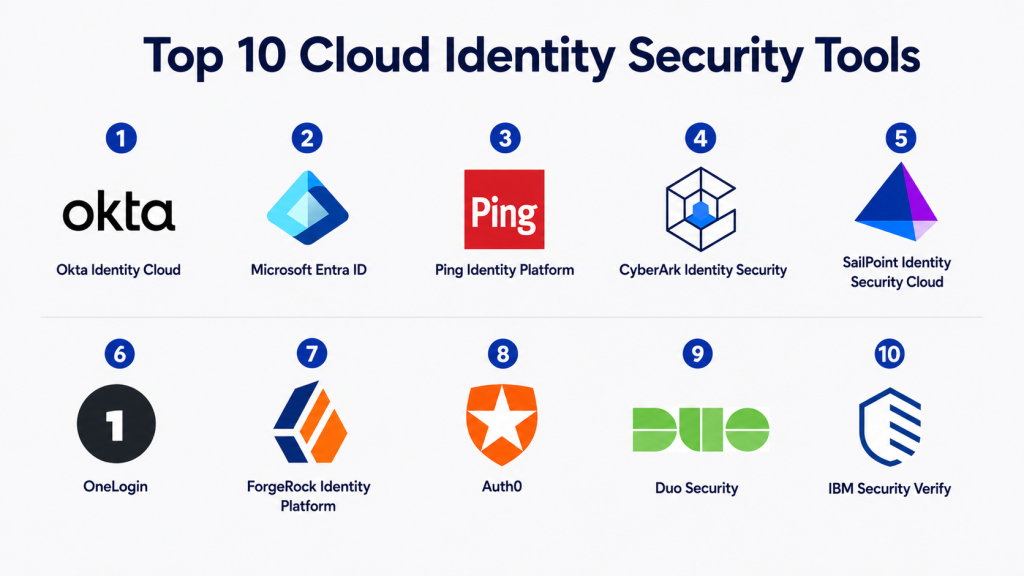
Top 10 Cloud Identity Security Tools
1- Microsoft Entra ID
Short description: Microsoft Entra ID is a leading cloud identity and access management platform that provides secure authentication, authorization, and identity governance for enterprise environments. It is widely used for managing hybrid and multi-cloud identity systems and is deeply integrated into the Microsoft ecosystem.
Key Features
- Single Sign-On (SSO) across applications
- Multi-Factor Authentication (MFA)
- Conditional access policies
- Identity lifecycle management
- Role-based access control (RBAC)
- Zero trust identity enforcement
- Hybrid identity management
Pros
- Strong enterprise adoption
- Deep Microsoft ecosystem integration
- Scalable for hybrid environments
- Robust conditional access controls
Cons
- Complex configuration for large deployments
- Best value within Microsoft ecosystem
- Requires expertise for advanced policies
- Licensing complexity
Platforms / Deployment
Cloud-based with hybrid identity support
Security & Compliance
Supports enterprise-grade identity security controls, encryption, audit logs, and compliance frameworks. Specific certifications vary by deployment and are Not publicly stated in detail.
Integrations & Ecosystem
- Microsoft 365
- Azure cloud services
- SaaS applications
- Third-party identity providers
- Security and SIEM tools
Support & Community
Strong global enterprise support with extensive documentation and partner ecosystem.
2- Okta Identity Cloud
Short description: Okta Identity Cloud is a widely adopted identity security platform that provides authentication, lifecycle management, and access governance for cloud-first organizations. It is known for its strong SaaS integration ecosystem and developer-friendly identity APIs.
Key Features
- Universal SSO integration
- Adaptive multi-factor authentication
- Identity lifecycle automation
- API-based identity management
- Access policy enforcement
- Device trust and contextual access
- Workforce and customer identity management
Pros
- Strong SaaS integration ecosystem
- Easy deployment for cloud apps
- Developer-friendly APIs
- Scalable identity management
Cons
- Pricing can increase with scale
- Complex enterprise policy tuning
- Dependency on SaaS ecosystem
- Limited deep infrastructure control
Platforms / Deployment
Cloud-native SaaS platform
Security & Compliance
Enterprise-grade identity controls available. Compliance certifications are Not publicly stated.
Integrations & Ecosystem
- SaaS applications
- Cloud platforms
- API ecosystems
- CI/CD pipelines
- Security monitoring tools
Support & Community
Strong enterprise support and large global developer community.
3- CyberArk Identity Security
Short description: CyberArk Identity Security focuses on securing privileged access, workforce identities, and machine identities. It is widely used for protecting high-risk accounts and enforcing strict identity governance.
Key Features
- Privileged access management (PAM)
- Identity governance and lifecycle management
- Secure cloud access controls
- Endpoint identity security
- Machine identity protection
- Adaptive authentication
- Zero trust enforcement
Pros
- Strong privileged identity protection
- Excellent enterprise security depth
- Machine identity support
- Mature security platform
Cons
- Complex deployment architecture
- Higher operational overhead
- Enterprise-focused pricing
- Requires security expertise
Platforms / Deployment
Cloud, hybrid, enterprise environments
Security & Compliance
Strong enterprise security governance features. Compliance certifications are Not publicly stated.
Integrations & Ecosystem
- Cloud platforms
- SIEM systems
- DevSecOps tools
- Endpoint security systems
- Enterprise IAM systems
Support & Community
Enterprise-grade support with strong security consulting services.
4- SailPoint Identity Security Cloud
Short description: SailPoint is a leading identity governance platform that helps organizations manage access, lifecycle policies, and compliance across enterprise systems.
Key Features
- Identity governance and administration (IGA)
- Access certification and reviews
- Automated provisioning/deprovisioning
- Role-based access modeling
- Policy-based access control
- Compliance reporting
- Identity lifecycle management
Pros
- Strong governance capabilities
- Excellent compliance support
- Scalable identity lifecycle management
- Good enterprise visibility
Cons
- Complex implementation
- Requires process maturity
- Enterprise-focused deployment
- UI learning curve
Platforms / Deployment
Cloud and hybrid enterprise environments
Security & Compliance
Strong compliance-oriented identity governance. Certifications are Not publicly stated in detail.
Integrations & Ecosystem
- ERP systems
- SaaS applications
- Cloud platforms
- Directory services
- Security monitoring tools
Support & Community
Strong enterprise support with governance-focused documentation.
5- Ping Identity
Short description: Ping Identity provides secure identity access management with a strong focus on authentication, API security, and hybrid identity environments.
Key Features
- SSO and MFA authentication
- API identity security
- Access governance
- Identity federation
- Adaptive authentication
- Zero trust access control
- Directory integration
Pros
- Strong hybrid identity support
- Flexible authentication options
- Good API security capabilities
- Enterprise scalability
Cons
- Complex configuration
- Requires IAM expertise
- Enterprise pricing model
- Steep learning curve
Platforms / Deployment
Cloud, hybrid, enterprise systems
Security & Compliance
Enterprise identity security controls available. Compliance details are Not publicly stated.
Integrations & Ecosystem
- SaaS applications
- API gateways
- Cloud platforms
- Identity providers
- Enterprise systems
Support & Community
Strong enterprise support and global adoption.
6- One Identity
Short description: One Identity provides identity governance, privileged access management, and identity lifecycle management in a unified identity security platform.
Key Features
- Identity governance and administration
- Privileged access management
- Role-based access control
- Identity lifecycle automation
- Access certification
- Audit and compliance reporting
- Hybrid identity management
Pros
- Unified identity platform
- Strong governance capabilities
- Good enterprise integration
- Flexible deployment
Cons
- Complex setup
- Requires training and expertise
- Enterprise-focused model
- Less developer-friendly
Platforms / Deployment
Cloud, hybrid, self-hosted enterprise environments
Security & Compliance
Strong identity governance controls. Certifications are Not publicly stated.
Integrations & Ecosystem
- Enterprise directories
- Cloud platforms
- Security tools
- SIEM systems
- Business applications
Support & Community
Enterprise support with professional services available.
7- Saviynt Identity Cloud
Short description: Saviynt provides converged identity governance and cloud identity security with strong compliance and access lifecycle management capabilities.
Key Features
- Identity governance and administration
- Access lifecycle automation
- Cloud entitlement management
- Privileged access governance
- Risk-based access controls
- Compliance reporting
- Identity analytics
Pros
- Strong governance + cloud identity integration
- Good compliance capabilities
- Unified identity platform
- Enterprise scalability
Cons
- Complex deployment
- Requires IAM maturity
- Enterprise pricing
- Learning curve
Platforms / Deployment
Cloud-native enterprise platform
Security & Compliance
Strong compliance-focused identity governance. Certifications are Not publicly stated.
Integrations & Ecosystem
- Cloud providers
- SaaS applications
- ERP systems
- Security platforms
- IAM ecosystems
Support & Community
Enterprise support with consulting and onboarding services.
8- Oracle Identity Management
Short description: Oracle Identity Management provides enterprise-grade IAM solutions for authentication, access control, and identity lifecycle management across Oracle and hybrid environments.
Key Features
- Identity and access management
- SSO and MFA
- Directory services integration
- Access governance
- Policy-based access control
- Lifecycle management
- Enterprise federation
Pros
- Strong enterprise scalability
- Good Oracle ecosystem integration
- Mature identity platform
- Robust governance features
Cons
- Complex setup
- Heavy enterprise dependency
- Higher operational cost
- Less agile than modern SaaS IAM tools
Platforms / Deployment
On-premise, hybrid, cloud enterprise environments
Security & Compliance
Enterprise identity security controls available. Compliance details are Not publicly stated.
Integrations & Ecosystem
- Oracle applications
- Enterprise ERP systems
- Cloud platforms
- Security tools
- Identity directories
Support & Community
Strong enterprise support through Oracle ecosystem.
9- IBM Security Verify
Short description: IBM Security Verify is an identity and access management platform that provides authentication, lifecycle management, and identity governance for hybrid environments.
Key Features
- SSO and MFA
- Identity lifecycle management
- Risk-based authentication
- Access governance
- Directory integration
- Zero trust access policies
- Identity analytics
Pros
- Strong enterprise security
- Good hybrid cloud support
- Advanced risk-based authentication
- Scalable architecture
Cons
- Complex implementation
- Enterprise-focused pricing
- Requires IAM expertise
- Slower onboarding
Platforms / Deployment
Cloud, hybrid, enterprise systems
Security & Compliance
Strong enterprise identity security features. Certifications are Not publicly stated.
Integrations & Ecosystem
- IBM security suite
- SIEM tools
- Cloud environments
- SaaS platforms
- Enterprise directories
Support & Community
Enterprise-grade global support.
10- JumpCloud
Short description: JumpCloud is a cloud-based directory and identity management platform that simplifies authentication, device management, and access control for SMBs and mid-market organizations.
Key Features
- Cloud directory services
- SSO and MFA
- Device management integration
- User lifecycle management
- Access control policies
- Directory-as-a-service
- Cross-platform identity management
Pros
- Easy deployment for SMBs
- Unified directory and identity
- Good cross-platform support
- Simplifies identity management
Cons
- Limited enterprise depth
- Less advanced governance features
- Smaller ecosystem
- Not ideal for large-scale enterprises
Platforms / Deployment
Cloud-native SaaS platform
Security & Compliance
Security controls included for identity and device management. Compliance certifications are Not publicly stated.
Integrations & Ecosystem
- SaaS applications
- Cloud platforms
- Device management systems
- Security tools
- API integrations
Support & Community
Good SMB-focused support and documentation.
Comparison Table
| Tool Name | Best For | Platforms Supported | Deployment | Standout Feature | Public Rating |
|---|---|---|---|---|---|
| Microsoft Entra ID | Enterprise hybrid identity | Cloud, hybrid | Cloud | Conditional access engine | N/A |
| Okta | SaaS identity management | Cloud apps | Cloud | Large SaaS integration ecosystem | N/A |
| CyberArk | Privileged identity security | Enterprise systems | Cloud/Hybrid | PAM + machine identity | N/A |
| SailPoint | Identity governance | Enterprise apps | Cloud/Hybrid | Strong compliance governance | N/A |
| Ping Identity | API + hybrid IAM | Cloud, hybrid | Cloud/Hybrid | API security focus | N/A |
| One Identity | Unified IAM platform | Enterprise systems | Hybrid | Governance + PAM combined | N/A |
| Saviynt | Cloud identity governance | Cloud apps | Cloud | Converged identity governance | N/A |
| Oracle IAM | Oracle ecosystem IAM | Enterprise systems | On-prem/Cloud | ERP integration | N/A |
| IBM Security Verify | Hybrid IAM | Enterprise apps | Cloud/Hybrid | Risk-based authentication | N/A |
| JumpCloud | SMB identity management | SaaS + devices | Cloud | Directory-as-a-service | N/A |
Evaluation & Scoring of Cloud Identity Security Tools
| Tool Name | Core 25% | Ease 15% | Integrations 15% | Security 10% | Performance 10% | Support 10% | Value 15% | Weighted Total |
|---|---|---|---|---|---|---|---|---|
| Microsoft Entra ID | 9.4 | 8.8 | 9.2 | 9.3 | 9.0 | 9.0 | 8.8 | 9.1 |
| Okta | 9.2 | 9.0 | 9.3 | 9.0 | 9.0 | 9.0 | 8.7 | 9.0 |
| CyberArk | 9.0 | 7.8 | 9.0 | 9.5 | 9.0 | 9.0 | 8.3 | 8.8 |
| SailPoint | 9.1 | 7.5 | 8.8 | 9.2 | 8.8 | 8.8 | 8.2 | 8.7 |
| Ping Identity | 8.8 | 8.0 | 8.8 | 9.0 | 8.8 | 8.8 | 8.4 | 8.6 |
| One Identity | 8.7 | 7.5 | 8.6 | 9.0 | 8.8 | 8.8 | 8.0 | 8.5 |
| Saviynt | 8.8 | 7.5 | 8.7 | 9.0 | 8.8 | 8.7 | 8.2 | 8.5 |
| Oracle IAM | 8.5 | 7.0 | 8.5 | 9.0 | 8.8 | 8.8 | 7.8 | 8.3 |
| IBM Security Verify | 8.6 | 7.8 | 8.7 | 9.0 | 8.8 | 8.8 | 8.0 | 8.5 |
| JumpCloud | 8.3 | 9.0 | 8.5 | 8.2 | 8.5 | 8.4 | 9.0 | 8.6 |
Which Cloud Identity Security Tool Is Right for You?
Solo / Freelancer
JumpCloud or Okta (basic plans) are practical for managing small identity environments.
SMB
JumpCloud, Okta, and Microsoft Entra ID offer the best balance of simplicity and capability.
Mid-Market
Okta, Ping Identity, and IBM Security Verify provide strong scalability and hybrid identity control.
Enterprise
Microsoft Entra ID, CyberArk, SailPoint, Saviynt, and Oracle IAM are best for large-scale governance and security.
Budget vs Premium
JumpCloud is budget-friendly, while CyberArk, SailPoint, and Oracle are premium enterprise platforms.
Feature Depth vs Ease of Use
Okta and JumpCloud are easier to use, while CyberArk and SailPoint offer deeper governance complexity.
Integrations & Scalability
Enterprises should prioritize integration with cloud providers, SaaS apps, SIEM systems, and CI/CD pipelines.
Security & Compliance Needs
Regulated industries should prioritize governance, audit logging, PAM, and identity lifecycle automation.
Frequently Asked Questions
1. What are cloud identity security tools?
Cloud identity security tools manage and protect user identities across cloud and hybrid environments. They control authentication, authorization, and access governance. They ensure only authorized users access systems. They are essential for modern cybersecurity.
2. Why are identity security tools important?
They are important because most cyberattacks target identities rather than infrastructure. Stolen credentials are commonly used in breaches. Identity security tools reduce unauthorized access risk. They enforce zero trust principles.
3. What is IAM in cloud security?
IAM stands for Identity and Access Management. It controls who can access what resources in cloud systems. It includes authentication and authorization. It ensures least-privilege access.
4. What is zero trust identity security?
Zero trust means no user or device is trusted by default. Every access request must be verified continuously. It reduces risk from compromised credentials. It is widely used in cloud security.
5. What is MFA in identity security?
MFA stands for Multi-Factor Authentication. It requires users to verify identity using multiple methods. It may include passwords, OTPs, or biometrics. It improves account security significantly.
6. Are identity security tools necessary for SMBs?
Yes, SMBs also face cyber threats targeting credentials. Lightweight tools like JumpCloud or Okta help manage access securely. They reduce risk of unauthorized access. Cloud tools make adoption easier.
7. What is identity lifecycle management?
It is the process of managing user accounts from creation to deletion. It includes onboarding, role changes, and offboarding. It ensures proper access control. It reduces security risks from unused accounts.
8. What is PAM in identity security?
PAM stands for Privileged Access Management. It controls access to sensitive systems and admin accounts. It limits misuse of high-level permissions. It is critical for enterprise security.
9. Can identity tools work across multiple clouds?
Yes, modern identity tools support multi-cloud environments. They integrate with AWS, Azure, Google Cloud, and SaaS platforms. They centralize identity management. This improves visibility and control.
10. What is the best cloud identity security tool?
There is no single best tool. Microsoft Entra ID and Okta are leading for general IAM. CyberArk is best for privileged access security. The best choice depends on business needs.
Conclusion
Cloud identity security tools are now the foundation of modern cybersecurity because identity has become the primary attack surface in cloud and hybrid environments. These platforms provide authentication, access control, governance, and continuous identity protection across users, devices, APIs, and machine identities. Microsoft Entra ID and Okta dominate general IAM use cases, while CyberArk, SailPoint, and Saviynt excel in enterprise governance and privileged access security. JumpCloud is ideal for SMBs seeking simplicity, while Ping Identity and IBM Security Verify support hybrid and complex architectures. The best strategy is to choose a platform that aligns with your cloud ecosystem, security maturity, and identity complexity, while ensuring scalability for future machine and AI-driven identities.

This article clearly explains cloud identity security tools and how they help organizations protect user identities, manage access, and strengthen cloud security.
Useful comparison guide showing how cloud identity security tools help strengthen access control, protect user identities, and improve overall cloud security posture.
A key gap is how effectively cloud identity security tools enforce least-privilege access dynamically without increasing operational overhead or slowing down user access.