Introduction
Web application scanners are security testing tools that automatically analyze websites and web applications to detect vulnerabilities such as SQL injection, cross-site scripting, insecure authentication, misconfigurations, and exposed sensitive data. These tools simulate attacker behavior or analyze application responses to identify weaknesses before hackers can exploit them.
In 2026, web application scanning has become essential because modern applications are built using APIs, microservices, cloud-native architectures, and third-party integrations. This complexity increases the attack surface significantly, making manual testing insufficient.
Common real-world use cases include scanning login pages for authentication flaws, testing APIs for injection vulnerabilities, validating secure headers, identifying exposed admin panels, checking cloud-hosted web apps for misconfigurations, and integrating security testing into CI CD pipelines.
When evaluating web application scanners, buyers should consider scanning accuracy, false positive rate, crawling depth, API testing support, CI CD integration, authentication handling, reporting quality, scalability, cloud readiness, ease of use, and remediation guidance.
Best for: DevSecOps teams, penetration testers, security engineers, SaaS companies, enterprise security teams, compliance teams, and organizations building web or API-driven applications.
Not ideal for: static websites with no backend logic, very small projects without security requirements, or teams not running any automated development pipelines.
Key Trends in Web Application Scanners
- Shift-left security integration inside CI CD pipelines and pull requests
- AI-powered crawling that discovers hidden application paths and logic flows
- API-first scanning as modern applications rely heavily on microservices
- Continuous scanning instead of periodic manual penetration testing
- Better authentication handling for complex modern login systems
- Reduced false positives using behavioral and context-aware analysis
- Integration of SAST, DAST, SCA, and API scanning into unified platforms
- Cloud-native scanning designed for Kubernetes and serverless apps
- Automated remediation suggestions and developer-friendly reporting
- Runtime validation combined with static scanning for full coverage
How We Selected These Tools
- Focused on tools specifically designed for web application vulnerability scanning
- Included both open-source and enterprise-grade scanners
- Prioritized tools widely used in real-world penetration testing and DevSecOps
- Considered support for modern authentication and API-based applications
- Evaluated CI CD and GitOps integration capability
- Included tools covering both DAST and hybrid scanning approaches
- Considered scalability for enterprise-level applications
- Focused on tools actively maintained and used in production environments
- Avoided outdated or experimental-only scanners
- Ensured balance between developer-friendly and security-heavy tools
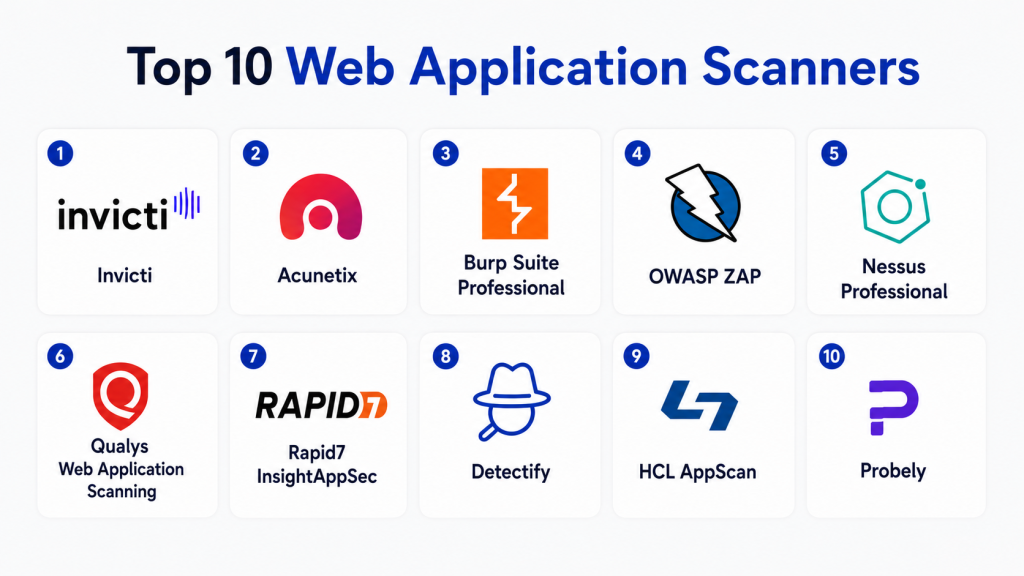
Top 10 Web Application Scanners
1- Burp Suite
Short description: Burp Suite is one of the most widely used web application security testing platforms used by penetration testers and security teams. It provides powerful manual and automated scanning capabilities for detecting vulnerabilities in web applications and APIs. It is especially strong for in-depth security testing and attack simulation.
Key Features
- Web vulnerability scanning and crawling engine
- Manual penetration testing tools
- Automated DAST scanning capabilities
- API security testing support
- Intercepting proxy for traffic analysis
- Authentication handling for complex apps
- Extensible plugin ecosystem
Pros
- Extremely powerful for security testing
- Widely adopted in penetration testing industry
- Deep control over scanning and analysis
- Strong community support and extensions
Cons
- Steep learning curve for beginners
- Resource intensive during deep scans
- Enterprise features can be expensive
- Requires expertise for full utilization
Platforms / Deployment
Windows. macOS. Linux. Desktop and enterprise editions.
Security & Compliance
Supports enterprise security workflows, access control, and audit capabilities depending on edition. Not publicly stated for full compliance certifications.
Integrations & Ecosystem
Burp Suite integrates into security testing and DevSecOps workflows.
- CI CD pipelines
- Security testing frameworks
- API testing tools
- Plugin marketplace
- DevSecOps toolchains
Support & Community
Strong security community support with extensive documentation and professional training resources.
2- OWASP ZAP
Short description: OWASP ZAP is a free and open-source web application security scanner widely used for automated and manual vulnerability testing. It is ideal for developers and security teams looking for a cost-effective DAST solution.
Key Features
- Automated web vulnerability scanning
- Passive and active scanning modes
- Intercepting proxy for traffic inspection
- API scanning support
- CI CD integration capability
- Spidering and application crawling
- Extensible scripting support
Pros
- Free and open-source
- Strong community support
- Easy CI CD integration
- Good for learning and beginners
Cons
- Limited advanced enterprise reporting
- UI can be overwhelming
- Slower on large applications
- Requires tuning for accuracy
Platforms / Deployment
Windows. macOS. Linux. Self-hosted.
Security & Compliance
Supports basic security testing and vulnerability reporting. Not publicly stated for enterprise compliance certifications.
Integrations & Ecosystem
OWASP ZAP integrates well into DevSecOps pipelines.
- GitHub Actions
- Jenkins
- GitLab CI
- Docker
- API testing workflows
Support & Community
Strong open-source OWASP community with frequent updates and documentation.
3- Acunetix by Invicti
Short description: Acunetix is a high-speed automated web vulnerability scanner designed to detect security issues in web applications and APIs. It is known for fast scanning and high accuracy in detecting vulnerabilities.
Key Features
- Automated DAST scanning engine
- API security testing
- High-speed vulnerability detection
- SQL injection and XSS detection
- Authentication-aware scanning
- CI CD integration support
- Reporting and compliance dashboards
Pros
- Very fast scanning performance
- High accuracy with fewer false positives
- Strong API testing capabilities
- Easy to use interface
Cons
- Enterprise pricing model
- Limited manual testing features
- Requires setup for complex authentication
- Focused mainly on DAST
Platforms / Deployment
Web. Cloud. Self-hosted.
Security & Compliance
Supports enterprise reporting and governance features. Not publicly stated for certifications.
Integrations & Ecosystem
Integrates into DevSecOps workflows and CI CD pipelines.
- Jenkins
- GitHub
- GitLab
- Azure DevOps
- Security dashboards
Support & Community
Enterprise support with documentation and onboarding assistance.
4- Invicti
Short description: Invicti is an enterprise-grade web application security scanner focused on automated DAST scanning with high accuracy and scalability. It is widely used for continuous security testing in production-like environments.
Key Features
- Automated web application scanning
- API vulnerability testing
- Proof-based vulnerability validation
- CI CD pipeline integration
- Continuous scanning capability
- Authentication handling
- Security dashboards and reporting
Pros
- Very high accuracy scanning engine
- Low false positive rate
- Strong enterprise scalability
- Good automation features
Cons
- Enterprise pricing structure
- Requires setup for advanced applications
- Focused mainly on DAST
- Learning curve for configuration
Platforms / Deployment
Web. Cloud. Self-hosted.
Security & Compliance
Supports enterprise security workflows, RBAC, and audit logs. Not publicly stated for certifications.
Integrations & Ecosystem
Integrates with DevSecOps and enterprise tooling.
- CI CD pipelines
- Jenkins
- GitHub
- GitLab
- Security orchestration tools
Support & Community
Strong enterprise support and documentation.
5- StackHawk
Short description: StackHawk is a developer-focused DAST platform designed for continuous security testing in CI CD pipelines. It is widely used for API and web application scanning in modern DevSecOps environments.
Key Features
- Continuous DAST scanning
- API security testing
- CI CD pipeline integration
- Developer-friendly configuration
- Authentication-aware scanning
- Automated vulnerability detection
- Git-based workflows
Pros
- Easy integration into CI CD pipelines
- Developer-friendly workflow
- Good API scanning support
- Fast setup process
Cons
- Limited advanced penetration testing features
- Requires tuning for large applications
- Enterprise features require paid plans
- Focused mainly on DAST
Platforms / Deployment
Cloud. CLI. CI CD integrations.
Security & Compliance
Supports enterprise authentication and reporting features depending on configuration. Not publicly stated.
Integrations & Ecosystem
Designed for modern DevSecOps environments.
- GitHub
- GitLab
- Jenkins
- Docker
- Kubernetes pipelines
Support & Community
Good developer documentation and enterprise support options.
6- Nessus
Short description: Nessus is a widely used vulnerability scanner that includes web application scanning capabilities along with infrastructure and network security testing. It is commonly used for enterprise vulnerability management.
Key Features
- Web application vulnerability scanning
- Network and system vulnerability detection
- Compliance auditing tools
- Plugin-based scanning engine
- Scheduled automated scans
- Risk prioritization system
- Reporting dashboards
Pros
- Broad vulnerability coverage
- Strong enterprise adoption
- Reliable scanning engine
- Good reporting capabilities
Cons
- Not purely focused on web apps
- Enterprise licensing required
- Limited deep penetration testing features
- Requires tuning for accuracy
Platforms / Deployment
Windows. Linux. macOS. Cloud.
Security & Compliance
Supports compliance frameworks and enterprise audit reporting depending on configuration. Not publicly stated.
Integrations & Ecosystem
Integrates into enterprise security ecosystems.
- SIEM tools
- Security dashboards
- CI CD pipelines
- Cloud environments
Support & Community
Strong enterprise support and security research community.
7- Rapid7 InsightAppSec
Short description: InsightAppSec is a cloud-based DAST platform designed for continuous application security testing. It helps organizations identify vulnerabilities in web applications and APIs during development and production stages.
Key Features
- Dynamic application security testing
- API security testing support
- Continuous scanning capabilities
- CI CD integration
- Attack simulation engine
- Vulnerability prioritization
- Reporting dashboards
Pros
- Strong enterprise DAST capabilities
- Good cloud-native architecture
- Continuous security testing support
- Easy integration into pipelines
Cons
- Enterprise pricing model
- Limited manual testing features
- Requires setup for complex apps
- Focused primarily on DAST
Platforms / Deployment
Cloud.
Security & Compliance
Supports enterprise governance, audit logging, and compliance reporting. Not publicly stated for certifications.
Integrations & Ecosystem
Integrates with DevSecOps pipelines.
- Jenkins
- GitHub
- GitLab
- Azure DevOps
- Security platforms
Support & Community
Enterprise support with documentation and onboarding services.
8- Qualys Web Application Scanning
Short description: Qualys WAS is a cloud-based web application vulnerability scanner used for large-scale enterprise security monitoring. It provides continuous scanning of web applications and APIs.
Key Features
- Cloud-based web application scanning
- Continuous vulnerability detection
- API scanning support
- Authentication-aware scanning
- Compliance reporting tools
- Risk prioritization engine
- Centralized dashboard
Pros
- Strong enterprise scalability
- Good compliance reporting
- Continuous monitoring capability
- Easy cloud deployment
Cons
- Enterprise-focused pricing
- Complex configuration for beginners
- Limited manual testing features
- Requires tuning for accuracy
Platforms / Deployment
Cloud.
Security & Compliance
Supports enterprise compliance frameworks and audit reporting. Not publicly stated.
Integrations & Ecosystem
Integrates into enterprise security systems.
- SIEM platforms
- DevSecOps pipelines
- Cloud environments
- API gateways
Support & Community
Strong enterprise support with global security operations coverage.
9- Aikido Security
Short description: Aikido Security is a modern application security platform that combines SAST, DAST, SCA, and web scanning into a unified system. It is designed for fast-moving DevSecOps teams.
Key Features
- Unified application security scanning
- Web application vulnerability detection
- API security testing
- CI CD integration
- Continuous monitoring
- Vulnerability prioritization
- Developer-friendly dashboard
Pros
- Unified security platform
- Easy developer experience
- Fast onboarding
- Good CI CD integration
Cons
- Newer platform compared to competitors
- Limited enterprise maturity
- Some advanced features still evolving
- Requires tuning for complex systems
Platforms / Deployment
Cloud.
Security & Compliance
Supports standard enterprise security features depending on configuration. Not publicly stated.
Integrations & Ecosystem
Integrates into DevSecOps workflows.
- GitHub
- GitLab
- CI CD pipelines
- Cloud environments
Support & Community
Growing community with modern DevSecOps focus.
10- Probely
Short description: Probely is a developer-friendly web vulnerability scanner focused on API and web application security testing. It is widely used in CI CD pipelines for continuous security validation.
Key Features
- Automated web vulnerability scanning
- API security testing
- CI CD pipeline integration
- Authentication-aware scanning
- Continuous scanning support
- Developer-friendly reports
- Vulnerability prioritization
Pros
- Easy to integrate into workflows
- Strong developer usability
- Good API scanning capabilities
- Fast onboarding
Cons
- Limited enterprise governance features
- Smaller ecosystem
- Advanced features require higher plans
- Focused mainly on DAST
Platforms / Deployment
Cloud.
Security & Compliance
Supports enterprise authentication and reporting depending on configuration. Not publicly stated.
Integrations & Ecosystem
Designed for DevSecOps and CI CD pipelines.
- GitHub
- GitLab
- Jenkins
- API testing tools
- CI CD workflows
Support & Community
Good documentation and developer-focused support.
Comparison Table
| Tool Name | Best For | Platforms Supported | Deployment | Standout Feature | Public Rating |
|---|---|---|---|---|---|
| Burp Suite | Manual + automated testing | Windows macOS Linux | Desktop + enterprise | Deep penetration testing tools | N/A |
| OWASP ZAP | Open-source scanning | Windows macOS Linux | Self-hosted | Free DAST scanning | N/A |
| Acunetix | Fast vulnerability scanning | Web | Cloud Self-hosted | High-speed scanning engine | N/A |
| Invicti | Enterprise DAST | Web | Cloud Self-hosted | Proof-based validation | N/A |
| StackHawk | CI CD security testing | Cloud CLI | Cloud | Developer-first DAST | N/A |
| Nessus | Broad vulnerability scanning | Windows Linux macOS | Cloud | Multi-layer vulnerability coverage | N/A |
| Rapid7 InsightAppSec | Cloud DAST | Cloud | Cloud | Continuous scanning | N/A |
| Qualys WAS | Enterprise web scanning | Cloud | Cloud | Continuous enterprise monitoring | N/A |
| Aikido Security | Unified AppSec platform | Cloud | Cloud | Combined SAST DAST SCA | N/A |
| Probely | Developer-friendly scanning | Cloud | Cloud | API-first scanning | N/A |
Evaluation and Scoring of Web Application Scanners
| Tool Name | Core 25% | Ease 15% | Integrations 15% | Security 10% | Performance 10% | Support 10% | Value 15% | Weighted Total |
|---|---|---|---|---|---|---|---|---|
| Burp Suite | 10 | 8 | 9 | 9 | 9 | 8 | 8 | 8.95 |
| OWASP ZAP | 8 | 9 | 8 | 8 | 8 | 8 | 10 | 8.45 |
| Acunetix | 9 | 8 | 9 | 9 | 9 | 8 | 8 | 8.75 |
| Invicti | 9 | 8 | 9 | 9 | 9 | 8 | 8 | 8.80 |
| StackHawk | 8 | 9 | 9 | 8 | 9 | 8 | 9 | 8.65 |
| Nessus | 8 | 8 | 8 | 8 | 8 | 8 | 9 | 8.10 |
| Rapid7 InsightAppSec | 8 | 8 | 8 | 9 | 8 | 8 | 8 | 8.20 |
| Qualys WAS | 8 | 7 | 8 | 9 | 8 | 9 | 8 | 8.15 |
| Aikido Security | 8 | 9 | 9 | 8 | 8 | 8 | 9 | 8.50 |
| Probely | 8 | 9 | 8 | 8 | 8 | 8 | 9 | 8.40 |
These scores reflect scanning accuracy, automation capability, integration depth, scalability, developer experience, and enterprise readiness. Burp Suite remains strongest for deep security testing, while Invicti and Acunetix excel in automated DAST. OWASP ZAP provides strong open-source value, and StackHawk and Probely are ideal for CI CD driven DevSecOps environments.
Which Web Application Scanner Is Right for You
Solo / Freelancer
Solo developers should prioritize simplicity and free or lightweight tools. OWASP ZAP, Probely, and Burp Suite Community are strong choices depending on testing depth needs.
SMB
SMBs should focus on automation and cost efficiency. Acunetix, StackHawk, OWASP ZAP, and Invicti offer good balance between usability and security coverage.
Mid-Market
Mid-market organizations need continuous scanning, API security, and CI CD integration. StackHawk, Invicti, Rapid7 InsightAppSec, and Aikido Security are strong options.
Enterprise
Enterprises require deep governance, compliance reporting, scalability, and automation. Burp Suite Enterprise, Invicti, Qualys WAS, and Rapid7 InsightAppSec are leading solutions.
Budget vs Premium
Open-source tools like OWASP ZAP provide strong value but require manual tuning. Premium platforms like Burp Suite Enterprise and Invicti offer automation, accuracy, and enterprise-grade reporting.
Feature Depth vs Ease of Use
Burp Suite offers maximum depth but requires expertise. OWASP ZAP and StackHawk are easier to use. Invicti and Acunetix balance usability with automation. Enterprise tools provide governance at the cost of complexity.
Integrations & Scalability
StackHawk, Invicti, and Rapid7 scale well in CI CD environments. Burp Suite excels in manual and hybrid workflows. Qualys and Nessus integrate deeply into enterprise security ecosystems.
Security & Compliance Needs
Organizations with strict compliance requirements should prioritize Invicti, Qualys WAS, Rapid7 InsightAppSec, and Burp Suite Enterprise due to strong governance, reporting, and audit capabilities.
Frequently Asked Questions FAQs
1. What is a web application scanner?
A web application scanner is a security tool that automatically tests websites and web apps for vulnerabilities. It simulates attacks or analyzes application behavior to find security weaknesses. These tools help prevent data breaches and security issues. They are widely used in DevSecOps workflows.
2. What types of vulnerabilities do web scanners detect?
Web scanners detect issues like SQL injection, cross-site scripting, authentication flaws, insecure configurations, and exposed sensitive data. They also check APIs and web services for security risks. Some tools also identify misconfigurations and compliance issues. Coverage varies by tool.
3. What is the difference between DAST and web scanners?
DAST is a type of web application scanning that tests running applications dynamically. Web scanners often refer to DAST tools specifically. Some platforms combine DAST with SAST and other security testing types. DAST focuses on runtime vulnerabilities.
4. Are web application scanners enough for security?
No, they are important but not sufficient alone. Organizations also need SAST, dependency scanning, API security testing, and runtime protection. A layered security approach is required. Web scanners are one part of a complete AppSec strategy.
5. Which tool is best for beginners?
OWASP ZAP, Probely, and StackHawk are good for beginners. They are easier to configure and integrate into workflows. OWASP ZAP is free and widely used for learning. StackHawk is developer-friendly for CI CD environments.
6. Do web scanners work with APIs?
Yes, modern web application scanners support API security testing. Tools like Invicti, StackHawk, Burp Suite, and Acunetix include API scanning features. APIs are a major focus in modern application security. Coverage depends on tool capabilities.
7. Can web scanners be used in CI CD pipelines?
Yes, most modern scanners integrate with CI CD pipelines. They can automatically scan applications during builds or deployments. This enables shift-left security. Tools like StackHawk and OWASP ZAP are commonly used in pipelines.
8. Do these tools produce false positives?
Yes, some tools may produce false positives depending on configuration and scanning depth. Enterprise tools like Invicti reduce false positives using validation techniques. Proper tuning helps improve accuracy. False positives vary by tool and application complexity.
9. What is authenticated scanning?
Authenticated scanning means the tool logs into the application before scanning. This allows testing of internal features and restricted pages. It provides deeper coverage than unauthenticated scanning. It is essential for modern applications.
10. How do organizations choose the right scanner?
Organizations choose based on application complexity, CI CD integration needs, budget, and security maturity. Developers prefer lightweight tools like OWASP ZAP or StackHawk. Enterprises choose Invicti or Burp Suite Enterprise. The right choice depends on workflow requirements.
Conclusion
Web application scanners are essential tools for securing modern applications built on APIs, microservices, and cloud-native architectures. They help identify vulnerabilities before attackers can exploit them and provide continuous security validation across development and production environments. Burp Suite remains the most powerful for deep security testing, while Invicti and Acunetix excel in automated DAST scanning. OWASP ZAP offers strong open-source value, and StackHawk and Probely are ideal for CI CD-driven DevSecOps workflows. Enterprises benefit most from platforms like Qualys and Rapid7 that offer governance and compliance support. The best strategy is to combine automated scanning with CI CD integration, regular testing, and layered application security practices to reduce risk and improve overall software resilience.

This article clearly explains web application scanners and how they help organizations identify security vulnerabilities and strengthen application protection more effectively.