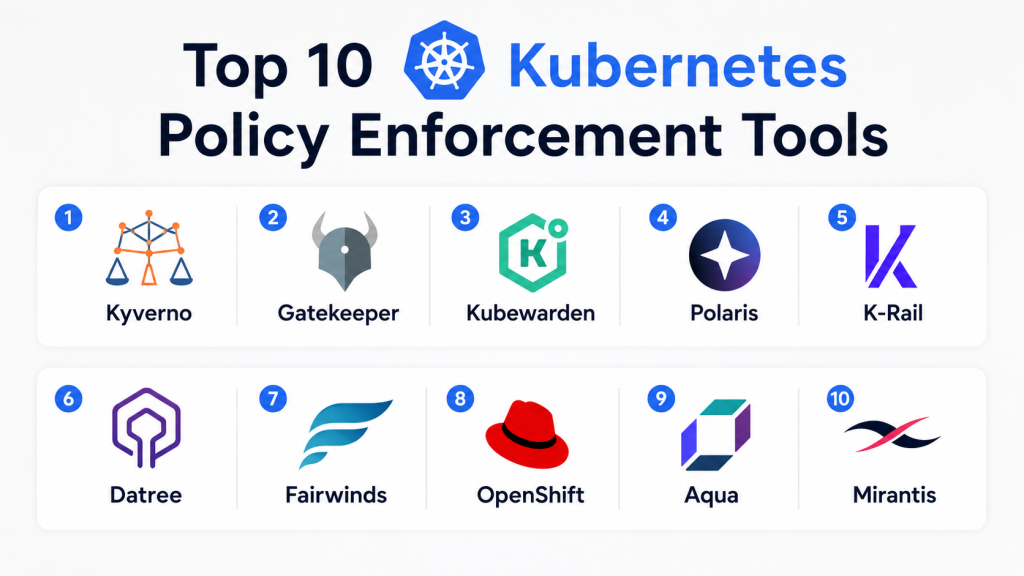
Introduction
Kubernetes policy enforcement tools help organizations define and enforce rules that control how workloads are deployed, configured, and executed inside Kubernetes clusters. These tools act as security and governance guardrails, ensuring that only compliant configurations are allowed to run in production.
In simple terms, they prevent risky or non-compliant Kubernetes resources from being deployed by validating them before or after they reach the cluster. This is essential because Kubernetes environments are highly dynamic, and even small misconfigurations can expose sensitive data, create privilege escalation risks, or lead to service outages.
Policy enforcement matters more than ever in 2026 because cloud-native adoption, multi-tenant clusters, AI workloads, and automated CI/CD pipelines have increased deployment speed significantly. Without automated guardrails, security teams cannot manually review every change.
Common real-world use cases include blocking privileged containers, enforcing resource limits, restricting unsafe images, validating network policies, enforcing compliance standards like PCI or ISO, preventing misconfigured infrastructure deployments, and applying organization-wide security baselines.
When evaluating Kubernetes policy enforcement tools, buyers should consider policy language simplicity, admission control capability, Kubernetes-native integration, multi-cluster support, CI/CD integration, performance overhead, scalability, audit reporting, security depth, developer experience, and ecosystem maturity.
Best for: Platform engineering teams, DevSecOps teams, Kubernetes administrators, cloud security engineers, SRE teams, enterprises running multi-cluster environments, and organizations enforcing compliance in cloud-native infrastructure.
Not ideal for: very small Kubernetes setups, teams without CI/CD pipelines, or organizations not using Kubernetes at scale.
Key Trends in Kubernetes Policy Enforcement Tools
- Shift-left enforcement is becoming standard with policies applied in CI/CD pipelines before deployment
- Kubernetes admission controllers are now the primary enforcement point for security policies
- YAML-based policy engines are gaining popularity due to lower learning curve
- Policy as Code is converging with GitOps workflows for version-controlled governance
- Runtime policy enforcement is growing alongside admission control validation
- AI-assisted policy generation and remediation is emerging in advanced platforms
- Multi-cluster policy management is becoming essential for enterprise Kubernetes environments
- Security posture enforcement is increasingly tied to compliance frameworks
- Policy observability and reporting dashboards are becoming standard features
- Open-source policy engines are widely adopted in cloud-native ecosystems
How We Selected These Tools
- Focused on tools designed specifically for Kubernetes policy enforcement and governance
- Included both admission control and runtime enforcement solutions
- Prioritized tools with strong DevSecOps and cloud-native adoption
- Considered Kubernetes-native integration and ease of policy adoption
- Evaluated CI/CD and GitOps compatibility for modern workflows
- Included open-source and enterprise-grade solutions for balanced coverage
- Reviewed support for YAML-based and Rego-based policy definitions
- Considered scalability across multi-cluster environments
- Focused on tools actively used in production Kubernetes environments
- Avoided generic security tools not directly focused on Kubernetes policy enforcement
Top 10 Kubernetes Policy Enforcement Tools
1- Open Policy Agent Gatekeeper
Short description: Open Policy Agent Gatekeeper is a Kubernetes admission controller that enforces policies using the Open Policy Agent framework. It enables organizations to define rules using a flexible policy language and apply them at the cluster level. It is widely used for enterprise-grade Kubernetes governance and compliance enforcement.
Key Features
- Kubernetes admission control for policy enforcement
- Rego-based policy definitions for flexible rule creation
- Validating webhook integration with Kubernetes API
- Policy templates and constraint frameworks
- Multi-namespace and cluster-wide enforcement
- Audit mode for policy evaluation without blocking
- Strong integration with cloud-native ecosystems
Pros
- Highly flexible and powerful policy engine
- Strong ecosystem adoption in Kubernetes security
- Suitable for complex enterprise governance
- Works across multi-cloud Kubernetes environments
Cons
- Steeper learning curve due to Rego language
- Requires careful policy design and testing
- Can be complex for beginners
- Requires operational management of admission controllers
Platforms / Deployment
Kubernetes. Cloud. Self-hosted.
Security & Compliance
Supports policy-based enforcement, audit logging, and compliance validation through admission control workflows. Specific certifications depend on deployment setup. Not publicly stated.
Integrations & Ecosystem
OPA Gatekeeper integrates deeply with Kubernetes and cloud-native security tooling. It is widely used in DevSecOps pipelines and policy frameworks.
- Kubernetes admission controllers
- CI/CD pipelines
- Service mesh ecosystems
- Terraform workflows
- Cloud-native security platforms
Support & Community
Strong open-source community support with CNCF backing, extensive documentation, and broad enterprise adoption.
2- Kyverno
Short description: Kyverno is a Kubernetes-native policy engine designed specifically for simplicity and ease of use. It allows policies to be written in YAML without requiring a separate policy language. It is widely used for validating, mutating, and generating Kubernetes resources.
Key Features
- YAML-based Kubernetes policy definitions
- Admission control for workload validation
- Mutation policies for automatic configuration changes
- Resource generation policies for standardization
- Policy reports for compliance visibility
- Native Kubernetes CRD integration
- CI/CD and GitOps friendly workflows
Pros
- Easy to learn compared to Rego-based tools
- Native Kubernetes experience and integration
- Supports mutation and generation policies
- Strong developer and platform team usability
Cons
- Kubernetes-focused only
- Less flexible than general-purpose policy engines
- Large-scale policy management requires discipline
- Advanced governance may need additional tooling
Platforms / Deployment
Kubernetes. Cloud. Self-hosted.
Security & Compliance
Supports admission control enforcement, policy validation, and compliance reporting. Security capabilities depend on Kubernetes configuration. Not publicly stated.
Integrations & Ecosystem
Kyverno integrates directly into Kubernetes environments and works well with GitOps and CI/CD pipelines.
- Kubernetes clusters
- Argo CD
- Flux
- CI/CD pipelines
- Container registries
Support & Community
Strong CNCF-backed open-source community with growing adoption and active documentation.
3- Kubewarden
Short description: Kubewarden is a policy engine for Kubernetes that allows policies to be written in WebAssembly modules. It focuses on security, extensibility, and performance for admission control workflows. It is useful for organizations looking for modern, language-agnostic policy enforcement.
Key Features
- WebAssembly-based policy execution
- Kubernetes admission control integration
- Language-agnostic policy development
- Lightweight runtime performance
- Policy distribution through OCI registries
- Audit and validation modes
- Extensible policy framework
Pros
- Modern and flexible policy architecture
- High performance due to WebAssembly runtime
- Language flexibility for policy development
- Good fit for cloud-native environments
Cons
- Smaller ecosystem compared to OPA and Kyverno
- Requires understanding of WebAssembly workflows
- Less mature enterprise adoption
- Limited community compared to older tools
Platforms / Deployment
Kubernetes. Cloud. Self-hosted.
Security & Compliance
Provides admission control enforcement and policy execution isolation. Security posture depends on cluster configuration. Not publicly stated.
Integrations & Ecosystem
Kubewarden integrates with Kubernetes and cloud-native infrastructure tooling.
- Kubernetes admission controllers
- OCI registries
- CI/CD pipelines
- GitOps tools
- Cloud-native platforms
Support & Community
Growing open-source community with increasing adoption in modern Kubernetes security environments.
4- Gatekeeper Library Policies
Short description: Gatekeeper Library Policies provide reusable policy templates built on Open Policy Agent Gatekeeper. They help enforce common Kubernetes security standards such as resource limits, image restrictions, and namespace controls. They are widely used as a starting point for enterprise policy enforcement.
Key Features
- Predefined policy templates for Kubernetes governance
- Reusable constraint frameworks
- Security and compliance rule sets
- Integration with OPA Gatekeeper
- Easy policy onboarding
- Standard Kubernetes best practice enforcement
- Audit and validation support
Pros
- Reduces effort to implement policies
- Based on industry best practices
- Strong alignment with OPA ecosystem
- Useful for rapid policy adoption
Cons
- Requires OPA Gatekeeper dependency
- Limited customization in default templates
- Needs tuning for enterprise environments
- Not a standalone enforcement engine
Platforms / Deployment
Kubernetes. Cloud. Self-hosted.
Security & Compliance
Supports standardized Kubernetes governance rules and compliance validation depending on implementation. Not publicly stated.
Integrations & Ecosystem
Works within OPA Gatekeeper ecosystem and Kubernetes admission control systems.
- Kubernetes clusters
- OPA Gatekeeper
- CI/CD pipelines
- DevSecOps workflows
- Cloud-native environments
Support & Community
Community-driven policy templates with strong adoption in Kubernetes governance environments.
5- K-Rail
Short description: K-Rail is a Kubernetes policy enforcement tool focused on real-time validation of workloads. It helps enforce security policies at admission time and ensures workloads meet predefined security baselines before deployment.
Key Features
- Kubernetes admission policy enforcement
- Security baseline validation
- Resource configuration checks
- Policy-driven workload control
- Integration with Kubernetes API server
- Audit logging for policy decisions
- CI/CD pipeline support
Pros
- Strong focus on security enforcement
- Simple policy validation workflows
- Good fit for compliance-driven environments
- Works directly with Kubernetes API
Cons
- Smaller ecosystem compared to OPA or Kyverno
- Limited advanced policy features
- Requires Kubernetes expertise
- Enterprise features may vary
Platforms / Deployment
Kubernetes. Self-hosted.
Security & Compliance
Provides admission control enforcement and security validation. Compliance capabilities depend on configuration. Not publicly stated.
Integrations & Ecosystem
Integrates with Kubernetes-native workflows and CI/CD pipelines.
- Kubernetes API server
- CI/CD systems
- Cloud-native security tools
- GitOps workflows
- DevSecOps pipelines
Support & Community
Community-driven support with limited enterprise backing depending on deployment.
6- Conftest
Short description: Conftest is a lightweight policy testing tool that uses Open Policy Agent to validate configuration files before deployment. It is commonly used in CI/CD pipelines to enforce infrastructure policies.
Key Features
- Policy testing for configuration files
- Rego-based policy engine integration
- CI/CD pipeline validation
- Supports Terraform, YAML, JSON, Kubernetes manifests
- Lightweight CLI-based execution
- Policy library reuse
- Pre-deployment validation
Pros
- Easy CI/CD integration
- Lightweight and fast execution
- Works well with OPA ecosystem
- Developer-friendly testing approach
Cons
- No runtime enforcement
- Requires Rego knowledge
- Limited reporting features
- Not a full Kubernetes admission controller
Platforms / Deployment
Linux. Windows. macOS. Self-hosted.
Security & Compliance
Used for pre-deployment policy validation. Security depends on policy design. Not publicly stated.
Integrations & Ecosystem
Integrates with CI/CD pipelines and infrastructure testing workflows.
- Terraform
- Kubernetes manifests
- GitHub Actions
- GitLab CI
- Jenkins
Support & Community
Open-source community with strong adoption in DevSecOps pipelines.
7- Cloud Custodian
Short description: Cloud Custodian is a policy as code tool that extends governance beyond Kubernetes into cloud environments. It is used for enforcing security, cost, and compliance policies across cloud resources.
Key Features
- Cloud governance policy automation
- YAML-based policy definitions
- Resource compliance enforcement
- Automated remediation actions
- Multi-cloud support
- Event-driven policy execution
- Audit reporting
Pros
- Strong cloud governance capabilities
- Supports automated remediation
- Useful for enterprise compliance
- Works across multiple cloud providers
Cons
- Not Kubernetes-specific
- Requires policy design expertise
- Complex setup for large environments
- May require integration layering
Platforms / Deployment
Cloud. Self-hosted.
Security & Compliance
Supports governance enforcement and audit workflows across cloud environments. Not publicly stated.
Integrations & Ecosystem
Integrates with cloud provider APIs and automation systems.
- AWS
- Azure
- Google Cloud
- Event-driven automation tools
- CI/CD pipelines
Support & Community
Open-source community support with enterprise usage in large cloud environments.
8- Polaris
Short description: Polaris is a Kubernetes policy validation tool that checks clusters for configuration best practices and security issues. It is used to ensure workloads comply with Kubernetes standards.
Key Features
- Kubernetes configuration validation
- Best practice enforcement
- Workload security checks
- Dashboard for policy insights
- CI/CD integration support
- Admission control integration
- Cluster-wide policy auditing
Pros
- Simple and easy to use
- Good Kubernetes best practices coverage
- Lightweight deployment
- Useful for baseline governance
Cons
- Limited advanced policy capabilities
- Not as flexible as OPA or Kyverno
- Smaller ecosystem
- Basic enforcement compared to enterprise tools
Platforms / Deployment
Kubernetes. Cloud.
Security & Compliance
Provides configuration validation and governance checks. Not publicly stated.
Integrations & Ecosystem
Integrates with Kubernetes clusters and CI/CD pipelines.
- Kubernetes
- CI/CD systems
- GitOps tools
- Cloud-native environments
Support & Community
Open-source community with adoption in Kubernetes governance use cases.
9- Kubescape
Short description: Kubescape is a Kubernetes security platform that provides policy enforcement, compliance checks, and risk analysis based on industry frameworks.
Key Features
- Kubernetes security posture management
- Compliance framework mapping
- Policy enforcement checks
- Cluster risk analysis
- CI/CD integration
- Vulnerability scanning support
- Continuous compliance monitoring
Pros
- Strong compliance framework coverage
- Good Kubernetes security visibility
- Easy integration with pipelines
- Useful for DevSecOps teams
Cons
- Focused mainly on Kubernetes security
- Advanced features may require setup
- Reporting can require tuning
- Smaller ecosystem than OPA
Platforms / Deployment
Kubernetes. Cloud. Self-hosted.
Security & Compliance
Supports compliance frameworks and policy enforcement. Not publicly stated for certifications.
Integrations & Ecosystem
Integrates with Kubernetes and DevSecOps pipelines.
- Kubernetes
- CI/CD tools
- GitHub Actions
- GitLab CI
- Cloud security tools
Support & Community
Strong open-source community and growing enterprise adoption.
10- Azure Policy for Kubernetes
Short description: Azure Policy for Kubernetes is a cloud-native policy enforcement tool used to manage governance rules for AKS clusters. It integrates directly with Azure Policy engine for Kubernetes workloads.
Key Features
- Kubernetes policy enforcement in Azure
- Integration with Azure Policy engine
- Admission control for AKS clusters
- Compliance monitoring
- Policy assignment at scale
- Resource governance controls
- Audit and reporting capabilities
Pros
- Native Azure integration
- Strong governance and compliance support
- Easy for Azure-first organizations
- Centralized policy management
Cons
- Limited to Azure ecosystem
- Not multi-cloud focused
- Requires Azure expertise
- Less flexible than open-source engines
Platforms / Deployment
Kubernetes. Azure Cloud.
Security & Compliance
Supports Azure governance, RBAC, and compliance frameworks. Exact certifications depend on Azure configuration.
Integrations & Ecosystem
Integrates deeply with Azure ecosystem and AKS clusters.
- Azure Kubernetes Service
- Azure Policy
- Azure Monitor
- Azure DevOps
- GitHub Actions
Support & Community
Microsoft enterprise support with strong documentation and Azure ecosystem adoption.
Comparison Table
| Tool Name | Best For | Platforms Supported | Deployment | Standout Feature | Public Rating |
|---|---|---|---|---|---|
| OPA Gatekeeper | Enterprise Kubernetes governance | Kubernetes | Cloud, Self-hosted | Flexible Rego-based policies | N/A |
| Kyverno | Kubernetes-native simplicity | Kubernetes | Cloud, Self-hosted | YAML-based policies | N/A |
| Kubewarden | Modern WebAssembly policies | Kubernetes | Cloud, Self-hosted | WebAssembly policy engine | N/A |
| Gatekeeper Library | Policy templates | Kubernetes | Cloud | Prebuilt governance rules | N/A |
| K-Rail | Admission control enforcement | Kubernetes | Self-hosted | Real-time policy validation | N/A |
| Conftest | CI/CD policy testing | Linux, macOS, Windows | Self-hosted | Lightweight policy testing | N/A |
| Cloud Custodian | Cloud governance automation | Cloud | Cloud, Self-hosted | Automated remediation policies | N/A |
| Polaris | Kubernetes best practices | Kubernetes | Cloud | Best practice validation | N/A |
| Kubescape | Kubernetes compliance | Kubernetes | Cloud, Self-hosted | Compliance framework mapping | N/A |
| Azure Policy | Azure Kubernetes governance | Kubernetes | Cloud | Native Azure policy integration | N/A |
Evaluation and Scoring of Kubernetes Policy Enforcement Tools
| Tool Name | Core 25% | Ease 15% | Integrations 15% | Security 10% | Performance 10% | Support 10% | Value 15% | Weighted Total |
|---|---|---|---|---|---|---|---|---|
| OPA Gatekeeper | 10 | 7 | 10 | 9 | 9 | 9 | 9 | 9.05 |
| Kyverno | 9 | 9 | 9 | 9 | 9 | 9 | 9 | 9.00 |
| Kubewarden | 8 | 8 | 8 | 8 | 9 | 7 | 8 | 8.10 |
| Gatekeeper Library | 8 | 9 | 8 | 8 | 8 | 8 | 9 | 8.30 |
| K-Rail | 8 | 8 | 8 | 8 | 8 | 7 | 8 | 8.00 |
| Conftest | 7 | 9 | 8 | 7 | 9 | 8 | 9 | 8.05 |
| Cloud Custodian | 8 | 7 | 8 | 9 | 8 | 8 | 9 | 8.20 |
| Polaris | 7 | 9 | 7 | 8 | 9 | 7 | 9 | 8.00 |
| Kubescape | 9 | 8 | 9 | 9 | 8 | 8 | 9 | 8.65 |
| Azure Policy | 8 | 8 | 8 | 9 | 8 | 9 | 8 | 8.40 |
These scores reflect policy depth, Kubernetes integration, ease of use, security strength, scalability, and ecosystem maturity. OPA Gatekeeper and Kyverno remain top choices for Kubernetes-native enforcement, while Kubescape and Azure Policy excel in compliance-driven environments. Conftest is strong for CI/CD validation, and Cloud Custodian extends governance into cloud resources beyond Kubernetes.
Which Kubernetes Policy Enforcement Tool Is Right for You
Solo / Freelancer
Solo developers working with Kubernetes should prioritize simplicity and quick setup. Kyverno and Polaris are the easiest to adopt, while Conftest is useful for CI/CD validation. OPA Gatekeeper may be powerful but more complex for small-scale environments.
SMB
SMBs need lightweight governance with CI/CD integration and minimal operational overhead. Kyverno, Conftest, Kubescape, and Polaris are strong choices. Cloud Custodian is useful if SMBs also manage broader cloud environments.
Mid-Market
Mid-market organizations require stronger governance, multi-cluster enforcement, and CI/CD policy automation. OPA Gatekeeper, Kyverno, Kubescape, Cloud Custodian, and Kubewarden are strong candidates depending on complexity and team expertise.
Enterprise
Enterprises need deep governance, auditability, compliance mapping, multi-cluster enforcement, and scalability. OPA Gatekeeper, Kyverno, Kubescape, Azure Policy, and Cloud Custodian are strong enterprise-grade solutions.
Budget vs Premium
Open-source tools like Kyverno, OPA Gatekeeper, Conftest, Polaris, and Kubescape offer strong value but require internal ownership. Cloud-managed or enterprise solutions provide better governance, support, and compliance automation at higher cost.
Feature Depth vs Ease of Use
OPA Gatekeeper provides maximum flexibility but requires Rego expertise. Kyverno is easier with YAML-based policies. Kubewarden offers modern flexibility with WebAssembly. Conftest is lightweight for CI/CD use. Azure Policy is easiest for Azure-native environments.
Integrations & Scalability
OPA Gatekeeper and Kyverno scale best across multi-cluster environments. Kubescape and Azure Policy offer strong enterprise integrations. Conftest fits CI/CD pipelines well. Cloud Custodian extends governance beyond Kubernetes into full cloud ecosystems.
Security & Compliance Needs
Enterprises with strict compliance requirements should prioritize Kubescape, OPA Gatekeeper, Kyverno, Azure Policy, and Cloud Custodian. These tools provide policy enforcement, audit logs, and compliance mapping needed for regulated environments.
Frequently Asked Questions FAQs
1. What is Kubernetes policy enforcement?
Kubernetes policy enforcement is the process of applying rules to control how workloads are deployed and run inside clusters. These rules ensure security, compliance, and operational consistency. They prevent unsafe configurations from reaching production. Enforcement can happen at admission time or runtime.
2. Why do Kubernetes clusters need policy enforcement?
Kubernetes clusters are highly dynamic and allow rapid deployment of workloads. Without policies, insecure configurations like privileged containers or missing resource limits can slip into production. Policy enforcement ensures guardrails are in place. This reduces risk and improves governance.
3. What is an admission controller in Kubernetes?
An admission controller is a Kubernetes component that intercepts API requests before they are stored in the cluster. Policy tools use admission controllers to validate or reject workloads. This allows enforcement of rules before deployment. It is a key mechanism for policy-based governance.
4. What is the difference between Kyverno and OPA Gatekeeper?
Kyverno uses YAML-based policies and is Kubernetes-native, making it easier to learn. OPA Gatekeeper uses Rego and offers more flexibility across systems. Kyverno is simpler for Kubernetes users, while OPA is more powerful for complex and cross-platform policies. Both are widely used in production.
5. Are policy enforcement tools only for security?
No, they are used for security, compliance, cost control, and operational consistency. They enforce resource limits, naming conventions, image policies, and deployment standards. They also help with governance and standardization across teams. Security is only one part of their purpose.
6. Do these tools affect Kubernetes performance?
Most policy tools introduce minimal overhead during admission control or runtime checks. However, poorly designed policies or large rule sets can add latency. Proper optimization and testing help maintain performance. In most production environments, the impact is negligible.
7. Can policy tools block deployments?
Yes, policy enforcement tools can block deployments that violate defined rules. For example, they can reject privileged containers or missing security labels. This helps prevent insecure workloads from reaching production. Policies can also run in audit mode without blocking.
8. What is GitOps in policy enforcement?
GitOps means managing policies as code stored in version control systems like Git. Changes are reviewed, tested, and deployed automatically. This improves transparency and traceability. Many Kubernetes policy tools support GitOps workflows.
9. What are common mistakes in Kubernetes policy enforcement?
Common mistakes include writing overly strict policies, failing to test policies before enforcement, and not involving developers in policy design. Another mistake is ignoring policy updates over time. Poor policy management can slow development or cause false positives.
10. How do organizations choose the right tool?
Organizations choose based on Kubernetes maturity, team expertise, compliance requirements, and cloud strategy. Kyverno is great for simplicity, OPA Gatekeeper for flexibility, and Kubescape or Azure Policy for compliance-heavy environments. The right choice depends on scale and governance needs.
Conclusion
Kubernetes policy enforcement tools are essential for securing modern cloud-native environments and ensuring consistent governance across clusters. They help organizations prevent misconfigurations, enforce compliance, and automate security guardrails inside fast-moving DevOps workflows. Kyverno and OPA Gatekeeper remain the most widely adopted solutions for core Kubernetes policy enforcement, while Kubescape and Azure Policy offer strong compliance-focused capabilities. Tools like Conftest and Polaris are ideal for lightweight CI/CD validation, and Cloud Custodian extends governance into broader cloud environments. The best approach is to start with a small set of critical policies, integrate them into CI/CD pipelines, test in audit mode, and gradually scale enforcement across environments to balance security and developer productivity.
