Introduction
Recommendation System Toolkits are frameworks and libraries used to build intelligent systems that suggest products, content, or actions based on user behavior, preferences, and contextual data. These tools power everything from e-commerce product recommendations to streaming suggestions and personalized marketing.
As digital platforms become more competitive, recommendation systems have become a core growth engine. They improve user engagement, increase conversions, and enable hyper-personalized experiences. Modern toolkits combine machine learning, deep learning, and real-time data pipelines to deliver highly relevant suggestions at scale.
Common use cases include:
- E-commerce product recommendations
- Streaming content suggestions
- Personalized marketing and ads
- Social media content feeds
- News and article recommendations
Key evaluation criteria:
- Algorithm support (collaborative, content-based, hybrid)
- Scalability and performance
- Real-time recommendation capabilities
- Integration with data pipelines
- Ease of model training and deployment
- Customization flexibility
- Community and ecosystem support
- Documentation and usability
Best for: Data scientists, ML engineers, AI teams, product teams, and companies building personalized user experiences.
Not ideal for: Small applications with minimal user data or systems where personalization is not a priority.
Key Trends in Recommendation System Toolkits
- Adoption of deep learning-based recommendation models
- Growth of real-time personalization systems
- Integration with vector databases and embeddings
- Use of transformer-based recommendation models
- Rise of hybrid recommendation systems
- Increased focus on privacy-aware recommendations
- Integration with streaming data pipelines
- Expansion of AutoML for recommendations
- Use of graph-based recommendation systems
- Focus on explainability and fairness in recommendations
How We Selected These Tools (Methodology)
- Evaluated industry adoption and research usage
- Assessed algorithm diversity and flexibility
- Reviewed scalability and performance
- Considered integration with ML ecosystems
- Included both open-source and enterprise-ready tools
- Analyzed community support and documentation
- Focused on production readiness
- Balanced ease of use and advanced capabilities
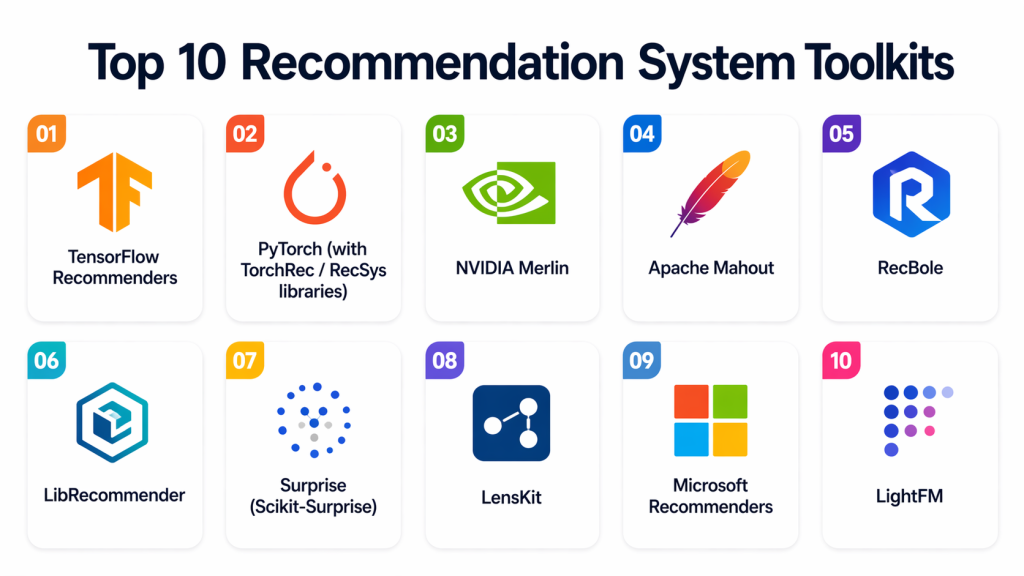
Top 10 Recommendation System Toolkits
#1 — TensorFlow Recommenders
Short description: A library built on TensorFlow designed for building scalable and flexible recommendation systems using deep learning.
Key Features
- Deep learning-based recommendation models
- Ranking and retrieval pipelines
- Integration with TensorFlow ecosystem
- Scalable training pipelines
- Customizable architectures
Pros
- Highly scalable
- Strong ecosystem
Cons
- Requires TensorFlow knowledge
- Complex setup
Platforms / Deployment
Cloud / Self-hosted
Security & Compliance
Varies
Integrations & Ecosystem
Works seamlessly with TensorFlow tools and ML pipelines.
- TensorFlow
- APIs
- Data pipelines
Support & Community
Large global community and strong documentation.
#2 — PyTorch (TorchRec)
Short description: A powerful framework for building recommendation systems using PyTorch, offering flexibility and performance.
Key Features
- Distributed training
- Embedding optimization
- Custom model building
- Scalable infrastructure
- GPU acceleration
Pros
- Highly flexible
- Strong performance
Cons
- Requires coding expertise
- Setup complexity
Platforms / Deployment
Cloud / Self-hosted
Security & Compliance
Varies
Integrations & Ecosystem
Works with PyTorch ecosystem and ML tools.
Support & Community
Very large developer community.
#3 — NVIDIA Merlin
Short description: An end-to-end recommendation system platform optimized for GPU acceleration and large-scale deployments.
Key Features
- GPU-accelerated pipelines
- Feature engineering tools
- Training and inference workflows
- Scalable architecture
- Real-time recommendations
Pros
- High performance
- End-to-end workflow
Cons
- Requires GPU infrastructure
- Learning curve
Platforms / Deployment
Cloud / Self-hosted
Security & Compliance
Not publicly stated
Integrations & Ecosystem
Works with NVIDIA ecosystem and ML tools.
Support & Community
Strong enterprise and developer support.
#4 — Apache Mahout
Short description: An open-source machine learning library that includes scalable recommendation algorithms.
Key Features
- Collaborative filtering
- Distributed processing
- Scalable algorithms
- Integration with big data tools
- Custom model support
Pros
- Open-source
- Scalable
Cons
- Outdated compared to newer tools
- Limited modern features
Platforms / Deployment
Self-hosted
Security & Compliance
Varies
Integrations & Ecosystem
Works with Hadoop ecosystem.
Support & Community
Moderate community support.
#5 — RecBole
Short description: A unified framework for evaluating and developing recommendation models with strong research support.
Key Features
- Multiple algorithms
- Benchmarking tools
- Dataset support
- Model evaluation
- Easy experimentation
Pros
- Research-friendly
- Easy benchmarking
Cons
- Not production-focused
- Limited deployment tools
Platforms / Deployment
Self-hosted
Security & Compliance
Varies
Integrations & Ecosystem
Works with Python ML ecosystem.
Support & Community
Active academic community.
#6 — LibRecommender
Short description: A Python library focused on building scalable recommendation systems with ease of use.
Key Features
- Multiple recommendation algorithms
- Easy API
- Model training tools
- Data preprocessing
- Evaluation metrics
Pros
- Beginner-friendly
- Lightweight
Cons
- Limited advanced features
- Smaller ecosystem
Platforms / Deployment
Self-hosted
Security & Compliance
Varies
Integrations & Ecosystem
Works with Python tools and APIs.
Support & Community
Growing community.
#7 — Surprise (Scikit-Surprise)
Short description: A simple and efficient library for building and analyzing recommendation systems.
Key Features
- Collaborative filtering algorithms
- Dataset tools
- Evaluation metrics
- Easy experimentation
- Lightweight design
Pros
- Easy to use
- Great for learning
Cons
- Not scalable
- Limited features
Platforms / Deployment
Self-hosted
Security & Compliance
Varies
Integrations & Ecosystem
Works with Python ecosystem.
Support & Community
Strong beginner community.
#8 — LensKit
Short description: An open-source toolkit for building, researching, and experimenting with recommendation algorithms.
Key Features
- Algorithm implementations
- Evaluation tools
- Data handling
- Experimentation framework
- Flexible design
Pros
- Research-focused
- Flexible
Cons
- Limited production use
- Smaller ecosystem
Platforms / Deployment
Self-hosted
Security & Compliance
Varies
Integrations & Ecosystem
Works with Python data tools.
Support & Community
Academic and research community.
#9 — Microsoft Recommenders
Short description: A collection of tools and best practices for building recommendation systems on Azure and open-source platforms.
Key Features
- Pre-built models
- Best practice guides
- Integration with Azure
- Scalable workflows
- Experimentation tools
Pros
- Enterprise-ready
- Well-documented
Cons
- Azure dependency
- Limited flexibility
Platforms / Deployment
Cloud / Self-hosted
Security & Compliance
Enterprise-grade cloud security
Integrations & Ecosystem
Deep integration with Microsoft ecosystem.
Support & Community
Strong enterprise support.
#10 — LightFM
Short description: A hybrid recommendation system library combining collaborative and content-based filtering.
Key Features
- Hybrid recommendation models
- Fast training
- Sparse data handling
- Flexible architecture
- Easy implementation
Pros
- Efficient
- Good for hybrid systems
Cons
- Limited scalability
- Not deep learning-based
Platforms / Deployment
Self-hosted
Security & Compliance
Varies
Integrations & Ecosystem
Works with Python ecosystem.
Support & Community
Active community.
Comparison Table (Top 10)
| Tool Name | Best For | Platform(s) Supported | Deployment | Standout Feature | Public Rating |
|---|---|---|---|---|---|
| TensorFlow Recommenders | Deep learning | Multi-platform | Hybrid | Ranking pipelines | N/A |
| PyTorch TorchRec | Custom models | Multi-platform | Hybrid | Flexibility | N/A |
| NVIDIA Merlin | Large-scale systems | Multi-platform | Hybrid | GPU acceleration | N/A |
| Apache Mahout | Big data | Multi-platform | Self-hosted | Distributed ML | N/A |
| RecBole | Research | Multi-platform | Self-hosted | Benchmarking | N/A |
| LibRecommender | Beginners | Multi-platform | Self-hosted | Easy API | N/A |
| Surprise | Learning | Multi-platform | Self-hosted | Simplicity | N/A |
| LensKit | Research | Multi-platform | Self-hosted | Experimentation | N/A |
| Microsoft Recommenders | Enterprise | Multi-platform | Hybrid | Azure integration | N/A |
| LightFM | Hybrid models | Multi-platform | Self-hosted | Hybrid filtering | N/A |
Evaluation & Scoring of Recommendation System Toolkits
| Tool Name | Core | Ease | Integrations | Security | Performance | Support | Value | Weighted Total |
|---|---|---|---|---|---|---|---|---|
| TensorFlow Recommenders | 9 | 6 | 9 | 7 | 9 | 9 | 7 | 8.3 |
| PyTorch TorchRec | 9 | 6 | 8 | 7 | 9 | 9 | 7 | 8.2 |
| NVIDIA Merlin | 9 | 7 | 8 | 7 | 10 | 8 | 6 | 8.4 |
| Apache Mahout | 7 | 6 | 7 | 6 | 7 | 7 | 8 | 7.0 |
| RecBole | 8 | 7 | 7 | 6 | 8 | 7 | 7 | 7.5 |
| LibRecommender | 7 | 8 | 6 | 6 | 7 | 6 | 8 | 7.2 |
| Surprise | 6 | 9 | 5 | 6 | 6 | 7 | 9 | 7.0 |
| LensKit | 7 | 7 | 6 | 6 | 7 | 6 | 8 | 7.1 |
| Microsoft Recommenders | 8 | 7 | 9 | 8 | 8 | 8 | 7 | 8.0 |
| LightFM | 8 | 8 | 6 | 6 | 7 | 7 | 8 | 7.5 |
How to interpret scores:
These scores provide a comparative view of each toolkit across important criteria. Higher scores indicate stronger overall capabilities, but the best choice depends on your use case. For example, enterprise teams may prioritize scalability and integrations, while smaller teams may focus on ease of use and cost efficiency.
Which Recommendation System Toolkit Is Right for You?
Solo / Freelancer
Surprise or LibRecommender are great for learning and small projects.
SMB
LightFM and RecBole offer a balance of usability and capability.
Mid-Market
TensorFlow Recommenders and PyTorch TorchRec provide scalable solutions.
Enterprise
NVIDIA Merlin and Microsoft Recommenders are ideal for large-scale deployments.
Budget vs Premium
Open-source tools are cost-effective, while enterprise solutions provide advanced capabilities.
Feature Depth vs Ease of Use
TensorFlow offers depth, while Surprise focuses on simplicity.
Integrations & Scalability
NVIDIA Merlin and TensorFlow excel in large-scale systems.
Security & Compliance Needs
Enterprises should prioritize cloud-integrated solutions with governance features.
Frequently Asked Questions (FAQs)
1. What is a recommendation system toolkit?
A recommendation system toolkit is a framework or library used to build systems that suggest relevant items to users. These tools provide algorithms, data processing pipelines, and evaluation methods to create personalized experiences.
2. What types of recommendation systems exist?
There are collaborative filtering, content-based, and hybrid recommendation systems. Modern toolkits often combine these approaches to improve accuracy and handle different types of data effectively.
3. Do I need machine learning knowledge to use these tools?
Yes, most toolkits require basic understanding of machine learning concepts. However, some tools provide simplified APIs that make it easier for beginners to get started with recommendations.
4. How are recommendations generated?
Recommendations are generated by analyzing user behavior, preferences, and item features. Models learn patterns from historical data and use them to predict what a user might like next.
5. Are these tools scalable for large applications?
Yes, many modern toolkits are designed for scalability and can handle large datasets and real-time processing. Enterprise tools offer distributed architectures for handling millions of users.
6. Can recommendation systems work in real-time?
Yes, many systems support real-time recommendations using streaming data and fast inference pipelines. This is especially important for dynamic applications like e-commerce and content platforms.
7. What data is required for recommendations?
User interaction data, item metadata, and contextual information are commonly used. The more relevant data you have, the better the recommendations will be.
8. Are recommendation systems accurate?
Accuracy depends on data quality, model selection, and tuning. With proper implementation, recommendation systems can significantly improve user engagement and satisfaction.
9. What are common challenges?
Challenges include data sparsity, cold-start problems, scalability, and maintaining recommendation quality over time. Continuous monitoring and tuning are required for optimal performance.
10. Are there alternatives to recommendation systems?
Alternatives include rule-based suggestions and manual curation, but they lack personalization and scalability compared to automated recommendation systems.
Conclusion
Recommendation System Toolkits are essential for building personalized digital experiences that drive engagement and business growth. From e-commerce to streaming platforms, these tools enable organizations to deliver relevant content and suggestions at scale. There is no single best toolkit for all scenarios. Developers may prefer flexible frameworks like TensorFlow Recommenders or PyTorch TorchRec, while enterprises may benefit from platforms like NVIDIA Merlin or Microsoft Recommenders. Smaller teams can start with simpler tools like Surprise or LibRecommender. The right choice depends on your data, scale, and technical expertise. Focus on tools that align with your infrastructure and long-term goals. Start by experimenting with a few toolkits, build prototypes, and evaluate performance. Validate scalability and accuracy before moving to production to ensure long-term success.
