Introduction
Data Quality Tools are specialized solutions that help organizations ensure data accuracy, consistency, completeness, and reliability across systems. These tools monitor, cleanse, validate, and enrich data so that it can be trusted for analytics, reporting, and operational decision-making.
In modern data-driven environments, poor data quality leads to incorrect insights, failed AI models, compliance risks, and revenue loss. With increasing adoption of cloud data warehouses, real-time pipelines, and AI applications, maintaining high-quality data has become critical. Data quality tools now offer automated validation, anomaly detection, AI-driven monitoring, and integration with modern data stacks.
Real-world use cases:
- Detecting and fixing inaccurate or duplicate data
- Monitoring data pipelines for anomalies
- Ensuring compliance with data governance standards
- Improving analytics and reporting accuracy
- Supporting machine learning and AI workflows
What buyers should evaluate:
- Data profiling and validation capabilities
- Integration with data warehouses and pipelines
- Automation and anomaly detection features
- Data cleansing and enrichment tools
- Real-time vs batch monitoring
- Scalability across datasets
- Ease of use and UI experience
- API and extensibility
- Governance and compliance features
- Pricing and deployment flexibility
Best for: Data engineers, analytics teams, data scientists, and enterprises managing large-scale data environments
Not ideal for: Organizations with minimal data usage or simple datasets
Key Trends in Data Quality Tools
- AI-driven anomaly detection and monitoring
- Real-time data quality validation
- Integration with modern data stacks and warehouses
- Data observability platforms gaining traction
- Automation of data quality workflows
- Embedded data quality in pipelines
- Focus on data governance and compliance
- Low-code and no-code interfaces
- Integration with BI and analytics tools
- Expansion into data reliability engineering
How We Selected These Tools Methodology
- Market adoption and industry recognition
- Coverage across data quality lifecycle
- Integration with modern data platforms
- Strength of validation and monitoring features
- Automation and analytics capabilities
- Scalability across large datasets
- Ease of deployment and usability
- Vendor innovation and maturity
- Support and documentation quality
- Fit across SMB and enterprise use cases
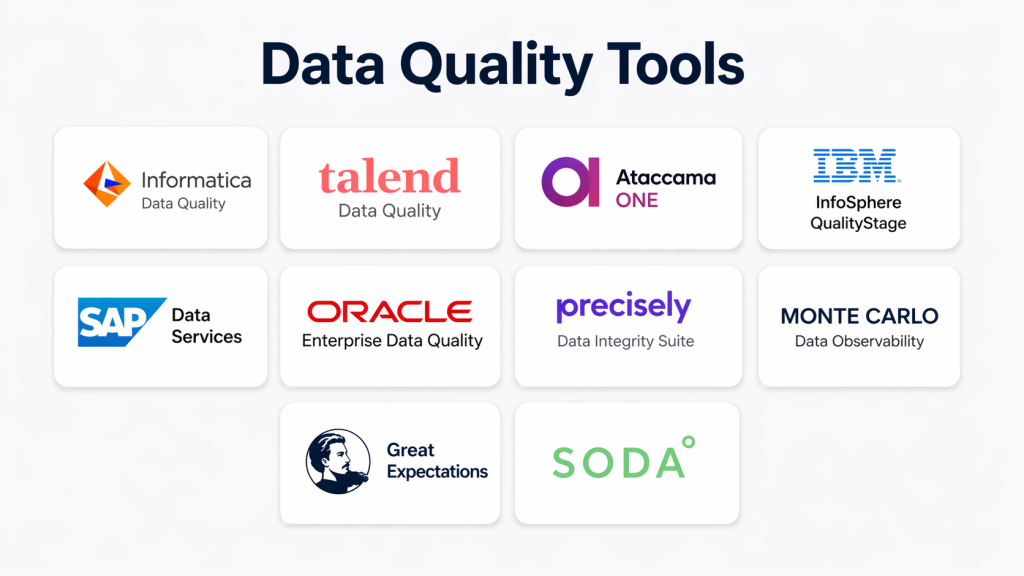
Top 10 Data Quality Tools
#1 — Informatica Data Quality
Short description:
Informatica Data Quality is an enterprise-grade platform for profiling, cleansing, and validating data. It supports large-scale data environments. It offers automation and monitoring. It integrates with enterprise systems. It is highly scalable. It is widely used by large organizations.
Key Features
- Data profiling
- Data cleansing
- Validation rules
- Monitoring
- Integration
Pros
- Comprehensive capabilities
- Scalable for enterprises
- Strong ecosystem
Cons
- Complex setup
- Expensive
Platforms / Deployment
- Cloud / On-prem
Security & Compliance
- RBAC
- Compliance Not publicly stated
Integrations & Ecosystem
Integrates with enterprise data platforms and analytics tools.
- Data warehouses
- BI tools
- APIs
Support & Community
Strong enterprise support and global presence.
#2 — Talend Data Quality
Short description:
Talend Data Quality provides tools for profiling, cleansing, and monitoring data. It integrates with Talend pipelines. It supports automation. It is scalable. It offers open-source flexibility. It is widely used.
Key Features
- Data profiling
- Cleansing
- Monitoring
- Integration
- Automation
Pros
- Open-source option
- Flexible
- Scalable
Cons
- Learning curve
- Complex interface
Platforms / Deployment
- Cloud / Hybrid
Security & Compliance
- RBAC
- Compliance Not publicly stated
Integrations & Ecosystem
Talend integrates with data pipelines and cloud platforms.
- Data warehouses
- APIs
Support & Community
Active community and enterprise support.
#3 — Ataccama ONE
Short description:
Ataccama ONE is a unified data quality and governance platform. It offers AI-driven data monitoring. It supports automation and workflows. It integrates with enterprise systems. It is scalable. It is suitable for large organizations.
Key Features
- AI-driven monitoring
- Data profiling
- Automation
- Integration
- Governance
Pros
- Strong automation
- Scalable
- Advanced features
Cons
- Cost
- Complex setup
Platforms / Deployment
- Cloud
Security & Compliance
- RBAC
- Compliance Not publicly stated
Integrations & Ecosystem
Supports integration with enterprise data platforms and APIs.
- Data systems
- APIs
Support & Community
Enterprise support with growing adoption.
#4 — IBM InfoSphere QualityStage
Short description:
IBM QualityStage provides data cleansing and matching capabilities. It supports large-scale data processing. It integrates with IBM ecosystem. It offers strong reliability. It is scalable. It is suitable for enterprises.
Key Features
- Data matching
- Cleansing
- Integration
- Monitoring
- Reporting
Pros
- Strong reliability
- Scalable
- Enterprise-ready
Cons
- Complex
- Expensive
Platforms / Deployment
- On-prem / Cloud
Security & Compliance
- RBAC
- Compliance Not publicly stated
Integrations & Ecosystem
Integrates with IBM data and analytics tools.
- Data platforms
- APIs
Support & Community
Enterprise-level support.
#5 — SAP Data Services
Short description:
SAP Data Services provides data quality and integration capabilities. It supports profiling and cleansing. It integrates with SAP systems. It is scalable. It offers strong enterprise features.
Key Features
- Data integration
- Profiling
- Cleansing
- Monitoring
- Reporting
Pros
- Strong SAP integration
- Scalable
- Reliable
Cons
- Complex
- Cost
Platforms / Deployment
- Cloud / On-prem
Security & Compliance
- RBAC
- Compliance Not publicly stated
Integrations & Ecosystem
Integrates with SAP and enterprise systems.
- ERP systems
- APIs
Support & Community
Enterprise support available.
#6 — Oracle Enterprise Data Quality
Short description:
Oracle Enterprise Data Quality provides tools for profiling and cleansing data. It supports monitoring and validation. It integrates with Oracle ecosystem. It is scalable. It offers strong performance.
Key Features
- Data profiling
- Cleansing
- Monitoring
- Integration
- Reporting
Pros
- Strong performance
- Scalable
- Reliable
Cons
- Complex
- Cost
Platforms / Deployment
- Cloud / On-prem
Security & Compliance
- RBAC
- Compliance Not publicly stated
Integrations & Ecosystem
Integrates with Oracle databases and applications.
- Databases
- APIs
Support & Community
Enterprise-level support.
#7 — Precisely Data Integrity Suite
Short description:
Precisely provides data quality and integrity solutions with strong governance features. It supports data monitoring and validation. It integrates with enterprise systems. It is scalable. It provides reliable performance.
Key Features
- Data validation
- Monitoring
- Integration
- Governance
- Reporting
Pros
- Strong governance
- Scalable
- Reliable
Cons
- Complex
- Cost
Platforms / Deployment
- Cloud
Security & Compliance
- RBAC
- Compliance Not publicly stated
Integrations & Ecosystem
Supports integration with enterprise systems and APIs.
- Data platforms
- APIs
Support & Community
Enterprise support available.
#8 — Monte Carlo Data Observability
Short description:
Monte Carlo focuses on data observability and quality monitoring. It detects anomalies in data pipelines. It provides alerts and insights. It integrates with modern data stacks. It is scalable.
Key Features
- Data observability
- Anomaly detection
- Monitoring
- Integration
- Alerts
Pros
- Strong monitoring
- Easy to use
- Scalable
Cons
- Limited cleansing features
- Cost
Platforms / Deployment
- Cloud
Security & Compliance
- RBAC
- Compliance Not publicly stated
Integrations & Ecosystem
Integrates with modern data warehouses and tools.
- Data warehouses
- APIs
Support & Community
Growing ecosystem with good documentation.
#9 — Great Expectations
Short description:
Great Expectations is an open-source data quality tool for validation and testing. It allows users to define data expectations. It integrates with pipelines. It is flexible. It is widely used by developers.
Key Features
- Data validation
- Testing framework
- Integration
- Automation
- Reporting
Pros
- Open-source
- Flexible
- Developer-friendly
Cons
- Requires setup
- Limited UI
Platforms / Deployment
- Cloud / Self-hosted
Security & Compliance
- Not publicly stated
Integrations & Ecosystem
Supports integration with data pipelines and tools.
- Data pipelines
- APIs
Support & Community
Strong open-source community.
#10 — Soda
Short description:
Soda provides data quality monitoring with a focus on observability. It detects anomalies and issues. It integrates with modern data stacks. It is scalable. It is easy to use.
Key Features
- Data monitoring
- Anomaly detection
- Integration
- Reporting
- Alerts
Pros
- Easy to use
- Scalable
- Flexible
Cons
- Limited advanced features
- Smaller ecosystem
Platforms / Deployment
- Cloud
Security & Compliance
- RBAC
- Compliance Not publicly stated
Integrations & Ecosystem
Integrates with modern data tools and APIs.
- Data warehouses
- APIs
Support & Community
Growing community and support.
Comparison Table
| Tool | Best For | Platform | Deployment | Standout Feature | Rating |
|---|---|---|---|---|---|
| Informatica | Enterprise | Multi | Hybrid | Full suite | N/A |
| Talend | SMB | Multi | Hybrid | Open-source | N/A |
| Ataccama | Enterprise | Cloud | Cloud | AI automation | N/A |
| IBM | Enterprise | Multi | Hybrid | Matching | N/A |
| SAP | Enterprise | Multi | Hybrid | SAP integration | N/A |
| Oracle | Enterprise | Multi | Hybrid | Performance | N/A |
| Precisely | Enterprise | Cloud | Cloud | Governance | N/A |
| Monte Carlo | Modern data | Cloud | Cloud | Observability | N/A |
| Great Expectations | Devs | Multi | Hybrid | Testing | N/A |
| Soda | SMB | Cloud | Cloud | Monitoring | N/A |
Evaluation & Scoring of Data Quality Tools
| Tool | Core | Ease | Integration | Security | Performance | Support | Value | Weighted Total |
|---|---|---|---|---|---|---|---|---|
| Informatica | 10 | 7 | 9 | 10 | 9 | 9 | 7 | 8.9 |
| Talend | 9 | 8 | 9 | 9 | 8 | 8 | 8 | 8.5 |
| Ataccama | 9 | 7 | 8 | 9 | 9 | 8 | 8 | 8.4 |
| IBM | 9 | 7 | 8 | 9 | 9 | 8 | 7 | 8.2 |
| SAP | 9 | 7 | 8 | 9 | 8 | 8 | 7 | 8.1 |
| Oracle | 9 | 7 | 8 | 9 | 9 | 8 | 7 | 8.2 |
| Precisely | 9 | 7 | 8 | 9 | 8 | 8 | 7 | 8.1 |
| Monte Carlo | 8 | 9 | 8 | 8 | 9 | 8 | 8 | 8.4 |
| Great Expectations | 8 | 7 | 9 | 8 | 8 | 7 | 9 | 8.1 |
| Soda | 8 | 9 | 8 | 8 | 8 | 7 | 9 | 8.3 |
Scoring is comparative and based on capabilities, usability, integrations, and value. Higher scores indicate stronger overall offerings, but the best tool depends on specific business needs and use cases.
Which Data Quality Tool Is Right for You
Solo / Freelancer
- Great Expectations
SMB
- Soda
Mid-Market
- Talend, Monte Carlo
Enterprise
- Informatica, Ataccama, SAP
Budget vs Premium
- Budget option is Great Expectations
- Premium option is Informatica
Feature Depth vs Ease of Use
- Easy option is Soda
- Advanced option is Informatica
Integrations & Scalability
- Strong integration offered by Talend
Security & Compliance Needs
- Enterprise-grade option is Informatica
Frequently Asked Questions
1. What are Data Quality Tools
Data quality tools are solutions that help organizations maintain accurate and reliable data. They identify errors and inconsistencies. They ensure data is usable for analytics. They improve decision-making.
2. Why are Data Quality Tools important
Poor data leads to incorrect insights and business risks. These tools help maintain accuracy. They improve reporting and analytics. They ensure compliance and trust.
3. How do Data Quality Tools work
They scan and validate datasets. They apply rules and checks. They detect anomalies. They provide alerts and reports.
4. Who should use Data Quality Tools
Data engineers, analysts, and enterprises use these tools. Organizations with large datasets benefit most. They help improve data reliability.
5. Are Data Quality Tools scalable
Yes, they support large datasets and cloud environments. They scale with business growth. They ensure consistent data quality across systems.
6. Do Data Quality Tools integrate with other tools
Yes, they integrate with data warehouses, pipelines, and analytics platforms. This improves workflows. It ensures seamless data management.
7. Are Data Quality Tools secure
They include access controls and monitoring. They ensure data protection. Proper configuration improves security. They reduce data risks.
8. Are Data Quality Tools difficult to implement
Some tools are easy to use while others require expertise. Setup depends on complexity. Proper planning ensures success.
9. What are alternatives to Data Quality Tools
Alternatives include manual validation and ETL tools. However, they are less efficient. Data quality tools provide automation and accuracy.
10. Are Data Quality Tools expensive
Pricing varies by features and scale. Open-source options are available. Enterprise tools can be costly. Investment depends on needs.
Conclusion
Data Quality Tools play a crucial role in ensuring that organizations can trust their data for analytics, reporting, and decision-making. As businesses increasingly rely on data-driven strategies, maintaining high data quality is no longer optional but essential. These tools help automate validation, detect anomalies, and ensure consistency across complex data environments. Choosing the right data quality solution depends on your organization’s scale, technical expertise, and integration requirements. Enterprise platforms like Informatica and Ataccama offer comprehensive capabilities, while tools like Soda and Great Expectations provide flexibility and ease of use for smaller teams. The best approach is to shortlist a few tools, test them in real-world scenarios, and ensure they align with your data strategy before making a final decision.
