Introduction
AIOps (Artificial Intelligence for IT Operations) platforms are advanced systems that use AI, machine learning, and big data analytics to automate and enhance IT operations. These tools collect and analyze massive volumes of telemetry data—logs, metrics, and events—to detect anomalies, predict issues, and automate responses in real time.
In modern IT environments where systems are distributed across cloud, hybrid, and microservices architectures, traditional monitoring tools struggle to keep up. AIOps platforms go beyond simple alerting—they correlate events, reduce noise, and often resolve issues automatically before users are impacted.
Common use cases include:
- Predictive incident detection and prevention
- Automated root cause analysis
- Alert noise reduction and event correlation
- Infrastructure and application performance optimization
- Automated incident response and remediation
Key evaluation criteria:
- AI/ML capabilities and anomaly detection
- Event correlation and noise reduction
- Automation and self-healing capabilities
- Integration with DevOps, ITSM, and observability tools
- Scalability across hybrid and cloud environments
- Ease of use and implementation
- Security and compliance features
- Cost and ROI
Best for: DevOps teams, SREs, IT operations, and enterprises managing large-scale, complex systems.
Not ideal for: Small teams with simple infrastructure or environments where basic monitoring tools are sufficient.
Key Trends in AIOps Platforms
- AI-driven root cause analysis and predictive analytics
- Autonomous remediation and self-healing systems
- Integration with observability (logs, metrics, traces)
- Generative AI for incident insights and automation
- Reduction of alert fatigue through intelligent filtering
- Real-time event correlation across systems
- API-first and extensible architectures
- Cross-cloud and hybrid environment support
- ChatOps and AI-assisted operations
- Convergence of AIOps with observability platforms
How We Selected These Tools (Methodology)
- Strong market adoption and enterprise relevance
- Feature depth in AI-driven analytics and automation
- Proven scalability and reliability
- Integration ecosystem with DevOps and ITSM tools
- Security and governance capabilities
- Ease of onboarding and usability
- Documentation and support quality
- Flexibility across environments
- Balance between enterprise and cloud-native platforms
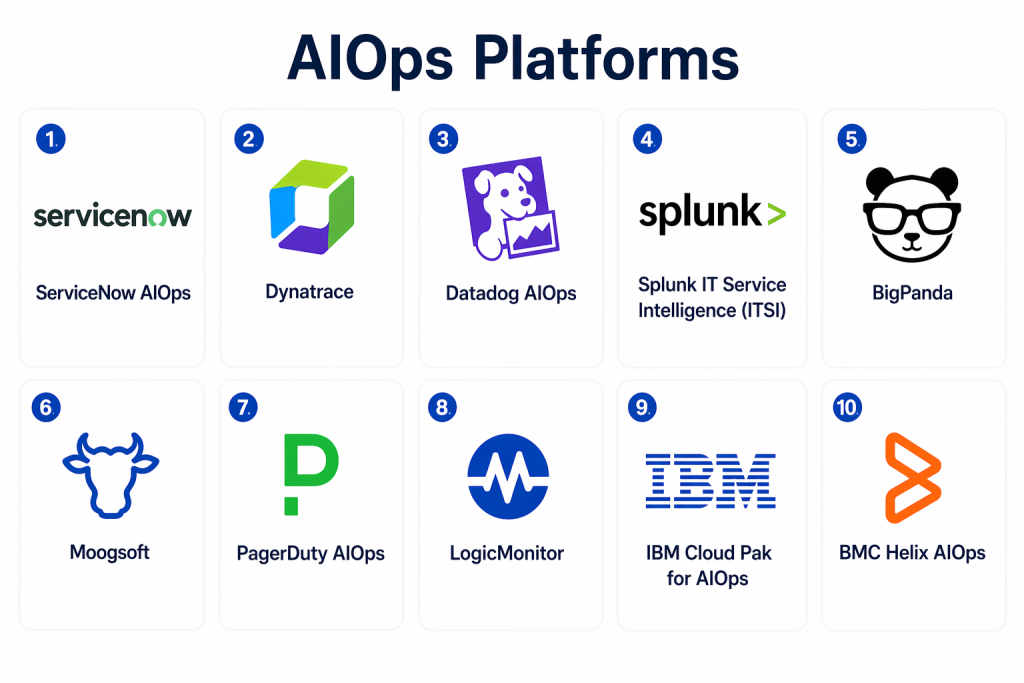
Top 10 AIOps Platforms Tools
#1 — ServiceNow AIOps
Short description: ServiceNow AIOps integrates AI-driven operations into its ITSM platform, enabling automated incident detection and resolution.
Key Features
- Event correlation and noise reduction
- Predictive analytics
- Automated workflows
- Integration with ITSM
- Root cause analysis
Pros
- Strong enterprise integration
- Unified IT operations platform
Cons
- Expensive
- Complex setup
Platforms / Deployment
- Cloud
Security & Compliance
- RBAC, audit logs
- Not publicly stated
Integrations & Ecosystem
- ITSM tools
- DevOps platforms
- APIs
Support & Community
Strong enterprise support.
#2 — Dynatrace
Short description: Dynatrace offers AI-powered observability with automated root cause analysis and performance monitoring.
Key Features
- AI-driven anomaly detection
- Full-stack observability
- Automated root cause analysis
- Real-time insights
- Cloud-native support
Pros
- Advanced automation
- Deep visibility
Cons
- High cost
- Learning curve
Platforms / Deployment
- Cloud / Hybrid
Security & Compliance
- Not publicly stated
Integrations & Ecosystem
- Kubernetes
- Cloud platforms
- APIs
Support & Community
Enterprise-grade support.
#3 — Datadog AIOps
Short description: Datadog provides AIOps capabilities within its observability platform, offering anomaly detection and predictive insights.
Key Features
- AI-based alerting
- Event correlation
- Performance forecasting
- Unified monitoring
- Automation workflows
Pros
- Strong integration ecosystem
- Easy to deploy
Cons
- Pricing complexity
- Vendor lock-in
Platforms / Deployment
- Cloud
Security & Compliance
- Not publicly stated
Integrations & Ecosystem
- AWS
- Azure
- Kubernetes
- APIs
Support & Community
Strong documentation and support.
#4 — Splunk AIOps
Short description: Splunk uses machine data analytics and AI to provide predictive insights and automated operations.
Key Features
- Log analytics
- AI-based anomaly detection
- Event correlation
- Predictive analytics
- Automation
Pros
- Powerful analytics
- Enterprise scalability
Cons
- Expensive
- Complex setup
Platforms / Deployment
- Cloud / Hybrid
Security & Compliance
- Not publicly stated
Integrations & Ecosystem
- DevOps tools
- APIs
Support & Community
Strong enterprise support.
#5 — BigPanda
Short description: BigPanda focuses on event correlation and alert noise reduction using machine learning.
Key Features
- Event correlation
- Alert deduplication
- Incident prioritization
- Analytics
- Integration support
Pros
- Reduces alert fatigue
- Easy integration
Cons
- Limited full-stack monitoring
- Requires integration setup
Platforms / Deployment
- Cloud
Security & Compliance
- Not publicly stated
Integrations & Ecosystem
- Monitoring tools
- APIs
Support & Community
Growing enterprise adoption.
#6 — Moogsoft
Short description: Moogsoft is a pioneer in AIOps, offering AI-driven incident management and automation.
Key Features
- AI-based anomaly detection
- Event correlation
- Incident automation
- Root cause analysis
- Analytics
Pros
- Strong AIOps focus
- Mature platform
Cons
- Complex deployment
- Pricing
Platforms / Deployment
- Cloud / Hybrid
Security & Compliance
- Not publicly stated
Integrations & Ecosystem
- DevOps tools
- APIs
Support & Community
Established presence in AIOps market.
#7 — PagerDuty AIOps
Short description: PagerDuty combines incident management with AI-driven event intelligence and automation.
Key Features
- Event intelligence
- Automated incident response
- Alert prioritization
- Analytics
- Workflow automation
Pros
- Strong incident management
- Easy integration
Cons
- Limited full observability
- Pricing
Platforms / Deployment
- Cloud
Security & Compliance
- Not publicly stated
Integrations & Ecosystem
- Monitoring tools
- APIs
Support & Community
Strong enterprise support.
#8 — LogicMonitor
Short description: LogicMonitor provides AIOps-driven monitoring and automation for hybrid IT environments.
Key Features
- AI-driven monitoring
- Anomaly detection
- Automated alerts
- Performance analytics
- Cloud monitoring
Pros
- Easy deployment
- Good scalability
Cons
- Limited customization
- Pricing
Platforms / Deployment
- Cloud
Security & Compliance
- Not publicly stated
Integrations & Ecosystem
- Cloud platforms
- APIs
Support & Community
Good support and documentation.
#9 — AppDynamics (Cisco)
Short description: AppDynamics offers AIOps capabilities integrated with application performance monitoring.
Key Features
- Business transaction monitoring
- AI-based insights
- Root cause analysis
- Performance analytics
- Automation
Pros
- Strong business insights
- Enterprise-ready
Cons
- Expensive
- Complex
Platforms / Deployment
- Cloud / Hybrid
Security & Compliance
- Not publicly stated
Integrations & Ecosystem
- Enterprise tools
- APIs
Support & Community
Strong enterprise support.
#10 — OpsRamp
Short description: OpsRamp provides AIOps-driven IT operations management with unified monitoring and automation.
Key Features
- Event correlation
- Automation workflows
- Service mapping
- Analytics
- Multi-cloud support
Pros
- Unified platform
- Strong automation
Cons
- Learning curve
- Smaller ecosystem
Platforms / Deployment
- Cloud / Hybrid
Security & Compliance
- Not publicly stated
Integrations & Ecosystem
- Cloud platforms
- APIs
Support & Community
Growing enterprise adoption.
Comparison Table (Top 10)
| Tool Name | Best For | Platform(s) Supported | Deployment | Standout Feature | Public Rating |
|---|---|---|---|---|---|
| ServiceNow | Enterprise ITSM | Web | Cloud | ITSM + AIOps | N/A |
| Dynatrace | AI observability | Web | Hybrid | AI root cause analysis | N/A |
| Datadog | Cloud monitoring | Web | Cloud | Unified observability | N/A |
| Splunk | Analytics | Web | Hybrid | Data analytics | N/A |
| BigPanda | Alert reduction | Web | Cloud | Event correlation | N/A |
| Moogsoft | AIOps pioneer | Web | Hybrid | AI automation | N/A |
| PagerDuty | Incident response | Web | Cloud | Event intelligence | N/A |
| LogicMonitor | Hybrid IT | Web | Cloud | AI monitoring | N/A |
| AppDynamics | Enterprise apps | Web | Hybrid | Business insights | N/A |
| OpsRamp | Multi-cloud | Web | Hybrid | Service mapping | N/A |
Evaluation & Scoring of AIOps Platforms
| Tool Name | Core | Ease | Integrations | Security | Performance | Support | Value | Weighted Total |
|---|---|---|---|---|---|---|---|---|
| ServiceNow | 10 | 7 | 10 | 9 | 10 | 9 | 6 | 8.9 |
| Dynatrace | 10 | 7 | 9 | 8 | 10 | 9 | 7 | 8.8 |
| Datadog | 9 | 8 | 10 | 8 | 9 | 9 | 7 | 8.6 |
| Splunk | 9 | 7 | 9 | 8 | 9 | 9 | 6 | 8.4 |
| BigPanda | 8 | 8 | 8 | 7 | 8 | 8 | 8 | 8.0 |
| Moogsoft | 9 | 7 | 8 | 7 | 9 | 8 | 7 | 8.1 |
| PagerDuty | 9 | 8 | 9 | 8 | 9 | 9 | 7 | 8.5 |
| LogicMonitor | 8 | 8 | 8 | 7 | 8 | 8 | 8 | 8.0 |
| AppDynamics | 9 | 7 | 9 | 8 | 9 | 9 | 6 | 8.3 |
| OpsRamp | 8 | 7 | 8 | 7 | 8 | 8 | 8 | 7.9 |
Interpretation:
These scores reflect comparative performance across automation, usability, integrations, and value. Enterprise tools score higher in scalability and analytics, while mid-market tools balance usability and cost. AIOps platforms are best evaluated based on how well they reduce alert noise and automate operations rather than just monitoring capabilities.
Which AIOps Platform Is Right for You?
Solo / Freelancer
Basic monitoring tools are usually sufficient; AIOps may be overkill.
SMB
LogicMonitor or Datadog provide ease of use and strong capabilities.
Mid-Market
BigPanda or PagerDuty offer balanced automation and integration.
Enterprise
ServiceNow, Dynatrace, or Splunk provide scalability and advanced AI capabilities.
Budget vs Premium
Premium tools offer automation and predictive analytics; lighter tools reduce cost.
Feature Depth vs Ease of Use
Advanced platforms provide deeper insights but require expertise.
Integrations & Scalability
Choose tools that integrate with your DevOps, ITSM, and cloud platforms.
Security & Compliance Needs
Enterprises should prioritize governance, RBAC, and audit logging.
Frequently Asked Questions (FAQs)
1. What is an AIOps platform?
AIOps platforms use AI and machine learning to automate IT operations, analyze data, and improve system reliability.
2. How is AIOps different from monitoring tools?
Traditional tools detect issues, while AIOps predicts, correlates, and often resolves them automatically.
3. Can AIOps reduce downtime?
Yes, by detecting anomalies early and automating responses, it reduces outages and MTTR.
4. Is AIOps expensive?
Costs vary; enterprise solutions can be expensive, but ROI is high due to automation.
5. What integrations are important?
ITSM tools, DevOps pipelines, cloud platforms, and observability tools.
6. Does AIOps replace DevOps?
No, it enhances DevOps by automating repetitive operational tasks.
7. Can AIOps work in hybrid environments?
Yes, most platforms support cloud, on-prem, and hybrid systems.
8. Is AIOps secure?
Security varies; enterprise tools provide stronger governance and controls.
9. What are the main benefits?
Reduced alert fatigue, faster resolution, predictive insights, and automation.
10. Is implementation difficult?
Initial setup can be complex, but long-term benefits outweigh the effort.
Conclusion
AIOps platforms are transforming how modern IT operations are managed by shifting from reactive monitoring to proactive and autonomous systems. By leveraging AI, machine learning, and advanced analytics, these tools help teams detect issues earlier, reduce alert noise, and automate incident resolution, significantly improving operational efficiency. As IT environments continue to grow in complexity, relying solely on traditional monitoring approaches is no longer sufficient. AIOps provides the intelligence needed to correlate events across systems and deliver actionable insights in real time. While enterprise platforms offer deep analytics and scalability, mid-market solutions provide a balance between usability and cost. The right platform depends on your infrastructure complexity, team expertise, and automation goals. It is essential to evaluate integration capabilities, scalability, and ease of use before making a decision. Start by identifying operational pain points, shortlist a few platforms, and test them in real-world scenarios. A well-implemented AIOps solution can dramatically improve reliability, reduce downtime, and enable smarter, more efficient IT operations.
