Introduction
Distributed Tracing Tools are observability solutions that track how a single request travels across multiple services in a distributed system. In modern architectures—especially microservices and cloud-native environments—one user action often triggers dozens of service interactions. Distributed tracing assigns a unique identifier to each request, allowing teams to follow its path and understand how each component contributes to performance and latency.
These tools are essential because traditional logs and metrics alone cannot explain where delays or failures originate. Distributed tracing connects these signals, helping teams identify bottlenecks, debug errors, and optimize system performance across services.
Common use cases include:
- Debugging latency issues in microservices
- Root cause analysis of failures
- Monitoring service dependencies
- Performance optimization across distributed systems
- Supporting DevOps and SRE observability
Key evaluation criteria:
- Trace collection and visualization
- OpenTelemetry support
- Scalability and storage efficiency
- Integration with logs and metrics
- Real-time analytics and alerting
- Ease of deployment and setup
- Security and access control
- Cost efficiency
Best for: DevOps teams, SREs, backend engineers, and organizations running microservices or distributed systems.
Not ideal for: Monolithic applications or systems with minimal service complexity.
Key Trends in Distributed Tracing Tools
- OpenTelemetry becoming the standard for instrumentation
- AI-assisted root cause analysis and anomaly detection
- Convergence of logs, metrics, and traces into unified observability
- Increased adoption of cloud-native and Kubernetes-based tracing
- Real-time trace analytics and visualization improvements
- Cost optimization via sampling and storage strategies
- API-first and extensible tracing platforms
- Increased demand for high-scale, low-cost trace storage
- Developer-friendly debugging workflows
- Integration with security monitoring and compliance tools
How We Selected These Tools (Methodology)
- Industry adoption and community support
- Feature completeness (tracing, visualization, analytics)
- Compatibility with OpenTelemetry standards
- Performance and scalability
- Integration ecosystem with DevOps tools
- Ease of deployment and usability
- Flexibility for cloud and on-prem environments
- Balance between open-source and enterprise tools
- Reliability and production readiness
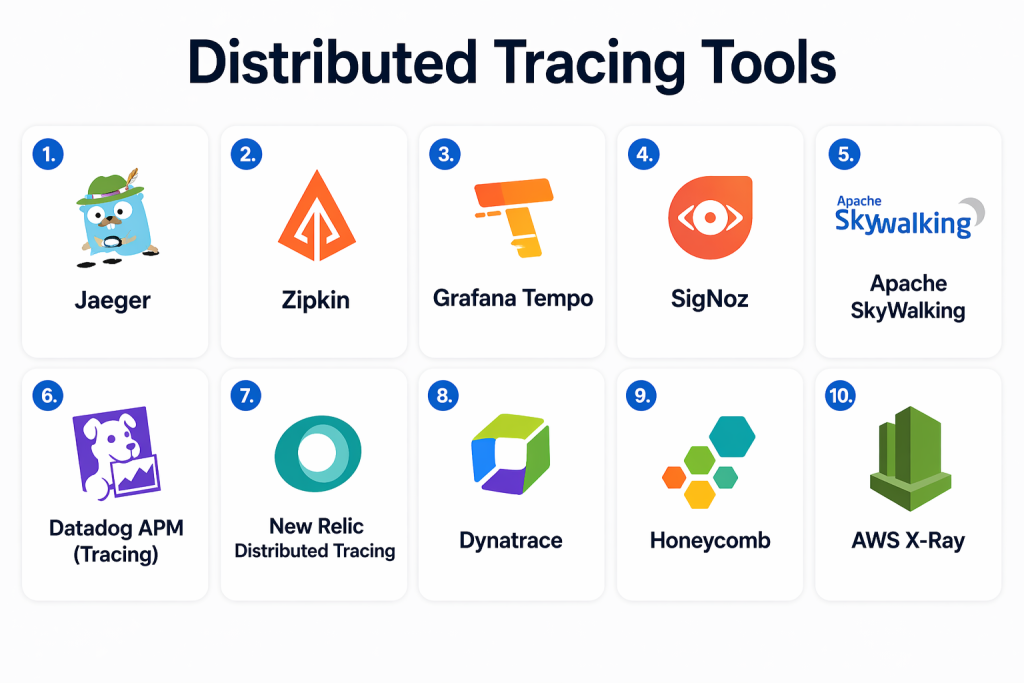
Top 10 Distributed Tracing Tools Tools
#1 — Jaeger
Short description: Jaeger is a widely adopted open-source distributed tracing system designed for monitoring and troubleshooting microservices architectures.
Key Features
- End-to-end distributed tracing
- Service dependency mapping
- Trace visualization
- Adaptive sampling
- OpenTelemetry support
- Scalable storage options
Pros
- Battle-tested and reliable
- Strong open-source ecosystem
Cons
- Limited advanced analytics
- UI can feel basic
Platforms / Deployment
- Cloud / Self-hosted
Security & Compliance
- Not publicly stated
Integrations & Ecosystem
Jaeger integrates with modern observability stacks.
- OpenTelemetry
- Kubernetes
- Prometheus
- APIs
Support & Community
Very strong open-source community and documentation.
#2 — Zipkin
Short description: Zipkin is one of the earliest distributed tracing tools, known for its simplicity and ease of deployment.
Key Features
- Trace collection and visualization
- Lightweight architecture
- Service-level insights
- Simple UI
- Open-source
Pros
- Easy to set up
- Minimal resource usage
Cons
- Limited scalability
- Basic analytics
Platforms / Deployment
- Self-hosted
Security & Compliance
- Not publicly stated
Integrations & Ecosystem
- OpenTelemetry
- APIs
- Databases
Support & Community
Strong legacy community support.
#3 — Grafana Tempo
Short description: Grafana Tempo is a scalable tracing backend optimized for cost-efficient storage and integration with Grafana dashboards.
Key Features
- High-scale trace storage
- Integration with Grafana
- OpenTelemetry support
- No indexing architecture
- Metrics correlation
Pros
- Cost-efficient
- Scales easily
Cons
- Limited advanced querying
- Requires external tools for analysis
Platforms / Deployment
- Cloud / Self-hosted
Security & Compliance
- Not publicly stated
Integrations & Ecosystem
- Grafana
- Prometheus
- Loki
- APIs
Support & Community
Growing community with strong ecosystem support.
#4 — SigNoz
Short description: SigNoz is an open-source observability platform combining traces, logs, and metrics in a unified interface.
Key Features
- Distributed tracing
- Unified observability
- OpenTelemetry-native
- Real-time analytics
- Visualization dashboards
Pros
- Modern UI
- All-in-one platform
Cons
- Limited enterprise features
- Still evolving
Platforms / Deployment
- Cloud / Self-hosted
Security & Compliance
- Not publicly stated
Integrations & Ecosystem
- OpenTelemetry
- Kubernetes
- APIs
Support & Community
Active open-source community.
#5 — Apache SkyWalking
Short description: SkyWalking is an observability platform offering distributed tracing with automated service insights.
Key Features
- Distributed tracing
- Service topology mapping
- Performance metrics
- Alerting
- Visualization tools
Pros
- Strong automation
- Deep insights
Cons
- Complex architecture
- Learning curve
Platforms / Deployment
- Cloud / Self-hosted
Security & Compliance
- Not publicly stated
Integrations & Ecosystem
- Kubernetes
- APIs
- Cloud tools
Support & Community
Large open-source ecosystem.
#6 — Datadog APM (Tracing)
Short description: Datadog offers distributed tracing as part of its full observability platform.
Key Features
- Distributed tracing
- Real-time analytics
- Integration with logs and metrics
- AI-based alerts
- Cloud-native support
Pros
- Unified observability
- Easy integration
Cons
- Pricing can increase
- Vendor lock-in
Platforms / Deployment
- Cloud
Security & Compliance
- Not publicly stated
Integrations & Ecosystem
- AWS
- Azure
- Kubernetes
- APIs
Support & Community
Strong enterprise support.
#7 — New Relic Distributed Tracing
Short description: New Relic provides tracing capabilities integrated with its observability platform.
Key Features
- Full-stack tracing
- Real-time monitoring
- Service maps
- Analytics dashboards
- Alerting
Pros
- Unified telemetry
- Scalable
Cons
- Interface complexity
- Pricing structure
Platforms / Deployment
- Cloud
Security & Compliance
- Not publicly stated
Integrations & Ecosystem
- Cloud platforms
- APIs
- DevOps tools
Support & Community
Strong documentation and community.
#8 — Dynatrace
Short description: Dynatrace offers AI-driven distributed tracing with automated root cause analysis.
Key Features
- AI-powered insights
- Automatic instrumentation
- Distributed tracing
- Performance analytics
- Service dependency mapping
Pros
- Advanced automation
- Deep insights
Cons
- Expensive
- Complex setup
Platforms / Deployment
- Cloud / Hybrid
Security & Compliance
- Not publicly stated
Integrations & Ecosystem
- Kubernetes
- Cloud tools
- APIs
Support & Community
Enterprise-level support.
#9 — Honeycomb
Short description: Honeycomb focuses on high-cardinality observability and debugging using distributed tracing.
Key Features
- High-cardinality tracing
- Real-time debugging
- Event-based observability
- Query-driven analysis
- Visualization
Pros
- Powerful debugging
- Developer-focused
Cons
- Learning curve
- Pricing
Platforms / Deployment
- Cloud
Security & Compliance
- Not publicly stated
Integrations & Ecosystem
- OpenTelemetry
- APIs
- Dev tools
Support & Community
Strong developer community.
#10 — AWS X-Ray
Short description: AWS X-Ray provides distributed tracing for applications running in AWS environments.
Key Features
- Request tracing
- Service maps
- Performance insights
- Integration with AWS services
- Error analysis
Pros
- Native AWS integration
- Easy setup
Cons
- Limited outside AWS
- Vendor lock-in
Platforms / Deployment
- Cloud
Security & Compliance
- Not publicly stated
Integrations & Ecosystem
- AWS services
- APIs
Support & Community
Strong AWS support ecosystem.
Comparison Table (Top 10)
| Tool Name | Best For | Platform(s) Supported | Deployment | Standout Feature | Public Rating |
|---|---|---|---|---|---|
| Jaeger | Open-source tracing | Web | Hybrid | Service mapping | N/A |
| Zipkin | Simple tracing | Web | Self-hosted | Lightweight setup | N/A |
| Grafana Tempo | Scalable storage | Web | Hybrid | Cost-efficient tracing | N/A |
| SigNoz | Unified observability | Web | Hybrid | All-in-one platform | N/A |
| SkyWalking | Automation | Web | Hybrid | Service topology | N/A |
| Datadog | Enterprise tracing | Web | Cloud | Full-stack observability | N/A |
| New Relic | Analytics | Web | Cloud | Unified telemetry | N/A |
| Dynatrace | AI tracing | Web | Hybrid | AI insights | N/A |
| Honeycomb | Debugging | Web | Cloud | High-cardinality analysis | N/A |
| AWS X-Ray | AWS apps | Web | Cloud | Native integration | N/A |
Evaluation & Scoring of Distributed Tracing Tools
| Tool Name | Core | Ease | Integrations | Security | Performance | Support | Value | Weighted Total |
|---|---|---|---|---|---|---|---|---|
| Jaeger | 9 | 7 | 9 | 7 | 9 | 8 | 9 | 8.5 |
| Zipkin | 7 | 8 | 7 | 6 | 7 | 7 | 9 | 7.5 |
| Tempo | 8 | 7 | 8 | 6 | 9 | 7 | 9 | 8.0 |
| SigNoz | 8 | 8 | 8 | 6 | 8 | 7 | 9 | 8.0 |
| SkyWalking | 9 | 6 | 8 | 7 | 9 | 8 | 8 | 8.2 |
| Datadog | 9 | 8 | 10 | 8 | 9 | 9 | 7 | 8.6 |
| New Relic | 9 | 8 | 9 | 7 | 9 | 9 | 8 | 8.5 |
| Dynatrace | 10 | 7 | 9 | 8 | 10 | 9 | 7 | 8.8 |
| Honeycomb | 8 | 7 | 8 | 7 | 8 | 8 | 7 | 7.8 |
| AWS X-Ray | 8 | 8 | 7 | 7 | 8 | 8 | 8 | 7.9 |
Interpretation:
These scores compare tools based on features, usability, integrations, and value. Higher scores reflect well-rounded platforms, while lower scores indicate niche or specialized tools. Enterprise tools excel in integrations and automation, while open-source tools provide flexibility and cost advantages.
Which Distributed Tracing Tools Tool Is Right for You?
Solo / Freelancer
Zipkin or Jaeger are simple and effective for small-scale systems.
SMB
SigNoz or Grafana Tempo offer modern features with manageable complexity.
Mid-Market
Datadog or New Relic provide strong observability and integration.
Enterprise
Dynatrace and SkyWalking offer deep insights, automation, and scalability.
Budget vs Premium
Open-source tools are cost-effective, while enterprise tools provide advanced analytics.
Feature Depth vs Ease of Use
Advanced tools provide deeper insights but require setup and expertise.
Integrations & Scalability
Choose tools that integrate with your DevOps stack and scale with your system.
Security & Compliance Needs
Enterprises should prioritize access control and governance features.
Frequently Asked Questions (FAQs)
1. What is distributed tracing?
Distributed tracing tracks how a request moves through multiple services in a system, helping teams understand performance and dependencies.
2. Why is distributed tracing important?
It helps identify bottlenecks, debug errors, and optimize system performance in complex architectures.
3. How is tracing different from logging?
Logging records events, while tracing follows a request across services to provide end-to-end visibility.
4. What is OpenTelemetry?
OpenTelemetry is a standard framework for collecting traces, metrics, and logs.
5. Are open-source tracing tools reliable?
Yes, tools like Jaeger and Zipkin are widely used in production environments.
6. Can tracing improve performance?
Yes, it helps identify slow components and optimize system behavior.
7. Do these tools support cloud environments?
Most modern tools support cloud-native and hybrid environments.
8. Is distributed tracing expensive?
Costs depend on scale and storage; open-source tools can reduce expenses.
9. How scalable are tracing tools?
Enterprise tools are highly scalable, while open-source depends on configuration.
10. Is it hard to implement tracing?
Initial setup can be complex, but standards like OpenTelemetry simplify adoption.
Conclusion
Distributed Tracing Tools have become a core part of modern observability, especially for systems built on microservices and cloud-native architectures. They provide the visibility needed to understand how requests flow across services, making it easier to detect performance bottlenecks and resolve issues quickly. As systems grow more complex, relying only on logs or metrics is no longer sufficient, and tracing fills that critical gap by connecting all components into a single view. Open-source tools offer flexibility and cost advantages, while enterprise platforms deliver advanced automation, analytics, and scalability. The right choice depends on your infrastructure, team expertise, and observability goals. It is important to evaluate integration capabilities, performance, and ease of use before making a decision. Start by identifying your tracing requirements, shortlist a few tools, and test them in real-world scenarios. A well-chosen distributed tracing solution can significantly improve system reliability, performance, and overall user experience.
