Introduction
Physics engines are software systems used to simulate real-world physical behaviors such as motion, collisions, gravity, and fluid dynamics within digital environments. They play a critical role in game development, simulations, robotics, and virtual reality by ensuring objects behave realistically.
As interactive experiences become more immersive, physics engines have evolved to support complex simulations, real-time calculations, and AI-assisted optimizations. Whether it’s realistic car movement in a racing game or accurate object interaction in a virtual training simulation, physics engines form the backbone of believable digital worlds.
Common Use Cases
- Game development (realistic movement and collisions)
- Robotics simulation and testing
- Virtual reality and augmented reality environments
- Engineering and physics simulations
- Animation and visual effects
What Buyers Should Evaluate
- Accuracy of simulation
- Performance and scalability
- Real-time vs offline simulation capabilities
- Integration with game engines or frameworks
- Ease of use and learning curve
- Support for 2D and 3D physics
- Documentation and community support
- Extensibility and customization
- Hardware optimization (CPU/GPU)
- Licensing and pricing model
Best for: Game developers, simulation engineers, robotics teams, VFX artists, and research institutions.
Not ideal for: Static design use cases or projects that don’t require real-time physical interaction.
Key Trends in Physics Engines
- Increased use of GPU-accelerated physics for real-time performance
- Integration with AI for predictive simulations and optimization
- Real-time digital twin simulations in industrial use cases
- Improved support for soft-body and fluid simulations
- Cross-platform compatibility across devices and systems
- Cloud-based simulation environments for scalability
- Enhanced support for VR and AR applications
- Modular and plugin-based architectures
- Growing demand for open-source solutions
- Built-in debugging and visualization tools
How We Selected These Tools (Methodology)
- Industry adoption across gaming and simulation sectors
- Strength of physics simulation capabilities
- Performance benchmarks and reliability signals
- Compatibility with major engines and frameworks
- Availability of documentation and learning resources
- Community size and active development
- Flexibility for different use cases
- Support for modern hardware acceleration
- Balance between usability and advanced features
- Representation across open-source and commercial tools
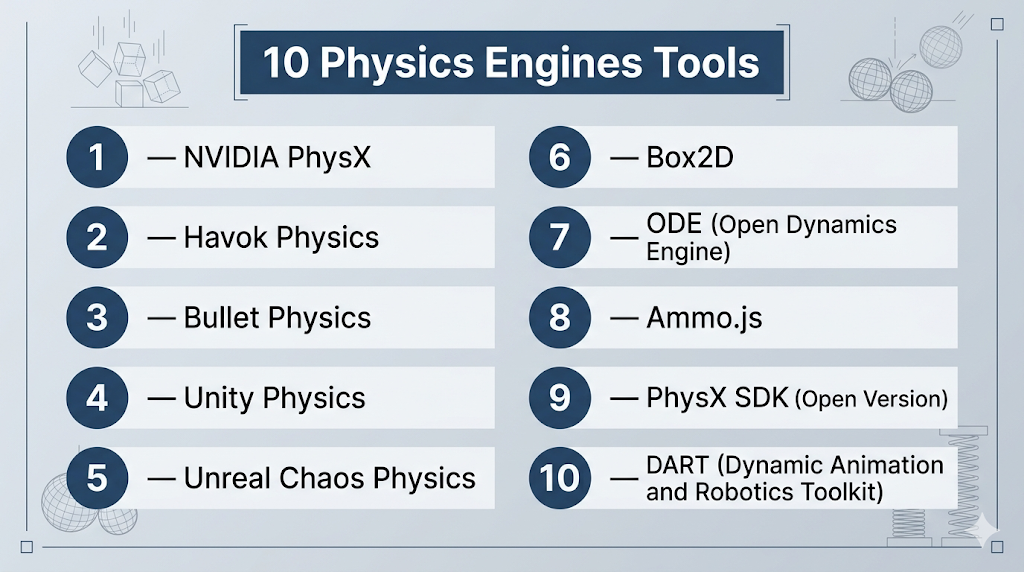
Top 10 Physics Engines Tools
#1 — NVIDIA PhysX
Short description: A widely used real-time physics engine known for high-performance simulation in games and interactive applications.
Key Features
- GPU-accelerated physics simulation
- Rigid body dynamics
- Collision detection system
- Cloth and particle simulation
- Integration with major engines
- Scalable performance
Pros
- High performance with GPU support
- Proven industry usage
Cons
- Requires optimization for best results
- Advanced features may be complex
Platforms / Deployment
Windows / Linux
Local
Security & Compliance
Not publicly stated
Integrations & Ecosystem
PhysX integrates with multiple engines and simulation environments.
- Game engine integrations
- SDK availability
- Developer tools
Support & Community
Strong documentation and active developer community.
#2 — Havok Physics
Short description: A commercial physics engine widely used in AAA games for realistic simulations.
Key Features
- Advanced rigid body simulation
- Collision detection
- Character physics
- Destruction simulation
- High scalability
Pros
- Trusted by large studios
- High-quality simulations
Cons
- Licensing cost
- Limited accessibility for indie developers
Platforms / Deployment
Varies / N/A
Security & Compliance
Not publicly stated
Integrations & Ecosystem
Designed for integration with custom engines and pipelines.
- Game engine support
- Custom APIs
Support & Community
Enterprise-level support; details not publicly stated.
#3 — Bullet Physics
Short description: An open-source physics engine used for real-time collision detection and simulation.
Key Features
- Rigid and soft body simulation
- Collision detection
- Real-time simulation
- Cross-platform support
- Open-source flexibility
Pros
- Free and open-source
- Flexible integration
Cons
- Requires manual setup
- Less polished tools
Platforms / Deployment
Windows / macOS / Linux
Local
Security & Compliance
Not publicly stated
Integrations & Ecosystem
Widely integrated across engines and frameworks.
- Game engines
- Robotics frameworks
- Custom projects
Support & Community
Active community with extensive documentation.
#4 — Unity Physics
Short description: A physics system integrated within Unity for real-time simulation in games.
Key Features
- Rigid body dynamics
- Collision detection
- Integration with Unity ECS
- Real-time simulation
- Performance optimization
Pros
- Seamless Unity integration
- Easy to use
Cons
- Limited outside Unity
- Advanced features require ECS knowledge
Platforms / Deployment
Windows / macOS / Linux
Local
Security & Compliance
Follows Unity security model; Not publicly stated
Integrations & Ecosystem
Part of Unity ecosystem with built-in support.
Support & Community
Strong support via Unity documentation and community.
#5 — Unreal Chaos Physics
Short description: A physics system built into Unreal Engine for advanced real-time simulations.
Key Features
- Destruction simulation
- Rigid body dynamics
- Cloth simulation
- Real-time physics
- Integration with Unreal
Pros
- Advanced physics capabilities
- Integrated workflow
Cons
- Requires Unreal Engine
- Complex setup
Platforms / Deployment
Windows / macOS
Local
Security & Compliance
Not publicly stated
Integrations & Ecosystem
Fully integrated within Unreal ecosystem.
Support & Community
Strong support through Unreal community.
#6 — Box2D
Short description: A lightweight 2D physics engine commonly used in mobile and indie games.
Key Features
- 2D rigid body simulation
- Collision detection
- Joint systems
- Lightweight performance
- Open-source
Pros
- Efficient for 2D games
- Easy integration
Cons
- Limited to 2D
- Basic compared to 3D engines
Platforms / Deployment
Windows / macOS / Linux
Local
Security & Compliance
Not publicly stated
Integrations & Ecosystem
Widely used in 2D engines and frameworks.
Support & Community
Strong community and documentation.
#7 — ODE (Open Dynamics Engine)
Short description: An open-source engine focused on rigid body dynamics simulation.
Key Features
- Rigid body physics
- Collision detection
- Joint systems
- Real-time simulation
- Open-source
Pros
- Free and flexible
- Lightweight
Cons
- Less modern features
- Smaller ecosystem
Platforms / Deployment
Windows / Linux
Local
Security & Compliance
Not publicly stated
Integrations & Ecosystem
Supports integration into custom projects.
Support & Community
Limited but functional community support.
#8 — Ammo.js
Short description: A JavaScript port of Bullet Physics for web-based simulations.
Key Features
- Browser-based physics
- Rigid body simulation
- Collision detection
- WebGL compatibility
- Lightweight
Pros
- Works in browsers
- Good for web games
Cons
- Limited performance
- Requires optimization
Platforms / Deployment
Web
Cloud
Security & Compliance
Not publicly stated
Integrations & Ecosystem
Used with web frameworks and engines.
Support & Community
Moderate community support.
#9 — PhysX SDK (Open Version)
Short description: A developer-friendly version of PhysX for custom implementations.
Key Features
- Real-time physics simulation
- SDK access
- Customization options
- GPU acceleration
- Cross-platform support
Pros
- Flexible integration
- High performance
Cons
- Requires expertise
- Setup complexity
Platforms / Deployment
Windows / Linux
Local
Security & Compliance
Not publicly stated
Integrations & Ecosystem
Supports custom pipelines and engines.
Support & Community
Backed by developer ecosystem.
#10 — DART (Dynamic Animation and Robotics Toolkit)
Short description: A physics engine focused on robotics and simulation research.
Key Features
- Rigid body dynamics
- Robotics simulation
- Collision detection
- Kinematics support
- Open-source
Pros
- Strong for robotics
- Accurate simulation
Cons
- Not game-focused
- Complex setup
Platforms / Deployment
Windows / macOS / Linux
Local
Security & Compliance
Not publicly stated
Integrations & Ecosystem
Used in robotics and research environments.
Support & Community
Academic and research-driven community.
Comparison Table (Top 10)
| Tool Name | Best For | Platform(s) Supported | Deployment | Standout Feature | Public Rating |
|---|---|---|---|---|---|
| NVIDIA PhysX | Real-time simulation | Windows, Linux | Local | GPU acceleration | N/A |
| Havok Physics | AAA games | Varies | Varies | High-end simulation | N/A |
| Bullet Physics | Open-source use | Windows, macOS, Linux | Local | Flexible integration | N/A |
| Unity Physics | Unity developers | Windows, macOS, Linux | Local | ECS integration | N/A |
| Chaos Physics | Unreal users | Windows, macOS | Local | Destruction system | N/A |
| Box2D | 2D games | Windows, macOS, Linux | Local | Lightweight | N/A |
| ODE | Basic simulation | Windows, Linux | Local | Simplicity | N/A |
| Ammo.js | Web physics | Web | Cloud | Browser-based | N/A |
| PhysX SDK | Custom engines | Windows, Linux | Local | Customization | N/A |
| DART | Robotics | Windows, macOS, Linux | Local | Robotics simulation | N/A |
Evaluation & Scoring of Physics Engines
| Tool Name | Core (25%) | Ease (15%) | Integrations (15%) | Security (10%) | Performance (10%) | Support (10%) | Value (15%) | Weighted Total |
|---|---|---|---|---|---|---|---|---|
| NVIDIA PhysX | 9 | 7 | 8 | 6 | 9 | 8 | 8 | 8.2 |
| Havok Physics | 10 | 6 | 8 | 6 | 9 | 8 | 6 | 8.0 |
| Bullet Physics | 8 | 7 | 7 | 5 | 8 | 7 | 9 | 7.8 |
| Unity Physics | 8 | 8 | 8 | 6 | 8 | 8 | 8 | 8.0 |
| Chaos Physics | 9 | 6 | 7 | 6 | 9 | 8 | 7 | 8.0 |
| Box2D | 7 | 9 | 7 | 5 | 7 | 8 | 9 | 7.8 |
| ODE | 6 | 7 | 6 | 5 | 6 | 6 | 8 | 6.7 |
| Ammo.js | 6 | 8 | 6 | 5 | 6 | 7 | 8 | 6.9 |
| PhysX SDK | 9 | 6 | 8 | 6 | 9 | 8 | 7 | 8.1 |
| DART | 7 | 5 | 6 | 5 | 7 | 6 | 7 | 6.6 |
How to interpret scores:
- Scores are comparative across tools
- Higher scores indicate balanced capabilities
- Lower scores may still suit niche needs
- Choose based on your priorities
- Always validate through testing
Which Physics Engines Tool Is Right for You?
Solo / Freelancer
- Best: Box2D, Bullet Physics
- Focus on simplicity and cost
SMB
- Best: Unity Physics, PhysX
- Balanced features and usability
Mid-Market
- Best: Unity Physics, Chaos Physics
- Need scalability and integration
Enterprise
- Best: Havok, PhysX
- Require performance and reliability
Budget vs Premium
- Budget: Bullet, Box2D
- Premium: Havok
Feature Depth vs Ease of Use
- Advanced: Havok, Chaos
- Easy: Box2D
Integrations & Scalability
- Strong: PhysX, Unity
- Limited: ODE
Security & Compliance Needs
- Most tools: Not publicly stated
- Validate based on project requirements
Frequently Asked Questions (FAQs)
What is a physics engine?
A physics engine simulates real-world physical behavior in digital environments.
Are physics engines only for games?
No, they are used in simulations, robotics, and engineering.
Which is best for beginners?
Box2D and Bullet are easier to start with.
Are there free options?
Yes, many open-source engines are available.
Do physics engines require coding?
Most require programming knowledge.
Can I use multiple physics engines?
Yes, depending on the project setup.
What is GPU acceleration?
It uses graphics hardware to improve performance.
Are these engines scalable?
Yes, many support large-scale simulations.
How do I choose the right engine?
Consider performance, use case, and integration needs.
What are common mistakes?
Ignoring performance requirements and integration complexity.
Conclusion
Physics engines are essential for building realistic and interactive digital experiences. From simple 2D simulations to complex real-time environments, the right engine depends on your project requirements and technical expertise.
