Introduction
RegTech Monitoring Tools are specialized compliance technology platforms that help organizations automate regulatory monitoring, detect suspicious activity, manage risk exposure, and maintain audit-ready compliance workflows. Instead of relying on spreadsheets, manual reviews, and fragmented reporting systems, businesses can use RegTech platforms to continuously monitor transactions, communications, internal controls, and regulatory obligations in real time.
As regulations become more complex and enforcement becomes more data-driven, compliance teams need smarter tools that can automate monitoring, reduce false positives, and strengthen governance. Modern RegTech platforms increasingly combine AI, workflow automation, analytics, and centralized compliance intelligence to improve operational efficiency and reduce regulatory risk.
Common use cases include:
- AML transaction monitoring
- Sanctions and watchlist screening
- Regulatory change monitoring
- Fraud and anomaly detection
- Compliance workflow automation
Key evaluation criteria:
- Monitoring depth
- AI and analytics capabilities
- Workflow automation
- Alert accuracy
- Integration ecosystem
- Scalability
- Reporting readiness
- Security controls
- Ease of implementation
Best for: Banks, fintech platforms, insurers, payment companies, investment firms, regulated enterprises, and large organizations with complex compliance requirements.
Not ideal for: Small businesses with minimal regulatory exposure or teams that only need lightweight compliance checklists.
Key Trends in RegTech Monitoring Tools
- AI-driven compliance intelligence
- Real-time anomaly detection
- Automated regulatory change mapping
- Explainable AI for compliance decisions
- API-first compliance infrastructure
- Cloud-native compliance operations
- Continuous risk scoring models
- Integrated fraud and compliance monitoring
- Stronger governance and audit trails
- Cross-border regulatory monitoring expansion
How We Selected These Tools
- Market credibility in compliance technology
- Breadth of monitoring capabilities
- AI and automation maturity
- Operational scalability
- Security posture indicators
- Integration flexibility
- Customer adoption across segments
- Workflow and reporting depth
- Vendor ecosystem and support maturity
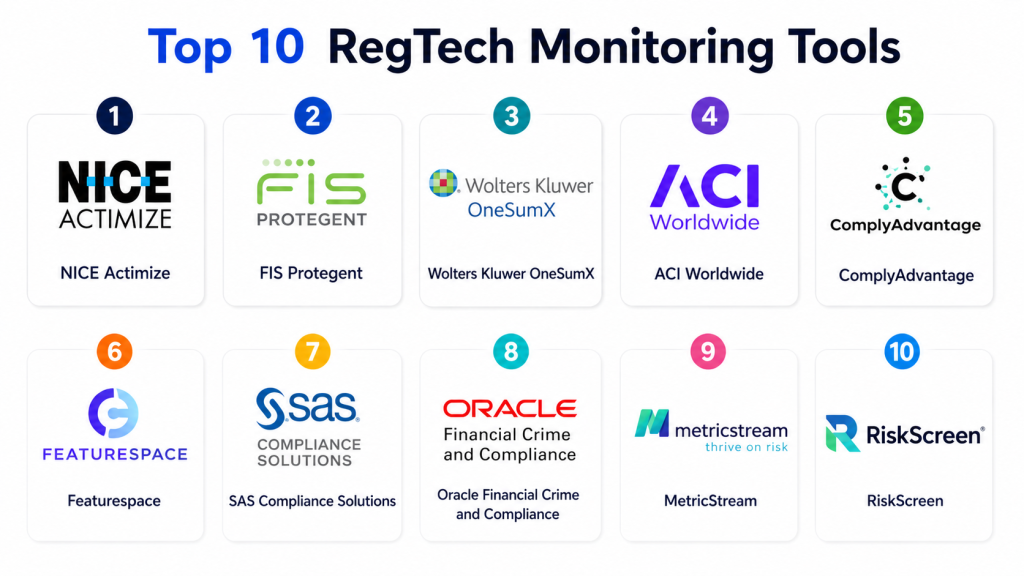
Top 10 RegTech Monitoring Tools
#1 — ComplyAdvantage
Short description: ComplyAdvantage is a leading AI-powered RegTech platform focused on AML monitoring, sanctions screening, customer risk intelligence, and fraud prevention. It is widely used by fintechs, digital banks, and regulated financial platforms.
Key Features
- AML transaction monitoring
- Real-time sanctions screening
- Customer risk scoring
- Adverse media monitoring
- Fraud intelligence signals
- API-first architecture
Pros
- Strong AI-driven monitoring
- Fast API integrations
- Excellent fintech fit
Cons
- Premium pricing tiers
- Configuration needed for tuning alerts
- Best value for compliance-heavy businesses
Platforms / Deployment
- Web
- Cloud
Security & Compliance
- RBAC
- MFA
- Audit logs
- Encryption
Integrations & Ecosystem
Strong API ecosystem designed for digital compliance infrastructure.
- APIs
- Payment platforms
- Banking systems
- Fraud detection tools
Support & Community
Strong onboarding, enterprise support, and developer-friendly documentation.
#2 — NICE Actimize
Short description: NICE Actimize is an enterprise-grade RegTech platform focused on financial crime monitoring, transaction surveillance, and compliance operations automation for large financial institutions.
Key Features
- AML monitoring
- Fraud analytics
- Risk scoring
- Case management
- Workflow automation
- Investigation tools
Pros
- Deep enterprise compliance capabilities
- Strong monitoring depth
- Mature workflow automation
Cons
- Complex implementation
- Premium cost structure
- Best suited for large organizations
Platforms / Deployment
- Web
- Cloud / Hybrid
Security & Compliance
- RBAC
- Audit logs
- Encryption
Integrations & Ecosystem
- APIs
- Core banking systems
- Analytics platforms
- Reporting tools
Support & Community
Strong enterprise implementation ecosystem.
#3 — Fenergo
Short description: Fenergo specializes in regulatory lifecycle monitoring, client onboarding compliance, KYC operations, and ongoing monitoring for financial institutions.
Key Features
- KYC monitoring
- Client lifecycle compliance
- Regulatory workflows
- Risk monitoring
- Reporting automation
- Workflow orchestration
Pros
- Strong customer lifecycle compliance
- Good automation depth
- Enterprise operational fit
Cons
- Complex setup
- Premium pricing
- Heavy enterprise focus
Platforms / Deployment
- Web
- Cloud / Hybrid
Security & Compliance
- RBAC
- MFA
- Audit logs
Integrations & Ecosystem
- APIs
- CRM systems
- Banking platforms
- Compliance tools
Support & Community
Strong enterprise support network.
#4 — Chainalysis KYT
Short description: Chainalysis KYT helps regulated organizations monitor crypto transactions, detect suspicious wallet activity, and manage blockchain compliance risk.
Key Features
- Blockchain monitoring
- Wallet risk scoring
- Suspicious activity alerts
- AML analytics
- Transaction tracing
- Investigative dashboards
Pros
- Strong crypto compliance intelligence
- Real-time blockchain monitoring
- Deep analytics capabilities
Cons
- Specialized use case
- Premium enterprise pricing
- Best for digital asset businesses
Platforms / Deployment
- Web
- Cloud
Security & Compliance
- RBAC
- Audit logs
- Encryption
Integrations & Ecosystem
- APIs
- Crypto exchanges
- Compliance systems
- Analytics platforms
Support & Community
Strong specialized compliance support.
#5 — OneTrust
Short description: OneTrust is a broad compliance and governance platform that helps businesses monitor privacy obligations, third-party risk, and regulatory compliance workflows.
Key Features
- Compliance monitoring
- Privacy governance
- Risk assessments
- Audit workflows
- Policy automation
- Reporting dashboards
Pros
- Broad compliance coverage
- Strong workflow tools
- Good enterprise usability
Cons
- Can be complex
- Pricing varies
- Large feature scope may exceed some needs
Platforms / Deployment
- Web
- Cloud
Support & Community
Strong enterprise documentation and support.
#6 — Ascent
Short description: Ascent uses AI to automate regulatory intelligence, obligation mapping, and compliance monitoring workflows for regulated industries.
Key Features
- Regulatory change monitoring
- AI obligation mapping
- Workflow automation
- Compliance dashboards
- Rule intelligence
- Monitoring alerts
Pros
- Strong regulatory intelligence focus
- Good automation value
- Modern AI-driven approach
Cons
- Enterprise positioning
- Adoption ecosystem still growing
- Custom workflows may require setup effort
Platforms / Deployment
- Web
- Cloud
Support & Community
Growing enterprise support model.
#7 — Quantexa
Short description: Quantexa combines entity intelligence, anomaly detection, and risk analytics to strengthen compliance monitoring and fraud detection.
Key Features
- Entity resolution
- Network analytics
- Risk monitoring
- Fraud detection
- AI-driven scoring
- Investigative workflows
Pros
- Excellent relationship intelligence
- Strong analytics depth
- Good fraud and compliance crossover
Cons
- Complex deployment
- Premium positioning
- Requires mature data infrastructure
Platforms / Deployment
- Web
- Cloud / Hybrid
Support & Community
Strong enterprise implementation support.
#8 — Napier AI
Short description: Napier AI focuses on AML transaction monitoring, compliance analytics, and AI-powered alert intelligence for financial institutions.
Key Features
- AML monitoring
- AI alert prioritization
- Case management
- Risk scoring
- Workflow automation
- Reporting dashboards
Pros
- Strong AI monitoring capabilities
- Good workflow efficiency
- Scalable cloud delivery
Cons
- Enterprise pricing varies
- Configuration needed
- Best for compliance-focused teams
Platforms / Deployment
- Web
- Cloud
Support & Community
Good enterprise onboarding support.
#9 — Behavox
Short description: Behavox focuses on communication monitoring, conduct risk detection, and employee compliance surveillance using advanced analytics.
Key Features
- Communication monitoring
- Behavioral analytics
- Conduct risk alerts
- Case workflows
- Investigation tools
- Monitoring dashboards
Pros
- Strong communication surveillance
- Good AI analytics
- Enterprise compliance fit
Cons
- Specialized monitoring focus
- Premium pricing
- Best for regulated communication-heavy industries
Platforms / Deployment
- Web
- Cloud
Support & Community
Strong enterprise support structure.
#10 — ThetaRay
Short description: ThetaRay uses AI and transaction intelligence to detect suspicious financial activity, monitor networks, and improve AML monitoring efficiency.
Key Features
- Transaction monitoring
- AI anomaly detection
- Network intelligence
- AML workflows
- Risk scoring
- Alert automation
Pros
- Strong anomaly detection
- Good network intelligence
- Scalable monitoring architecture
Cons
- Premium pricing
- Best suited for regulated financial operations
- Requires integration planning
Platforms / Deployment
- Web
- Cloud
Support & Community
Strong enterprise implementation support.
Comparison Table
| Tool Name | Best For | Platform Supported | Deployment | Standout Feature | Public Rating |
|---|---|---|---|---|---|
| ComplyAdvantage | Fintech compliance | Web | Cloud | AI AML monitoring | N/A |
| NICE Actimize | Enterprise monitoring | Web | Cloud / Hybrid | Financial crime analytics | N/A |
| Fenergo | Client lifecycle compliance | Web | Cloud / Hybrid | KYC monitoring | N/A |
| Chainalysis KYT | Crypto compliance | Web | Cloud | Blockchain monitoring | N/A |
| OneTrust | Governance monitoring | Web | Cloud | Broad compliance coverage | N/A |
| Ascent | Regulatory intelligence | Web | Cloud | AI obligation mapping | N/A |
| Quantexa | Risk intelligence | Web | Cloud / Hybrid | Entity intelligence | N/A |
| Napier AI | AML monitoring | Web | Cloud | AI alert scoring | N/A |
| Behavox | Communication monitoring | Web | Cloud | Conduct analytics | N/A |
| ThetaRay | Transaction intelligence | Web | Cloud | Network anomaly detection | N/A |
Evaluation & Scoring of RegTech Monitoring Tools
| Tool Name | Core 25% | Ease 15% | Integrations 15% | Security 10% | Performance 10% | Support 10% | Value 15% | Weighted Total |
|---|---|---|---|---|---|---|---|---|
| ComplyAdvantage | 9 | 8 | 9 | 8 | 9 | 8 | 8 | 8.5 |
| NICE Actimize | 10 | 6 | 9 | 9 | 9 | 9 | 6 | 8.2 |
| Fenergo | 8 | 7 | 8 | 8 | 8 | 8 | 7 | 7.7 |
| Chainalysis KYT | 8 | 8 | 8 | 8 | 8 | 8 | 7 | 7.8 |
| OneTrust | 8 | 8 | 8 | 8 | 8 | 8 | 7 | 7.8 |
| Ascent | 8 | 8 | 7 | 8 | 8 | 7 | 7 | 7.5 |
| Quantexa | 9 | 6 | 8 | 8 | 9 | 8 | 6 | 7.7 |
| Napier AI | 8 | 8 | 8 | 8 | 8 | 7 | 7 | 7.7 |
| Behavox | 8 | 7 | 7 | 8 | 8 | 7 | 7 | 7.4 |
| ThetaRay | 8 | 7 | 8 | 8 | 8 | 7 | 7 | 7.6 |
Frequently Asked Questions
1. What is RegTech monitoring
RegTech monitoring uses software to continuously watch compliance-related activity, detect risks, and automate regulatory workflows. It reduces manual monitoring work. It also improves audit readiness.
2. Who uses RegTech tools
Banks, fintech companies, insurers, exchanges, payment providers, and regulated enterprises commonly use RegTech solutions. Adoption depends on regulatory complexity. Larger organizations benefit most.
3. Do RegTech tools use AI
Yes, many modern RegTech platforms use machine learning, anomaly detection, and intelligent workflow automation. AI helps reduce false positives. It also improves monitoring accuracy.
4. Are these tools cloud-based
Most modern RegTech platforms are cloud-native or cloud-first. Some enterprise vendors also support hybrid deployment models. Deployment depends on business needs.
5. Can RegTech integrate with existing systems
Yes, APIs are a core feature in most platforms. They commonly connect with banking systems, CRMs, fraud engines, and reporting tools. Strong integration improves operational efficiency.
6. Are RegTech tools secure
Enterprise platforms generally include encryption, RBAC, MFA, and audit logs. Security maturity varies by provider. Buyers should validate governance controls carefully.
7. Which industries benefit most
Financial services, fintech, insurance, healthcare, and highly regulated enterprises benefit significantly. Any business with complex compliance needs can gain value.
8. Is implementation difficult
Cloud-native platforms are generally easier to deploy, while enterprise platforms may require longer onboarding and deeper integration planning.
9. Can small companies use RegTech
Yes, but lightweight solutions are often more practical for smaller teams. Enterprise-grade platforms may be too complex or costly.
10. How should companies choose
Evaluate monitoring depth, integrations, workflow automation, deployment flexibility, security controls, and long-term scalability before selecting a platform.
Conclusion
RegTech Monitoring Tools are becoming essential infrastructure for modern compliance operations. They help organizations monitor faster, automate workflows, reduce risk, and improve governance visibility.
The biggest advantage is continuous monitoring combined with smarter automation. Teams can shift from reactive compliance to proactive compliance management.
The right platform depends on your regulatory obligations, monitoring complexity, and operational scale.
Fintechs may prioritize API-first agility, while enterprises often need deep workflow orchestration and advanced monitoring intelligence.

The way the tools are compared makes it easy to understand their capabilities and helps businesses choose the right RegTech monitoring solution with confidence.