Introduction
Post-Quantum Cryptography Migration Tools help organizations transition from classical cryptographic algorithms to quantum-resistant alternatives. As quantum computing advances, traditional encryption methods like RSA and ECC are expected to become vulnerable. These tools enable enterprises to identify cryptographic risks, test quantum-safe algorithms, and gradually migrate systems without disrupting operations.
The urgency around quantum readiness is increasing, especially for industries dealing with long-lived sensitive data. Attackers can capture encrypted data today and decrypt it later when quantum capabilities mature, making proactive migration essential.
Real-world use cases:
- Discovering and inventorying cryptographic assets across systems
- Testing quantum-safe algorithms in existing applications
- Migrating TLS, PKI, and certificates to quantum-resistant standards
- Securing sensitive data against future quantum attacks
- Ensuring compliance with emerging security guidelines
What buyers should evaluate:
- Algorithm support and flexibility
- Crypto discovery and inventory capabilities
- Integration with existing PKI and infrastructure
- Ease of migration and backward compatibility
- Performance impact of new algorithms
- Compliance readiness and auditability
- Deployment flexibility across environments
- Automation and orchestration features
- Vendor ecosystem and long-term support
Best for: Enterprises, government agencies, financial institutions, and security-focused organizations planning long-term data protection strategies.
Not ideal for: Small teams with low-risk data exposure or organizations not yet mature in cryptographic management practices.
Key Trends in Post-Quantum Cryptography Migration Tools
- Hybrid cryptography adoption combining classical and quantum-safe algorithms
- Automated crypto discovery tools gaining importance
- Integration with PKI and certificate lifecycle management systems
- Growing support for NIST-selected PQC algorithms
- Increased enterprise focus on crypto agility
- Cloud providers embedding PQC readiness into services
- Performance optimization for quantum-safe algorithms
- Vendor-neutral frameworks and open-source tools gaining traction
- Policy-driven migration strategies becoming common
- Security-first DevOps workflows incorporating PQC testing
How We Selected These Tools (Methodology)
- Evaluated industry recognition and innovation in PQC space
- Assessed support for quantum-safe algorithms and standards
- Reviewed crypto discovery and migration capabilities
- Analyzed integration with existing infrastructure and PKI systems
- Considered ease of use and implementation complexity
- Evaluated scalability for enterprise environments
- Reviewed security posture and compliance readiness
- Compared community support and ecosystem strength
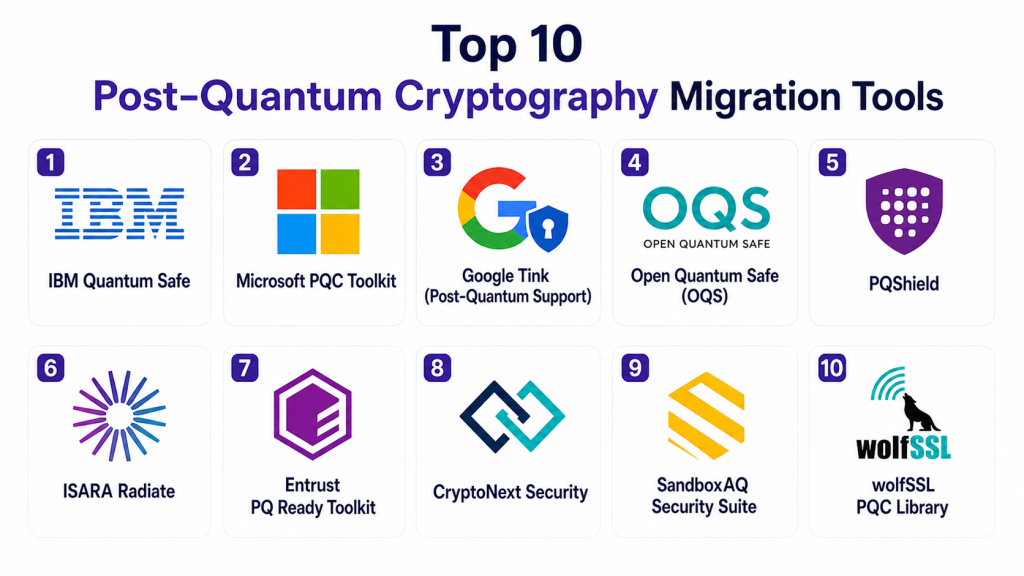
Top 10 Post-Quantum Cryptography Migration Tools
#1 — IBM Quantum Safe
Short description:
IBM Quantum Safe provides a comprehensive platform for assessing cryptographic risks and planning migration to quantum-safe standards. It offers tools for crypto discovery, risk analysis, and migration planning.
Key Features
- Crypto asset discovery
- Risk assessment tools
- Quantum-safe algorithm support
- Migration planning
- Enterprise integration
- Compliance reporting
Pros
- Enterprise-grade solution
- Strong research backing
- Comprehensive feature set
Cons
- Complex implementation
- Enterprise-focused pricing
- Requires expertise
Platforms / Deployment
Cloud / Hybrid
Security & Compliance
Not publicly stated
Integrations & Ecosystem
Integrates with enterprise security systems and infrastructure.
- PKI systems
- Cloud platforms
- Security tools
Support & Community
Strong enterprise support and documentation.
#2 — Microsoft PQC Toolkit
Short description:
Microsoft offers tools and frameworks for experimenting with quantum-safe cryptography and integrating it into applications.
Key Features
- PQC algorithm testing
- Integration with development tools
- Cloud compatibility
- Hybrid cryptography support
- Developer SDKs
Pros
- Developer-friendly
- Strong cloud integration
- Continuous innovation
Cons
- Limited production readiness in some areas
- Requires development effort
- Ecosystem dependency
Platforms / Deployment
Cloud / Windows
Security & Compliance
Not publicly stated
Integrations & Ecosystem
Works within Microsoft ecosystem.
- Azure
- Developer tools
Support & Community
Strong documentation and enterprise backing.
#3 — Google Tink (Post-Quantum Support)
Short description:
Google Tink is a multi-language cryptographic library that supports modern cryptographic practices and is evolving to include quantum-safe algorithms.
Key Features
- Easy-to-use crypto APIs
- Multi-language support
- Secure defaults
- PQC experimentation
- Integration-ready
Pros
- Developer-friendly
- Open-source
- Flexible
Cons
- Limited enterprise features
- Requires coding knowledge
- PQC support evolving
Platforms / Deployment
Multi-platform
Security & Compliance
Encryption, secure defaults
Integrations & Ecosystem
Supports application-level integration.
- Backend systems
- APIs
Support & Community
Active open-source community.
#4 — Open Quantum Safe (OQS)
Short description:
Open Quantum Safe is an open-source project focused on developing and integrating quantum-safe cryptographic algorithms into existing systems.
Key Features
- PQC algorithm library
- OpenSSL integration
- Research-focused tools
- Community-driven development
- Testing frameworks
Pros
- Open-source
- Strong research backing
- Flexible integration
Cons
- Requires expertise
- Not enterprise-ready out-of-the-box
- Limited UI
Platforms / Deployment
Linux / Multi-platform
Security & Compliance
Not publicly stated
Integrations & Ecosystem
Works with cryptographic libraries.
- OpenSSL
- Development frameworks
Support & Community
Strong academic and open-source support.
#5 — PQShield
Short description:
PQShield provides quantum-safe cryptographic solutions, focusing on hardware and software implementations for secure migration.
Key Features
- PQC algorithm implementations
- Hardware acceleration
- Embedded security solutions
- Migration support
- Enterprise integration
Pros
- Strong hardware focus
- Advanced cryptography
- Enterprise-ready
Cons
- Specialized use cases
- Complex deployment
- Limited general-purpose tooling
Platforms / Deployment
Varies / N/A
Security & Compliance
Not publicly stated
Integrations & Ecosystem
Supports hardware and enterprise systems.
- Embedded systems
- Security infrastructure
Support & Community
Commercial support available.
#6 — ISARA Radiate
Short description:
ISARA Radiate enables organizations to discover cryptographic assets and migrate to quantum-safe encryption seamlessly.
Key Features
- Crypto discovery
- Risk analysis
- Migration planning
- Hybrid cryptography
- Reporting tools
Pros
- Easy migration planning
- Strong enterprise focus
- Compliance-ready
Cons
- Enterprise pricing
- Requires integration effort
- Limited open-source support
Platforms / Deployment
Cloud / Hybrid
Security & Compliance
Not publicly stated
Integrations & Ecosystem
Works with enterprise systems.
- PKI
- Security tools
Support & Community
Strong enterprise support.
#7 — Entrust PQ Ready Toolkit
Short description:
Entrust provides tools for assessing and implementing quantum-safe cryptography within enterprise environments.
Key Features
- Crypto inventory
- Risk analysis
- PQC readiness tools
- Certificate management
- Integration with PKI
Pros
- Strong PKI integration
- Enterprise-focused
- Compliance support
Cons
- Complex deployment
- Pricing not transparent
- Requires expertise
Platforms / Deployment
Cloud / Hybrid
Security & Compliance
Not publicly stated
Integrations & Ecosystem
Deep PKI integration.
- Certificate systems
- Identity systems
Support & Community
Enterprise-grade support.
#8 — CryptoNext Security
Short description:
CryptoNext Security offers quantum-safe cryptography solutions focusing on migration and secure communications.
Key Features
- PQC algorithms
- Migration tools
- Secure communications
- Hybrid encryption
- Integration APIs
Pros
- Focused PQC expertise
- Flexible integration
- Enterprise-ready
Cons
- Smaller ecosystem
- Limited awareness
- Requires expertise
Platforms / Deployment
Varies / N/A
Security & Compliance
Not publicly stated
Integrations & Ecosystem
Supports secure systems integration.
- Enterprise apps
- Security platforms
Support & Community
Commercial support available.
#9 — SandboxAQ Security Suite
Short description:
SandboxAQ provides advanced security solutions combining AI and quantum technologies to support cryptographic risk management and migration.
Key Features
- Crypto risk discovery
- AI-driven insights
- PQC migration support
- Compliance tools
- Enterprise analytics
Pros
- Innovative approach
- AI integration
- Strong enterprise focus
Cons
- Newer platform
- Pricing unclear
- Complex setup
Platforms / Deployment
Cloud
Security & Compliance
Not publicly stated
Integrations & Ecosystem
Enterprise integrations.
- Security platforms
- Cloud systems
Support & Community
Commercial support available.
#10 — wolfSSL PQC Library
Short description:
wolfSSL provides lightweight cryptographic libraries with support for quantum-safe algorithms, suitable for embedded and IoT environments.
Key Features
- PQC algorithm support
- Lightweight design
- Embedded systems focus
- High performance
- Secure communication
Pros
- Lightweight and fast
- Ideal for IoT
- Strong performance
Cons
- Limited enterprise features
- Requires development work
- Narrow use cases
Platforms / Deployment
Embedded / Multi-platform
Security & Compliance
Encryption support
Integrations & Ecosystem
Works with embedded and application systems.
- IoT devices
- Embedded platforms
Support & Community
Active development and documentation.
Comparison Table
| Tool Name | Best For | Platform(s) Supported | Deployment | Standout Feature | Public Rating |
|---|---|---|---|---|---|
| IBM Quantum Safe | Enterprise migration | Multi-platform | Hybrid | Risk assessment | N/A |
| Microsoft PQC Toolkit | Developers | Windows / Cloud | Cloud | Dev integration | N/A |
| Google Tink | Developers | Multi-platform | N/A | Easy APIs | N/A |
| Open Quantum Safe | Research & testing | Linux | Self-hosted | Open-source PQC | N/A |
| PQShield | Hardware security | Multi-platform | N/A | Hardware acceleration | N/A |
| ISARA Radiate | Enterprise crypto discovery | Multi-platform | Hybrid | Migration tools | N/A |
| Entrust Toolkit | PKI integration | Multi-platform | Hybrid | Certificate focus | N/A |
| CryptoNext | Secure comms | Multi-platform | N/A | PQC encryption | N/A |
| SandboxAQ | Risk analysis | Cloud | Cloud | AI insights | N/A |
| wolfSSL | Embedded systems | Multi-platform | Self-hosted | Lightweight PQC | N/A |
Evaluation & Scoring
| Tool Name | Core | Ease | Integrations | Security | Performance | Support | Value | Weighted Total |
|---|---|---|---|---|---|---|---|---|
| IBM | 9 | 7 | 8 | 9 | 8 | 8 | 7 | 8.3 |
| Microsoft | 8 | 8 | 9 | 8 | 8 | 8 | 8 | 8.2 |
| Tink | 7 | 9 | 8 | 8 | 8 | 7 | 9 | 8.0 |
| OQS | 8 | 6 | 7 | 9 | 8 | 7 | 9 | 7.9 |
| PQShield | 8 | 6 | 7 | 9 | 9 | 7 | 7 | 7.8 |
| ISARA | 9 | 7 | 8 | 9 | 8 | 8 | 7 | 8.2 |
| Entrust | 9 | 7 | 8 | 9 | 8 | 8 | 7 | 8.2 |
| CryptoNext | 8 | 7 | 7 | 9 | 8 | 7 | 7 | 7.8 |
| SandboxAQ | 9 | 7 | 8 | 9 | 8 | 7 | 7 | 8.1 |
| wolfSSL | 7 | 8 | 7 | 8 | 9 | 7 | 9 | 8.0 |
How to interpret scores:
These scores reflect how each tool performs across critical factors such as features, ease of use, integrations, and security. A higher score indicates a more balanced solution, but it does not necessarily mean it is the best fit for every organization. Some tools excel in specific areas like enterprise compliance or embedded systems performance. Use this scoring as a comparative guide, and prioritize the criteria that align most closely with your business requirements, technical environment, and long-term security strategy.
Which Tool Is Right for You?
Solo / Freelancer
Lightweight libraries like wolfSSL or Tink are ideal for experimentation and small-scale projects.
SMB
Microsoft PQC Toolkit or Tink provide a balance of usability and integration.
Mid-Market
ISARA Radiate and Entrust Toolkit offer better migration planning and scalability.
Enterprise
IBM Quantum Safe and SandboxAQ are best suited for large-scale deployments and compliance needs.
Budget vs Premium
Open-source tools like OQS are cost-effective, while enterprise solutions offer advanced capabilities.
Feature Depth vs Ease of Use
Developer tools are easier, while enterprise platforms provide deeper insights and control.
Integrations & Scalability
Choose tools that integrate well with your PKI and infrastructure.
Security & Compliance Needs
Highly regulated industries should prioritize auditability and compliance features.
Frequently Asked Questions (FAQs)
1. What is post-quantum cryptography?
Post-quantum cryptography refers to encryption algorithms designed to resist attacks from quantum computers. These algorithms aim to replace traditional methods that may become vulnerable in the future.
2. Why is migration important?
Migration ensures long-term security of sensitive data. Organizations need to protect data that must remain secure for many years.
3. Are quantum computers a real threat today?
They are not yet widely capable, but future advancements could break current encryption methods. Preparing early is recommended.
4. What are hybrid cryptographic approaches?
Hybrid approaches combine classical and quantum-safe algorithms to ensure compatibility and security during transition phases.
5. How long does migration take?
Migration timelines vary depending on system complexity and readiness. It can take months or years for large enterprises.
6. Do these tools integrate with existing systems?
Most tools are designed to integrate with PKI, cloud platforms, and enterprise systems.
7. What industries need PQC the most?
Finance, healthcare, government, and telecom sectors have the highest urgency due to sensitive data.
8. Are open-source PQC tools reliable?
Yes, many are backed by strong research communities and are widely used for experimentation and development.
9. What are common migration challenges?
Challenges include compatibility issues, performance overhead, and lack of expertise.
10. How do I get started?
Begin with crypto discovery, assess risks, and test quantum-safe algorithms before full deployment.
Conclusion
Post-quantum cryptography migration is becoming a critical priority for organizations aiming to future-proof their security infrastructure. As quantum computing advances, relying on traditional encryption methods will pose increasing risks, especially for data that must remain secure over long periods. The tools covered in this guide provide a range of capabilities, from lightweight libraries for developers to enterprise-grade platforms for large-scale migration planning. Selecting the right solution depends on your organization’s size, technical maturity, and compliance requirements. Rather than rushing into a full migration, the most effective strategy is to assess your current cryptographic landscape, pilot a few tools, and gradually transition to quantum-safe algorithms while maintaining operational stability.

Well explained
This blog gives a clear idea about post-quantum cryptography migration tools in simple language. It helps readers understand key features, pros, cons, and comparison points before choosing the right security solution.