Introduction
Insurance Underwriting Platforms are specialized software systems that help insurers evaluate risk, price policies, and make underwriting decisions more efficiently. These platforms combine data, rules engines, analytics, and automation to streamline underwriting workflows that were traditionally manual and time-consuming.
In simple terms, underwriting platforms help insurers decide who to insure, at what price, and under what conditions. As insurance products become more complex and customer expectations increase, these platforms are becoming essential for speed, accuracy, and consistency.
Common use cases include:
- Risk assessment and pricing of insurance policies
- Automating underwriting decisions and approvals
- Managing underwriting rules and guidelines
- Supporting new product launches
- Integrating data sources for better decision-making
Key evaluation criteria:
- Rule engine flexibility and configurability
- Data integration and analytics capabilities
- Automation and decision support
- Scalability and performance
- Security and compliance readiness
- Ease of use for underwriters
- API and ecosystem integrations
- Reporting and audit capabilities
- Deployment flexibility
Best for: Insurance carriers, reinsurers, and insurtech companies that need efficient and scalable underwriting processes.
Not ideal for: Small agencies with basic underwriting needs or those relying on simple manual workflows.
Key Trends in Insurance Underwriting Platforms
- AI-driven risk assessment and predictive modeling
- Automation of underwriting decisions using rules engines
- Use of external data sources for real-time risk evaluation
- Cloud-native underwriting platforms replacing legacy systems
- API-first design enabling integrations with ecosystems
- Embedded underwriting within digital insurance journeys
- Advanced analytics and real-time dashboards
- Straight-through processing for low-risk policies
- Low-code configuration for faster product updates
- Improved compliance tracking and audit capabilities
How We Selected These Tools
- Strong adoption across insurance markets
- Comprehensive underwriting capabilities
- Proven scalability and reliability
- Modern architecture and cloud readiness
- Security and compliance capabilities
- Integration ecosystem and API support
- AI and automation features
- Flexibility across insurance lines
- Vendor innovation and roadmap strength
- Usability for underwriting teams
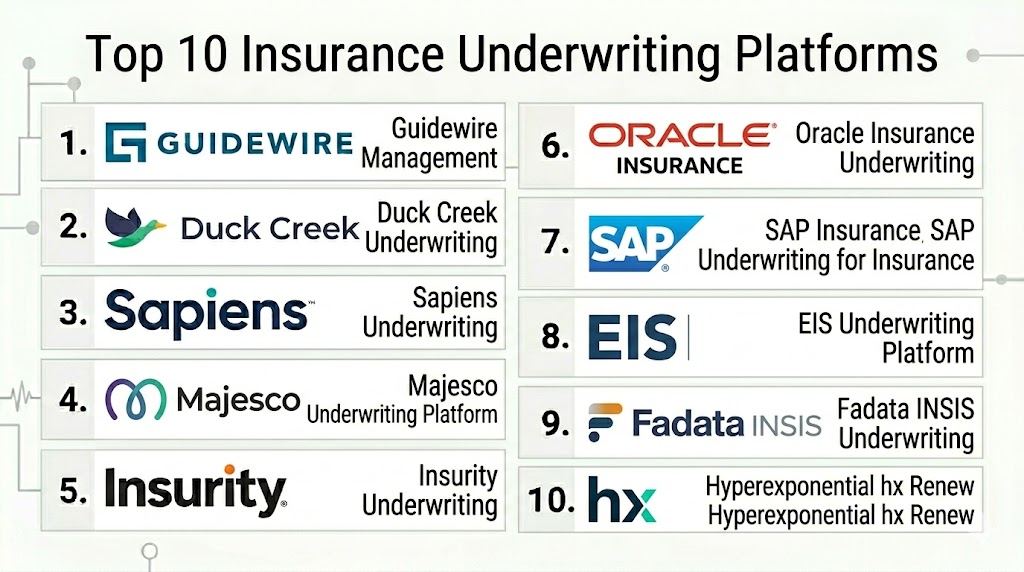
Top 10 Insurance Underwriting Platforms Tools
#1 — Guidewire Underwriting Management
Short description:
An enterprise-grade underwriting platform designed for complex insurance operations. It provides advanced rule engines, workflow automation, and deep integration with policy systems. Ideal for large insurers requiring scalable and configurable underwriting processes.
Key Features
- Advanced underwriting rules engine
- Workflow automation
- Risk assessment tools
- Integration with policy systems
- Reporting and analytics
- Multi-line support
Pros
- Highly scalable
- Strong integration capabilities
- Flexible configuration
- Enterprise-grade reliability
Cons
- Complex implementation
- High cost
- Requires expertise
- Long deployment time
Platforms / Deployment
Cloud / Hybrid
Security & Compliance
SSO, RBAC, encryption, audit logs. Compliance not publicly stated.
Integrations & Ecosystem
Integrates with enterprise systems and platforms.
- Policy administration systems
- Claims systems
- CRM tools
- Data platforms
Support & Community
Strong enterprise support and partner ecosystem.
#2 — Duck Creek Underwriting
Short description:
A cloud-based underwriting platform focused on flexibility and speed. It supports rule-based automation and integrates with broader insurance systems for streamlined workflows.
Key Features
- Configurable underwriting rules
- Workflow automation
- Real-time analytics
- API-first architecture
- Product configuration support
Pros
- Modern cloud platform
- Faster deployment
- Flexible configuration
- Strong integration support
Cons
- Customization complexity
- Pricing not transparent
- Learning curve
- Integration effort
Platforms / Deployment
Cloud
Security & Compliance
Encryption, RBAC, MFA. Compliance not publicly stated.
Integrations & Ecosystem
Supports API-driven integrations.
- Policy systems
- CRM platforms
- Data tools
- External services
Support & Community
Reliable vendor support.
#3 — Sapiens Underwriting
Short description:
A flexible underwriting platform designed for life, health, and property insurers. It offers digital capabilities and supports automated underwriting processes.
Key Features
- Multi-line underwriting support
- Workflow automation
- Analytics tools
- Integration capabilities
- Reporting features
Pros
- Broad coverage
- Strong digital features
- Scalable
- Good analytics
Cons
- Implementation effort
- Learning curve
- Customization complexity
- Cost considerations
Platforms / Deployment
Cloud / Hybrid
Security & Compliance
Encryption, RBAC. Compliance not publicly stated.
Integrations & Ecosystem
Supports enterprise integrations.
- Policy systems
- Claims platforms
- Data tools
- Financial systems
Support & Community
Enterprise-level support.
#4 — Majesco Underwriting Platform
Short description:
A cloud-based underwriting solution designed for agility and customer-centric operations. It supports faster product innovation and digital underwriting workflows.
Key Features
- Cloud-native architecture
- Underwriting automation
- Product configuration
- Workflow management
- API integrations
Pros
- Flexible platform
- Strong cloud capabilities
- Good user interface
- Scalable
Cons
- Implementation complexity
- Pricing not transparent
- Customization effort
- Integration challenges
Platforms / Deployment
Cloud
Security & Compliance
Encryption, RBAC. Compliance not publicly stated.
Integrations & Ecosystem
Integrates with multiple systems.
- CRM tools
- Policy systems
- Data platforms
- Payment tools
Support & Community
Good onboarding and support.
#5 — Insurity Underwriting
Short description:
A modern underwriting platform focused on property and casualty insurance. It offers automation and configurability for faster underwriting decisions.
Key Features
- Property and casualty focus
- Automated underwriting workflows
- Rule engine
- Cloud deployment
- Analytics
Pros
- Fast implementation
- Industry specialization
- Flexible workflows
- Cloud-ready
Cons
- Limited outside P and C
- Customization limits
- Integration effort
- Pricing not clear
Platforms / Deployment
Cloud
Security & Compliance
Encryption, RBAC. Compliance not publicly stated.
Integrations & Ecosystem
Supports API integrations.
- Policy systems
- CRM tools
- Data platforms
- Claims systems
Support & Community
Strong industry-focused support.
#6 — Oracle Insurance Underwriting
Short description:
An enterprise underwriting solution designed for large insurers with complex requirements. It integrates with Oracle’s ecosystem for unified operations.
Key Features
- Enterprise architecture
- Workflow automation
- Risk assessment tools
- Integration capabilities
- Analytics
Pros
- Scalable
- Strong reliability
- Deep integrations
- Comprehensive features
Cons
- Complex setup
- High cost
- Requires expertise
- Less flexible UI
Platforms / Deployment
Cloud / Hybrid
Security & Compliance
SSO, encryption, RBAC. Compliance not publicly stated.
Integrations & Ecosystem
Integrates with enterprise systems.
- Financial tools
- CRM platforms
- Data tools
- External integrations
Support & Community
Global enterprise support.
#7 — SAP Underwriting for Insurance
Short description:
A platform designed for insurers using SAP systems. It provides underwriting capabilities integrated with enterprise processes.
Key Features
- SAP ecosystem integration
- Underwriting workflows
- Analytics tools
- Reporting capabilities
- Scalable infrastructure
Pros
- Strong integration
- Reliable performance
- Scalable
- Enterprise-ready
Cons
- High cost
- Complex implementation
- Requires SAP expertise
- Limited flexibility
Platforms / Deployment
Cloud / Hybrid
Security & Compliance
SSO, encryption, RBAC. Compliance not publicly stated.
Integrations & Ecosystem
Works within SAP ecosystem.
- ERP systems
- Financial platforms
- Analytics tools
- External integrations
Support & Community
Strong enterprise support.
#8 — EIS Underwriting Platform
Short description:
A digital-first underwriting platform with API-driven architecture. It focuses on customer experience and automation.
Key Features
- API-first design
- Workflow automation
- Real-time analytics
- Customer experience tools
- Multi-line support
Pros
- Modern architecture
- Strong integrations
- Scalable
- Flexible
Cons
- Implementation complexity
- Cost considerations
- Requires expertise
- Limited SMB fit
Platforms / Deployment
Cloud
Security & Compliance
Encryption, RBAC. Compliance not publicly stated.
Integrations & Ecosystem
Strong API ecosystem.
- CRM tools
- Data platforms
- Policy systems
- External integrations
Support & Community
Enterprise-level support.
#9 — Fadata INSIS Underwriting
Short description:
A modular underwriting platform offering flexibility and scalability. It supports multiple insurance lines and configurable workflows.
Key Features
- Modular architecture
- Multi-line support
- Workflow automation
- API integrations
- Reporting tools
Pros
- Flexible design
- Scalable
- Good configurability
- Modular deployment
Cons
- Learning curve
- Customization effort
- Implementation complexity
- Pricing unclear
Platforms / Deployment
Cloud / Hybrid
Security & Compliance
Encryption, RBAC. Compliance not publicly stated.
Integrations & Ecosystem
Supports integrations via APIs.
- CRM tools
- Claims systems
- Data platforms
- Financial systems
Support & Community
Moderate vendor support.
#10 — Hyperexponential hx Renew
Short description:
A specialized underwriting platform focused on pricing and risk modeling for commercial and specialty insurers. It enables rapid pricing model development and deployment.
Key Features
- Pricing and risk modeling
- Workflow automation
- Data integration
- Analytics tools
- Scenario modeling
Pros
- Strong pricing capabilities
- Modern platform
- Flexible
- Fast model updates
Cons
- Specialized use case
- Limited general underwriting features
- Integration effort
- Pricing not transparent
Platforms / Deployment
Cloud
Security & Compliance
Encryption, RBAC. Compliance not publicly stated.
Integrations & Ecosystem
Supports data-driven integrations.
- Data platforms
- Policy systems
- Analytics tools
- APIs
Support & Community
Focused vendor support.
Comparison Table
| Tool Name | Best For | Platforms | Deployment | Standout Feature | Public Rating |
|---|---|---|---|---|---|
| Guidewire | Enterprise insurers | Web | Cloud Hybrid | Advanced rules engine | N/A |
| Duck Creek | Modern insurers | Web | Cloud | Flexible workflows | N/A |
| Sapiens | Multi-line insurers | Web | Cloud Hybrid | Broad coverage | N/A |
| Majesco | Digital insurers | Web | Cloud | Customer-centric design | N/A |
| Insurity | P and C insurers | Web | Cloud | Fast deployment | N/A |
| Oracle | Enterprise | Web | Cloud Hybrid | Enterprise integration | N/A |
| SAP | SAP users | Web | Cloud Hybrid | SAP ecosystem | N/A |
| EIS | Digital insurers | Web | Cloud | API-first design | N/A |
| Fadata | Modular needs | Web | Cloud Hybrid | Modular architecture | N/A |
| Hyperexponential | Pricing focused | Web | Cloud | Risk modeling | N/A |
Evaluation and Scoring
| Tool Name | Core | Ease | Integrations | Security | Performance | Support | Value | Weighted Total |
|---|---|---|---|---|---|---|---|---|
| Guidewire | 9 | 6 | 9 | 8 | 9 | 9 | 6 | 8.2 |
| Duck Creek | 8 | 7 | 8 | 8 | 8 | 8 | 7 | 7.8 |
| Sapiens | 8 | 7 | 8 | 8 | 8 | 8 | 7 | 7.8 |
| Majesco | 8 | 7 | 8 | 8 | 8 | 8 | 7 | 7.8 |
| Insurity | 7 | 8 | 7 | 7 | 7 | 7 | 8 | 7.4 |
| Oracle | 9 | 6 | 9 | 9 | 9 | 9 | 6 | 8.3 |
| SAP | 9 | 6 | 9 | 9 | 9 | 9 | 6 | 8.3 |
| EIS | 8 | 7 | 9 | 8 | 8 | 8 | 7 | 7.9 |
| Fadata | 7 | 7 | 7 | 7 | 7 | 7 | 7 | 7.0 |
| Hyperexponential | 8 | 7 | 8 | 8 | 8 | 8 | 7 | 7.8 |
Scores are comparative and help evaluate strengths across platforms. The best choice depends on business requirements, scale, and integration needs.
Which Insurance Underwriting Platform Is Right for You
Solo / Freelancer
Typically not required. Basic tools are sufficient.
SMB
Insurity and Fadata offer flexibility and easier adoption.
Mid-Market
Duck Creek, Majesco, and Sapiens provide balanced capabilities.
Enterprise
Guidewire, Oracle, and SAP are best for complex underwriting operations.
Budget vs Premium
Budget tools focus on simplicity, while premium tools offer advanced capabilities.
Feature Depth vs Ease of Use
Enterprise platforms provide deeper features, while smaller platforms are easier to use.
Integrations and Scalability
Enterprise tools offer stronger integration and scalability.
Security and Compliance Needs
Larger platforms provide stronger security for regulated environments.
Frequently Asked Questions
1. What is an underwriting platform
An underwriting platform is software that helps insurers evaluate risk and make pricing decisions.
It automates workflows and improves decision accuracy.
It also integrates data from multiple sources.
2. How does underwriting software work
It uses rules, data, and analytics to assess risk and recommend decisions.
Automation helps reduce manual effort.
It improves speed and consistency.
3. What are key features of underwriting platforms
Key features include rule engines, automation, analytics, and integrations.
Some platforms also include AI-driven decision support.
These features improve underwriting efficiency.
4. Why is automation important
Automation reduces manual work and speeds up decision-making.
It also improves accuracy and consistency.
This leads to better operational efficiency.
5. Are these platforms secure
Most platforms include encryption, access control, and audit logs.
Security capabilities vary by vendor.
Buyers should validate security features before adoption.
6. Can small insurers use these tools
Yes, but they should choose platforms that match their size and complexity.
Enterprise tools may be too complex.
Cloud platforms are usually better for smaller teams.
7. How long does implementation take
Implementation depends on complexity and customization.
Smaller platforms are faster to deploy.
Enterprise systems take longer.
8. Do these tools support integrations
Yes, most platforms integrate with policy, claims, and CRM systems.
API support is essential.
Strong integrations improve efficiency.
9. What are common mistakes
Common mistakes include ignoring integration needs and scalability.
Another issue is underestimating implementation effort.
Proper planning is critical.
10. What are alternatives
Alternatives include manual processes or custom-built systems.
However, they lack automation and scalability.
Dedicated platforms provide better efficiency.
Conclusion
Insurance Underwriting Platforms play a crucial role in modern insurance operations by improving risk assessment, pricing accuracy, and workflow efficiency. These platforms enable insurers to automate decisions, integrate data sources, and scale operations effectively. From enterprise-grade solutions like Guidewire, Oracle, and SAP to flexible platforms like Insurity and Hyperexponential, there are options for different business needs. The right platform depends on factors such as scale, complexity, and integration requirements. Organizations should focus on long-term value, scalability, and ease of integration rather than just features. A practical approach is to shortlist a few tools, test their capabilities, and validate their fit before making a final decision.

A helpful and well-organized comparison that highlights the key features of insurance underwriting platforms, making it easier to evaluate and choose the right solution for risk assessment and policy management.