Introduction
Corporate Card Management Tools are platforms that help organizations issue, control, monitor, and optimize company spending through corporate cards. These tools combine payment infrastructure with software that enables finance teams to track transactions, enforce policies, and automate reconciliation.
Modern businesses rely heavily on corporate cards for travel, SaaS subscriptions, vendor payments, and employee expenses. Without proper controls, this can lead to overspending and compliance risks. Corporate card platforms solve this by providing real-time visibility, automated controls, and centralized spend management.
These tools go beyond simple payments by offering spend limits, policy enforcement, receipt automation, and integrations with accounting systems, making financial operations faster and more secure.
Common use cases include:
- Issuing corporate cards to employees and teams
- Managing business expenses and subscriptions
- Enforcing spending limits and policies
- Automating expense reporting and reconciliation
- Monitoring real-time company spending
What buyers should evaluate:
- Spending controls and policy enforcement
- Real-time tracking and reporting
- Integration with accounting and ERP systems
- Virtual card capabilities
- Automation of reconciliation and approvals
- Security and fraud prevention
- Multi-currency and global support
- Ease of use and onboarding
- Scalability and performance
Best for: Finance teams, startups, SMBs, and enterprises managing employee spending, subscriptions, and vendor payments.
Not ideal for: Very small businesses with minimal expenses or organizations already using simple accounting tools without card-based workflows.
Key Trends in Corporate Card Management Tools
- Virtual card adoption: Safer, single-use cards for vendors and subscriptions
- Real-time spend visibility: Immediate tracking of company expenses
- AI-powered expense automation: Auto-categorization and anomaly detection
- Integrated spend platforms: Combining cards, expenses, and bill payments
- API-first architecture: Faster integrations with finance stacks
- Fraud prevention controls: Instant card freeze, alerts, and monitoring
- Policy-driven spending: Custom limits by team, vendor, or category
- Global payment support: Multi-currency and cross-border capabilities
- Subscription management: Tracking recurring SaaS expenses
- Automation of reconciliation: Eliminating manual bookkeeping
How We Selected These Tools (Methodology)
- Evaluated market adoption and fintech innovation
- Assessed card issuing and spend control capabilities
- Reviewed automation and expense management features
- Analyzed integration with accounting, ERP, and banking systems
- Considered ease of use and onboarding speed
- Checked security and fraud prevention features
- Compared scalability across startups to enterprises
- Reviewed performance and reliability indicators
- Ensured balanced coverage across fintech and enterprise tools
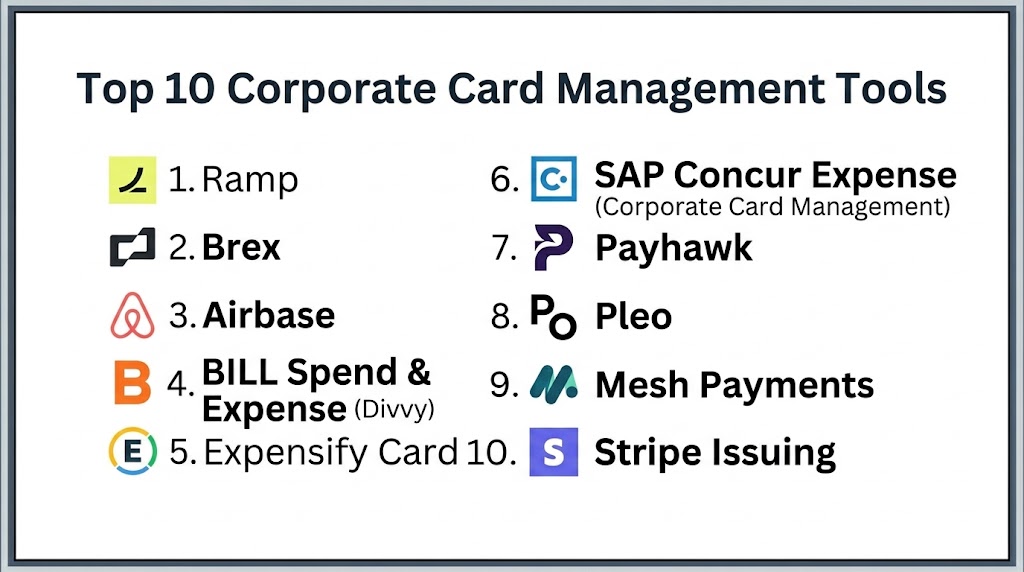
Top 10 Corporate Card Management Tools
#1 — Ramp
Short description: Ramp is a modern corporate card and spend management platform focused on automation, cost savings, and real-time financial visibility for growing companies.
Key Features
- Corporate card issuance
- Real-time expense tracking
- AI-powered spend insights
- Automated approvals
- Vendor and subscription tracking
- Spend controls and limits
Pros
- Strong automation and insights
- Easy to use
- Cost optimization features
Cons
- Limited global availability
- Smaller ecosystem than legacy tools
- Requires setup
Platforms / Deployment
Web / Mobile, Cloud
Security & Compliance
Encryption, access controls; certifications not publicly stated
Integrations & Ecosystem
Integrates with accounting tools and financial systems.
- ERP integrations
- API support
- Payment systems
Support & Community
Strong support for startups and mid-market
#2 — Brex
Short description: Brex combines corporate cards with expense management and financial tools tailored for startups and scaling companies.
Key Features
- Corporate card management
- Expense automation
- Real-time spend tracking
- Policy enforcement
- Financial reporting
Pros
- Startup-friendly
- Strong automation
- Easy onboarding
Cons
- Limited enterprise features
- Regional restrictions
- Pricing varies
Platforms / Deployment
Web / Mobile, Cloud
Security & Compliance
Not publicly stated
Integrations & Ecosystem
Integrates with accounting and CRM tools.
- API integrations
- Financial systems
Support & Community
Strong startup ecosystem support
#3 — Airbase
Short description: Airbase is an all-in-one spend management platform combining corporate cards, bill payments, and expense tracking.
Key Features
- Corporate cards
- Expense tracking
- Approval workflows
- Payment automation
- Reporting dashboards
Pros
- Unified platform
- Strong automation
- Scalable
Cons
- Complex setup
- Pricing varies
- Learning curve
Platforms / Deployment
Cloud
Security & Compliance
Not publicly stated
Integrations & Ecosystem
Integrates with ERP and finance tools.
Support & Community
Good enterprise support
#4 — BILL Spend & Expense (Divvy)
Short description: BILL Spend & Expense provides corporate card management with budgeting and expense automation capabilities.
Key Features
- Corporate card issuance
- Budget controls
- Expense tracking
- Approval workflows
- Reporting tools
Pros
- Strong budgeting features
- Easy to use
- Good automation
Cons
- Limited enterprise features
- Basic analytics
- Pricing varies
Platforms / Deployment
Cloud
Security & Compliance
Not publicly stated
Integrations & Ecosystem
Integrates with accounting systems.
Support & Community
Good support
#5 — Expensify Card
Short description: Expensify Card integrates expense management with corporate card functionality for seamless reporting.
Key Features
- Smart receipt scanning
- Automated expense reports
- Corporate card integration
- Approval workflows
- Real-time tracking
Pros
- Easy to use
- Fast setup
- Strong automation
Cons
- Limited advanced features
- Not ideal for large enterprises
- Pricing varies
Platforms / Deployment
Web / Mobile, Cloud
Security & Compliance
Encryption
Integrations & Ecosystem
Integrates with accounting and payment systems.
Support & Community
Strong documentation
#6 — SAP Concur Expense (Corporate Card Management)
Short description: SAP Concur provides enterprise-grade corporate card and expense management with strong compliance and reporting features.
Key Features
- Expense tracking
- Corporate card integration
- Policy enforcement
- Approval workflows
- Reporting dashboards
Pros
- Enterprise-ready
- Strong compliance
- Scalable
Cons
- Complex implementation
- Expensive
- Requires training
Platforms / Deployment
Web / Mobile, Cloud
Security & Compliance
Encryption, audit controls
Integrations & Ecosystem
Deep integration with SAP ecosystem.
Support & Community
Enterprise-level support
#7 — Payhawk
Short description: Payhawk combines corporate cards, expense management, and accounts payable into a unified platform.
Key Features
- Corporate cards
- Real-time tracking
- Expense automation
- Multi-currency support
- Reporting dashboards
Pros
- Strong global capabilities
- Unified platform
- Scalable
Cons
- Pricing varies
- Setup complexity
- Learning curve
Platforms / Deployment
Cloud
Security & Compliance
Not publicly stated
Integrations & Ecosystem
Integrates with ERP and accounting systems.
Support & Community
Good support
#8 — Pleo
Short description: Pleo offers smart corporate cards with automated expense management for SMBs and growing companies.
Key Features
- Smart corporate cards
- Receipt capture
- Expense automation
- Spend controls
- Reporting tools
Pros
- Easy to use
- Strong automation
- SMB-friendly
Cons
- Limited enterprise features
- Regional availability
- Pricing varies
Platforms / Deployment
Web / Mobile, Cloud
Security & Compliance
Not publicly stated
Integrations & Ecosystem
Integrates with accounting tools.
Support & Community
Strong support
#9 — Mesh Payments
Short description: Mesh Payments focuses on spend management with virtual cards and automated expense workflows.
Key Features
- Virtual cards
- Expense tracking
- Approval workflows
- Reporting dashboards
- Policy controls
Pros
- Strong virtual card features
- Easy automation
- Flexible
Cons
- Smaller ecosystem
- Limited enterprise reach
- Pricing varies
Platforms / Deployment
Cloud
Security & Compliance
Not publicly stated
Integrations & Ecosystem
Integrates with finance tools.
Support & Community
Growing support
#10 — Stripe Issuing
Short description: Stripe Issuing allows businesses to create and manage custom corporate cards with developer-friendly APIs.
Key Features
- Card issuing APIs
- Virtual and physical cards
- Spend controls
- Real-time transaction data
- Fraud detection
Pros
- Highly customizable
- Developer-friendly
- Scalable
Cons
- Requires technical setup
- Not plug-and-play
- Limited UI features
Platforms / Deployment
Cloud
Security & Compliance
Encryption, fraud detection
Integrations & Ecosystem
Integrates with Stripe ecosystem and APIs.
Support & Community
Strong developer support
Comparison Table
| Tool Name | Best For | Platform(s) Supported | Deployment | Standout Feature | Public Rating |
|---|---|---|---|---|---|
| Ramp | Startups | Web/Mobile | Cloud | AI insights | N/A |
| Brex | Startups | Web/Mobile | Cloud | Financial tools | N/A |
| Airbase | SMB/Mid | Web | Cloud | Unified spend | N/A |
| BILL Divvy | SMB | Web | Cloud | Budget controls | N/A |
| Expensify | SMB | Web/Mobile | Cloud | Automation | N/A |
| SAP Concur | Enterprise | Web/Mobile | Cloud | Compliance | N/A |
| Payhawk | Mid/Enterprise | Web | Cloud | Multi-currency | N/A |
| Pleo | SMB | Web/Mobile | Cloud | Ease of use | N/A |
| Mesh | SMB | Web | Cloud | Virtual cards | N/A |
| Stripe Issuing | Developers | API | Cloud | Custom cards | N/A |
Evaluation & Scoring of Corporate Card Management Tools
| Tool | Core | Ease | Integrations | Security | Performance | Support | Value | Weighted Total |
|---|---|---|---|---|---|---|---|---|
| Ramp | 9 | 8 | 8 | 7 | 8 | 7 | 8 | 8.1 |
| Brex | 8 | 8 | 8 | 7 | 8 | 7 | 8 | 7.9 |
| Airbase | 8 | 7 | 8 | 7 | 8 | 7 | 7 | 7.7 |
| BILL | 7 | 8 | 7 | 7 | 7 | 7 | 8 | 7.5 |
| Expensify | 7 | 9 | 7 | 7 | 7 | 8 | 8 | 7.6 |
| SAP Concur | 9 | 6 | 9 | 8 | 9 | 8 | 6 | 8.1 |
| Payhawk | 8 | 7 | 8 | 7 | 8 | 7 | 7 | 7.7 |
| Pleo | 7 | 9 | 7 | 7 | 7 | 7 | 8 | 7.6 |
| Mesh | 7 | 8 | 7 | 7 | 7 | 7 | 7 | 7.3 |
| Stripe | 8 | 6 | 9 | 8 | 8 | 7 | 7 | 7.8 |
How to interpret scores:
- Higher Core = stronger spend management features
- Higher Ease = simpler user experience
- Higher Value = better cost vs features
- Enterprises prioritize Core + Security, startups prioritize Ease + Value
Which Corporate Card Management Tool Is Right for You?
Solo / Freelancer
Not required; basic expense tools are sufficient.
SMB
Expensify, Zoho Expense alternatives, and Pleo offer simplicity and affordability.
Mid-Market
Airbase, Payhawk, and BILL provide better automation and scalability.
Enterprise
SAP Concur and advanced platforms offer compliance and control.
Budget vs Premium
- Budget: Expensify, Pleo
- Premium: SAP Concur, Airbase
Feature Depth vs Ease of Use
- Feature-rich: SAP Concur, Stripe
- Easy-to-use: Ramp, Expensify
Integrations & Scalability
Choose tools with strong API and ERP integrations.
Security & Compliance Needs
Prioritize tools with fraud detection, spend controls, and audit logs.
Frequently Asked Questions (FAQs)
1. What are corporate card management tools?
These tools help businesses issue and manage company cards for employees. They provide real-time tracking, spending controls, and automation. This improves financial visibility and control.
2. How do corporate cards improve expense management?
They automate expense tracking and eliminate manual reimbursements. Transactions are recorded instantly and categorized automatically. This reduces errors and saves time.
3. What features should I look for?
Look for spend controls, real-time tracking, integrations, and automation. Virtual cards and approval workflows are also important. Security features are critical.
4. Are corporate card platforms secure?
Most offer encryption, fraud detection, and access controls. Virtual cards add extra security. Security levels vary by provider.
5. Can these tools integrate with accounting systems?
Yes, most integrate with accounting and ERP systems. This ensures seamless reconciliation and reporting.
6. What is a virtual corporate card?
A virtual card is a digital card used for online payments. It can be limited to specific vendors or amounts. This reduces fraud risk.
7. How long does implementation take?
Startup tools can be deployed quickly, often in days. Enterprise tools may take weeks. Integration complexity affects timelines.
8. What pricing models are used?
Most tools offer subscription-based pricing or transaction-based fees. Some provide free tiers with card usage.
9. Who should use corporate card tools?
Businesses with employee expenses, subscriptions, or vendor payments benefit most. Finance teams rely on them for control and visibility.
10. What mistakes should be avoided?
Choosing tools without integrations or scalability is a common mistake. Ignoring automation features can also reduce efficiency.
Conclusion
Corporate Card Management Tools have transformed how businesses manage employee spending and financial control. By combining corporate cards with automation, real-time tracking, and policy enforcement, these platforms eliminate manual processes and reduce financial risk. As companies scale, managing expenses across teams and departments becomes more complex, making these tools essential. From startup-focused platforms like Ramp and Brex to enterprise solutions like SAP Concur, there are options for every business size. The right choice depends on your operational complexity, integration needs, and budget. Businesses should prioritize automation, visibility, and security when selecting a tool. It is also important to ensure seamless integration with existing finance systems. Instead of choosing based on popularity alone, organizations should evaluate how well a tool fits their workflows. Running a pilot with shortlisted tools is the best way to validate performance. This ensures better financial control, efficiency, and long-term scalability.
