Introduction
Search Relevance Tuning Tools are platforms and frameworks that help organizations improve how accurately search engines return results that match user intent. Instead of relying only on keyword matching, these tools optimize ranking using signals like user behavior, semantics, personalization, and business rules.
Search relevance is critical because it directly impacts user experience, engagement, and conversion rates. If users cannot find what they are looking for quickly, they leave. These tools ensure that search systems return the right results, in the right order, at the right time.
Common use cases include:
- E-commerce product search optimization
- Enterprise knowledge base search
- Content discovery and recommendation systems
- SaaS application search experiences
- AI-powered semantic and vector search
Key evaluation criteria:
- Ranking control and boosting rules
- Semantic and vector search capabilities
- Behavioral signal integration (clicks, CTR)
- A/B testing and evaluation frameworks
- Scalability and latency performance
- Integration with search engines and APIs
- Security and compliance capabilities
- Ease of tuning without heavy engineering
Best for: Search engineers, product managers, data scientists, e-commerce platforms, SaaS companies, and enterprises relying on search-driven experiences.
Not ideal for: Small applications with minimal search usage or systems where search is not a core feature.
Key Trends in Search Relevance Tuning Tools
- Adoption of semantic and vector search for intent-based ranking
- Growth of hybrid search (keyword + vector) systems
- Use of machine learning for ranking optimization (LTR models)
- Integration of LLMs for query understanding and rewriting
- Rise of real-time personalization based on user behavior
- Increased use of A/B testing and evaluation frameworks
- Expansion of low-code tuning interfaces
- Focus on analytics-driven relevance optimization
- Integration with RAG and AI-powered search systems
- Emphasis on continuous relevance monitoring and feedback loops
How We Selected These Tools (Methodology)
- Evaluated market adoption and ecosystem strength
- Assessed ranking and tuning capabilities
- Reviewed support for semantic and vector search
- Considered integration flexibility with search engines
- Included both open-source and enterprise tools
- Analyzed performance and scalability
- Focused on real-world production readiness
- Balanced developer-focused and business-friendly tools
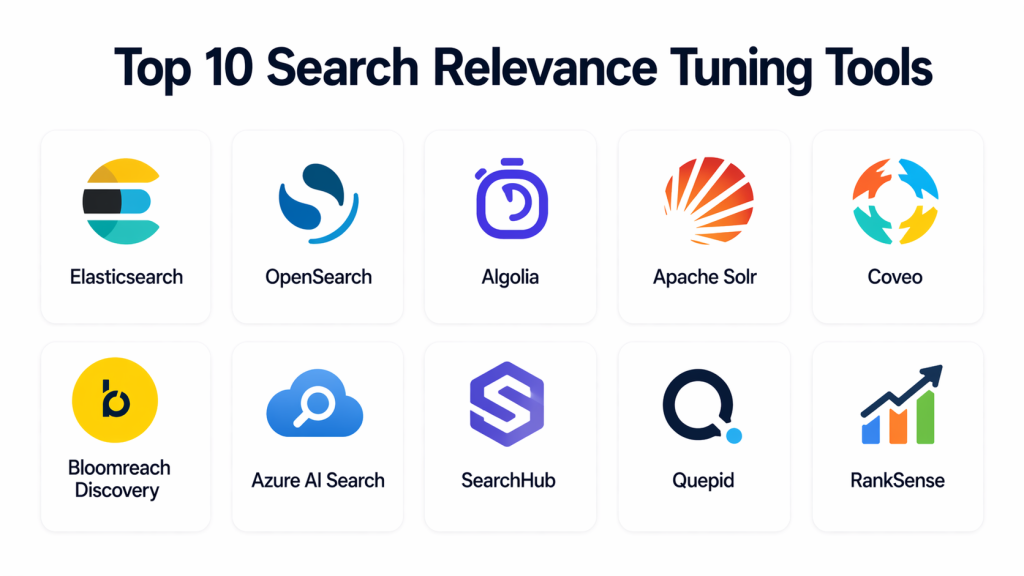
Top 10 Search Relevance Tuning Tools
#1 — Elasticsearch
Short description: A powerful open-source search engine widely used for building scalable search systems with advanced relevance tuning capabilities.
Key Features
- BM25 ranking and scoring
- Custom relevance tuning
- Full-text search
- Aggregations and analytics
- Machine learning integration
- Scalable architecture
Pros
- Highly customizable
- Strong ecosystem
Cons
- Requires expertise
- Operational complexity
Platforms / Deployment
Cloud / Self-hosted
Security & Compliance
Supports RBAC, encryption; certifications not publicly stated
Integrations & Ecosystem
Extensive integrations with data platforms and APIs.
- Logstash
- Kibana
- APIs
Support & Community
Large global community and enterprise support.
#2 — OpenSearch
Short description: An open-source search platform derived from Elasticsearch with strong relevance tuning and analytics features.
Key Features
- Search ranking tuning
- Analytics dashboards
- Plugin ecosystem
- Scalable indexing
- Query optimization
Pros
- Open-source flexibility
- Strong performance
Cons
- Requires setup
- Limited enterprise tooling compared to paid platforms
Platforms / Deployment
Cloud / Self-hosted
Security & Compliance
Varies
Integrations & Ecosystem
Supports APIs and cloud integrations.
Support & Community
Active open-source community.
#3 — Algolia
Short description: A hosted search platform designed for fast, relevant, and user-friendly search experiences with built-in tuning capabilities.
Key Features
- Instant search results
- AI-driven ranking
- Personalization
- Synonym management
- A/B testing
- Analytics
Pros
- Easy to implement
- High performance
Cons
- Pricing at scale
- Limited backend control
Platforms / Deployment
Cloud
Security & Compliance
Enterprise-grade security; details vary
Integrations & Ecosystem
Works with web apps and APIs.
Support & Community
Strong documentation and support.
#4 — Apache Solr
Short description: A mature open-source search platform built on Lucene with powerful relevance tuning and indexing features.
Key Features
- Custom ranking models
- Faceted search
- Query boosting
- Scalability
- Distributed search
Pros
- Highly configurable
- Proven reliability
Cons
- Complex configuration
- Requires maintenance
Platforms / Deployment
Self-hosted / Cloud
Security & Compliance
Varies
Integrations & Ecosystem
Supports enterprise search and APIs.
Support & Community
Strong open-source ecosystem.
#5 — Coveo
Short description: An AI-powered enterprise search platform focused on personalization and relevance optimization.
Key Features
- AI-powered ranking
- Personalization engine
- Analytics dashboards
- Relevance tuning tools
- Machine learning models
Pros
- Strong AI capabilities
- Enterprise-ready
Cons
- Expensive
- Complex implementation
Platforms / Deployment
Cloud
Security & Compliance
Enterprise-grade; details not publicly stated
Integrations & Ecosystem
Integrates with enterprise platforms and CRM systems.
Support & Community
Enterprise support model.
#6 — Bloomreach Discovery
Short description: A search and merchandising platform designed for e-commerce relevance tuning and product discovery.
Key Features
- AI-driven search
- Product ranking
- Personalization
- Analytics tools
- Merchandising controls
Pros
- Strong for e-commerce
- Easy tuning
Cons
- Limited outside retail use
- Pricing not transparent
Platforms / Deployment
Cloud
Security & Compliance
Not publicly stated
Integrations & Ecosystem
Supports e-commerce platforms and APIs.
Support & Community
Enterprise support.
#7 — Azure AI Search
Short description: A cloud-based search service with built-in relevance tuning, semantic ranking, and AI capabilities.
Key Features
- Semantic search
- Hybrid search
- Scoring profiles
- AI enrichment
- Indexing pipelines
Pros
- Scalable
- Strong cloud integration
Cons
- Azure dependency
- Pricing complexity
Platforms / Deployment
Cloud
Security & Compliance
Enterprise-grade cloud security
Integrations & Ecosystem
Deep integration with Azure services.
Support & Community
Strong enterprise support.
#8 — SearchHub
Short description: A platform designed for managing and optimizing search relevance through analytics and testing.
Key Features
- Query analysis
- Ranking tuning
- A/B testing
- Analytics dashboards
- Workflow management
Pros
- Easy experimentation
- Good visibility
Cons
- Smaller ecosystem
- Limited scalability
Platforms / Deployment
Cloud
Security & Compliance
Not publicly stated
Integrations & Ecosystem
Supports APIs and search engines.
Support & Community
Growing community.
#9 — Quepid
Short description: An open-source relevance tuning tool that helps teams test and improve search quality using metrics and feedback.
Key Features
- Relevance scoring (NDCG, etc.)
- Query testing
- Collaboration tools
- Metrics tracking
- Experimentation
Pros
- Free and open-source
- Strong evaluation capabilities
Cons
- Requires manual setup
- Limited UI
Platforms / Deployment
Self-hosted
Security & Compliance
Varies
Integrations & Ecosystem
Works with Elasticsearch and Solr.
Support & Community
Active open-source community.
#10 — RankSense
Short description: A search optimization platform that helps improve ranking using automation and analytics.
Key Features
- Automated tuning
- Ranking optimization
- Analytics insights
- SEO integration
- Query optimization
Pros
- Easy to use
- Automation features
Cons
- Limited enterprise features
- Smaller ecosystem
Platforms / Deployment
Cloud
Security & Compliance
Not publicly stated
Integrations & Ecosystem
Supports APIs and search tools.
Support & Community
Moderate support resources.
Comparison Table (Top 10)
| Tool Name | Best For | Platform(s) Supported | Deployment | Standout Feature | Public Rating |
|---|---|---|---|---|---|
| Elasticsearch | Developers | Multi-platform | Hybrid | Custom ranking | N/A |
| OpenSearch | Open-source search | Multi-platform | Hybrid | Plugin ecosystem | N/A |
| Algolia | Fast search apps | Web | Cloud | AI ranking | N/A |
| Apache Solr | Enterprise search | Multi-platform | Hybrid | Query boosting | N/A |
| Coveo | Enterprise AI search | Web | Cloud | Personalization | N/A |
| Bloomreach | E-commerce | Web | Cloud | Product ranking | N/A |
| Azure AI Search | Cloud search | Web | Cloud | Semantic ranking | N/A |
| SearchHub | Optimization | Web | Cloud | A/B testing | N/A |
| Quepid | Evaluation | Multi-platform | Self-hosted | Relevance scoring | N/A |
| RankSense | Automation | Web | Cloud | Auto tuning | N/A |
Evaluation & Scoring of Search Relevance Tuning Tools
| Tool Name | Core | Ease | Integrations | Security | Performance | Support | Value | Weighted Total |
|---|---|---|---|---|---|---|---|---|
| Elasticsearch | 9 | 6 | 9 | 7 | 9 | 8 | 7 | 8.2 |
| OpenSearch | 8 | 7 | 8 | 7 | 8 | 7 | 8 | 7.9 |
| Algolia | 8 | 9 | 7 | 7 | 9 | 8 | 7 | 8.1 |
| Apache Solr | 8 | 6 | 8 | 7 | 8 | 7 | 7 | 7.7 |
| Coveo | 9 | 7 | 8 | 8 | 9 | 8 | 6 | 8.2 |
| Bloomreach | 8 | 8 | 7 | 7 | 8 | 7 | 6 | 7.7 |
| Azure AI Search | 9 | 8 | 9 | 8 | 9 | 8 | 7 | 8.6 |
| SearchHub | 7 | 8 | 6 | 6 | 7 | 6 | 7 | 7.0 |
| Quepid | 7 | 7 | 7 | 6 | 7 | 7 | 9 | 7.3 |
| RankSense | 7 | 8 | 6 | 6 | 7 | 6 | 8 | 7.1 |
How to interpret scores:
These scores provide a relative comparison of tools across key factors. Higher scores indicate stronger overall capabilities, but the best choice depends on your use case. Enterprise teams may prioritize scalability and security, while smaller teams may value ease of use and cost efficiency.
Which Search Relevance Tuning Tool Is Right for You?
Solo / Freelancer
Quepid or RankSense are suitable for experimentation and lightweight tuning.
SMB
Algolia and OpenSearch provide a balance of usability and performance.
Mid-Market
Elasticsearch and Solr offer flexibility and scalability.
Enterprise
Coveo and Azure AI Search provide advanced AI-driven relevance and enterprise features.
Budget vs Premium
Open-source tools reduce cost, while managed platforms offer convenience.
Feature Depth vs Ease of Use
Elasticsearch offers depth; Algolia offers simplicity.
Integrations & Scalability
Azure AI Search and Elasticsearch excel in large-scale systems.
Security & Compliance Needs
Enterprises should prioritize tools with strong governance and access controls.
Frequently Asked Questions (FAQs)
1. What is search relevance tuning?
Search relevance tuning is the process of improving how accurately search results match user intent by adjusting ranking algorithms, signals, and data inputs.
2. Why is search relevance important?
It directly impacts user experience, engagement, and conversions. Better relevance means users find what they need faster.
3. What techniques are used in tuning?
Common techniques include semantic search, personalization, boosting rules, and machine learning models.
4. What is semantic search?
Semantic search focuses on understanding user intent rather than exact keyword matches, improving result accuracy.
5. Do these tools support AI-based ranking?
Yes, many tools use machine learning and AI to optimize ranking dynamically.
6. How is search relevance measured?
Metrics like precision, recall, and NDCG are used to evaluate relevance performance.
7. Can relevance tuning be automated?
Yes, many platforms offer automated tuning using AI and analytics.
8. Are these tools scalable?
Most modern tools are designed to scale for enterprise-level workloads.
9. What are common challenges?
Data quality, query understanding, and balancing business rules with user intent are key challenges.
10. Are open-source tools reliable?
Yes, but they often require more setup and expertise compared to managed solutions.
Conclusion
Search relevance tuning tools are essential for delivering accurate, fast, and meaningful search experiences. As user expectations grow, simply returning results is not enough—those results must be highly relevant and personalized. There is no one-size-fits-all solution. Enterprises may benefit from platforms like Azure AI Search or Coveo, while developers may prefer Elasticsearch or OpenSearch for flexibility. Smaller teams can start with tools like Quepid or RankSense for experimentation and optimization. The right tool depends on your scale, technical expertise, and business requirements. Focus on tools that integrate well with your existing systems and support continuous optimization. Start by shortlisting a few tools, running experiments, and measuring relevance improvements. Validate performance and scalability before full deployment to ensure long-term success.
