Introduction
Test Case Management Tools are software platforms designed to help teams create, organize, manage, and track test cases throughout the software testing lifecycle. These tools provide a centralized system where QA teams can plan test scenarios, execute test runs, and monitor results efficiently.
In modern software development environments driven by agile methodologies and continuous delivery, managing test cases manually is no longer scalable. Test case management tools ensure better visibility, traceability, and collaboration across development, QA, and product teams.
Common use cases include:
- Organizing and managing test cases across projects
- Tracking test execution and results
- Mapping requirements to test cases for traceability
- Managing regression testing cycles
- Collaborating across QA, developers, and stakeholders
Buyers should evaluate:
- Ease of test case creation and organization
- Integration with bug tracking and CI/CD tools
- Reporting and analytics capabilities
- Support for manual and automated testing
- Scalability for large test suites
- Role-based access and collaboration features
- Customization and workflow flexibility
- Pricing and licensing model
Best for: QA teams, test managers, developers, and organizations with structured testing workflows.
Not ideal for: Small teams with minimal testing needs or projects where simple spreadsheets are sufficient.
Key Trends in Test Case Management Tools
- AI-assisted test case generation and optimization
- Integration with automated testing frameworks
- Shift toward cloud-based collaboration platforms
- Real-time reporting and analytics dashboards
- Increased focus on traceability and compliance
- Support for agile and DevOps workflows
- API-first architectures for integration flexibility
- Enhanced user experience and low-code interfaces
- Integration with test automation pipelines
- Improved role-based access and governance
How We Selected These Tools (Methodology)
- Evaluated industry adoption and popularity
- Assessed feature completeness for test management
- Reviewed usability and user experience
- Considered integration capabilities with DevOps tools
- Analyzed scalability for enterprise usage
- Included both open-source and commercial tools
- Evaluated reporting and analytics capabilities
- Considered community support and documentation
- Reviewed flexibility for different testing workflows
- Focused on real-world usability and reliability
Top 10 Test Case Management Tools Tools
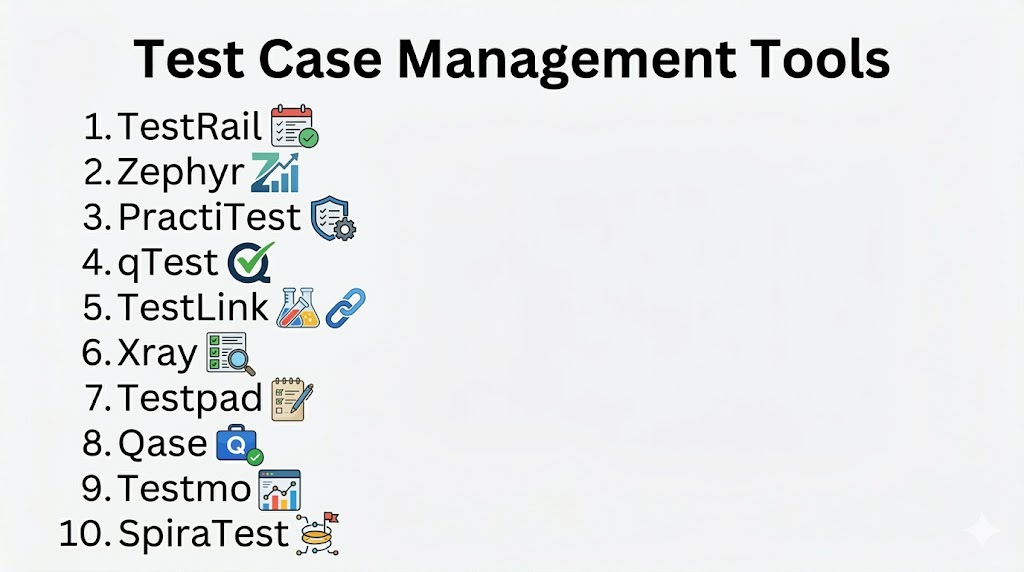
#1 — TestRail
Short description: A widely used test case management tool designed for organizing, tracking, and managing testing activities efficiently.
Key Features
- Test case creation and management
- Test run tracking
- Detailed reporting
- Requirement traceability
- Role-based access control
- Integration with CI/CD tools
Pros
- Easy to use
- Strong reporting features
Cons
- Paid tool
- Limited customization
Platforms / Deployment
- Cloud / Self-hosted
Security & Compliance
- Not publicly stated
Integrations & Ecosystem
TestRail integrates with popular development and testing tools.
- Jira
- CI/CD tools
- APIs
Support & Community
Strong documentation and commercial support.
#2 — Zephyr
Short description: A flexible test management solution designed for integration with agile and DevOps environments.
Key Features
- Test case management
- Agile support
- Real-time reporting
- Requirement traceability
- Integration with issue tracking
- Test automation support
Pros
- Strong Jira integration
- Scalable
Cons
- Complex setup
- Performance issues in large projects
Platforms / Deployment
- Cloud / Self-hosted
Security & Compliance
- Not publicly stated
Integrations & Ecosystem
Zephyr integrates deeply with development ecosystems.
- Jira
- CI/CD tools
- APIs
Support & Community
Commercial support with growing user base.
#3 — PractiTest
Short description: End-to-end test management platform focused on visibility and traceability.
Key Features
- Centralized test repository
- Requirement traceability
- Real-time dashboards
- Automation integration
- Custom workflows
- API support
Pros
- Strong reporting
- Flexible workflows
Cons
- Paid solution
- Learning curve
Platforms / Deployment
- Cloud
Security & Compliance
- Not publicly stated
Integrations & Ecosystem
PractiTest supports integrations across development pipelines.
- CI/CD tools
- Issue trackers
- APIs
Support & Community
Reliable commercial support.
#4 — qTest
Short description: Enterprise test management tool designed for scaling QA processes.
Key Features
- Test planning and execution
- Requirement traceability
- Automation integration
- Real-time reporting
- Agile workflow support
- Risk-based testing
Pros
- Enterprise scalability
- Strong integrations
Cons
- Expensive
- Complex interface
Platforms / Deployment
- Cloud
Security & Compliance
- Not publicly stated
Integrations & Ecosystem
qTest integrates with enterprise development tools.
- Jira
- CI/CD pipelines
- APIs
Support & Community
Enterprise-grade support services.
#5 — TestLink
Short description: Open-source test management tool for managing test cases and execution.
Key Features
- Test case management
- Test execution tracking
- Reporting tools
- Requirement management
- User roles
- Open-source flexibility
Pros
- Free to use
- Customizable
Cons
- Outdated UI
- Limited modern integrations
Platforms / Deployment
- Self-hosted
Security & Compliance
- Not publicly stated
Integrations & Ecosystem
TestLink integrates with basic development tools.
- Bug tracking tools
- APIs
Support & Community
Community-driven support.
#6 — Xray
Short description: Test management tool built specifically for integration with Jira environments.
Key Features
- Native Jira integration
- Test case management
- Automation support
- Requirement traceability
- Reporting dashboards
- CI/CD integration
Pros
- Seamless Jira integration
- Strong traceability
Cons
- Jira dependency
- Paid tool
Platforms / Deployment
- Cloud / Self-hosted
Security & Compliance
- Not publicly stated
Integrations & Ecosystem
Xray works closely with agile development ecosystems.
- Jira
- CI/CD tools
- APIs
Support & Community
Active community and vendor support.
#7 — Testpad
Short description: Lightweight test management tool focused on simplicity and exploratory testing.
Key Features
- Checklist-style test cases
- Easy test execution
- Real-time collaboration
- Simple UI
- Reporting tools
- Cloud access
Pros
- Easy to use
- Minimal setup
Cons
- Limited advanced features
- Not ideal for large enterprises
Platforms / Deployment
- Cloud
Security & Compliance
- Not publicly stated
Integrations & Ecosystem
Testpad integrates with lightweight workflows.
- APIs
- Issue tracking tools
Support & Community
Moderate support and documentation.
#8 — Qase
Short description: Modern test management platform with focus on usability and integrations.
Key Features
- Test case management
- Test run tracking
- Automation integration
- Reporting dashboards
- Role-based access
- API support
Pros
- Modern interface
- Good integration support
Cons
- Paid features
- Smaller ecosystem
Platforms / Deployment
- Cloud
Security & Compliance
- Not publicly stated
Integrations & Ecosystem
Qase integrates with development and QA tools.
- CI/CD tools
- Issue trackers
- APIs
Support & Community
Growing community and support resources.
#9 — Testmo
Short description: Unified test management platform for manual, exploratory, and automated testing.
Key Features
- Unified test management
- Automation integration
- Session-based testing
- Reporting dashboards
- CI/CD integration
- API support
Pros
- All-in-one platform
- Modern UI
Cons
- Paid tool
- Limited legacy integrations
Platforms / Deployment
- Cloud / Self-hosted
Security & Compliance
- Not publicly stated
Integrations & Ecosystem
Testmo integrates with modern DevOps environments.
- CI/CD tools
- APIs
- Issue tracking tools
Support & Community
Reliable vendor support.
#10 — SpiraTest
Short description: Comprehensive test management tool with built-in defect tracking.
Key Features
- Test case management
- Requirement traceability
- Defect tracking
- Reporting tools
- Automation integration
- Agile support
Pros
- All-in-one solution
- Strong traceability
Cons
- Interface complexity
- Learning curve
Platforms / Deployment
- Cloud / Self-hosted
Security & Compliance
- Not publicly stated
Integrations & Ecosystem
SpiraTest integrates with development and QA ecosystems.
- CI/CD tools
- APIs
- Issue tracking systems
Support & Community
Commercial support with documentation.
Comparison Table (Top 10)
| Tool Name | Best For | Platform(s) Supported | Deployment | Standout Feature | Public Rating |
|---|---|---|---|---|---|
| TestRail | General QA teams | Cross-platform | Hybrid | Reporting | N/A |
| Zephyr | Agile teams | Cross-platform | Hybrid | Jira integration | N/A |
| PractiTest | Enterprises | Web | Cloud | Traceability | N/A |
| qTest | Large enterprises | Web | Cloud | Scalability | N/A |
| TestLink | Open-source users | Web | Self-hosted | Free usage | N/A |
| Xray | Jira users | Cross-platform | Hybrid | Native integration | N/A |
| Testpad | Small teams | Web | Cloud | Simplicity | N/A |
| Qase | Modern teams | Web | Cloud | UI/UX | N/A |
| Testmo | DevOps teams | Cross-platform | Hybrid | Unified testing | N/A |
| SpiraTest | Full lifecycle | Cross-platform | Hybrid | Built-in tracking | N/A |
Evaluation & Scoring of Test Case Management Tools
| Tool Name | Core (25%) | Ease (15%) | Integrations (15%) | Security (10%) | Performance (10%) | Support (10%) | Value (15%) | Weighted Total (0–10) |
|---|---|---|---|---|---|---|---|---|
| TestRail | 9 | 8 | 8 | 6 | 8 | 8 | 7 | 8.0 |
| Zephyr | 8 | 7 | 9 | 6 | 8 | 7 | 7 | 7.7 |
| PractiTest | 8 | 7 | 8 | 6 | 8 | 8 | 6 | 7.6 |
| qTest | 9 | 6 | 9 | 7 | 9 | 8 | 6 | 8.0 |
| TestLink | 7 | 6 | 6 | 5 | 6 | 6 | 9 | 6.8 |
| Xray | 8 | 7 | 9 | 6 | 8 | 7 | 7 | 7.7 |
| Testpad | 6 | 9 | 6 | 5 | 6 | 6 | 8 | 6.9 |
| Qase | 7 | 8 | 7 | 6 | 7 | 7 | 7 | 7.2 |
| Testmo | 8 | 8 | 8 | 6 | 8 | 7 | 7 | 7.7 |
| SpiraTest | 8 | 7 | 8 | 6 | 8 | 7 | 6 | 7.4 |
How to interpret:
- Scores are relative comparisons across tools.
- Higher scores indicate better balance of features and usability.
- Enterprise tools score higher in capability, while open-source tools offer better value.
Which Test Case Management Tools Tool Is Right for You?
Solo / Freelancer
Choose TestLink or Testpad for simplicity and cost efficiency.
SMB
TestRail or Qase provide a good balance of usability and features.
Mid-Market
PractiTest and Testmo offer scalability and integration capabilities.
Enterprise
qTest and Zephyr are suitable for large teams and complex workflows.
Budget vs Premium
- Budget-friendly: TestLink, Testpad
- Premium: qTest, PractiTest
Feature Depth vs Ease of Use
- Easy tools: Testpad, Qase
- Advanced tools: qTest, Zephyr
Integrations & Scalability
- Strong integrations: Xray, qTest
Security & Compliance Needs
- Enterprise tools generally provide better governance and control.
Frequently Asked Questions (FAQs)
1. What is a test case management tool?
It helps organize, track, and manage test cases throughout the testing lifecycle.
2. Do I need a test management tool?
Yes, especially for large projects where manual tracking becomes difficult.
3. Are these tools suitable for automation?
Most tools integrate with automated testing frameworks.
4. Can I integrate with CI/CD pipelines?
Yes, modern tools support CI/CD integration.
5. Are there free options?
Yes, tools like TestLink are open-source.
6. What is requirement traceability?
It links test cases to requirements to ensure full coverage.
7. How scalable are these tools?
Enterprise tools are highly scalable for large teams.
8. Can I switch tools later?
Yes, but migration effort depends on data complexity.
9. What industries use these tools?
Software development, finance, healthcare, and IT services.
10. What are alternatives?
Spreadsheets or basic project management tools for small teams.
Conclusion
Test case management tools play a crucial role in maintaining structured, efficient, and scalable testing processes. From lightweight solutions like Testpad to enterprise-grade platforms like qTest, each tool offers unique strengths based on team size and workflow complexity. The right choice depends on your organization’s testing maturity, integration needs, and budget constraints. Rather than selecting a tool based solely on popularity, it is more effective to evaluate how well it fits into your existing development and QA ecosystem. A practical next step is to shortlist a few tools, run pilot implementations, and assess usability, reporting, and integration capabilities before making a final decision.
