Introduction
Container Platforms enable developers and organizations to package applications along with their dependencies into lightweight, portable units called containers. In simple terms, containers allow software to run consistently across different environments—whether on a developer’s laptop, a data center, or the cloud.
In modern software development, container platforms have become essential for building, deploying, and scaling applications efficiently. They eliminate the classic “it works on my machine” problem and enable faster development cycles, better resource utilization, and improved scalability.
Today’s container platforms go beyond simple containerization. They include orchestration, automation, scaling, networking, security, CI/CD integrations, and hybrid cloud support. These platforms are widely used in DevOps, microservices architectures, cloud-native applications, and enterprise deployments.
Common use cases include:
- Microservices architecture deployment
- CI/CD pipelines
- Cloud-native application development
- Dev/test environment standardization
- Scalable application hosting
What buyers should evaluate:
- Ease of deployment
- Orchestration capabilities
- Scalability
- Integration ecosystem
- Security features
- Multi-cloud support
- Developer experience
- Monitoring and logging
- Automation features
- Cost and operational overhead
Best for: Developers, DevOps teams, enterprises, cloud-native businesses, startups, and IT infrastructure teams.
Not ideal for: Small teams with simple applications that do not require scalability or containerization.
Key Trends in Container Platforms
- Kubernetes becoming the standard orchestration layer
- Growth of serverless containers
- Integration with CI/CD pipelines
- Multi-cloud and hybrid deployments
- Container security and runtime protection
- GitOps and infrastructure-as-code adoption
- AI-driven monitoring and optimization
- Edge computing with containers
- Simplified developer platforms
- Rise of lightweight container runtimes
How We Selected These Tools (Methodology)
- Market adoption and popularity
- Feature completeness
- Performance and scalability
- Ease of use
- Integration ecosystem
- Security capabilities
- Multi-cloud support
- Developer experience
- Community and support
- Overall value
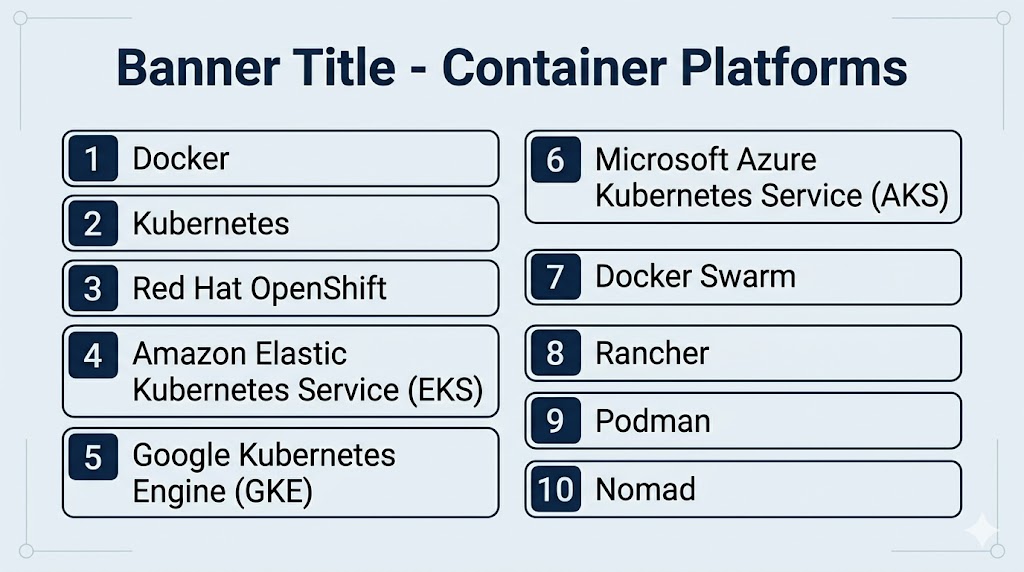
Top 10 Container Platforms
#1 — Docker
Short description: The most widely used container platform for building, packaging, and running containers.
Key Features
- Container creation and management
- Docker Engine runtime
- Image repositories
- CLI tools
- Container networking
- Developer-friendly workflows
Pros
- Easy to get started
- Massive ecosystem
Cons
- Limited orchestration features alone
- Requires additional tools for scaling
Platforms / Deployment
Windows / macOS / Linux
Cloud / Local
Security & Compliance
Basic container security features available.
Integrations & Ecosystem
CI/CD tools, cloud platforms, developer tools.
Support & Community
Huge global community.
#2 — Kubernetes
Short description: The industry-standard container orchestration platform for managing large-scale deployments.
Key Features
- Container orchestration
- Auto-scaling
- Load balancing
- Self-healing containers
- Service discovery
- Declarative configuration
Pros
- Highly scalable
- Industry standard
Cons
- Complex to learn
- Requires setup and management
Platforms / Deployment
Cross-platform
Cloud / Self-hosted / Hybrid
Security & Compliance
Advanced security controls available.
Integrations & Ecosystem
Cloud providers, DevOps tools, APIs.
Support & Community
Massive open-source community.
#3 — Red Hat OpenShift
Short description: Enterprise Kubernetes platform with added developer and security features.
Key Features
- Kubernetes-based orchestration
- Built-in CI/CD
- Developer tools
- Security policies
- Monitoring and logging
- Multi-cloud support
Pros
- Enterprise-ready
- Strong security features
Cons
- Premium pricing
- Requires expertise
Platforms / Deployment
Linux / Cloud
Cloud / Hybrid
Security & Compliance
Enterprise-grade security controls.
Integrations & Ecosystem
Red Hat ecosystem, cloud providers.
Support & Community
Strong enterprise support.
#4 — Amazon Elastic Kubernetes Service (EKS)
Short description: Managed Kubernetes service by AWS for scalable container orchestration.
Key Features
- Managed Kubernetes control plane
- Auto scaling
- Integration with AWS services
- Security controls
- Monitoring tools
- High availability
Pros
- No infrastructure management
- Strong AWS integration
Cons
- AWS dependency
- Cost complexity
Platforms / Deployment
Cloud
Security & Compliance
AWS security model.
Integrations & Ecosystem
AWS services, APIs.
Support & Community
Strong cloud ecosystem.
#5 — Google Kubernetes Engine (GKE)
Short description: Fully managed Kubernetes platform by Google Cloud.
Key Features
- Automated cluster management
- Auto-scaling
- Monitoring tools
- Security features
- CI/CD integrations
- High performance
Pros
- Excellent Kubernetes support
- Easy scaling
Cons
- Google Cloud dependency
- Pricing varies
Platforms / Deployment
Cloud
Security & Compliance
Google Cloud security controls.
Integrations & Ecosystem
Google Cloud services.
Support & Community
Strong cloud-native reputation.
#6 — Microsoft Azure Kubernetes Service (AKS)
Short description: Managed Kubernetes service integrated with Microsoft Azure ecosystem.
Key Features
- Managed clusters
- Auto-scaling
- Azure integrations
- Monitoring tools
- Security features
- DevOps integration
Pros
- Strong Microsoft integration
- Easy deployment
Cons
- Azure dependency
- Requires cloud expertise
Platforms / Deployment
Cloud
Security & Compliance
Azure security controls.
Integrations & Ecosystem
Azure services, Microsoft tools.
Support & Community
Strong enterprise support.
#7 — Docker Swarm
Short description: Lightweight orchestration tool built into Docker.
Key Features
- Cluster management
- Service scaling
- Load balancing
- Simple setup
- Integrated Docker CLI
- High availability
Pros
- Easy to use
- Lightweight
Cons
- Less powerful than Kubernetes
- Smaller ecosystem
Platforms / Deployment
Cross-platform
Self-hosted
Security & Compliance
Basic controls available.
Integrations & Ecosystem
Docker ecosystem.
Support & Community
Moderate community support.
#8 — Rancher
Short description: Kubernetes management platform for multi-cluster environments.
Key Features
- Multi-cluster management
- Centralized dashboard
- Access control
- Monitoring tools
- Policy management
- Integration support
Pros
- Simplifies Kubernetes
- Multi-cloud support
Cons
- Requires Kubernetes knowledge
- Setup complexity
Platforms / Deployment
Linux / Cloud
Cloud / Hybrid
Security & Compliance
Enterprise-grade controls.
Integrations & Ecosystem
Kubernetes ecosystem.
Support & Community
Strong open-source support.
#9 — Podman
Short description: Daemonless container engine for secure container management.
Key Features
- Rootless containers
- Docker-compatible CLI
- Container management
- Security isolation
- Lightweight runtime
- Linux integration
Pros
- Improved security model
- No daemon required
Cons
- Smaller ecosystem
- Learning curve for beginners
Platforms / Deployment
Linux
Security & Compliance
Enhanced security features.
Integrations & Ecosystem
Linux and open-source tools.
Support & Community
Growing adoption.
#10 — Nomad
Short description: Flexible workload orchestrator supporting containers and non-container workloads.
Key Features
- Lightweight orchestration
- Multi-workload support
- High scalability
- Simple deployment
- Integration with HashiCorp tools
- Resource scheduling
Pros
- Simple and flexible
- Supports multiple workloads
Cons
- Smaller ecosystem
- Less feature-rich than Kubernetes
Platforms / Deployment
Cross-platform
Cloud / Self-hosted
Security & Compliance
Basic enterprise controls.
Integrations & Ecosystem
HashiCorp ecosystem.
Support & Community
Growing community.
Comparison Table (Top 10)
| Tool Name | Best For | Platform(s) Supported | Deployment | Standout Feature | Public Rating |
|---|---|---|---|---|---|
| Docker | Developers | Cross-platform | Local/Cloud | Container creation | N/A |
| Kubernetes | Enterprises | Cross-platform | Hybrid | Orchestration standard | N/A |
| OpenShift | Enterprises | Linux/Cloud | Hybrid | Enterprise Kubernetes | N/A |
| Amazon EKS | AWS users | Cloud | Cloud | Managed Kubernetes | N/A |
| GKE | Google Cloud users | Cloud | Cloud | Auto management | N/A |
| AKS | Azure users | Cloud | Cloud | Azure integration | N/A |
| Docker Swarm | Small teams | Cross-platform | Self-hosted | Simplicity | N/A |
| Rancher | Multi-cluster | Cross-platform | Hybrid | Central management | N/A |
| Podman | Security-focused | Linux | Self-hosted | Rootless containers | N/A |
| Nomad | Flexible workloads | Cross-platform | Hybrid | Lightweight orchestration | N/A |
Evaluation & Scoring of Container Platforms
| Tool Name | Core (25%) | Ease (15%) | Integrations (15%) | Security (10%) | Performance (10%) | Support (10%) | Value (15%) | Weighted Total |
|---|---|---|---|---|---|---|---|---|
| Docker | 9 | 10 | 9 | 8 | 9 | 9 | 9 | 9.2 |
| Kubernetes | 10 | 7 | 10 | 9 | 10 | 10 | 9 | 9.4 |
| OpenShift | 9 | 7 | 9 | 10 | 9 | 9 | 7 | 8.7 |
| Amazon EKS | 9 | 8 | 9 | 9 | 9 | 9 | 8 | 8.8 |
| GKE | 9 | 9 | 9 | 9 | 9 | 9 | 8 | 8.9 |
| AKS | 9 | 9 | 9 | 9 | 9 | 9 | 8 | 8.9 |
| Docker Swarm | 7 | 9 | 7 | 7 | 8 | 7 | 9 | 7.9 |
| Rancher | 8 | 8 | 9 | 9 | 8 | 8 | 8 | 8.3 |
| Podman | 8 | 7 | 7 | 9 | 8 | 7 | 9 | 7.9 |
| Nomad | 8 | 8 | 8 | 8 | 8 | 7 | 9 | 8.1 |
How to interpret scores:
Kubernetes-based platforms dominate scalability and orchestration, while Docker excels in simplicity and developer experience.
Which Container Platform Is Right for You?
Solo / Freelancer
Docker, Podman
SMB
Docker Swarm, Docker
Mid-Market
Rancher, AKS, GKE
Enterprise
Kubernetes, OpenShift, EKS
Budget vs Premium
- Budget: Docker, Podman
- Premium: OpenShift
Feature Depth vs Ease of Use
- Easy: Docker, Swarm
- Deep: Kubernetes, OpenShift
Integrations & Scalability
Kubernetes, EKS, AKS
Security & Compliance Needs
OpenShift, Podman
Frequently Asked Questions (FAQs)
What is a container platform?
It helps build, run, and manage containers.
Is Kubernetes required?
Not always, but it is the standard for orchestration.
Is Docker enough?
Yes for small setups, but orchestration may be needed.
Are containers secure?
Yes, with proper configuration.
What is orchestration?
Managing multiple containers automatically.
Are containers faster than VMs?
Yes, they are lightweight.
Do I need cloud?
Not necessarily, containers can run locally.
Which platform is best for beginners?
Docker.
Which is best for enterprise?
Kubernetes or OpenShift.
How do I choose?
Based on scale, complexity, and ecosystem.
Conclusion
Container Platforms are essential for building scalable, portable, and efficient modern applications. Docker remains the entry point for developers, while Kubernetes dominates large-scale orchestration. Managed services like EKS, GKE, and AKS simplify deployment, and OpenShift adds enterprise-grade capabilities. Tools like Rancher and Nomad help manage complexity and flexibility. The right platform depends on your team size, technical expertise, scalability needs, and budget. Start small, test workloads, and gradually scale your container strategy to match your infrastructure goals.
