Introduction
Container image scanners help organizations detect security vulnerabilities, misconfigurations, malware risks, and outdated packages inside container images before they are deployed to production. In modern cloud-native environments, container images are built frequently through CI/CD pipelines, often pulling dependencies from multiple sources. Without scanning, a single vulnerable package inside an image can expose the entire application stack.
These tools are critical because containers are now the default packaging unit for microservices, Kubernetes workloads, and cloud deployments. A vulnerable base image or dependency can lead to supply chain attacks, privilege escalation, or runtime exploitation.
Common real-world use cases include scanning Docker images in CI/CD pipelines, validating base images, checking Kubernetes deployments, generating SBOMs, blocking insecure images, and ensuring compliance with security policies.
Buyers should evaluate vulnerability coverage, scanning speed, false positive rate, CI/CD integration, Kubernetes support, SBOM generation, policy enforcement, cloud compatibility, developer experience, and reporting capabilities.
Best for: DevSecOps teams, cloud security engineers, platform engineers, Kubernetes administrators, and organizations deploying containerized applications at scale.
Not ideal for: teams not using containers, very small applications with minimal deployment pipelines, or organizations relying only on traditional VM-based infrastructure.
Key Trends in Container Image Scanners
- Shift-left container security is standard, with scanning embedded directly into CI/CD pipelines.
- SBOM-driven security workflows are becoming mandatory for supply chain visibility and compliance.
- Multi-layer scanning is expanding, covering OS packages, application dependencies, and language runtimes.
- Kubernetes-native scanning is increasing, with deeper integration into cluster admission control.
- Faster scanning engines like Grype are optimized for CI speed and pipeline efficiency.
- Unified security platforms are emerging, combining image scanning, runtime security, and policy enforcement.
- Open-source dominance remains strong, especially Trivy, Grype, and Clair.
- Cloud-native security platforms are integrating scanning with CNAPP systems.
- AI-assisted vulnerability prioritization is improving remediation workflows.
- Registry-integrated scanning is growing, especially in enterprise container registries.
How We Selected These Tools
- Focused on tools that scan container images, Docker layers, and OCI artifacts
- Included both open-source and enterprise-grade scanners
- Prioritized tools with strong CI/CD integration support
- Selected tools that support CVE databases and vulnerability intelligence feeds
- Considered SBOM generation and supply chain security alignment
- Evaluated Kubernetes and cloud-native compatibility
- Included tools suitable for startups, SMBs, and enterprises
- Considered performance and scan speed for pipeline usage
- Avoided unsupported claims and unverified certifications
- Used N/A where public ratings or compliance data is not confirmed
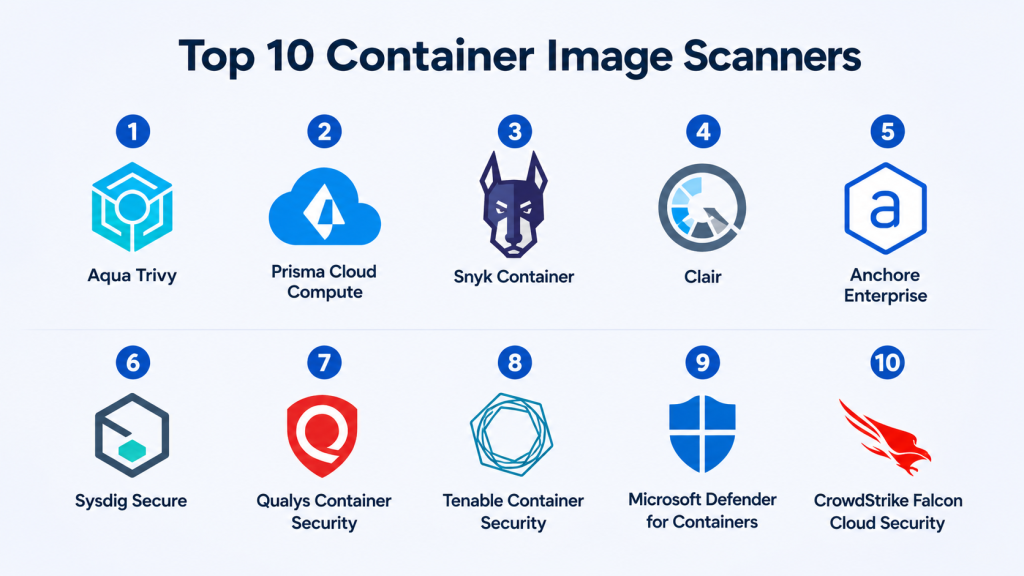
Top 10 Container Image Scanners
1- Trivy
Short description: Trivy is one of the most widely used open-source container image scanners designed for speed, simplicity, and broad security coverage. It scans container images, file systems, Git repositories, and Kubernetes manifests for vulnerabilities and misconfigurations. It is widely adopted in DevSecOps pipelines due to its ease of use and fast scanning engine.
Key Features
- Container image vulnerability scanning
- OS package and language dependency scanning
- Kubernetes manifest scanning
- SBOM generation support
- CI/CD pipeline integration
- Git repository scanning
- Fast vulnerability database updates
Pros
- Extremely fast and easy to use
- Strong multi-purpose scanning capability
- Excellent CI/CD integration
- Large open-source adoption
Cons
- Broad scope may introduce overhead
- Advanced enterprise policy features require additional tooling
- Limited runtime security features
- Can produce large scan outputs in complex images
Platforms / Deployment
CLI, Linux, macOS, Windows, CI/CD pipelines, containers, Kubernetes environments
Security & Compliance
Supports vulnerability databases from multiple sources and SBOM standards. Enterprise compliance features depend on integration setup. Not publicly stated for formal certifications.
Integrations & Ecosystem
Trivy integrates deeply into DevOps and cloud-native ecosystems.
- GitHub Actions
- GitLab CI
- Jenkins pipelines
- Kubernetes clusters
- Docker workflows
- SBOM tools and registries
Support & Community
Strong open-source community with wide adoption in DevSecOps environments and extensive documentation.
2- Grype
Short description: Grype is a lightweight open-source vulnerability scanner focused specifically on container images and file systems. It is designed for speed and accuracy and is commonly used with SBOM workflows generated by Syft.
Key Features
- Container image vulnerability scanning
- Filesystem scanning support
- SBOM-based scanning
- Multiple output formats (JSON, SARIF, SPDX)
- Fast scanning engine
- Integration with Anchore ecosystem
- CVE database mapping
Pros
- Very fast scanning performance
- High accuracy with fewer false positives
- Strong SBOM integration
- Lightweight CLI tool
Cons
- Limited to vulnerability scanning only
- No built-in policy enforcement
- Requires ecosystem tools for full security coverage
- Less feature-rich UI support
Platforms / Deployment
CLI, Linux, macOS, Windows, CI/CD pipelines, containers
Security & Compliance
Uses multiple vulnerability feeds including NVD and distro-specific databases. Compliance reporting requires external tools. Not publicly stated for certifications.
Integrations & Ecosystem
- Syft SBOM generator
- CI/CD pipelines
- Docker registries
- Security automation workflows
- DevSecOps pipelines
Support & Community
Strong open-source support under Anchore ecosystem with active DevSecOps adoption.
3- Clair
Short description: Clair is an open-source container vulnerability analysis tool designed for scanning container images stored in registries. It works as a backend service that analyzes image layers and detects known vulnerabilities using CVE databases.
Key Features
- Registry-based image scanning
- Layered vulnerability analysis
- CVE database integration
- API-driven architecture
- Scalable scanning engine
- Integration with container registries
- Continuous vulnerability updates
Pros
- Strong registry integration
- Scalable backend architecture
- Good for centralized scanning systems
- Mature open-source project
Cons
- Requires external frontend tools
- Less developer-friendly than modern CLI tools
- Slower adoption compared to newer scanners
- Limited modern CI/CD features
Platforms / Deployment
Self-hosted, cloud, container registry environments, Kubernetes
Security & Compliance
Security depends on deployment architecture and registry configuration. Compliance features depend on external integrations. Not publicly stated for formal certifications.
Integrations & Ecosystem
- Container registries like Harbor
- CI/CD pipelines via API
- Kubernetes environments
- Vulnerability databases
- Enterprise scanning workflows
Support & Community
Community-driven project with strong use in registry-based scanning systems.
4- Anchore Engine
Short description: Anchore Engine is a container security platform that provides deep analysis of container images, policy-based scanning, and compliance enforcement capabilities. It is designed for enterprise-grade security governance.
Key Features
- Deep container image analysis
- Policy-based scanning engine
- Vulnerability detection
- Compliance rule enforcement
- CI/CD integration
- Image inspection and reporting
- Registry scanning support
Pros
- Strong enterprise policy enforcement
- Detailed vulnerability insights
- Good compliance alignment
- Supports governance workflows
Cons
- Complex setup and configuration
- Heavier system requirements
- Less developer-friendly than CLI scanners
- Requires maintenance effort
Platforms / Deployment
Self-hosted, cloud, Kubernetes, enterprise environments
Security & Compliance
Supports policy-based compliance checks. Formal certifications depend on deployment context. Not publicly stated.
Integrations & Ecosystem
- CI/CD pipelines
- Container registries
- Kubernetes
- Security governance systems
- DevSecOps platforms
Support & Community
Enterprise-focused support through Anchore ecosystem and documentation.
5- Snyk Container
Short description: Snyk Container is a developer-focused security tool that scans container images for vulnerabilities and integrates tightly into CI/CD workflows and developer environments.
Key Features
- Container image vulnerability scanning
- Base image recommendations
- CI/CD integration
- Developer-first UI
- Continuous monitoring
- Security prioritization
- Registry scanning support
Pros
- Strong developer experience
- Easy CI/CD integration
- Good remediation guidance
- Continuous monitoring capabilities
Cons
- Best features require paid tiers
- Limited customization for advanced users
- Vendor ecosystem dependency
- Can generate alert noise if not tuned
Platforms / Deployment
Cloud-based, CLI, CI/CD pipelines, developer environments
Security & Compliance
Enterprise-grade security features available depending on plan. Not publicly stated for certifications.
Integrations & Ecosystem
- GitHub
- GitLab
- Docker Hub
- CI/CD pipelines
- IDE integrations
Support & Community
Strong commercial support and developer community adoption.
6- Aqua Trivy Enterprise
Short description: Aqua Trivy Enterprise builds on Trivy’s open-source engine and adds enterprise governance, reporting, and compliance features for large organizations.
Key Features
- Advanced vulnerability scanning
- Policy enforcement
- Enterprise dashboards
- CI/CD integration
- Registry scanning
- Compliance reporting
- Multi-cluster Kubernetes support
Pros
- Enterprise-grade enhancements
- Built on proven Trivy engine
- Strong governance capabilities
- Scalable architecture
Cons
- Requires commercial licensing
- Complexity compared to OSS version
- Best value in large organizations
- May overlap with existing CNAPP tools
Platforms / Deployment
Cloud, enterprise Kubernetes, hybrid environments
Security & Compliance
Enterprise compliance capabilities included depending on licensing. Not publicly stated for certification details.
Integrations & Ecosystem
- CI/CD systems
- Kubernetes clusters
- Container registries
- Security governance tools
- DevSecOps platforms
Support & Community
Commercial enterprise support through Aqua Security ecosystem.
7- Docker Scout
Short description: Docker Scout is a Docker-native container scanning tool that provides vulnerability insights directly within Docker workflows.
Key Features
- Docker image scanning
- Vulnerability detection
- Base image recommendations
- Docker Desktop integration
- CI/CD support
- SBOM insights
- Registry scanning
Pros
- Native Docker integration
- Easy adoption for Docker users
- Good developer experience
- Simple workflow integration
Cons
- Limited beyond Docker ecosystem
- Fewer enterprise governance features
- Dependency on Docker tooling
- Less flexible than standalone scanners
Platforms / Deployment
Docker Desktop, CLI, cloud-based Docker environments
Security & Compliance
Security features tied to Docker ecosystem. Not publicly stated for compliance certifications.
Integrations & Ecosystem
- Docker Hub
- CI/CD pipelines
- Docker Desktop
- Container registries
- Developer workflows
Support & Community
Strong Docker ecosystem support and documentation.
8- Syft + Grype Stack
Short description: Syft generates SBOMs while Grype scans those SBOMs for vulnerabilities, creating a powerful paired container security workflow.
Key Features
- SBOM generation (Syft)
- Vulnerability scanning (Grype)
- Multi-format SBOM support
- CI/CD integration
- Container image scanning
- Software dependency mapping
- DevSecOps automation
Pros
- Strong SBOM-driven security model
- Modular architecture
- High scanning accuracy
- Lightweight and flexible
Cons
- Requires two tools
- No unified UI
- Needs pipeline integration setup
- Limited enterprise dashboards
Platforms / Deployment
CLI, CI/CD pipelines, containers, DevSecOps workflows
Security & Compliance
Supports SBOM standards like SPDX and CycloneDX. Compliance depends on external reporting tools.
Integrations & Ecosystem
- CI/CD pipelines
- Container registries
- DevSecOps tools
- Security automation systems
- Kubernetes workflows
Support & Community
Strong Anchore-backed open-source ecosystem support.
9- Harbor Scanner
Short description: Harbor is a container registry with built-in image scanning capabilities using integrated vulnerability scanners like Clair and Trivy.
Key Features
- Container registry with scanning
- Image vulnerability detection
- Policy-based access control
- Role-based security
- Multi-tenant support
- CI/CD integration
- Registry governance
Pros
- Integrated registry + scanning
- Strong enterprise adoption
- Centralized container management
- Good Kubernetes integration
Cons
- Requires full registry adoption
- Setup complexity
- Scanner dependency configuration
- Less flexible as standalone tool
Platforms / Deployment
Self-hosted, Kubernetes, cloud environments
Security & Compliance
Supports RBAC, audit logs, and enterprise registry security controls. Not publicly stated for certifications.
Integrations & Ecosystem
- Kubernetes
- CI/CD pipelines
- Container registries
- DevSecOps tools
- Vulnerability scanners
Support & Community
Strong CNCF-backed ecosystem and enterprise adoption.
10- Qualys Container Security
Short description: Qualys Container Security is an enterprise-grade vulnerability scanning and compliance platform for container images and runtime environments.
Key Features
- Container image scanning
- Runtime security monitoring
- Vulnerability intelligence
- Compliance reporting
- CI/CD integration
- Registry scanning
- Centralized security dashboards
Pros
- Strong enterprise security platform
- Full lifecycle container visibility
- Compliance-focused features
- Scalable architecture
Cons
- Enterprise-focused pricing
- Complex setup for small teams
- Requires platform adoption
- Less developer-friendly than CLI tools
Platforms / Deployment
Cloud, enterprise environments, Kubernetes, hybrid infrastructure
Security & Compliance
Enterprise compliance capabilities included depending on deployment. Not publicly stated for certifications.
Integrations & Ecosystem
- CI/CD pipelines
- Container registries
- Security operations tools
- Cloud environments
- Kubernetes clusters
Support & Community
Enterprise-grade support through Qualys security ecosystem.
Comparison Table
| Tool Name | Best For | Platforms Supported | Deployment | Standout Feature | Public Rating |
|---|---|---|---|---|---|
| Trivy | General-purpose DevSecOps teams | CLI, CI/CD, Kubernetes | Cloud / Self-hosted | Multi-scope scanning engine | N/A |
| Grype | Fast vulnerability scanning | CLI, CI/CD | Self-hosted | High-speed CVE scanning | N/A |
| Clair | Registry-based scanning | Container registries | Self-hosted | Backend registry scanner | N/A |
| Anchore Engine | Enterprise policy enforcement | Kubernetes, CI/CD | Self-hosted | Policy-based scanning | N/A |
| Snyk Container | Developer security teams | CI/CD, Git platforms | Cloud | Developer remediation | N/A |
| Aqua Trivy Enterprise | Enterprise security | Kubernetes, CI/CD | Cloud | Governance layer on Trivy | N/A |
| Docker Scout | Docker users | Docker ecosystem | Cloud | Native Docker integration | N/A |
| Syft + Grype | SBOM-driven security | CLI, CI/CD | Self-hosted | SBOM + scanning pipeline | N/A |
| Harbor | Container registry teams | Kubernetes, registries | Self-hosted | Built-in registry scanning | N/A |
| Qualys Container Security | Enterprise security programs | Cloud, Kubernetes | Cloud / Hybrid | Full lifecycle security | N/A |
Evaluation & Scoring of Container Image Scanners
| Tool Name | Core 25% | Ease 15% | Integrations 15% | Security 10% | Performance 10% | Support 10% | Value 15% | Weighted Total |
|---|---|---|---|---|---|---|---|---|
| Trivy | 9.5 | 9.0 | 9.2 | 8.8 | 9.2 | 9.0 | 9.5 | 9.1 |
| Grype | 9.0 | 9.0 | 8.8 | 8.5 | 9.5 | 8.5 | 9.2 | 8.9 |
| Clair | 8.2 | 7.5 | 8.0 | 8.0 | 8.2 | 7.8 | 8.5 | 8.0 |
| Anchore Engine | 8.8 | 7.0 | 8.5 | 9.0 | 8.5 | 8.2 | 8.0 | 8.3 |
| Snyk Container | 8.8 | 8.8 | 9.0 | 8.7 | 8.8 | 8.8 | 8.2 | 8.7 |
| Aqua Trivy Enterprise | 9.2 | 8.5 | 9.0 | 9.2 | 9.0 | 9.0 | 8.5 | 8.9 |
| Docker Scout | 8.0 | 9.2 | 8.5 | 8.0 | 8.5 | 8.2 | 8.8 | 8.3 |
| Syft + Grype | 8.9 | 8.5 | 8.8 | 8.5 | 9.0 | 8.5 | 9.0 | 8.8 |
| Harbor | 8.7 | 8.0 | 8.8 | 8.8 | 8.5 | 8.5 | 8.5 | 8.6 |
| Qualys Container Security | 9.0 | 8.0 | 9.0 | 9.2 | 8.8 | 9.0 | 8.0 | 8.7 |
These scores are comparative and should be used as guidance rather than absolute ranking. The best tool depends on whether your focus is developer speed, enterprise governance, SBOM workflows, or registry-based scanning.
Which Container Image Scanner Is Right for You?
Solo / Freelancer
Use lightweight tools like Trivy or Grype. They are simple, fast, and integrate easily into small CI/CD pipelines.
SMB
Trivy, Docker Scout, or Snyk Container work best. Focus on ease of use and CI/CD integration rather than complex governance.
Mid-Market
Combine Trivy or Grype with Snyk or Harbor for better visibility and team-level security workflows.
Enterprise
Qualys, Aqua Trivy Enterprise, Anchore Engine, or Harbor-based systems provide governance, compliance, and scale.
Budget vs Premium
Open-source tools (Trivy, Grype, Clair) are enough for most teams. Premium platforms are useful when compliance, reporting, and centralized governance are required.
Feature Depth vs Ease of Use
Trivy and Docker Scout are easiest. Anchore and Qualys offer deeper enterprise control. Grype offers best speed for focused scanning.
Integrations & Scalability
Choose tools that integrate with your CI/CD system, Kubernetes clusters, and container registry. Scaling depends on pipeline automation and policy enforcement maturity.
Security & Compliance Needs
Enterprise environments should prioritize audit logs, policy enforcement, SBOM tracking, and compliance reporting capabilities.
Frequently Asked Questions
1. What is a container image scanner?
A container image scanner checks container images for vulnerabilities, insecure packages, and misconfigurations before they are deployed. It helps identify security risks in OS libraries and application dependencies. These tools are used in CI/CD pipelines and DevSecOps workflows. They help prevent insecure images from reaching production environments.
2. Why are container image scanners important?
They are important because container images often contain third-party dependencies that may have known vulnerabilities. If these are not detected early, attackers can exploit them in production. Scanners reduce risk by identifying issues before deployment. They are a key part of supply chain security.
3. What is the difference between Trivy and Grype?
Trivy is a multi-purpose scanner that checks images, Kubernetes manifests, IaC, and more. Grype focuses only on vulnerability scanning of container images and SBOMs. Grype is faster for pure scanning tasks, while Trivy is broader. Both are widely used open-source tools.
4. Do container image scanners work in CI/CD pipelines?
Yes, most modern scanners integrate directly into CI/CD pipelines. They can block builds, generate reports, and trigger alerts when vulnerabilities are found. This enables shift-left security practices. It ensures issues are caught before deployment.
5. Can container scanners detect runtime threats?
No, most image scanners only analyze static images. Runtime threats require separate tools like runtime security monitors. Image scanners detect known vulnerabilities before deployment. Runtime tools detect suspicious behavior during execution.
6. What is SBOM in container scanning?
SBOM stands for Software Bill of Materials. It lists all components inside a container image. It helps track dependencies and vulnerabilities more clearly. Tools like Trivy and Syft generate SBOMs for security analysis.
7. Are open-source container scanners enough?
Open-source tools are enough for many teams, especially startups and SMBs. Tools like Trivy and Grype provide strong coverage. However, enterprises may need additional governance, compliance, and reporting features. The choice depends on scale and regulatory needs.
8. How do scanners reduce false positives?
They use vulnerability databases, filtering rules, severity scoring, and context-based analysis. Some tools also support SBOM validation and distro-specific matching. Proper tuning and baseline management further reduce noise. Enterprise tools may include advanced prioritization.
9. Do container scanners support Kubernetes?
Yes, many tools integrate with Kubernetes environments. They can scan images used in deployments and sometimes validate manifests. Some tools also scan running clusters. This helps enforce security policies in containerized environments.
10. What is the best container image scanner?
There is no single best tool. Trivy is widely used for general-purpose scanning. Grype is best for fast vulnerability checks. Enterprise tools like Qualys or Anchore are better for governance-heavy environments. The right choice depends on your workflow.
Conclusion
Container image scanners are essential for securing modern cloud-native applications by detecting vulnerabilities before deployment. The best tool depends on your environment, whether you prioritize speed, developer experience, Kubernetes integration, or enterprise governance. Trivy and Grype are strong open-source options for most teams, while tools like Snyk, Docker Scout, and Harbor provide platform-level integration. Enterprise organizations may require Anchore, Qualys, or Aqua-based solutions for compliance and policy enforcement. The most effective approach is to combine fast CI/CD scanning with governance and SBOM-based visibility, ensuring security is integrated throughout the container lifecycle.
