Introduction
Cloud Policy as Code tools help teams define, test, enforce, and manage cloud governance rules using code instead of manual reviews or spreadsheet-based controls. In simple terms, these tools let organizations write policies that automatically check whether infrastructure, cloud resources, Kubernetes workloads, and deployment pipelines follow security, compliance, cost, and operational standards.
They matter now because cloud environments are becoming more complex, distributed, automated, and developer-driven. Teams are using infrastructure as code, containers, Kubernetes, multi-cloud platforms, and CI/CD pipelines at scale. Without policy automation, misconfigurations can reach production quickly and create security, compliance, cost, or reliability risks.
Real-world use cases include blocking public storage buckets, enforcing encryption, validating Terraform plans, controlling Kubernetes deployments, checking IAM permissions, preventing risky cloud changes, applying FinOps guardrails, and maintaining compliance evidence.
When evaluating Cloud Policy as Code tools, buyers should consider policy language, cloud coverage, IaC support, Kubernetes support, CI/CD integration, developer experience, policy testing, enforcement modes, reporting, auditability, scalability, security controls, and community strength.
Best for: DevOps teams, platform engineers, cloud security teams, compliance teams, SRE teams, FinOps teams, enterprises, SaaS companies, and organizations using infrastructure as code at scale.
Not ideal for: very small teams with simple cloud environments, companies that do not use automated deployments, or organizations that only need basic manual cloud configuration checks.
Key Trends in Cloud Policy as Code Tools
- Shift-left cloud governance is becoming standard, with policies checked earlier in CI/CD pipelines before infrastructure reaches production.
- AI-assisted policy creation is emerging, helping teams convert plain-English requirements into draft policy logic, although human validation is still required.
- Kubernetes policy enforcement is now a major requirement because cloud-native workloads depend heavily on admission control, namespace governance, and workload security.
- Multi-cloud policy consistency is becoming more important as organizations need the same security and compliance rules across AWS, Azure, Google Cloud, and Kubernetes.
- Policy testing and simulation are gaining priority so teams can validate rules before blocking deployments.
- Developer-friendly workflows are becoming essential because policies must guide engineers without slowing delivery.
- Compliance automation is expanding, with policy checks tied to audit evidence, control mapping, and continuous monitoring.
- Runtime and build-time enforcement are converging, allowing teams to check infrastructure code before deployment and monitor deployed resources afterward.
- Open-source policy engines remain important, especially for teams that want flexibility, transparency, and vendor-neutral governance.
- FinOps guardrails are becoming more common, using policy as code to prevent over-provisioning, enforce tagging, and control cloud waste.
How We Selected These Tools
The tools in this list were selected based on practical usefulness for cloud policy automation, infrastructure governance, Kubernetes policy enforcement, and DevOps workflows.
- We prioritized tools that support policy as code, cloud governance, infrastructure as code scanning, Kubernetes admission control, or automated compliance checks.
- We included a balanced mix of open-source tools, enterprise platforms, cloud-native tools, and developer-first policy engines.
- We considered support for Terraform, CloudFormation, Kubernetes, Helm, cloud APIs, CI/CD pipelines, and multi-cloud environments.
- We evaluated whether each tool supports preventive enforcement, audit-only mode, custom policies, reusable rules, and reporting.
- We considered developer experience, including local CLI support, readable policy languages, Git workflows, and pipeline integration.
- We looked at ecosystem strength, including documentation, community usage, plugins, cloud coverage, and enterprise support options.
- We included tools suitable for startups, SMBs, platform teams, security teams, enterprises, and regulated organizations.
- We avoided guessed certifications, ratings, pricing claims, and unsupported feature statements.
- We used “N/A” where public ratings were not confidently known.
- We treated the scoring table as comparative guidance, not as a universal ranking.
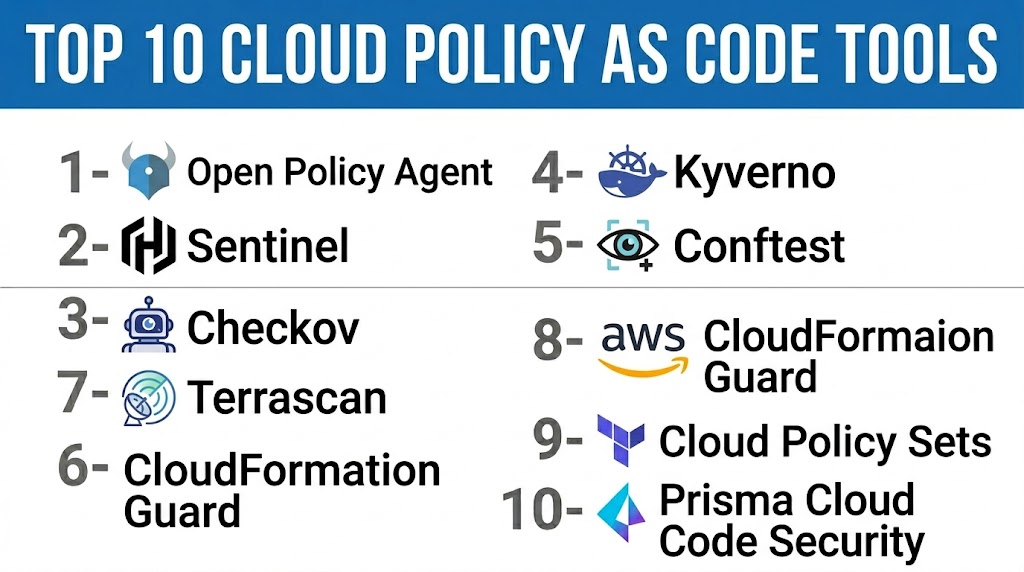
Top 10 Cloud Policy as Code Tools
1- Open Policy Agent
Short description: Open Policy Agent is a general-purpose policy engine used to enforce rules across cloud-native systems, Kubernetes, APIs, microservices, CI/CD pipelines, and infrastructure workflows. It uses the Rego policy language and is widely adopted in modern platform engineering and cloud security environments. OPA is best for teams that want flexible, vendor-neutral policy enforcement across multiple systems. It is powerful but requires policy design skills and engineering ownership.
Key Features
- General-purpose policy engine for cloud-native environments
- Rego policy language for custom policy logic
- Works with Kubernetes, APIs, CI/CD, service mesh, and infrastructure workflows
- Supports decoupled policy decision-making
- Strong open-source ecosystem
- Useful for authorization, governance, and compliance use cases
- Can be embedded into many platforms and workflows
Pros
- Highly flexible and vendor-neutral
- Strong community and ecosystem
- Useful across many policy use cases, not only cloud infrastructure
- Good fit for advanced platform engineering teams
Cons
- Rego has a learning curve
- Requires engineering maturity to implement well
- Not a complete cloud governance platform by itself
- Reporting and dashboards usually require additional tooling
Platforms / Deployment
Cloud, self-hosted, Kubernetes, CI/CD, API-driven environments, Linux, macOS, and developer workflows.
Security & Compliance
Security depends on deployment architecture and integration model. Access control, audit logging, and compliance reporting depend on how OPA is implemented. Formal compliance details for an organization-specific deployment should be treated as Not publicly stated unless verified.
Integrations & Ecosystem
Open Policy Agent integrates with many cloud-native and DevOps systems because it is designed as a flexible policy decision engine. It is often used as the foundation for broader governance platforms.
- Kubernetes admission control
- Envoy and service mesh workflows
- CI/CD pipelines
- API authorization systems
- Terraform and infrastructure validation workflows
- Custom internal platforms
Support & Community
OPA has a strong open-source community, broad documentation, and wide adoption in cloud-native engineering. Commercial support may come through vendors that build platforms around OPA. Internal expertise is important for successful adoption.
2- HashiCorp Sentinel
Short description: HashiCorp Sentinel is a policy as code framework designed for HashiCorp workflows, especially Terraform-based infrastructure management. It helps teams enforce governance rules before infrastructure changes are applied. Sentinel is best for organizations using Terraform Cloud, Terraform Enterprise, or broader HashiCorp automation. It supports policy enforcement around infrastructure provisioning, security standards, compliance controls, and operational guardrails.
Key Features
- Policy as code for Terraform workflows
- Preventive enforcement before infrastructure changes
- Policy checks against Terraform plans
- Fine-grained governance for infrastructure provisioning
- Integration with HashiCorp platform workflows
- Supports soft and hard policy enforcement styles
- Useful for compliance and cloud control validation
Pros
- Strong fit for Terraform-heavy organizations
- Useful for pre-deployment governance
- Integrates naturally with HashiCorp workflows
- Good for regulated infrastructure delivery processes
Cons
- Best suited to HashiCorp ecosystem users
- Less flexible outside Terraform workflows
- Requires Sentinel policy language knowledge
- May not be ideal for teams using many non-HashiCorp tools
Platforms / Deployment
Cloud and enterprise HashiCorp platform environments. Best suited for Terraform Cloud and Terraform Enterprise workflows.
Security & Compliance
Security features depend on the HashiCorp platform edition and configuration. Identity controls, role-based access, audit logs, and compliance details should be verified with the vendor. If not confirmed, use Not publicly stated.
Integrations & Ecosystem
Sentinel works most naturally inside Terraform and HashiCorp workflows, where infrastructure plans can be checked before deployment.
- Terraform Cloud
- Terraform Enterprise
- Terraform plan validation
- HashiCorp platform workflows
- CI/CD pipelines connected to Terraform
- Cloud infrastructure provisioning processes
Support & Community
Support depends on the HashiCorp product plan and customer agreement. Documentation is available for policy development, but teams need internal ownership to write, test, and maintain effective governance policies.
3- Checkov
Short description: Checkov is an open-source policy as code and infrastructure as code scanning tool used to detect misconfigurations before deployment. It supports Terraform, CloudFormation, Kubernetes, Helm, ARM templates, Serverless, and other IaC formats. Checkov is useful for security, DevOps, and platform teams that want fast CI/CD scanning and developer-friendly policy checks. It is especially strong for shift-left security and cloud configuration validation.
Key Features
- Infrastructure as code scanning
- Supports multiple IaC frameworks
- Built-in policies for cloud security checks
- Custom policies using Python and YAML styles
- CI/CD and version control integration
- Graph-based policy analysis
- Developer-friendly CLI workflows
Pros
- Strong open-source adoption
- Good for shift-left cloud security
- Supports many infrastructure formats
- Easy to integrate into developer workflows
Cons
- Primarily focused on IaC scanning rather than full runtime governance
- Custom policy maintenance requires ownership
- Enterprise reporting may require a commercial platform
- False positives may need tuning
Platforms / Deployment
CLI, CI/CD, cloud development workflows, Linux, macOS, Windows, and containerized environments.
Security & Compliance
Security depends on how Checkov is integrated and managed. Built-in policies can support security and compliance workflows, but formal compliance claims should be verified through the associated platform or vendor. If not confirmed, use Not publicly stated.
Integrations & Ecosystem
Checkov integrates well into developer-first security workflows and can be used early in the software delivery pipeline.
- Terraform
- CloudFormation
- Kubernetes
- Helm
- ARM templates
- Serverless framework
- CI/CD and Git workflows
Support & Community
Checkov has strong open-source visibility and developer documentation. Community support is active in cloud security and DevSecOps circles. Enterprise support depends on the commercial platform or vendor offering used with it.
4- Cloud Custodian
Short description: Cloud Custodian is an open-source cloud governance as code tool that lets teams define policies for cloud resource management, compliance, cost control, and security operations. It is commonly used to detect, report, and remediate cloud misconfigurations across major cloud environments. Cloud Custodian is strong for teams that want policy-driven automation against live cloud resources. It is especially useful for continuous governance, cleanup, tagging, and remediation workflows.
Key Features
- Cloud governance as code
- Policy-based detection and remediation
- Supports major cloud providers
- Useful for cost, security, compliance, and operational controls
- Can take automated actions on cloud resources
- YAML-based policy definitions
- Strong fit for continuous cloud governance
Pros
- Strong for runtime cloud governance
- Flexible automation and remediation capabilities
- Useful for cost control and security operations
- Open-source and widely recognized
Cons
- Requires careful policy testing before remediation
- YAML policies can become complex at scale
- Reporting and dashboards may require additional tooling
- Automation mistakes can impact production resources if not governed well
Platforms / Deployment
Cloud, self-hosted, CI/CD, scheduled jobs, serverless workflows, and cloud automation environments.
Security & Compliance
Security depends on cloud permissions, policy scope, deployment model, and access controls. Automated remediation should be tightly controlled. Compliance documentation should be treated as Not publicly stated unless verified through a specific vendor or managed platform.
Integrations & Ecosystem
Cloud Custodian is commonly used inside cloud operations, security, FinOps, and governance workflows.
- AWS
- Azure
- Google Cloud
- Cloud tagging workflows
- Security remediation workflows
- Cost governance automation
Support & Community
Cloud Custodian has a strong open-source community and broad governance use cases. Commercial support may be available through platforms built around it. Teams should invest in policy testing, review, and change management.
5- Pulumi Policy as Code
Short description: Pulumi Policy as Code helps organizations define cloud guardrails for infrastructure managed through Pulumi and other discovered cloud resources. It is designed for teams using Pulumi infrastructure as code who want policy enforcement during deployments and audit-style governance for existing resources. It supports preventive policies that block non-compliant changes and audit policies that detect issues. It is a good fit for teams that want policy enforcement close to developer workflows.
Key Features
- Policy enforcement for Pulumi infrastructure workflows
- Preventive policies that can block non-compliant changes
- Audit-style policies for existing resources
- Supports guardrails across cloud infrastructure
- Useful for developer-driven infrastructure governance
- Policy packs for reusable controls
- Integration with Pulumi organization workflows
Pros
- Strong fit for Pulumi users
- Good developer experience
- Supports preventive and audit-style governance
- Useful for cloud guardrails tied to infrastructure delivery
Cons
- Best value comes when using Pulumi
- Not as universal as general-purpose policy engines
- Advanced governance may require custom policy design
- Teams using only Terraform may prefer other options
Platforms / Deployment
Cloud, Pulumi platform workflows, developer environments, and infrastructure delivery pipelines.
Security & Compliance
Security depends on Pulumi organization settings, access controls, and deployment configuration. Specific compliance certifications and audit capabilities should be verified directly. If not confirmed, use Not publicly stated.
Integrations & Ecosystem
Pulumi Policy as Code works best inside Pulumi-based infrastructure workflows, where policies can be applied to stacks, deployments, and cloud accounts.
- Pulumi infrastructure as code
- AWS, Azure, and Google Cloud resources
- CI/CD workflows
- Organization-level policy packs
- Cloud discovery workflows
- Developer deployment pipelines
Support & Community
Pulumi has documentation and community support for infrastructure as code and policy workflows. Enterprise support depends on the plan and customer agreement. Teams using Pulumi can adopt policy as code more naturally within the same ecosystem.
6- Kyverno
Short description: Kyverno is a Kubernetes-native policy engine designed to validate, mutate, generate, and verify Kubernetes resources. It uses YAML-based policies, making it approachable for Kubernetes teams that do not want to learn a separate policy language. Kyverno is best for organizations that need Kubernetes admission control, workload governance, image verification, and namespace-level rules. It is especially practical for platform teams managing shared clusters.
Key Features
- Kubernetes-native policy engine
- YAML-based policy definitions
- Validate, mutate, and generate Kubernetes resources
- Admission control for Kubernetes workloads
- Image verification support
- Policy reporting and audit capabilities
- Strong fit for platform engineering teams
Pros
- Easy for Kubernetes teams to understand
- No separate policy language required for many use cases
- Strong for workload governance
- Useful for platform guardrails and cluster standards
Cons
- Kubernetes-focused, not a full cloud governance platform
- Advanced enterprise reporting may need additional tools
- Policies still require testing and lifecycle management
- Not ideal for non-Kubernetes infrastructure alone
Platforms / Deployment
Kubernetes, cloud-managed Kubernetes, self-managed Kubernetes clusters, and GitOps workflows.
Security & Compliance
Security depends on cluster configuration, RBAC, admission controller setup, and policy scope. Compliance mapping depends on the policies implemented. Formal compliance claims should be treated as Not publicly stated unless verified.
Integrations & Ecosystem
Kyverno fits naturally into Kubernetes platform engineering and GitOps environments.
- Kubernetes admission control
- GitOps workflows
- Container image policies
- Namespace governance
- CI/CD pipelines
- Policy reporting tools
Support & Community
Kyverno has a strong Kubernetes-focused open-source community and practical documentation. Commercial support may be available through vendors and ecosystem partners. It is widely useful for platform teams standardizing cluster governance.
7- OPA Gatekeeper
Short description: OPA Gatekeeper is a Kubernetes admission control tool built around Open Policy Agent. It helps teams enforce policies on Kubernetes resources before they are admitted into a cluster. Gatekeeper is best for teams that already use OPA or want Rego-based Kubernetes governance. It is useful for enforcing security, compliance, naming, labeling, resource limits, and workload standards across clusters.
Key Features
- Kubernetes admission control using OPA
- Rego-based constraint templates
- Policy enforcement and audit modes
- Supports reusable policy templates
- Useful for cluster governance and compliance
- Can enforce labels, resource limits, security rules, and naming standards
- Works across Kubernetes environments
Pros
- Strong fit for OPA-based organizations
- Powerful policy logic with Rego
- Useful for Kubernetes governance at scale
- Supports audit and enforcement workflows
Cons
- Rego learning curve can slow adoption
- Kubernetes-focused use case
- Policy debugging can be complex for beginners
- Requires strong platform ownership
Platforms / Deployment
Kubernetes, managed Kubernetes, self-managed Kubernetes, and cloud-native platform environments.
Security & Compliance
Security depends on Kubernetes RBAC, admission controller configuration, and policy design. Compliance depends on implemented controls and audit workflows. Specific certifications are Not publicly stated.
Integrations & Ecosystem
OPA Gatekeeper integrates with Kubernetes-native platform and governance workflows.
- Kubernetes clusters
- OPA policy ecosystem
- GitOps workflows
- CI/CD deployment gates
- Admission control pipelines
- Policy audit reporting
Support & Community
OPA Gatekeeper benefits from the broader OPA and Kubernetes communities. Documentation and examples are available, but successful implementation requires teams comfortable with Kubernetes admission control and Rego policies.
8- AWS CloudFormation Guard
Short description: AWS CloudFormation Guard is a policy as code tool for validating AWS infrastructure templates against rules before deployment. It is useful for teams that use CloudFormation and want to enforce security, compliance, and operational standards through code. CloudFormation Guard helps validate whether infrastructure definitions follow expected patterns. It is best suited for AWS-focused teams using CloudFormation-heavy workflows.
Key Features
- Policy validation for CloudFormation templates
- Rule-based infrastructure checks
- Useful for AWS-specific governance
- Supports pre-deployment validation
- Helps enforce security and compliance patterns
- Developer-friendly CLI workflow
- Can be integrated into CI/CD pipelines
Pros
- Good fit for AWS CloudFormation users
- Lightweight and focused
- Useful for early validation before deployment
- Works well in AWS-native workflows
Cons
- AWS-focused, not multi-cloud by design
- Less suitable for Terraform-heavy teams
- Not a full governance dashboard platform
- Requires teams to write and maintain rules
Platforms / Deployment
AWS-focused CLI and CI/CD workflows. CloudFormation infrastructure validation.
Security & Compliance
Security depends on how it is used in pipelines and AWS governance workflows. Compliance support depends on the rules written by the organization. Formal compliance details are Not publicly stated unless verified in a specific environment.
Integrations & Ecosystem
CloudFormation Guard fits naturally into AWS infrastructure and deployment workflows.
- AWS CloudFormation
- AWS deployment pipelines
- CI/CD workflows
- AWS governance controls
- Template validation processes
- Infrastructure review workflows
Support & Community
Support is tied to AWS documentation, community examples, and internal AWS expertise. It is practical for AWS-focused teams but may require rule-writing discipline for long-term success.
9- Terrascan
Short description: Terrascan is an infrastructure as code security scanner that helps teams detect compliance and security violations before cloud resources are deployed. It supports common IaC formats and is useful for DevSecOps teams that want policy checks in CI/CD workflows. Terrascan is best for teams looking for open-source scanning across Terraform, Kubernetes, and cloud templates. It helps identify risky configurations early in the development cycle.
Key Features
- Infrastructure as code security scanning
- Supports Terraform and Kubernetes use cases
- Policy-based misconfiguration detection
- CLI-based developer workflow
- CI/CD integration support
- Custom policy support
- Useful for shift-left cloud security
Pros
- Good open-source option for IaC scanning
- Useful for DevSecOps workflows
- Helps catch misconfigurations before deployment
- Can support multiple infrastructure formats
Cons
- May require tuning for enterprise-scale use
- Reporting and workflow features may be limited compared with platforms
- Custom policy management needs ownership
- Runtime governance may require additional tools
Platforms / Deployment
CLI, CI/CD, developer workstations, Linux, macOS, Windows, and containerized workflows.
Security & Compliance
Security depends on scanning workflow, repository access, and integration design. Compliance mapping depends on implemented policies. Specific certifications are Not publicly stated unless confirmed by a commercial offering.
Integrations & Ecosystem
Terrascan integrates into DevSecOps and infrastructure validation workflows.
- Terraform
- Kubernetes
- CI/CD pipelines
- Git repositories
- Containerized scans
- Custom policy workflows
Support & Community
Terrascan has open-source documentation and community usage in infrastructure security. Support depends on the maintainers, ecosystem, and any commercial tooling used alongside it.
10- Stacklet
Short description: Stacklet is a cloud governance platform built around governance as code principles and the Cloud Custodian ecosystem. It helps organizations detect, prevent, and remediate cloud risk, waste, and compliance issues across large cloud environments. Stacklet is best for enterprises that want policy automation, cloud governance workflows, and operational remediation at scale. It is especially useful when teams want a managed platform experience around policy-driven cloud operations.
Key Features
- Cloud governance as code platform
- Built around Cloud Custodian-style policy automation
- Continuous detection and remediation workflows
- Supports cloud cost, security, and compliance controls
- Policy-driven operational automation
- Enterprise reporting and governance workflows
- Useful for large-scale cloud environments
Pros
- Strong fit for enterprise cloud governance
- Useful for continuous remediation
- Builds on a recognized governance as code approach
- Helps reduce manual cloud operations work
Cons
- May be more than small teams need
- Requires governance process maturity
- Policy automation must be carefully controlled
- Pricing and support should be validated directly
Platforms / Deployment
Cloud governance platform. Cloud deployment. Supports cloud environments and governance automation workflows.
Security & Compliance
Security and compliance details should be verified directly with the vendor. Enterprise controls may vary by plan and deployment. If not confirmed, use Not publicly stated.
Integrations & Ecosystem
Stacklet fits enterprise environments where cloud security, cost control, and compliance teams need automated governance workflows.
- Major cloud platforms
- Cloud Custodian policy ecosystem
- Security operations workflows
- FinOps governance workflows
- Compliance reporting workflows
- Cloud remediation automation
Support & Community
Stacklet support depends on the customer plan and enterprise agreement. The platform is especially relevant for teams that want managed governance capabilities around Cloud Custodian-style policies and automation.
Comparison Table
| Tool Name | Best For | Platforms Supported | Deployment | Standout Feature | Public Rating |
|---|---|---|---|---|---|
| Open Policy Agent | Advanced platform and cloud-native teams | Kubernetes, APIs, CI/CD, cloud-native systems | Self-hosted / Hybrid | Flexible general-purpose policy engine | N/A |
| HashiCorp Sentinel | Terraform-heavy organizations | Terraform Cloud, Terraform Enterprise | Cloud / Enterprise | Terraform plan policy enforcement | N/A |
| Checkov | DevSecOps and IaC scanning teams | CLI, CI/CD, Terraform, Kubernetes, CloudFormation | Self-hosted / CI/CD | Broad infrastructure as code scanning | N/A |
| Cloud Custodian | Cloud governance and remediation teams | AWS, Azure, Google Cloud | Self-hosted / Cloud automation | Policy-driven cloud remediation | N/A |
| Pulumi Policy as Code | Pulumi infrastructure teams | Pulumi, cloud environments, CI/CD | Cloud | Preventive and audit policy workflows | N/A |
| Kyverno | Kubernetes platform teams | Kubernetes | Self-hosted / Kubernetes | YAML-based Kubernetes policy engine | N/A |
| OPA Gatekeeper | OPA-based Kubernetes teams | Kubernetes | Self-hosted / Kubernetes | Rego-based Kubernetes admission control | N/A |
| AWS CloudFormation Guard | AWS CloudFormation teams | AWS, CloudFormation, CI/CD | CLI / Cloud workflow | AWS template validation | N/A |
| Terrascan | Open-source IaC security teams | CLI, CI/CD, Terraform, Kubernetes | Self-hosted / CI/CD | Shift-left IaC security scanning | N/A |
| Stacklet | Enterprise cloud governance teams | Multi-cloud governance workflows | Cloud | Managed governance as code automation | N/A |
Evaluation & Scoring of Cloud Policy as Code Tools
| Tool Name | Core 25% | Ease 15% | Integrations 15% | Security 10% | Performance 10% | Support 10% | Value 15% | Weighted Total 0–10 |
|---|---|---|---|---|---|---|---|---|
| Open Policy Agent | 9.5 | 7.0 | 9.2 | 8.5 | 9.0 | 8.5 | 9.0 | 8.70 |
| HashiCorp Sentinel | 8.8 | 7.5 | 8.5 | 8.5 | 8.7 | 8.0 | 8.0 | 8.29 |
| Checkov | 9.0 | 8.5 | 8.8 | 8.0 | 8.5 | 8.5 | 9.2 | 8.68 |
| Cloud Custodian | 8.8 | 7.6 | 8.5 | 8.0 | 8.4 | 8.2 | 9.0 | 8.43 |
| Pulumi Policy as Code | 8.3 | 8.2 | 8.0 | 8.0 | 8.3 | 8.0 | 8.2 | 8.17 |
| Kyverno | 8.7 | 8.8 | 8.3 | 8.2 | 8.5 | 8.5 | 9.0 | 8.65 |
| OPA Gatekeeper | 8.8 | 7.2 | 8.4 | 8.3 | 8.5 | 8.3 | 8.8 | 8.34 |
| AWS CloudFormation Guard | 7.8 | 8.2 | 7.5 | 8.2 | 8.4 | 7.8 | 8.8 | 8.06 |
| Terrascan | 8.0 | 8.0 | 7.8 | 7.8 | 8.0 | 7.5 | 8.8 | 8.01 |
| Stacklet | 8.7 | 8.0 | 8.5 | 8.3 | 8.5 | 8.4 | 7.8 | 8.36 |
The scores are comparative and should be used as a practical buying guide, not as a universal ranking. A tool with a lower score may still be the best option for a specific environment. For example, Kyverno may be ideal for Kubernetes teams, while Sentinel may be better for Terraform-focused enterprises. Open-source tools can deliver strong value but may require more internal ownership, while enterprise platforms may provide better support, reporting, and governance workflows.
Which Cloud Policy as Code Tool Is Right for You?
Solo / Freelancer
Solo users and freelancers usually need lightweight tools that are easy to run locally or inside a simple CI/CD pipeline. Checkov, Terrascan, and AWS CloudFormation Guard are practical starting points depending on the infrastructure format used. If Kubernetes is the main environment, Kyverno is often easier to adopt than more complex policy engines.
For independent consultants, the best approach is to use a simple scanner first, then add deeper policy enforcement only when client environments become more complex.
SMB
SMBs need tools that balance speed, security, and ease of adoption. Checkov, Kyverno, Pulumi Policy as Code, and Cloud Custodian are strong options depending on whether the team is focused on IaC scanning, Kubernetes governance, Pulumi workflows, or runtime cloud remediation.
SMBs should avoid over-engineering policy frameworks too early. Start with a few high-value rules such as encryption, public exposure, tagging, IAM risk, and resource limits.
Mid-Market
Mid-market companies usually need policy as code across multiple teams, repositories, environments, and cloud accounts. OPA, Checkov, Cloud Custodian, Kyverno, and OPA Gatekeeper are strong options for teams building a mature platform governance model.
If the company uses Terraform at scale, HashiCorp Sentinel should be considered. If the company uses Pulumi heavily, Pulumi Policy as Code is a natural fit.
Enterprise
Enterprises need policy standardization, auditability, role-based governance, multi-cloud enforcement, reporting, and scalable workflows. Open Policy Agent, HashiCorp Sentinel, Cloud Custodian, Stacklet, Checkov, and Kyverno are all strong candidates depending on the enterprise architecture.
Enterprises should focus on policy lifecycle management, approval workflows, exception handling, audit evidence, reporting, and integration with identity, CI/CD, and cloud governance systems.
Budget vs Premium
For budget-conscious teams, open-source tools like OPA, Checkov, Cloud Custodian, Kyverno, Gatekeeper, and Terrascan provide strong value. However, they require internal ownership for setup, testing, maintenance, and reporting.
Premium platforms or enterprise-managed offerings make sense when teams need centralized dashboards, support, compliance workflows, policy packs, governance automation, and lower operational burden.
Feature Depth vs Ease of Use
OPA and Gatekeeper offer deep flexibility but require learning Rego. Kyverno is easier for Kubernetes teams because it uses YAML-style policies. Checkov is easier for infrastructure scanning and CI/CD integration. Cloud Custodian is powerful for runtime governance but needs careful automation design.
Choose depth when your environment is complex. Choose ease of use when adoption speed and developer experience are more important.
Integrations & Scalability
For Terraform-heavy organizations, Sentinel and Checkov are strong options. For Kubernetes-heavy organizations, Kyverno and OPA Gatekeeper are better fits. For runtime multi-cloud governance, Cloud Custodian and Stacklet are useful. For platform-wide policy decisions across many systems, OPA is the most flexible.
The best tool should fit your existing workflow instead of forcing every team to change how they build and deploy infrastructure.
Security & Compliance Needs
Security-focused buyers should evaluate policy testing, audit logs, exception workflows, identity integration, access controls, reporting, and policy change history. Compliance teams should also check whether the tool can map policies to internal controls and generate usable evidence.
Do not assume compliance certifications or enterprise controls unless they are confirmed by the vendor or validated in your own deployment.
Frequently Asked Questions
1. What is a Cloud Policy as Code tool?
A Cloud Policy as Code tool lets teams define cloud governance rules using code instead of manual checklists. These rules can check infrastructure, cloud resources, Kubernetes workloads, and deployment pipelines. The goal is to prevent risky configurations before they reach production. It helps teams improve security, compliance, cost control, and operational consistency.
2. Why is policy as code important for cloud security?
Policy as code is important because cloud changes happen quickly through automation and developer workflows. Manual reviews cannot keep up with modern deployment speed. Automated policies help catch risky settings such as public access, missing encryption, excessive permissions, or unapproved resource types. This reduces security gaps without slowing teams too much.
3. How is policy as code different from infrastructure as code scanning?
Infrastructure as code scanning checks templates or code for misconfigurations before deployment. Policy as code is broader because it can define, enforce, and audit rules across pipelines, Kubernetes, cloud resources, APIs, and runtime environments. Some tools focus mainly on scanning, while others enforce policies continuously. Many organizations use both approaches together.
4. Which teams should own cloud policy as code?
Cloud policy as code is usually owned jointly by platform engineering, cloud security, DevOps, and compliance teams. Security teams define control requirements, while platform teams turn them into practical policies. Developers should be involved so policies are understandable and not disruptive. Shared ownership leads to better adoption and fewer blocked deployments.
5. What are common mistakes when implementing policy as code?
A common mistake is starting with too many blocking policies at once. Teams also fail when policies are unclear, poorly tested, or not explained to developers. Another mistake is writing policies without an exception process. Successful adoption starts with audit mode, clear documentation, gradual enforcement, and regular policy review.
6. Can policy as code tools support Kubernetes governance?
Yes, several tools are built specifically for Kubernetes governance. Kyverno and OPA Gatekeeper are common options for Kubernetes admission control and workload policy enforcement. They can validate labels, resource limits, security settings, image rules, and namespace standards. Kubernetes teams should test policies in audit mode before enforcing them.
7. Do policy as code tools work with Terraform?
Yes, many policy as code tools support Terraform workflows. HashiCorp Sentinel is commonly used with Terraform Cloud and Terraform Enterprise, while Checkov, Terrascan, OPA, and other tools can scan or validate Terraform configurations. These tools can check plans, modules, variables, and resource definitions. The best choice depends on the team’s Terraform workflow and governance needs.
8. Are open-source policy as code tools enough for enterprises?
Open-source tools can be enough if the organization has strong engineering ownership and can manage policy design, testing, deployment, reporting, and support internally. Enterprises may still need commercial platforms for dashboards, audit evidence, role-based workflows, support, and centralized governance. The decision depends on internal maturity. Many enterprises use open-source engines with commercial or custom platforms around them.
9. How should teams start with policy as code?
Teams should start with a small set of high-value policies such as encryption, public exposure, tagging, IAM risks, and resource limits. Run policies in audit mode first to understand impact. Then move selected rules into enforcement mode after teams agree on exceptions and fixes. A gradual rollout builds trust and avoids blocking critical delivery work.
10. What are alternatives to Cloud Policy as Code tools?
Alternatives include manual cloud reviews, native cloud configuration checks, security posture tools, compliance spreadsheets, and custom scripts. These may work for small or simple environments. However, they often become hard to scale when teams use multiple clouds, CI/CD pipelines, Kubernetes, and infrastructure as code. Policy as code tools provide repeatable, automated, and version-controlled governance.
Conclusion
Cloud Policy as Code tools help organizations make cloud governance repeatable, automated, testable, and developer-friendly. The best tool depends on your infrastructure stack, cloud providers, Kubernetes usage, Terraform or Pulumi adoption, compliance needs, and internal engineering maturity. Open Policy Agent is strong for flexible platform-wide policy decisions, Checkov is practical for shift-left IaC scanning, Cloud Custodian is useful for runtime cloud governance, Kyverno and Gatekeeper are strong for Kubernetes, and Sentinel or Pulumi Policy as Code fit specific IaC ecosystems. Enterprises may also consider Stacklet for managed governance automation. The right next step is to shortlist two or three tools, test them against real policies, run them in audit mode, validate developer feedback, and then enforce the most important controls gradually.

This article clearly explains cloud policy as code tools and how they help organizations automate compliance, enforce security policies, and manage cloud governance more efficiently.
A challenge rarely discussed is policy lifecycle management—over time, outdated or conflicting policies can create deployment friction and policy fatigue. Treating policies as products with versioning, testing, and ownership is critical for sustainable governance at scale.