Introduction
Hedge Fund Order Management Systems OMS are specialized trading and investment operations platforms built to help hedge funds manage order creation, execution workflows, compliance checks, allocation management, portfolio visibility, and post-trade processing from a single centralized system. These platforms are designed for speed, precision, and operational control across complex trading environments.
For hedge funds, managing orders through disconnected spreadsheets, broker portals, and manual workflows creates operational risk, delayed execution, compliance gaps, and scalability challenges. A modern OMS streamlines the entire investment lifecycle by connecting portfolio managers, traders, compliance teams, operations teams, and counterparties through a unified workflow engine.
Common use cases include:
- Order creation and execution management
- Multi-asset trade lifecycle management
- Pre-trade and post-trade compliance checks
- Allocation and reconciliation workflows
- Broker connectivity and execution analytics
Key evaluation criteria:
- Execution speed and reliability
- Multi-asset order coverage
- Portfolio and allocation management
- Broker and venue connectivity
- Compliance workflow automation
- Reporting and analytics depth
- Ease of operational use
- Scalability
- Security and governance controls
Best for: Hedge funds, quantitative funds, institutional asset managers, multi-strategy investment firms, and firms with complex execution workflows.
Not ideal for: Individual investors, small advisory businesses, or firms with basic order routing needs that can be handled through broker-native tools.
Key Trends in Hedge Fund Order Management Systems
- AI-driven execution optimization
- Real-time portfolio and exposure visibility
- Cloud-based OMS deployment models
- Integrated OMS and EMS workflows
- Embedded compliance automation
- Advanced allocation and reconciliation tools
- API-first connectivity with brokers and exchanges
- Multi-asset and global venue support
- Automated reporting and audit readiness
- Operational workflow orchestration across teams
How We Selected These Tools
- Market adoption among institutional firms
- Breadth of OMS functionality
- Execution reliability and operational depth
- Multi-asset trading support
- Integration ecosystem maturity
- Security and governance readiness
- Reporting and analytics capabilities
- Scalability for growing funds
- Vendor reputation and customer support quality
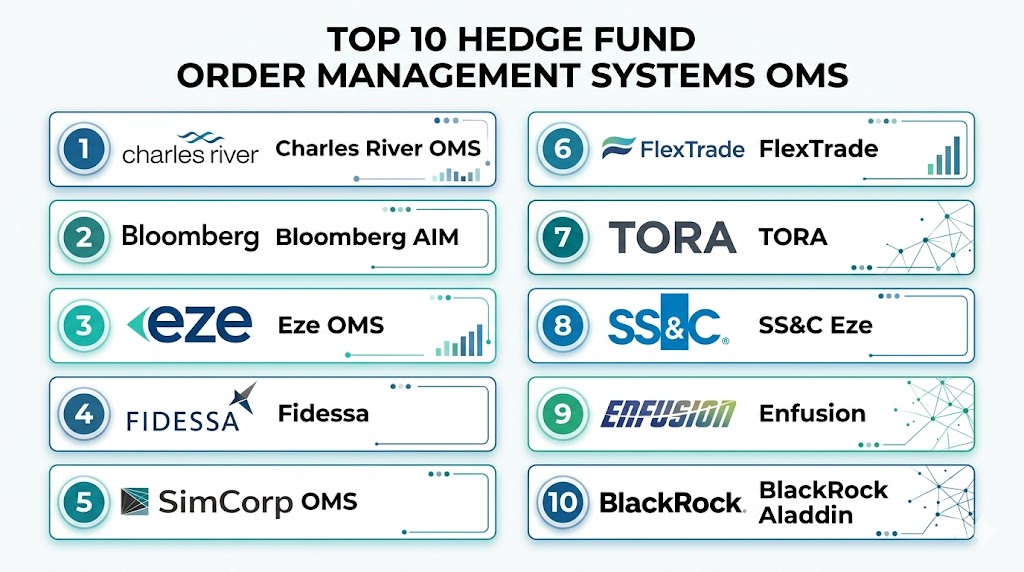
Top 10 Hedge Fund Order Management Systems
#1 — Bloomberg AIM
Short description: Bloomberg AIM is a widely adopted institutional OMS that combines order workflows, compliance controls, portfolio visibility, and execution connectivity in a unified investment operations platform. It is especially strong for firms needing broad ecosystem integration.
Key Features
- Order lifecycle management
- Compliance monitoring
- Portfolio visibility
- Broker connectivity
- Allocation workflows
- Execution analytics
Pros
- Strong institutional ecosystem
- Reliable execution workflows
- Broad operational coverage
Cons
- Premium pricing
- Complex onboarding
- Best suited for professional teams
Platforms / Deployment
- Web / Desktop
- Cloud
Security & Compliance
- RBAC
- MFA
- Audit logs
- Encryption
Integrations & Ecosystem
Bloomberg AIM connects deeply with institutional trading, market data, and reporting systems.
- APIs
- Broker networks
- Market data tools
- Reporting platforms
Support & Community
Strong enterprise onboarding, implementation guidance, and premium support resources.
#2 — Charles River IMS
Short description: Charles River IMS provides institutional-grade order management, portfolio management, and compliance automation for hedge funds and investment firms needing sophisticated operational control.
Key Features
- Multi-asset OMS
- Compliance automation
- Allocation workflows
- Portfolio analytics
- Trade monitoring
Pros
- Deep workflow automation
- Strong compliance capabilities
- Scalable infrastructure
Cons
- Complex implementation
- High cost structure
- Requires specialized onboarding
Platforms / Deployment
- Web
- Cloud / Hybrid
Security & Compliance
- RBAC
- Audit logs
- Encryption
Integrations & Ecosystem
- APIs
- Broker integrations
- Custodian systems
- Analytics tools
Support & Community
Strong institutional support with implementation partner ecosystem.
#3 — Eze OMS
Short description: Eze OMS is designed for hedge funds and asset managers that need trading workflows, portfolio oversight, compliance checks, and operational automation in one integrated platform.
Key Features
- Order management
- Portfolio workflows
- Compliance engine
- Allocation tools
- Reporting dashboards
Pros
- Built for investment firms
- Strong operational depth
- Good workflow automation
Cons
- Learning curve
- Enterprise pricing
- Setup complexity varies
Platforms / Deployment
- Web
- Cloud
Security & Compliance
- RBAC
- MFA
- Audit logs
Integrations & Ecosystem
- APIs
- Broker networks
- Portfolio systems
- Reporting integrations
Support & Community
Reliable institutional onboarding and support services.
#4 — FlexTrade FlexOMS
Short description: FlexTrade FlexOMS delivers institutional-grade order routing, execution workflows, and operational flexibility for hedge funds trading across multiple asset classes and markets.
Key Features
- Multi-asset order routing
- Smart execution tools
- Compliance checks
- Allocation management
- Workflow automation
Pros
- Excellent execution flexibility
- Broad asset support
- Strong connectivity ecosystem
Cons
- Premium deployment cost
- Advanced configuration required
- Best for sophisticated teams
Platforms / Deployment
- Web / Desktop
- Cloud / Hybrid
Security & Compliance
- RBAC
- Encryption
- Audit logs
Integrations & Ecosystem
- APIs
- Broker connectivity
- Trading venues
- Analytics systems
Support & Community
Strong institutional implementation and support capabilities.
#5 — Fidessa
Short description: Fidessa is a long-established institutional trading and OMS platform known for market connectivity, execution workflows, and operational depth for sophisticated trading firms.
Key Features
- Institutional OMS
- Global connectivity
- Execution workflows
- Allocation engine
- Trade monitoring
Pros
- Deep market connectivity
- Reliable infrastructure
- Proven institutional platform
Cons
- Expensive
- Complex setup
- Heavy enterprise focus
Platforms / Deployment
- Web / Desktop
- Cloud / Hybrid
Security & Compliance
- RBAC
- Audit logs
- Encryption
Integrations & Ecosystem
- APIs
- Exchanges
- Brokers
- Reporting systems
Support & Community
Strong enterprise support network.
#6 — SS&C Eze Eclipse
Short description: SS&C Eze Eclipse provides cloud-based order management and portfolio workflows built for investment firms seeking operational efficiency and scalability.
Key Features
- Order workflows
- Portfolio monitoring
- Compliance automation
- Allocation tools
- Reporting dashboards
Pros
- Cloud-first deployment
- Strong hedge fund focus
- Scalable workflows
Cons
- Pricing varies
- Advanced customization may require setup effort
- Learning curve for new teams
Platforms / Deployment
- Web
- Cloud
Security & Compliance
- RBAC
- MFA
- Audit logs
Integrations & Ecosystem
- APIs
- Broker systems
- Custodian platforms
- Reporting tools
Support & Community
Good institutional support and onboarding.
#7 — Limina IMS
Short description: Limina IMS is a modern investment management platform combining OMS, portfolio management, and operational automation for buy-side firms.
Key Features
- OMS workflows
- Portfolio visibility
- Compliance monitoring
- Workflow automation
- Reporting tools
Pros
- Modern interface
- Flexible workflows
- Cloud scalability
Cons
- Smaller ecosystem than legacy leaders
- Enterprise adoption still growing
- Premium positioning
Platforms / Deployment
- Web
- Cloud
Security & Compliance
- RBAC
- Audit logs
- Encryption
Integrations & Ecosystem
- APIs
- Broker connectivity
- Analytics platforms
- Reporting systems
Support & Community
Growing institutional support model.
#8 — SimCorp
Short description: SimCorp offers integrated investment operations with strong OMS functionality, portfolio management, compliance workflows, and analytics for institutional investment firms.
Key Features
- Multi-asset OMS
- Portfolio workflows
- Compliance engine
- Reporting analytics
- Operational automation
Pros
- Broad enterprise functionality
- Strong operational depth
- Highly scalable platform
Cons
- Complex deployment
- Expensive
- Significant onboarding effort
Platforms / Deployment
- Web
- Cloud / Hybrid
Security & Compliance
- RBAC
- MFA
- Audit logs
Integrations & Ecosystem
- APIs
- Custodian systems
- Broker integrations
- Data platforms
Support & Community
Comprehensive enterprise support ecosystem.
#9 — Enfusion
Short description: Enfusion combines order management, portfolio management, and investment operations in a unified cloud-native platform for hedge funds and institutional managers.
Key Features
- OMS workflows
- Portfolio monitoring
- Compliance controls
- Reporting automation
- Real-time analytics
Pros
- Unified operating platform
- Cloud-native design
- Strong operational visibility
Cons
- Premium pricing
- Enterprise onboarding needed
- Advanced workflows may require setup customization
Platforms / Deployment
- Web
- Cloud
Security & Compliance
- RBAC
- Audit logs
- MFA
Integrations & Ecosystem
- APIs
- Broker systems
- Analytics tools
- Reporting platforms
Support & Community
Strong institutional support model.
#10 — Murex
Short description: Murex is a capital markets platform that includes advanced order workflows, risk visibility, compliance controls, and execution support for sophisticated investment firms.
Key Features
- Institutional order workflows
- Risk visibility
- Compliance automation
- Multi-asset support
- Reporting analytics
Pros
- Extremely powerful platform
- Deep analytics
- Enterprise-grade operational controls
Cons
- Very complex deployment
- Premium cost structure
- Best suited for large firms
Platforms / Deployment
- Web / Linux
- Cloud / Hybrid
Security & Compliance
- RBAC
- Encryption
- Audit logs
Integrations & Ecosystem
- APIs
- Trading systems
- Market data platforms
- Reporting tools
Support & Community
Strong enterprise implementation and support ecosystem.
Comparison Table
| Tool Name | Best For | Platform Supported | Deployment | Standout Feature | Public Rating |
|---|---|---|---|---|---|
| Bloomberg AIM | Institutional hedge funds | Web / Desktop | Cloud | Unified investment workflows | N/A |
| Charles River IMS | Multi-strategy funds | Web | Cloud / Hybrid | Compliance automation | N/A |
| Eze OMS | Hedge fund operations | Web | Cloud | Investment workflow depth | N/A |
| FlexTrade FlexOMS | Execution-heavy funds | Web / Desktop | Cloud / Hybrid | Smart order routing | N/A |
| Fidessa | Global trading firms | Web / Desktop | Cloud / Hybrid | Market connectivity | N/A |
| SS&C Eze Eclipse | Cloud-focused hedge funds | Web | Cloud | Cloud-native OMS | N/A |
| Limina IMS | Modern buy-side firms | Web | Cloud | Flexible workflows | N/A |
| SimCorp | Institutional managers | Web | Cloud / Hybrid | Broad enterprise operations | N/A |
| Enfusion | Unified cloud operations | Web | Cloud | Integrated OMS + operations | N/A |
| Murex | Sophisticated institutions | Web / Linux | Cloud / Hybrid | Deep operational controls | N/A |
Evaluation & Scoring of Hedge Fund Order Management Systems
| Tool Name | Core 25% | Ease 15% | Integrations 15% | Security 10% | Performance 10% | Support 10% | Value 15% | Weighted Total |
|---|---|---|---|---|---|---|---|---|
| Bloomberg AIM | 10 | 7 | 10 | 9 | 10 | 9 | 6 | 8.6 |
| Charles River IMS | 9 | 6 | 9 | 8 | 9 | 8 | 6 | 7.9 |
| Eze OMS | 8 | 7 | 8 | 8 | 8 | 8 | 7 | 7.8 |
| FlexTrade FlexOMS | 9 | 6 | 10 | 8 | 10 | 8 | 6 | 8.1 |
| Fidessa | 9 | 6 | 9 | 8 | 9 | 8 | 6 | 7.9 |
| SS&C Eze Eclipse | 8 | 8 | 8 | 8 | 8 | 8 | 7 | 7.9 |
| Limina IMS | 8 | 8 | 7 | 8 | 8 | 7 | 7 | 7.6 |
| SimCorp | 9 | 6 | 9 | 8 | 9 | 8 | 6 | 7.9 |
| Enfusion | 8 | 8 | 8 | 8 | 8 | 8 | 7 | 7.9 |
| Murex | 10 | 5 | 9 | 9 | 10 | 8 | 5 | 7.9 |
How to interpret scores:
- Higher scores indicate stronger institutional-grade OMS capabilities.
- Premium enterprise tools excel in connectivity, execution control, and operational depth.
- Cloud-native platforms often score higher in usability and deployment speed.
- Smaller funds should balance sophistication against implementation complexity.
- The right choice depends on strategy complexity, asset coverage, and operational scale.
Which Hedge Fund Order Management System Is Right for You
Solo / Freelancer
Full hedge fund OMS platforms are generally unnecessary. Broker-native trading systems or lightweight execution platforms are usually sufficient.
SMB
Emerging hedge funds may benefit from cloud-native platforms like SS&C Eze Eclipse, Limina IMS, or Enfusion for operational efficiency and faster deployment.
Mid-Market
Mid-sized investment firms should prioritize scalable OMS platforms with strong compliance automation, reporting, and broker connectivity.
Enterprise
Large hedge funds and multi-strategy firms should consider Bloomberg AIM, Charles River IMS, FlexTrade FlexOMS, Fidessa, or Murex for institutional-grade execution and operational control.
Budget vs Premium
Budget-conscious firms should focus on deployment efficiency and operational fit, while premium suites justify cost through broader integrations and deeper functionality.
Feature Depth vs Ease of Use
Legacy institutional platforms offer unmatched depth, while newer cloud-native platforms often deliver better usability and faster onboarding.
Integrations & Scalability
Choose platforms with strong APIs, broker connectivity, allocation automation, and operational extensibility for long-term growth.
Security & Compliance Needs
Audit logs, access controls, workflow governance, and embedded compliance automation are essential for institutional trading environments.
Frequently Asked Questions
1. What is a hedge fund OMS
A hedge fund OMS is software that manages the full order lifecycle, from idea generation and order creation to execution, allocation, compliance, and reporting. It centralizes trading workflows. This improves speed, control, and operational efficiency.
2. Why do hedge funds need an OMS
An OMS reduces manual work, improves execution coordination, and strengthens operational oversight. It helps traders, portfolio managers, compliance teams, and operations teams work from a unified workflow. This reduces operational risk.
3. Can OMS platforms support multiple asset classes
Yes, many institutional OMS platforms support equities, fixed income, derivatives, FX, and alternative assets. Coverage varies by platform. Multi-asset support is critical for diversified hedge funds.
4. Do OMS platforms include compliance checks
Most institutional systems include pre-trade and post-trade compliance monitoring. They can automate policy checks, allocation controls, and audit-ready reporting. This helps reduce compliance gaps.
5. Are these systems cloud-based
Many modern OMS platforms are cloud-native, while enterprise vendors often support hybrid deployment models. Cloud deployment improves scalability and accessibility. Deployment depends on operational requirements.
6. Can OMS platforms integrate with brokers
Yes, broker connectivity is one of the core strengths of institutional OMS platforms. They connect with brokers, exchanges, custodians, and analytics systems. Strong connectivity improves execution efficiency.
7. Are OMS platforms secure
Most enterprise-grade OMS platforms include encryption, role-based access, audit logs, and strong governance controls. Security maturity varies by vendor. Institutional firms should evaluate controls carefully.
8. How long does implementation take
Cloud-native OMS tools can deploy faster, while enterprise institutional platforms may require substantial onboarding and integration planning. Complexity depends on workflows and connectivity needs.
9. Can OMS tools improve operational efficiency
Yes, automation across order routing, allocations, reconciliations, compliance, and reporting significantly improves operational efficiency. Teams can scale workflows without proportionally increasing operational overhead.
10. How should a hedge fund choose an OMS
Start by evaluating asset coverage, execution workflows, compliance requirements, integration needs, and operational scale. Shortlist a few platforms, validate connectivity, and test workflows before committing.
Conclusion
Hedge Fund Order Management Systems have become core operational infrastructure for modern investment firms. They improve execution control, strengthen compliance oversight, and connect front-office and back-office workflows through a unified operating model.
The biggest benefit is operational precision. Funds can manage orders faster, reduce workflow friction, and improve oversight across trading operations.
The right OMS depends on fund size, strategy complexity, asset coverage, and operational maturity.
Smaller firms may prioritize cloud-native simplicity and fast deployment, while large institutions need deep integration, sophisticated compliance controls, and enterprise-grade execution infrastructure.
Connectivity, automation, scalability, and governance should be central evaluation criteria during vendor selection.
