Introduction
Trade Finance Platforms are digital systems that help banks, financial institutions, and global businesses manage international trade transactions. These platforms automate and streamline processes such as letters of credit, bank guarantees, export-import financing, invoice discounting, and supply chain finance.
In simple terms, trade finance software ensures that exporters get paid, importers receive goods safely, and banks manage risk efficiently in cross-border transactions. These systems reduce paperwork, improve transparency, and speed up global trade operations.
As global trade becomes more complex and digital-first, trade finance platforms are essential for improving liquidity, reducing fraud risk, and ensuring compliance with international regulations.
Common use cases include:
- Managing letters of credit and bank guarantees
- Supply chain and invoice financing
- Export-import transaction management
- Trade compliance and documentation
- Risk assessment and fraud prevention
Key evaluation criteria:
- Automation of trade workflows
- Compliance and regulatory support
- Integration with banking and ERP systems
- Risk management capabilities
- Scalability and performance
- Security and audit readiness
- Ease of use for trade finance teams
- API and ecosystem integration
- Reporting and analytics
Best for: Banks, corporates, multinational companies, exporters, importers, and financial institutions involved in global trade.
Not ideal for: Small businesses with no international trade operations or simple domestic transactions.
Key Trends in Trade Finance Platforms
- Blockchain-based trade finance for transparency and trust
- AI-driven risk assessment and fraud detection
- End-to-end digitalization of trade documentation
- Cloud-based trade finance systems replacing legacy platforms
- API-first architecture for ecosystem integration
- Real-time tracking of trade transactions
- Supply chain finance digitization
- Automation of letters of credit processing
- ESG and sustainability tracking in trade finance
- Embedded finance within supply chain ecosystems
How We Selected These Tools
- Strong global adoption in trade finance ecosystem
- End-to-end trade lifecycle capabilities
- Proven scalability in banking environments
- Security and compliance readiness
- Integration with core banking and ERP systems
- Automation and workflow capabilities
- Support for multiple trade finance instruments
- Vendor innovation and roadmap strength
- API and ecosystem flexibility
- Usability for banks and corporates
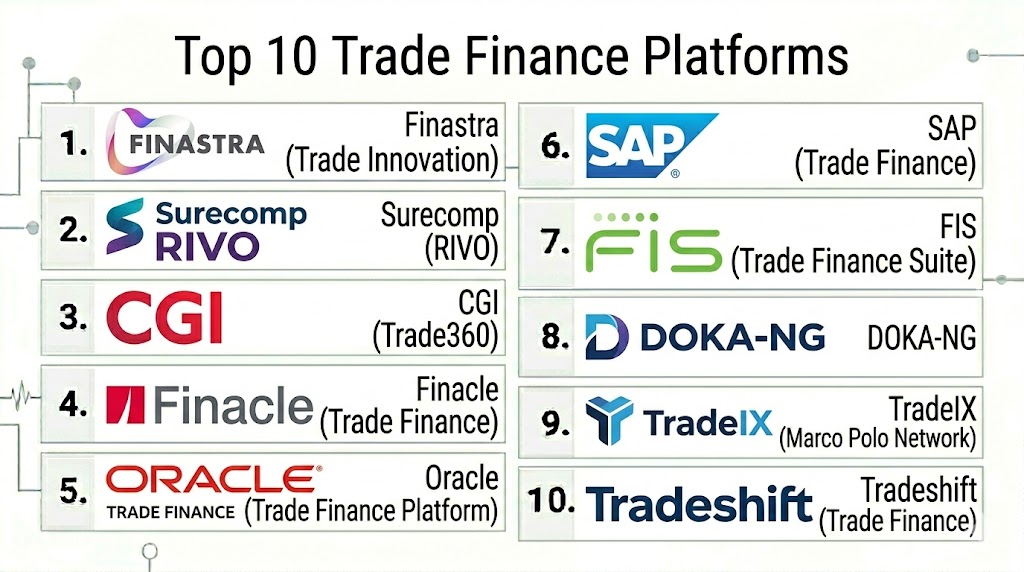
Top 10 Trade Finance Platforms Tools
#1 — Finastra Trade Innovation
Short description:
A widely used enterprise trade finance platform that supports end-to-end trade lifecycle management. It helps banks automate letters of credit, guarantees, and trade workflows with strong compliance and integration capabilities.
Key Features
- Letter of credit automation
- Bank guarantee management
- Trade workflow automation
- Compliance tracking
- Risk management tools
- Reporting and analytics
Pros
- Strong enterprise adoption
- Comprehensive trade coverage
- Scalable platform
- Reliable performance
Cons
- Complex implementation
- High cost
- Requires expertise
- Customization effort
Platforms / Deployment
Cloud / Hybrid
Security & Compliance
Encryption, RBAC, audit logs. Compliance not publicly stated.
Integrations & Ecosystem
Integrates with banking and ERP systems.
- Core banking platforms
- ERP systems
- CRM tools
- APIs
Support & Community
Strong enterprise support.
#2 — Surecomp RIVO
Short description:
A digital trade finance platform designed for banks and corporates to manage trade transactions efficiently. It supports automation and collaboration across trade ecosystems.
Key Features
- Trade transaction management
- Workflow automation
- Document handling
- Compliance tracking
- Integration capabilities
Pros
- Modern platform
- Strong automation
- Good collaboration features
- Scalable
Cons
- Integration effort
- Customization complexity
- Learning curve
- Pricing not transparent
Platforms / Deployment
Cloud
Security & Compliance
Encryption, RBAC. Compliance not publicly stated.
Integrations & Ecosystem
Supports banking integrations.
- Core banking systems
- ERP platforms
- Trade networks
- APIs
Support & Community
Good vendor support.
#3 — CGI Trade360
Short description:
An enterprise-grade trade finance platform that provides end-to-end trade lifecycle management with strong automation and compliance support.
Key Features
- Trade lifecycle management
- Letter of credit processing
- Risk management
- Workflow automation
- Reporting tools
Pros
- Strong enterprise capabilities
- Reliable
- Scalable
- Good compliance support
Cons
- Complex setup
- High cost
- Requires expertise
- Customization effort
Platforms / Deployment
Cloud / Hybrid
Security & Compliance
Encryption, RBAC. Compliance not publicly stated.
Integrations & Ecosystem
Supports enterprise integrations.
- Banking systems
- ERP platforms
- Data systems
- APIs
Support & Community
Enterprise-level support.
#4 — Finacle Trade Finance
Short description:
A digital banking platform offering trade finance capabilities for banks. It supports automation and real-time processing of trade transactions.
Key Features
- Trade finance workflows
- Letter of credit management
- Guarantee processing
- Compliance tools
- Reporting analytics
Pros
- Strong banking integration
- Scalable
- Reliable
- Good automation
Cons
- Complex implementation
- Learning curve
- Customization effort
- Pricing not transparent
Platforms / Deployment
Cloud / Hybrid
Security & Compliance
Encryption, RBAC. Compliance not publicly stated.
Integrations & Ecosystem
Integrates with banking systems.
- Core banking
- ERP systems
- CRM tools
- APIs
Support & Community
Strong enterprise support.
#5 — Oracle Trade Finance Platform
Short description:
An enterprise solution designed for global trade finance operations. It integrates with Oracle’s ecosystem for seamless financial and trade workflows.
Key Features
- Trade transaction management
- Workflow automation
- Risk analytics
- Compliance tracking
- Integration support
Pros
- Strong enterprise integration
- Scalable
- Reliable
- Comprehensive features
Cons
- High cost
- Complex setup
- Requires expertise
- Less flexible UI
Platforms / Deployment
Cloud / Hybrid
Security & Compliance
Encryption, RBAC. Compliance not publicly stated.
Integrations & Ecosystem
Deep integration with Oracle systems.
- ERP systems
- Financial platforms
- CRM tools
- APIs
Support & Community
Global enterprise support.
#6 — SAP Trade Finance
Short description:
A trade finance solution integrated into SAP ecosystem, designed for large enterprises managing global supply chains and trade operations.
Key Features
- Trade workflow automation
- Document management
- Risk assessment
- Compliance tracking
- Analytics tools
Pros
- Strong SAP integration
- Scalable
- Reliable
- Enterprise-ready
Cons
- High cost
- Complex implementation
- Requires SAP expertise
- Customization effort
Platforms / Deployment
Cloud / Hybrid
Security & Compliance
Encryption, RBAC. Compliance not publicly stated.
Integrations & Ecosystem
Deep integration with SAP ecosystem.
- ERP systems
- Supply chain tools
- Financial systems
- APIs
Support & Community
Strong enterprise support.
#7 — FIS Trade Finance Suite
Short description:
A banking-focused trade finance platform that supports global trade operations, compliance, and risk management.
Key Features
- Trade processing
- Workflow automation
- Risk management
- Compliance tools
- Reporting
Pros
- Strong banking focus
- Reliable
- Scalable
- Good compliance features
Cons
- Complex setup
- Customization effort
- Learning curve
- Pricing not transparent
Platforms / Deployment
Cloud / Hybrid
Security & Compliance
Encryption, RBAC. Compliance not publicly stated.
Integrations & Ecosystem
Supports banking integrations.
- Core banking
- ERP systems
- CRM tools
- APIs
Support & Community
Enterprise support available.
#8 — DOKA-NG
Short description:
A specialized trade finance platform focused on bank guarantees and documentary trade operations with strong automation capabilities.
Key Features
- Guarantee management
- Trade documentation
- Workflow automation
- Compliance tracking
- Reporting tools
Pros
- Strong niche focus
- Reliable
- Scalable
- Good automation
Cons
- Limited broader features
- Integration effort
- Learning curve
- Pricing not transparent
Platforms / Deployment
Cloud / Hybrid
Security & Compliance
Encryption, RBAC. Compliance not publicly stated.
Integrations & Ecosystem
Supports banking integrations.
- ERP systems
- Core banking
- Data platforms
- APIs
Support & Community
Vendor support available.
#9 — TradeIX Marco Polo Network
Short description:
A blockchain-based trade finance platform designed to improve transparency and efficiency in global trade transactions.
Key Features
- Blockchain trade tracking
- Smart contract workflows
- Supply chain finance
- Risk transparency
- Data sharing
Pros
- High transparency
- Modern blockchain approach
- Secure
- Innovative
Cons
- Limited adoption in some regions
- Integration effort
- Learning curve
- Regulatory complexity
Platforms / Deployment
Cloud
Security & Compliance
Blockchain-based security, encryption. Compliance not publicly stated.
Integrations & Ecosystem
Supports API-based integrations.
- Banking systems
- ERP platforms
- Trade networks
- APIs
Support & Community
Growing ecosystem.
#10 — Tradeshift Trade Finance
Short description:
A cloud-based trade finance platform focused on digitizing supply chain and invoice financing workflows.
Key Features
- Invoice financing
- Supply chain finance
- Workflow automation
- Supplier management
- Analytics tools
Pros
- Strong supply chain focus
- Easy to use
- Scalable
- Good automation
Cons
- Limited traditional trade finance features
- Integration effort
- Customization limits
- Pricing not transparent
Platforms / Deployment
Cloud
Security & Compliance
Encryption, RBAC. Compliance not publicly stated.
Integrations & Ecosystem
Supports enterprise integrations.
- ERP systems
- Supply chain platforms
- Financial systems
- APIs
Support & Community
Good vendor support.
Comparison Table
| Tool Name | Best For | Platforms | Deployment | Standout Feature | Public Rating |
|---|---|---|---|---|---|
| Finastra | Banks | Web | Cloud Hybrid | Trade lifecycle | N/A |
| Surecomp | Corporates | Web | Cloud | Collaboration | N/A |
| CGI | Enterprises | Web | Cloud Hybrid | End-to-end trade | N/A |
| Finacle | Banks | Web | Cloud Hybrid | Banking integration | N/A |
| Oracle | Enterprise | Web | Cloud Hybrid | Ecosystem integration | N/A |
| SAP | Global enterprises | Web | Cloud Hybrid | ERP integration | N/A |
| FIS | Banks | Web | Cloud Hybrid | Risk management | N/A |
| DOKA-NG | Guarantees | Web | Cloud Hybrid | Guarantee focus | N/A |
| TradeIX | Blockchain trade | Web | Cloud | Transparency | N/A |
| Tradeshift | Supply chain | Web | Cloud | Invoice finance | N/A |
Evaluation and Scoring
| Tool Name | Core | Ease | Integrations | Security | Performance | Support | Value | Weighted Total |
|---|---|---|---|---|---|---|---|---|
| Finastra | 9 | 6 | 9 | 9 | 9 | 9 | 6 | 8.3 |
| Surecomp | 8 | 7 | 8 | 8 | 8 | 8 | 7 | 7.8 |
| CGI | 9 | 6 | 9 | 9 | 9 | 9 | 6 | 8.3 |
| Finacle | 8 | 7 | 8 | 8 | 8 | 8 | 7 | 7.8 |
| Oracle | 9 | 6 | 9 | 9 | 9 | 9 | 6 | 8.3 |
| SAP | 9 | 6 | 9 | 9 | 9 | 9 | 6 | 8.3 |
| FIS | 8 | 6 | 8 | 8 | 8 | 8 | 7 | 7.7 |
| DOKA | 7 | 7 | 7 | 7 | 7 | 7 | 7 | 7.0 |
| TradeIX | 8 | 7 | 8 | 8 | 8 | 8 | 7 | 7.8 |
| Tradeshift | 8 | 8 | 8 | 8 | 8 | 8 | 7 | 7.9 |
Frequently Asked Questions
1. What is a trade finance platform
A trade finance platform is software that helps manage international trade transactions like letters of credit and guarantees.
It automates workflows and reduces manual processing.
It improves transparency and efficiency in global trade operations.
2. Why are trade finance platforms important
They help reduce risk, improve transaction speed, and ensure compliance in global trade.
They also reduce paperwork and operational costs.
This makes international trade more efficient.
3. What features should buyers look for
Key features include workflow automation, compliance tools, and integration capabilities.
Risk management and reporting are also important.
These features improve operational efficiency.
4. Are these platforms cloud-based
Most modern platforms are cloud-based or hybrid.
Cloud systems offer scalability and real-time processing.
They are easier to maintain.
5. Are trade finance platforms secure
Yes, most include encryption, RBAC, and audit logs.
Security varies by vendor.
Enterprises should validate compliance requirements.
6. Can small companies use them
Small businesses usually do not need full trade finance platforms.
They are mainly designed for banks and large enterprises.
Simpler tools may be sufficient.
7. How long does implementation take
Implementation depends on complexity and customization.
Enterprise systems take longer.
Cloud platforms are faster.
8. Do these tools support integrations
Yes, most integrate with ERP and banking systems.
API support is common.
Integrations improve efficiency.
9. What are common mistakes
Ignoring integration and compliance needs is common.
Underestimating complexity is another issue.
Proper planning is essential.
10. What are alternatives
Alternatives include manual trade processing or basic ERP modules.
However, they lack automation and scale.
Dedicated platforms are more efficient.
Conclusion
Trade Finance Platforms are essential for managing complex international trade operations efficiently and securely. They automate documentation, streamline workflows, and reduce risks in cross-border transactions. From enterprise systems like SAP, Oracle, and Finastra to modern blockchain-based platforms like TradeIX, the ecosystem offers solutions for different business needs. The right platform depends on transaction volume, integration requirements, and operational complexity. Organizations should focus on scalability, compliance, and ecosystem connectivity when selecting a solution. A practical approach is to shortlist a few platforms, evaluate them through real-world trade scenarios, and validate integration and security requirements before final adoption.
