Introduction
Actuarial Modeling Software are specialized platforms used by actuaries and financial professionals to model risk, forecast financial outcomes, and support decision-making in insurance, pensions, and investment sectors. These tools help organizations evaluate uncertainty, calculate reserves, price products, and ensure long-term financial stability.
In simple terms, actuarial modeling software turns complex data and assumptions into financial projections that guide critical business decisions. As regulatory demands increase and risk environments become more dynamic, these platforms are essential for accuracy, transparency, and efficiency.
Common use cases include:
- Insurance product pricing and valuation
- Risk modeling and scenario analysis
- Reserving and capital modeling
- Regulatory reporting and compliance
- Financial forecasting and projections
Key evaluation criteria:
- Modeling flexibility and accuracy
- Performance and scalability
- Integration with data systems
- Reporting and analytics capabilities
- Regulatory compliance support
- Ease of use for actuaries
- Automation and workflow support
- Deployment flexibility
- Vendor support and ecosystem
Best for: Insurance companies, reinsurers, pension funds, and financial institutions requiring advanced risk and financial modeling.
Not ideal for: Small organizations with simple financial needs or those without actuarial expertise.
Key Trends in Actuarial Modeling Software
- AI and machine learning enhancing predictive modeling
- Cloud-based actuarial platforms replacing legacy systems
- Real-time analytics and scenario modeling
- Automation of reporting and regulatory compliance
- Integration with enterprise data platforms
- Increased focus on risk and capital optimization
- API-driven ecosystems for flexibility
- Advanced visualization and dashboards
- Support for complex multi-line insurance modeling
- Faster model execution through high-performance computing
How We Selected These Tools
- Strong adoption in actuarial and insurance markets
- Comprehensive modeling and forecasting capabilities
- Proven scalability and performance
- Modern architecture and cloud readiness
- Security and compliance capabilities
- Integration ecosystem and API support
- Advanced analytics and risk modeling features
- Flexibility across financial and insurance use cases
- Vendor reputation and innovation
- Usability for actuarial teams
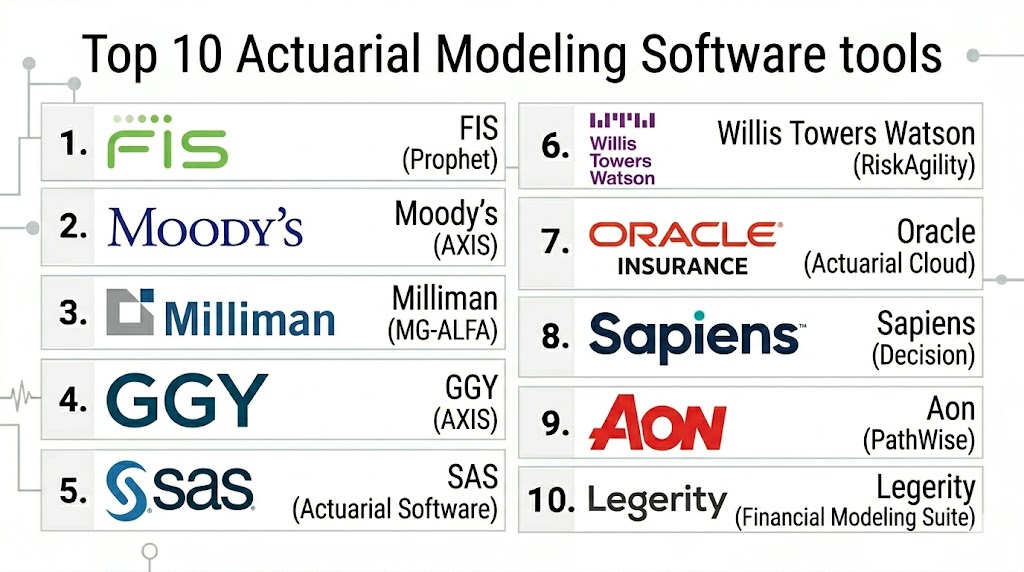
Top 10 Actuarial Modeling Software Tools
#1 — FIS Prophet
Short description:
A widely used actuarial modeling platform designed for life insurance and financial modeling. It provides powerful capabilities for valuation, risk analysis, and reporting. It is trusted by global insurers for complex actuarial calculations.
Key Features
- Advanced actuarial modeling
- Financial projections and forecasting
- Regulatory reporting support
- Scenario analysis
- Integration capabilities
Pros
- Industry-standard platform
- Strong modeling capabilities
- Scalable performance
- Reliable analytics
Cons
- Complex setup
- High cost
- Requires expertise
- Learning curve
Platforms / Deployment
Cloud / Hybrid
Security & Compliance
Encryption, RBAC. Compliance not publicly stated.
Integrations & Ecosystem
Supports integration with enterprise systems.
- Data platforms
- Financial systems
- Reporting tools
- APIs
Support & Community
Strong enterprise support and documentation.
#2 — Moody’s AXIS
Short description:
A powerful actuarial modeling system used for life, health, and pension modeling. It offers flexibility and high-performance calculations for complex risk scenarios.
Key Features
- Multi-line modeling support
- Scenario analysis
- Risk modeling
- Financial projections
- Reporting tools
Pros
- Flexible modeling
- Strong performance
- Scalable
- Good analytics
Cons
- Learning curve
- Implementation effort
- Customization complexity
- Pricing not transparent
Platforms / Deployment
Cloud / Hybrid
Security & Compliance
Encryption, RBAC. Compliance not publicly stated.
Integrations & Ecosystem
Integrates with data and financial systems.
- Data platforms
- Financial tools
- Reporting systems
- APIs
Support & Community
Enterprise-level support.
#3 — Milliman MG-ALFA
Short description:
A comprehensive actuarial modeling platform focused on asset liability management and financial modeling. It is widely used for insurance and pension applications.
Key Features
- Asset liability modeling
- Financial forecasting
- Scenario analysis
- Risk modeling
- Reporting tools
Pros
- Strong financial modeling
- Scalable
- Reliable
- Industry adoption
Cons
- Complex setup
- Learning curve
- Customization effort
- Pricing not transparent
Platforms / Deployment
Cloud / Hybrid
Security & Compliance
Encryption, RBAC. Compliance not publicly stated.
Integrations & Ecosystem
Supports enterprise integrations.
- Financial systems
- Data platforms
- Analytics tools
- APIs
Support & Community
Strong vendor support.
#4 — GGY AXIS
Short description:
An actuarial modeling system designed for life insurance and risk analysis. It provides powerful modeling capabilities and supports complex calculations.
Key Features
- Life insurance modeling
- Scenario analysis
- Risk calculations
- Reporting tools
- Integration support
Pros
- Strong modeling engine
- Flexible
- Scalable
- Reliable
Cons
- Learning curve
- Implementation complexity
- Customization effort
- Pricing not clear
Platforms / Deployment
Cloud / Hybrid
Security & Compliance
Encryption, RBAC. Compliance not publicly stated.
Integrations & Ecosystem
Integrates with enterprise systems.
- Data platforms
- Financial systems
- Reporting tools
- APIs
Support & Community
Enterprise support available.
#5 — SAS Actuarial Software
Short description:
A data-driven actuarial platform that combines analytics and modeling capabilities. It is widely used for risk management and predictive modeling.
Key Features
- Advanced analytics
- Risk modeling
- Data integration
- Reporting tools
- Automation capabilities
Pros
- Strong analytics
- Scalable
- Flexible
- Reliable
Cons
- Complex interface
- Learning curve
- High cost
- Customization effort
Platforms / Deployment
Cloud / Hybrid
Security & Compliance
Encryption, RBAC. Compliance not publicly stated.
Integrations & Ecosystem
Supports data-driven integrations.
- Data platforms
- Analytics tools
- Financial systems
- APIs
Support & Community
Strong enterprise support.
#6 — Willis Towers Watson RiskAgility
Short description:
A modern actuarial modeling platform designed for risk and capital modeling. It offers flexibility and supports complex financial calculations.
Key Features
- Risk modeling
- Capital modeling
- Scenario analysis
- Financial forecasting
- Reporting tools
Pros
- Strong risk modeling
- Flexible
- Scalable
- Modern platform
Cons
- Implementation effort
- Learning curve
- Pricing not transparent
- Customization complexity
Platforms / Deployment
Cloud
Security & Compliance
Encryption, RBAC. Compliance not publicly stated.
Integrations & Ecosystem
Supports integration with enterprise systems.
- Data platforms
- Financial tools
- Analytics systems
- APIs
Support & Community
Vendor support available.
#7 — Oracle Actuarial Cloud
Short description:
A cloud-based actuarial solution offering modeling and analytics capabilities. It integrates with Oracle’s ecosystem for enterprise operations.
Key Features
- Cloud-based modeling
- Analytics tools
- Financial forecasting
- Integration capabilities
- Reporting tools
Pros
- Cloud-native
- Strong integration
- Scalable
- Reliable
Cons
- Requires Oracle ecosystem
- Customization effort
- Pricing not transparent
- Learning curve
Platforms / Deployment
Cloud
Security & Compliance
Encryption, RBAC. Compliance not publicly stated.
Integrations & Ecosystem
Integrates with enterprise systems.
- Financial tools
- Data platforms
- Analytics tools
- APIs
Support & Community
Enterprise support available.
#8 — Sapiens Decision
Short description:
A decision modeling platform that supports actuarial workflows and automation. It enables rule-based decision-making and analytics.
Key Features
- Decision modeling
- Workflow automation
- Analytics
- Integration capabilities
- Reporting tools
Pros
- Flexible platform
- Strong automation
- Scalable
- Modern design
Cons
- Limited core actuarial features
- Customization effort
- Learning curve
- Pricing not transparent
Platforms / Deployment
Cloud
Security & Compliance
Encryption, RBAC. Compliance not publicly stated.
Integrations & Ecosystem
Supports API integrations.
- CRM tools
- Data platforms
- Financial systems
- APIs
Support & Community
Vendor support available.
#9 — Aon PathWise
Short description:
A platform designed for capital modeling and risk analysis. It provides insights into financial performance and risk exposure.
Key Features
- Capital modeling
- Risk analysis
- Scenario simulation
- Financial forecasting
- Reporting tools
Pros
- Strong analytics
- Scalable
- Reliable
- Good reporting
Cons
- Specialized use case
- Learning curve
- Integration effort
- Pricing not transparent
Platforms / Deployment
Cloud
Security & Compliance
Encryption, RBAC. Compliance not publicly stated.
Integrations & Ecosystem
Supports data integrations.
- Data platforms
- Financial tools
- Analytics systems
- APIs
Support & Community
Enterprise support.
#10 — Legerity Financial Modeling Suite
Short description:
A flexible financial modeling platform used for actuarial and financial analysis. It supports customizable modeling and reporting.
Key Features
- Financial modeling
- Scenario analysis
- Reporting tools
- Data integration
- Analytics
Pros
- Flexible
- Scalable
- Customizable
- Good reporting
Cons
- Learning curve
- Customization effort
- Integration complexity
- Pricing not transparent
Platforms / Deployment
Cloud / Hybrid
Security & Compliance
Encryption, RBAC. Compliance not publicly stated.
Integrations & Ecosystem
Supports integrations with enterprise systems.
- Data platforms
- Financial tools
- Analytics tools
- APIs
Support & Community
Vendor support available.
Comparison Table
| Tool Name | Best For | Platforms | Deployment | Standout Feature | Public Rating |
|---|---|---|---|---|---|
| FIS Prophet | Life insurers | Web | Cloud Hybrid | Industry standard modeling | N/A |
| Moody’s AXIS | Multi-line modeling | Web | Cloud Hybrid | Flexible modeling | N/A |
| Milliman MG-ALFA | Financial modeling | Web | Cloud Hybrid | Asset liability modeling | N/A |
| GGY AXIS | Life modeling | Web | Cloud Hybrid | Risk calculations | N/A |
| SAS | Analytics | Web | Cloud Hybrid | Data-driven modeling | N/A |
| RiskAgility | Risk modeling | Web | Cloud | Capital modeling | N/A |
| Oracle | Enterprise | Web | Cloud | Integration | N/A |
| Sapiens | Decision modeling | Web | Cloud | Automation | N/A |
| Aon PathWise | Capital modeling | Web | Cloud | Risk insights | N/A |
| Legerity | Financial modeling | Web | Cloud Hybrid | Custom modeling | N/A |
Evaluation and Scoring
| Tool Name | Core | Ease | Integrations | Security | Performance | Support | Value | Weighted Total |
|---|---|---|---|---|---|---|---|---|
| Prophet | 9 | 6 | 9 | 8 | 9 | 9 | 6 | 8.2 |
| AXIS | 8 | 7 | 8 | 8 | 8 | 8 | 7 | 7.8 |
| MG-ALFA | 8 | 7 | 8 | 8 | 8 | 8 | 7 | 7.8 |
| GGY AXIS | 8 | 7 | 8 | 8 | 8 | 8 | 7 | 7.8 |
| SAS | 8 | 6 | 9 | 8 | 8 | 8 | 7 | 7.9 |
| RiskAgility | 8 | 7 | 8 | 8 | 8 | 8 | 7 | 7.8 |
| Oracle | 9 | 6 | 9 | 9 | 9 | 9 | 6 | 8.3 |
| Sapiens | 7 | 7 | 7 | 7 | 7 | 7 | 7 | 7.0 |
| PathWise | 8 | 7 | 8 | 8 | 8 | 8 | 7 | 7.8 |
| Legerity | 7 | 7 | 7 | 7 | 7 | 7 | 7 | 7.0 |
Scores are comparative and highlight strengths across tools. The best choice depends on business needs and complexity.
Which Actuarial Modeling Software Is Right for You
Solo / Freelancer
Not typically required. These tools are designed for specialized professionals.
SMB
Limited use cases. Smaller firms may use simpler financial tools.
Mid-Market
RiskAgility, Sapiens, and Legerity offer flexibility and scalability.
Enterprise
Prophet, AXIS, and Oracle are best suited for complex actuarial operations.
Budget vs Premium
Budget tools offer basic modeling, while premium tools provide advanced analytics.
Feature Depth vs Ease of Use
Enterprise tools offer deeper features, while smaller tools are easier to use.
Integrations and Scalability
Enterprise platforms provide stronger integration and scalability.
Security and Compliance Needs
Larger platforms offer better compliance and security capabilities.
Frequently Asked Questions
1. What is actuarial modeling software
It is software used to model financial risk and predict future outcomes.
It helps actuaries make data-driven decisions.
It is widely used in insurance and finance.
2. Why is it important
It helps organizations manage risk and ensure financial stability.
It improves decision-making accuracy.
It supports regulatory compliance.
3. What features should buyers look for
Key features include modeling, analytics, reporting, and integration capabilities.
Some tools also offer automation and AI features.
These improve efficiency and accuracy.
4. Are these tools cloud-based
Many modern tools are cloud-based or support hybrid deployment.
Cloud systems offer scalability and flexibility.
Hybrid models are used for compliance needs.
5. Are these tools secure
Most platforms include encryption and access controls.
Security features vary by vendor.
Buyers should verify details before adoption.
6. Can small companies use them
Small companies may not need full actuarial platforms.
Simpler tools may be sufficient.
Enterprise tools are more complex.
7. How long does implementation take
Implementation depends on complexity and customization.
Enterprise systems take longer.
Planning is important.
8. Do these tools support integrations
Yes, most tools integrate with financial and data systems.
API support is important.
Integrations improve efficiency.
9. What are common mistakes
Common mistakes include ignoring scalability and integration needs.
Another issue is underestimating complexity.
Proper planning is essential.
10. What are alternatives
Alternatives include spreadsheets or basic analytics tools.
However, they lack advanced modeling capabilities.
Dedicated software provides better accuracy.
Conclusion
Actuarial Modeling Software plays a critical role in helping organizations manage risk, forecast financial outcomes, and make informed decisions. These platforms enable insurers and financial institutions to handle complex calculations, improve accuracy, and meet regulatory requirements. From industry-leading tools like Prophet and AXIS to flexible platforms like RiskAgility and Legerity, there are solutions for different levels of complexity and scale. The right choice depends on business needs, expertise, and integration requirements. Instead of focusing only on features, organizations should evaluate performance, scalability, and usability. A practical approach is to shortlist a few tools, test their capabilities, and validate their fit before making a final decision.
