Introduction
Policy as Code tools help organizations define, test, enforce, and audit security, compliance, operational, and governance rules using code. Instead of keeping policies in documents or applying them manually, teams write policies that can be checked automatically across infrastructure, Kubernetes, CI/CD pipelines, cloud accounts, and application environments.
Policy as Code matters because modern environments move fast. Cloud resources, containers, APIs, AI workloads, and infrastructure pipelines change constantly. Manual reviews cannot keep up with this speed. Policy as Code helps teams prevent misconfigurations, enforce standards, reduce compliance risk, and shift governance earlier into development workflows.
Common real-world use cases include blocking insecure Terraform changes, enforcing Kubernetes admission policies, checking cloud configurations, validating CI/CD releases, controlling infrastructure permissions, and creating audit-ready governance reports.
When evaluating Policy as Code tools, buyers should consider policy language, learning curve, CI/CD integration, Kubernetes support, cloud provider coverage, runtime enforcement, reporting, developer experience, scalability, security controls, and community maturity.
Best for: DevOps teams, platform engineers, cloud security teams, compliance teams, SREs, Kubernetes administrators, enterprise architects, and organizations that need automated governance across cloud-native environments.
Not ideal for: very small teams with simple infrastructure, organizations without automation pipelines, or teams that only need occasional manual compliance reviews.
Key Trends in Policy as Code Tools
- Shift-left governance is becoming standard, with policies checked before infrastructure or application changes reach production.
- Kubernetes admission control is a major use case as organizations need to enforce rules on workloads, namespaces, images, and cluster configurations.
- Cloud misconfiguration prevention is a top priority because insecure storage, networking, identity, and encryption settings can create serious risk.
- Policy engines are becoming more developer-friendly, with better testing, templates, documentation, and reusable policy libraries.
- GitOps and CI/CD integration are growing because teams want policy checks inside pull requests and deployment pipelines.
- Runtime enforcement is gaining importance, especially for organizations that need continuous compliance after deployment.
- AI-assisted policy writing and review is emerging, helping teams draft rules, summarize violations, and explain remediation steps.
- Open-source policy ecosystems are expanding, especially around Kubernetes, Terraform, and cloud-native platforms.
- Compliance mapping is becoming more practical, with policies aligned to internal standards, security benchmarks, and regulatory controls.
- Centralized policy management is becoming important as enterprises want consistent governance across teams, clouds, and environments.
How We Selected These Tools
- Tools were selected based on relevance to Policy as Code, cloud governance, Kubernetes enforcement, infrastructure scanning, and compliance automation.
- Preference was given to tools with strong adoption in DevOps, platform engineering, security, and cloud-native environments.
- Kubernetes support was considered important because policy enforcement is often needed at admission control and runtime levels.
- CI/CD and GitOps integration were prioritized because modern policy workflows usually begin before deployment.
- Cloud provider support and infrastructure-as-code scanning were reviewed for practical enterprise use.
- Open-source maturity, community strength, and ecosystem adoption were considered.
- Enterprise readiness was evaluated through access controls, auditability, reporting, policy management, and support posture where known.
- The list includes general-purpose policy engines, Kubernetes-native policy tools, IaC scanners, cloud governance tools, and platform-specific policy frameworks.
- Public ratings were not included because ratings vary across review platforms and should not be guessed.
- Unknown details are written as “Not publicly stated” or “Varies / N/A” to avoid invented claims.
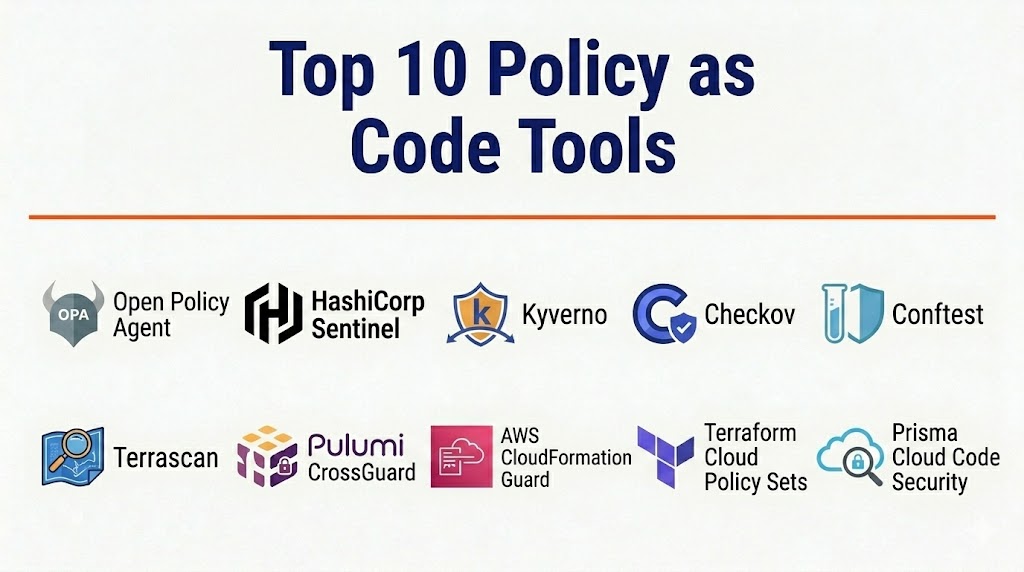
Top 10 Policy as Code Tools
1- Open Policy Agent
Short description: Open Policy Agent is a general-purpose open-source policy engine used to enforce rules across cloud-native environments, APIs, Kubernetes, CI/CD pipelines, and microservices. It uses the Rego policy language to define flexible rules over structured data. OPA is widely used where teams need centralized, reusable, and programmable policy decisions. It is best for organizations that need broad policy enforcement beyond one specific platform.
Key Features
- General-purpose policy engine for multiple environments.
- Rego policy language for flexible rule definition.
- Works with Kubernetes, APIs, microservices, and CI/CD workflows.
- Decouples policy decisions from application logic.
- Supports JSON and YAML input data.
- Strong integration ecosystem.
- Useful for compliance, authorization, and infrastructure governance.
Pros
- Highly flexible and platform-neutral.
- Strong open-source community and ecosystem.
- Suitable for advanced enterprise policy models.
- Works across many governance and security use cases.
Cons
- Rego has a learning curve for new users.
- Requires policy design discipline to avoid complexity.
- Reporting and user experience may need additional tooling.
- Implementation quality depends on integration maturity.
Platforms / Deployment
Linux. Windows. macOS. Kubernetes. Cloud. Self-hosted.
Security & Compliance
Security and compliance depend on how OPA is deployed and integrated. Supports fine-grained policy decisions, audit-friendly workflows, and centralized governance patterns. Specific certifications are not applicable in the same way as a commercial SaaS product. Varies / N/A.
Integrations & Ecosystem
Open Policy Agent integrates with cloud-native systems, Kubernetes, APIs, service meshes, CI/CD pipelines, and custom applications. Its flexible input model allows teams to apply policies across many environments.
- Kubernetes
- Envoy
- Terraform workflows
- CI/CD pipelines
- APIs and microservices
- Custom governance systems
Support & Community
OPA has strong open-source documentation, community support, policy examples, and wide adoption in cloud-native security and platform engineering communities. Commercial support may be available through vendors and ecosystem providers.
2- HashiCorp Sentinel
Short description: HashiCorp Sentinel is a Policy as Code framework designed for HashiCorp ecosystem workflows, especially Terraform Cloud and Terraform Enterprise. It helps organizations enforce governance rules before infrastructure changes are applied. Sentinel is useful for teams that need policy checks tied closely to Terraform runs, workspaces, and infrastructure workflows. It is especially strong for enterprises already using HashiCorp products.
Key Features
- Policy as Code framework for HashiCorp workflows.
- Strong integration with Terraform Cloud and Terraform Enterprise.
- Policy checks before infrastructure changes are applied.
- Supports soft mandatory, hard mandatory, and advisory policies.
- Useful for cost, security, compliance, and operational guardrails.
- Centralized governance across infrastructure workflows.
- Policy testing and enforcement inside Terraform pipelines.
Pros
- Excellent fit for Terraform Cloud and Terraform Enterprise users.
- Strong governance control before infrastructure deployment.
- Useful for enterprise infrastructure compliance.
- Supports policy enforcement without external pipeline complexity.
Cons
- Tightly tied to HashiCorp ecosystem.
- Less flexible for non-HashiCorp environments.
- Sentinel language requires learning.
- May not be suitable for teams using only open-source Terraform workflows.
Platforms / Deployment
Web. Cloud. Hybrid where supported through HashiCorp enterprise workflows.
Security & Compliance
Security features depend on Terraform Cloud or Terraform Enterprise configuration. Enterprise access controls, policy enforcement, audit workflows, and governance features may be available. Specific compliance details should be verified directly.
Integrations & Ecosystem
Sentinel works best inside HashiCorp workflows where policy checks are required before infrastructure changes are approved or applied. It is especially relevant for Terraform-based governance.
- Terraform Cloud
- Terraform Enterprise
- HashiCorp Vault workflows
- HashiCorp Consul workflows
- CI/CD workflows
- Cloud infrastructure pipelines
Support & Community
Support depends on HashiCorp product plan and deployment model. Documentation is available, and enterprise customers typically receive vendor support and onboarding resources.
3- Kyverno
Short description: Kyverno is a Kubernetes-native Policy as Code tool designed to validate, mutate, generate, and clean up Kubernetes resources using YAML-based policies. It is popular with platform teams that want policy enforcement without learning a separate policy language. Kyverno is especially useful for Kubernetes admission control, image verification, namespace standards, and workload governance. It is best for teams that want Kubernetes policy management in a familiar format.
Key Features
- Kubernetes-native policy management.
- YAML-based policy definitions.
- Validate, mutate, generate, and clean up resources.
- Admission control for Kubernetes workloads.
- Image verification and supply chain policy support.
- Policy reporting and background scanning.
- GitOps-friendly policy workflows.
Pros
- Easier for Kubernetes users because policies are YAML-based.
- Strong fit for admission control and cluster governance.
- Good developer and platform team experience.
- Active cloud-native community.
Cons
- Primarily focused on Kubernetes.
- Less general-purpose than OPA.
- Large policy sets require governance and testing discipline.
- Enterprise reporting may need additional tooling.
Platforms / Deployment
Kubernetes. Cloud. Self-hosted.
Security & Compliance
Security depends on Kubernetes deployment and cluster controls. Supports admission control, policy reports, image verification, and governance workflows. Specific certifications are not applicable in the same way as SaaS tools. Varies / N/A.
Integrations & Ecosystem
Kyverno integrates directly into Kubernetes clusters and works well with GitOps and cloud-native workflows. It is often used by platform teams to enforce cluster standards.
- Kubernetes
- Argo CD
- Flux
- OCI image registries
- CI/CD pipelines
- Policy Reporter ecosystem
Support & Community
Kyverno has strong open-source documentation, active community support, and growing adoption in Kubernetes governance. Commercial support may be available through ecosystem vendors.
4- Checkov
Short description: Checkov is an Infrastructure as Code security and compliance scanning tool used to detect misconfigurations before deployment. It scans Terraform, Kubernetes, CloudFormation, Helm, Dockerfiles, and other configuration formats. Checkov is useful for teams that want policy checks inside CI/CD pipelines and pull requests. It is especially strong for shift-left cloud security and infrastructure governance.
Key Features
- IaC scanning for misconfigurations.
- Supports Terraform, Kubernetes, CloudFormation, Helm, and more.
- Large built-in policy library.
- Custom policy support.
- CI/CD and pull request integration.
- Cloud security and compliance checks.
- Developer-friendly remediation guidance.
Pros
- Strong shift-left infrastructure security scanning.
- Broad IaC format support.
- Useful built-in policy coverage.
- Good fit for DevSecOps workflows.
Cons
- Focused mainly on scanning rather than runtime enforcement.
- False positives may require tuning.
- Enterprise reporting depends on deployment and platform setup.
- Teams need policy ownership to avoid alert fatigue.
Platforms / Deployment
Linux. Windows. macOS. Cloud. Self-hosted.
Security & Compliance
Supports policy checks mapped to common security and compliance expectations, but specific compliance certification depends on deployment and vendor edition. Not publicly stated for all details.
Integrations & Ecosystem
Checkov integrates into development and security workflows to scan infrastructure definitions before deployment. It is often used in CI/CD pipelines and code review processes.
- Terraform
- Kubernetes
- CloudFormation
- Helm
- Dockerfiles
- GitHub Actions and CI/CD pipelines
Support & Community
Checkov has strong open-source usage, documentation, and community support. Enterprise support and advanced capabilities may be available through related commercial offerings.
5- Cloud Custodian
Short description: Cloud Custodian is an open-source rules engine for cloud governance, cost control, security, and compliance automation. It lets teams define policies in YAML and apply them across cloud accounts and resources. Cloud Custodian is useful for detecting, reporting, and remediating cloud resource violations. It is best for teams that need cloud governance automation beyond static IaC scanning.
Key Features
- Cloud governance using YAML policies.
- Detects and remediates cloud resource violations.
- Supports security, cost, compliance, and operational policies.
- Event-driven and scheduled policy execution.
- Multi-cloud support depending on provider capability.
- Automated cleanup and remediation workflows.
- Useful for large cloud account governance.
Pros
- Strong runtime cloud governance capability.
- Practical for cost control and security automation.
- Open-source and flexible.
- Useful for real cloud environment remediation.
Cons
- Requires careful policy testing before automation.
- Setup can be complex in large environments.
- Reporting may require additional tooling.
- Policy mistakes can cause operational impact if remediation is too aggressive.
Platforms / Deployment
Linux. Cloud. Self-hosted.
Security & Compliance
Security depends on cloud permissions, deployment architecture, and policy scope. Supports audit-friendly governance workflows and remediation logs. Specific certifications are not applicable in the same way as SaaS tools. Varies / N/A.
Integrations & Ecosystem
Cloud Custodian integrates with cloud provider APIs and event systems to enforce governance rules on live resources. It works well for cloud security, cost governance, and compliance automation.
- AWS
- Microsoft Azure
- Google Cloud
- Serverless workflows
- Cloud event systems
- Reporting and notification tools
Support & Community
Cloud Custodian has open-source documentation and an established community. Support is community-driven unless implemented through a commercial service provider or internal platform team.
6- Conftest
Short description: Conftest is a lightweight Policy as Code testing tool that uses Open Policy Agent and Rego to test configuration files. It is commonly used to validate Terraform, Kubernetes, Docker, YAML, JSON, and other structured files before deployment. Conftest is best for teams that want simple command-line policy testing inside CI/CD pipelines. It is especially useful when teams already use OPA or want local policy validation.
Key Features
- Policy testing for structured configuration files.
- Uses OPA and Rego policies.
- Works with Terraform, Kubernetes, JSON, YAML, Docker, and more.
- Simple CLI-based workflow.
- Easy CI/CD integration.
- Supports custom policy libraries.
- Good for pre-deployment validation.
Pros
- Lightweight and easy to integrate.
- Strong fit for developer workflows.
- Works well with OPA policy ecosystems.
- Good for local and pipeline-based testing.
Cons
- Requires Rego knowledge.
- Focused on testing rather than runtime enforcement.
- Reporting is basic without extra tooling.
- Best suited for technical teams.
Platforms / Deployment
Linux. Windows. macOS. Self-hosted.
Security & Compliance
Security depends on how policies are written and where Conftest is executed. It can support compliance checks, but certifications are not applicable as a standalone open-source CLI tool. Varies / N/A.
Integrations & Ecosystem
Conftest integrates into developer machines, CI/CD pipelines, and infrastructure code workflows. It is often paired with OPA for reusable policy governance.
- Open Policy Agent
- Terraform
- Kubernetes
- Docker
- GitHub Actions
- GitLab CI/CD
Support & Community
Conftest has open-source documentation and community support. It is strongest for teams already familiar with OPA and Rego-based governance.
7- Terrascan
Short description: Terrascan is an open-source Infrastructure as Code security scanner that detects compliance and security violations before cloud resources are deployed. It supports Terraform, Kubernetes, Helm, Kustomize, Dockerfiles, and cloud templates. Terrascan is useful for DevSecOps teams that want policy enforcement inside pipelines. It is best for organizations focused on IaC misconfiguration prevention.
Key Features
- IaC scanning for security and compliance issues.
- Supports Terraform, Kubernetes, Helm, Kustomize, and Dockerfiles.
- Built-in policy packs for cloud security.
- Custom policy support.
- CI/CD integration.
- Supports multiple cloud providers.
- Shift-left infrastructure governance workflows.
Pros
- Good coverage for IaC and Kubernetes scanning.
- Useful for security-focused DevOps teams.
- Open-source and pipeline-friendly.
- Helps catch risks before deployment.
Cons
- Focused mainly on scanning rather than runtime remediation.
- May require tuning to reduce noise.
- Policy management can become complex over time.
- Enterprise support details vary.
Platforms / Deployment
Linux. Windows. macOS. Self-hosted.
Security & Compliance
Supports security and compliance policy checks, but specific certifications are not applicable as an open-source scanner. Varies / N/A.
Integrations & Ecosystem
Terrascan works in CI/CD pipelines and developer workflows to scan infrastructure code before deployment. It is useful for Terraform and Kubernetes-heavy environments.
- Terraform
- Kubernetes
- Helm
- Kustomize
- Dockerfiles
- CI/CD pipelines
Support & Community
Terrascan has open-source documentation and community support. Support maturity depends on internal adoption and any commercial ecosystem services used.
8- KICS
Short description: KICS is an open-source Infrastructure as Code security scanning tool designed to find vulnerabilities, compliance gaps, and misconfigurations in infrastructure definitions. It supports many IaC formats and is useful for teams building secure cloud and container environments. KICS helps developers detect risky configurations early in the software delivery lifecycle. It is best for security teams that want broad IaC scanning coverage.
Key Features
- Scans infrastructure code for security issues.
- Supports Terraform, Kubernetes, Docker, CloudFormation, Helm, and more.
- Large query library for misconfiguration detection.
- Custom query support.
- CI/CD integration.
- Reports for security and compliance workflows.
- Useful for shift-left cloud security.
Pros
- Broad IaC format support.
- Good for early misconfiguration detection.
- Open-source and developer-friendly.
- Useful for security teams standardizing IaC checks.
Cons
- Primarily focused on scanning rather than enforcement.
- Requires tuning to reduce false positives.
- Enterprise workflow integration may require additional tooling.
- Policy ownership is needed for long-term success.
Platforms / Deployment
Linux. Windows. macOS. Self-hosted.
Security & Compliance
KICS supports security and compliance-oriented checks, but standalone compliance certifications are not applicable. Varies / N/A.
Integrations & Ecosystem
KICS integrates into CI/CD workflows, developer tools, and security pipelines. It is useful when teams need broad scanning coverage across multiple IaC formats.
- Terraform
- Kubernetes
- Docker
- CloudFormation
- Helm
- CI/CD pipelines
Support & Community
KICS has open-source documentation and community support. Support depth depends on internal security team maturity and any related commercial services used.
9- Pulumi CrossGuard
Short description: Pulumi CrossGuard is a Policy as Code capability within the Pulumi ecosystem. It helps teams enforce infrastructure policies on Pulumi deployments using familiar programming language workflows. CrossGuard is useful for developer-centric teams that already define infrastructure with Pulumi. It supports policy packs for compliance, security, cost, and operational guardrails.
Key Features
- Policy enforcement for Pulumi infrastructure deployments.
- Uses programming-language-based policy definitions.
- Supports compliance, cost, security, and operational rules.
- Works with Pulumi stacks and cloud deployments.
- Useful for developer-centric IaC governance.
- Policy packs for reusable governance.
- CI/CD and deployment workflow integration.
Pros
- Strong fit for Pulumi users.
- Developer-friendly policy authoring.
- Good for infrastructure governance in code-first teams.
- Supports reusable policy packs.
Cons
- Best suited to Pulumi environments.
- Less relevant for teams not using Pulumi.
- Requires programming language skills.
- Smaller ecosystem than OPA or Terraform-focused tools.
Platforms / Deployment
Linux. Windows. macOS. Cloud. Self-hosted.
Security & Compliance
Security features depend on Pulumi deployment model and organization configuration. Policy enforcement, access controls, and audit workflows may be available depending on plan. Specific compliance details should be verified directly.
Integrations & Ecosystem
Pulumi CrossGuard integrates with Pulumi infrastructure workflows and cloud providers. It works well for teams that want governance inside developer-led IaC pipelines.
- Pulumi
- AWS
- Microsoft Azure
- Google Cloud
- Kubernetes
- CI/CD pipelines
Support & Community
Support depends on Pulumi plan and usage model. Pulumi provides documentation, community resources, and commercial support options for enterprise customers.
10- CloudFormation Guard
Short description: CloudFormation Guard is a policy validation tool used to check AWS CloudFormation templates against custom rules. It helps AWS-focused teams validate infrastructure definitions before deployment. CloudFormation Guard is useful for enforcing security, compliance, and operational standards in AWS IaC workflows. It is best for teams heavily invested in CloudFormation and AWS-native governance.
Key Features
- Policy validation for CloudFormation templates.
- Custom rules for AWS infrastructure standards.
- Pre-deployment template checks.
- Useful for AWS compliance and security guardrails.
- CLI-based workflow.
- CI/CD pipeline integration.
- Supports governance for AWS-native IaC.
Pros
- Strong fit for AWS CloudFormation users.
- Lightweight and focused.
- Useful for pre-deployment AWS policy checks.
- Works well in AWS-native workflows.
Cons
- Primarily focused on AWS CloudFormation.
- Limited compared to general-purpose policy engines.
- Requires rule-writing discipline.
- Less useful for multi-cloud teams.
Platforms / Deployment
Linux. Windows. macOS. Cloud. Self-hosted.
Security & Compliance
Security and compliance depend on AWS environment design and policy definitions. CloudFormation Guard helps validate templates against internal rules, but standalone certification is not applicable. Varies / N/A.
Integrations & Ecosystem
CloudFormation Guard fits into AWS-native infrastructure pipelines. It is especially useful for validating infrastructure templates before CloudFormation stacks are deployed.
- AWS CloudFormation
- AWS CodePipeline
- GitHub Actions
- GitLab CI/CD
- AWS governance workflows
- Cloud security pipelines
Support & Community
Support is mainly through AWS documentation and community usage. Enterprise AWS customers may receive broader support through AWS support plans.
Comparison Table
| Tool Name | Best For | Platforms Supported | Deployment | Standout Feature | Public Rating |
|---|---|---|---|---|---|
| Open Policy Agent | General-purpose policy enforcement | Linux, Windows, macOS, Kubernetes | Cloud, Self-hosted | Flexible policy engine with Rego | N/A |
| HashiCorp Sentinel | Terraform governance | Web | Cloud, Hybrid | Native Terraform Cloud policy enforcement | N/A |
| Kyverno | Kubernetes policy enforcement | Kubernetes | Cloud, Self-hosted | YAML-based Kubernetes policies | N/A |
| Checkov | IaC security scanning | Linux, Windows, macOS | Cloud, Self-hosted | Broad IaC misconfiguration detection | N/A |
| Cloud Custodian | Cloud governance automation | Linux | Cloud, Self-hosted | Runtime cloud remediation policies | N/A |
| Conftest | Lightweight policy testing | Linux, Windows, macOS | Self-hosted | CLI-based OPA policy testing | N/A |
| Terrascan | IaC compliance scanning | Linux, Windows, macOS | Self-hosted | Terraform and Kubernetes security scanning | N/A |
| KICS | Broad IaC security scanning | Linux, Windows, macOS | Self-hosted | Large query library for IaC risks | N/A |
| Pulumi CrossGuard | Pulumi policy governance | Linux, Windows, macOS | Cloud, Self-hosted | Policy packs for Pulumi deployments | N/A |
| CloudFormation Guard | AWS CloudFormation policy checks | Linux, Windows, macOS | Cloud, Self-hosted | AWS-native template validation | N/A |
Evaluation and Scoring of Policy as Code Tools
| Tool Name | Core 25% | Ease 15% | Integrations 15% | Security 10% | Performance 10% | Support 10% | Value 15% | Weighted Total |
|---|---|---|---|---|---|---|---|---|
| Open Policy Agent | 10 | 7 | 10 | 8 | 9 | 9 | 9 | 9.00 |
| HashiCorp Sentinel | 8 | 7 | 8 | 8 | 8 | 8 | 7 | 7.70 |
| Kyverno | 9 | 9 | 8 | 8 | 8 | 8 | 9 | 8.55 |
| Checkov | 8 | 8 | 9 | 8 | 8 | 8 | 9 | 8.30 |
| Cloud Custodian | 8 | 7 | 8 | 8 | 8 | 7 | 9 | 7.95 |
| Conftest | 7 | 8 | 8 | 7 | 8 | 7 | 9 | 7.70 |
| Terrascan | 8 | 7 | 8 | 8 | 8 | 7 | 9 | 7.90 |
| KICS | 8 | 8 | 8 | 8 | 8 | 7 | 9 | 8.05 |
| Pulumi CrossGuard | 7 | 8 | 7 | 8 | 8 | 8 | 7 | 7.50 |
| CloudFormation Guard | 7 | 8 | 6 | 8 | 8 | 7 | 8 | 7.35 |
These scores are comparative and based on policy coverage, enforcement capability, ecosystem strength, ease of adoption, security usefulness, and buyer value. A higher score does not mean one tool is best for every organization. OPA is strongest for broad policy decisions, Kyverno is excellent for Kubernetes teams, and Checkov or KICS may be better for IaC scanning. Buyers should shortlist based on enforcement needs, cloud stack, developer workflow, and compliance requirements.
Which Policy as Code Tool Is Right for You
Solo / Freelancer
Solo users usually need lightweight tools that are easy to run locally or inside simple CI/CD pipelines. Conftest, Checkov, KICS, and CloudFormation Guard are practical options depending on the infrastructure format. If Kubernetes policies are required, Kyverno can be a strong choice. OPA is powerful, but it may be more than needed for very small projects.
SMB
SMBs should prioritize ease of adoption, built-in policies, CI/CD integration, and low operational overhead. Checkov, KICS, Kyverno, and Conftest are strong choices for fast policy adoption. Cloud Custodian can help if the team needs active cloud governance and remediation. Pulumi CrossGuard is useful for teams already using Pulumi.
Mid-Market
Mid-market organizations usually need policy consistency across cloud infrastructure, Kubernetes, CI/CD pipelines, and engineering teams. OPA, Kyverno, Checkov, Cloud Custodian, and Terrascan are strong options depending on enforcement scope. Teams should also consider how policies will be tested, versioned, approved, and reported across multiple teams.
Enterprise
Enterprises should focus on centralized policy management, auditability, runtime enforcement, CI/CD governance, RBAC, and compliance reporting. OPA, HashiCorp Sentinel, Kyverno, Cloud Custodian, and Checkov are strong candidates depending on platform strategy. Sentinel is especially relevant for Terraform Cloud or Terraform Enterprise users. OPA is strong when policies must apply across many systems.
Budget vs Premium
Open-source tools such as OPA, Kyverno, Conftest, Cloud Custodian, Terrascan, KICS, and CloudFormation Guard can provide strong value, but they require internal ownership. Premium or ecosystem-tied tools may reduce operational effort with better support, policy management, and reporting. Budget buyers should consider engineering time as part of total cost.
Feature Depth vs Ease of Use
OPA offers deep flexibility but requires Rego knowledge. Kyverno is easier for Kubernetes users because it uses YAML policies. Checkov and KICS are easier for IaC scanning because they include many built-in checks. Cloud Custodian is powerful for runtime cloud governance but requires careful remediation design. Sentinel is best when Terraform governance is the main requirement.
Integrations and Scalability
OPA, Checkov, Kyverno, and Cloud Custodian offer strong integration potential across modern DevOps workflows. Sentinel scales well inside HashiCorp environments. CloudFormation Guard works well for AWS-native teams, while Pulumi CrossGuard fits Pulumi users. Enterprises should validate CI/CD, GitOps, cloud provider, Kubernetes, reporting, and audit integrations before choosing.
Security and Compliance Needs
Security-focused teams should look for policy testing, audit logs, enforcement modes, access controls, policy versioning, and compliance mapping. Policy as Code can reduce risk only if rules are maintained, tested, and aligned with real security standards. Teams should also avoid overly aggressive automatic remediation until policies are proven safe in staging or advisory mode.
Frequently Asked Questions FAQs
1. What is Policy as Code?
Policy as Code is the practice of writing security, compliance, operational, and governance rules as code. These policies can be tested, versioned, reviewed, and enforced automatically. It helps teams move away from manual checks and static documents. Policy as Code is commonly used in cloud, Kubernetes, CI/CD, and infrastructure automation workflows.
2. Why do organizations need Policy as Code tools?
Organizations need Policy as Code tools because modern infrastructure changes too quickly for manual governance. These tools help prevent misconfigurations, enforce standards, and reduce compliance risk before deployment. They also create repeatable and auditable policy workflows. This improves collaboration between security, compliance, platform, and engineering teams.
3. What is the difference between OPA and Kyverno?
OPA is a general-purpose policy engine that can be used across Kubernetes, APIs, CI/CD pipelines, microservices, and infrastructure workflows. Kyverno is Kubernetes-native and uses YAML-based policies, which makes it easier for many Kubernetes teams. OPA is more flexible across environments, while Kyverno is easier for Kubernetes-specific policy enforcement. The best choice depends on scope and team skills.
4. Are Policy as Code tools only for Kubernetes?
No, Policy as Code tools can be used across Kubernetes, Terraform, cloud accounts, CI/CD pipelines, APIs, containers, and application workflows. Some tools are Kubernetes-focused, while others are general-purpose or IaC-specific. Organizations often use multiple tools together. For example, they may use Checkov for IaC scanning and Kyverno for Kubernetes admission control.
5. Can Policy as Code tools improve security?
Yes, Policy as Code tools can improve security by detecting risky configurations before deployment and enforcing rules at runtime. They can block insecure storage, weak identity settings, privileged containers, exposed networks, and missing encryption. However, their effectiveness depends on policy quality and maintenance. Poorly written or outdated policies can create gaps or false confidence.
6. How do Policy as Code tools fit into CI/CD pipelines?
Policy as Code tools can run during pull requests, build stages, deployment approvals, and release gates. They check infrastructure or application changes against defined rules before changes reach production. If a violation is found, the pipeline can warn, block, or require approval. This helps teams shift governance earlier into development workflows.
7. What are common mistakes when adopting Policy as Code?
Common mistakes include writing too many policies too quickly, skipping policy testing, failing to explain violations clearly, and creating rules that block developers without remediation guidance. Another mistake is treating Policy as Code as only a security tool instead of a shared governance practice. Teams should start with high-value policies and expand gradually.
8. Do Policy as Code tools support compliance?
Many Policy as Code tools support compliance workflows by mapping rules to internal standards or security benchmarks. They can help create repeatable evidence for audits and reduce manual review effort. However, using a tool does not automatically make an organization compliant. Compliance still requires process ownership, documentation, access control, and regular validation.
9. What skills are needed to use Policy as Code tools?
Teams need basic understanding of infrastructure, cloud security, CI/CD workflows, and policy logic. Some tools require specific languages such as Rego, while others use YAML or programming languages. Security teams and platform teams should collaborate so policies are both technically correct and practical for developers. Documentation and examples are important for adoption.
10. Should teams use one Policy as Code tool or multiple tools?
Many organizations use more than one tool because policy needs differ across environments. For example, OPA may be used for broad policy decisions, Kyverno for Kubernetes, and Checkov for IaC scanning. Using multiple tools is reasonable if responsibilities are clear. The key is to avoid duplicate policies, conflicting rules, and fragmented reporting.
Conclusion
Policy as Code tools help organizations turn governance from manual review into automated, repeatable, and auditable rules. The best tool depends on where policies need to run, how technical the team is, and whether the focus is Kubernetes, Terraform, cloud accounts, CI/CD, or runtime governance. Open Policy Agent is a strong general-purpose choice, Kyverno is excellent for Kubernetes-native teams, Checkov and KICS are practical for IaC scanning, and Cloud Custodian is valuable for cloud governance automation. Sentinel is best for teams deeply invested in HashiCorp workflows, while CloudFormation Guard is useful for AWS-native template validation. Teams should start with a small set of high-impact policies, test them in advisory mode, integrate them into CI/CD, validate developer experience, and then scale enforcement gradually across environments.
