Introduction
GitOps tools help organizations manage infrastructure and application deployments using Git repositories as the single source of truth. Instead of manually applying changes to Kubernetes clusters or cloud infrastructure, teams define desired states in Git, and GitOps platforms automatically synchronize environments with those definitions.
GitOps has become a core operating model for cloud-native infrastructure because organizations need more reliable deployments, stronger audit trails, faster rollback capabilities, and better automation across Kubernetes and multi-cloud environments. Modern platform engineering teams increasingly depend on GitOps workflows to scale application delivery while reducing operational drift and deployment inconsistencies.
Common use cases include Kubernetes application delivery, multi-cluster management, infrastructure deployment automation, progressive delivery, compliance-driven deployment approvals, disaster recovery, and environment standardization.
When evaluating GitOps tools, buyers should consider Kubernetes integration, multi-cluster scalability, CI/CD compatibility, policy enforcement, security controls, observability, deployment rollback capabilities, ecosystem maturity, developer experience, and enterprise governance features.
Best for: DevOps teams, platform engineers, Kubernetes administrators, SRE teams, cloud-native enterprises, SaaS companies, and organizations standardizing continuous delivery workflows.
Not ideal for: organizations without Kubernetes adoption, teams relying heavily on manual deployment workflows, or very small projects with minimal infrastructure automation needs.
Key Trends in GitOps Tools
- GitOps is becoming the default deployment model for Kubernetes, especially in enterprise cloud-native environments.
- Multi-cluster management is a major focus, with platforms like Rancher Fleet emphasizing GitOps at large scale.
- Progressive delivery and automated rollbacks are increasingly integrated with GitOps workflows.
- Platform engineering adoption is accelerating, with GitOps becoming central to internal developer platforms.
- Security and policy enforcement integration is becoming more important for regulated environments.
- Open-source GitOps tools continue dominating adoption, especially Argo CD and Flux.
- Developer experience improvements are reducing operational complexity with dashboards, drift detection, and visualization tools.
- Enterprise GitOps platforms are adding governance layers, audit trails, RBAC, and compliance reporting.
- GitOps and Infrastructure as Code workflows are converging, especially around Terraform and Kubernetes automation.
- AI-assisted deployment analysis and anomaly detection are starting to appear in enterprise delivery platforms.
How We Selected These Tools
The tools in this list were selected based on practical GitOps adoption, Kubernetes ecosystem relevance, enterprise scalability, and deployment automation capabilities.
- We prioritized tools with strong GitOps alignment and Kubernetes-native deployment workflows.
- We included both open-source and enterprise GitOps platforms.
- We evaluated ecosystem maturity, community adoption, and cloud-native relevance.
- We considered multi-cluster support, scalability, and operational reliability.
- We reviewed integration capabilities with CI/CD pipelines, Kubernetes, Helm, Git platforms, and observability systems.
- We evaluated governance capabilities including RBAC, auditability, policy enforcement, and enterprise management.
- We considered developer experience, onboarding complexity, and operational maintainability.
- We included tools useful for startups, SMBs, mid-market teams, enterprises, and managed Kubernetes environments.
- We avoided guessed ratings, unsupported claims, and unverified certifications.
- We treated the scoring model as comparative guidance rather than a universal ranking.
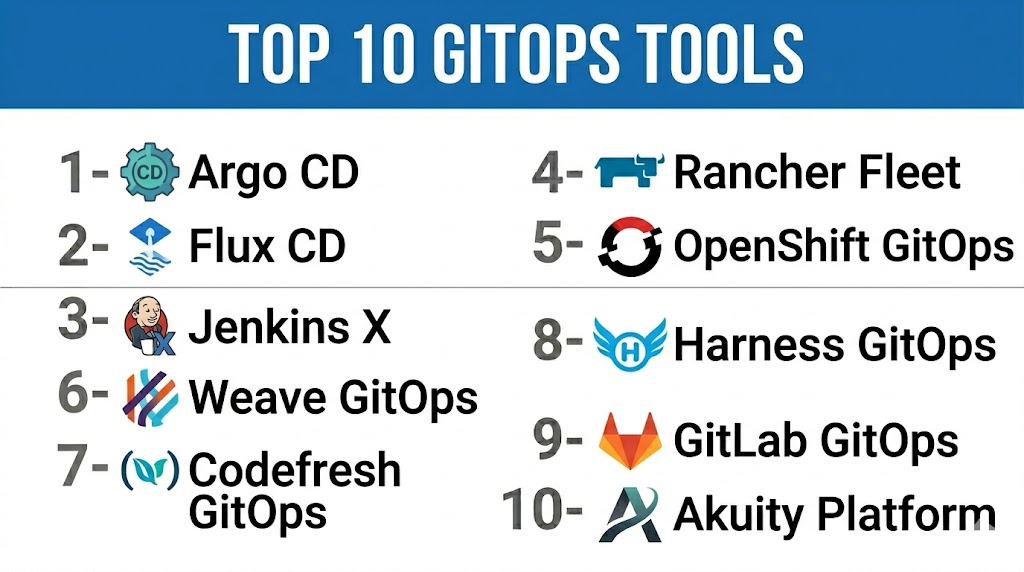
Top 10 GitOps Tools
1- Argo CD
Short description: Argo CD is one of the most widely adopted GitOps tools for Kubernetes application delivery. It continuously monitors Git repositories and synchronizes Kubernetes clusters to the desired application state. Argo CD is especially popular among platform engineering and DevOps teams because of its strong UI, drift detection, rollback capabilities, and Kubernetes-native design. It is commonly the first GitOps platform organizations adopt.
Key Features
- Kubernetes-native GitOps delivery
- Automated synchronization and drift detection
- Visual deployment dashboards
- Rollback and version tracking
- Multi-cluster deployment management
- Helm, Kustomize, and YAML support
- RBAC and deployment controls
Pros
- Strong community adoption
- Excellent Kubernetes integration
- Easy onboarding compared with many alternatives
- Powerful visibility and synchronization features
Cons
- Enterprise governance may require additional tooling
- Large-scale deployments can become operationally complex
- RBAC management may need careful design
- Primarily focused on Kubernetes workloads
Platforms / Deployment
Kubernetes, cloud-native environments, Linux, cloud deployment, self-hosted deployment.
Security & Compliance
Supports RBAC, audit logging, SSO integrations, and Kubernetes-native security controls. Additional compliance requirements depend on deployment architecture and surrounding platform controls.
Integrations & Ecosystem
Argo CD integrates deeply with Kubernetes and modern cloud-native deployment ecosystems.
- Kubernetes
- Helm
- Kustomize
- GitHub and GitLab
- CI/CD platforms
- Prometheus and monitoring tools
Support & Community
Argo CD has one of the strongest communities in the GitOps ecosystem with broad documentation, tutorials, and enterprise adoption. Commercial support is available through vendors and platform providers.
2- Flux CD
Short description: Flux CD is a Kubernetes-native GitOps toolkit designed around modular components and automation workflows. It is a CNCF-graduated project and is widely respected for flexibility, extensibility, and Kubernetes-native architecture. Flux is especially popular among platform engineering teams that prefer CLI-first workflows and highly composable deployment automation.
Key Features
- Kubernetes-native GitOps automation
- Modular GitOps toolkit architecture
- Continuous reconciliation engine
- OCI artifact support
- Multi-tenancy support
- Progressive delivery integrations
- Strong extensibility model
Pros
- Strong CNCF ecosystem support
- Flexible and modular architecture
- Excellent Kubernetes-native design
- Good for advanced platform engineering teams
Cons
- Steeper learning curve than Argo CD
- Less UI-focused by default
- Governance workflows may require additional tooling
- More operational complexity for beginners
Platforms / Deployment
Kubernetes, cloud-native environments, Linux, cloud deployment, self-hosted deployment.
Security & Compliance
Supports Kubernetes-native security controls, RBAC, and Git-based deployment auditing. Enterprise compliance depends on deployment configuration and surrounding platform architecture.
Integrations & Ecosystem
Flux integrates deeply with Kubernetes and cloud-native delivery ecosystems.
- Kubernetes
- Helm
- OCI repositories
- GitHub and GitLab
- Progressive delivery tooling
- GitOps workflows
Support & Community
Flux benefits from strong CNCF backing and a mature Kubernetes-focused community. Enterprise support is available through vendors and managed Kubernetes ecosystems.
3- Rancher Fleet
Short description: Rancher Fleet is a GitOps engine designed for managing deployments across large numbers of Kubernetes clusters. It is optimized for multi-cluster operations and is commonly used inside Rancher-based Kubernetes environments. Fleet is especially valuable for enterprises and managed service providers operating Kubernetes at scale.
Key Features
- Large-scale multi-cluster GitOps
- Centralized fleet management
- Git-based deployment workflows
- Kubernetes-native operations
- Helm-based deployment support
- Cluster grouping and targeting
- Rancher ecosystem integration
Pros
- Excellent multi-cluster scalability
- Strong fit for large Kubernetes fleets
- Good integration with Rancher
- Useful for enterprise operations teams
Cons
- May be excessive for small environments
- Best suited for Rancher ecosystems
- Less community adoption than Argo CD or Flux
- Operational complexity increases at scale
Platforms / Deployment
Kubernetes, Rancher-managed environments, cloud deployment, self-hosted deployment.
Security & Compliance
Supports Kubernetes RBAC and Rancher-based access management. Security posture depends on Rancher deployment architecture and operational configuration.
Integrations & Ecosystem
Fleet integrates closely with Rancher and Kubernetes management workflows.
- Rancher
- Kubernetes
- Helm
- Git repositories
- Multi-cluster orchestration
- GitOps workflows
Support & Community
Fleet benefits from Rancher and SUSE ecosystem support. Community adoption is strongest among large Kubernetes operators and Rancher users.
4- Weave GitOps
Short description: Weave GitOps is a GitOps platform built around the Flux ecosystem and designed to simplify Kubernetes GitOps workflows. It provides dashboards, deployment visibility, and operational tooling on top of Flux CD. It is useful for organizations wanting a more accessible operational experience around Flux-based GitOps.
Key Features
- Flux-based GitOps management
- Git-driven Kubernetes deployments
- Deployment dashboards
- Cluster reconciliation automation
- GitOps visualization
- Helm and Kustomize support
- Enterprise GitOps management capabilities
Pros
- Easier operational visibility for Flux users
- Strong Kubernetes-native focus
- Good dashboard experience
- Useful for enterprise GitOps management
Cons
- Best suited for Flux ecosystems
- Enterprise features may require commercial versions
- Less standalone adoption than Argo CD
- Kubernetes-focused scope
Platforms / Deployment
Kubernetes, cloud-native environments, cloud deployment, self-hosted deployment.
Security & Compliance
Security controls depend on Flux deployment configuration and platform architecture. Enterprise governance features may vary by edition.
Integrations & Ecosystem
Weave GitOps works naturally within Flux and Kubernetes delivery ecosystems.
- Flux CD
- Kubernetes
- Helm
- GitHub and GitLab
- GitOps workflows
- Cloud-native tooling
Support & Community
Weave GitOps benefits from the Flux ecosystem and enterprise support offerings. Community adoption is strongest among Flux users and Kubernetes platform teams.
5- Jenkins X
Short description: Jenkins X is a cloud-native CI/CD and GitOps platform designed for Kubernetes-based software delivery. It combines automated pipelines, preview environments, and GitOps deployment management. Jenkins X is useful for organizations that want both CI/CD automation and GitOps workflows in a Kubernetes-native platform.
Key Features
- Automated cloud-native CI/CD pipelines
- GitOps deployment workflows
- Preview environments
- Kubernetes-native delivery
- Environment promotion automation
- Tekton pipeline integration
- ChatOps support
Pros
- Combines CI/CD and GitOps workflows
- Strong Kubernetes-native design
- Useful for developer productivity
- Supports automated environment promotion
Cons
- More operational complexity than simpler GitOps tools
- Learning curve for platform management
- Can require significant Kubernetes expertise
- Smaller community compared with Argo CD
Platforms / Deployment
Kubernetes, cloud-native platforms, Linux, cloud deployment, self-hosted deployment.
Security & Compliance
Supports Kubernetes-native RBAC and CI/CD security workflows. Enterprise compliance depends on deployment configuration and pipeline governance.
Integrations & Ecosystem
Jenkins X integrates with cloud-native delivery and CI/CD ecosystems.
- Kubernetes
- Tekton
- Git repositories
- Preview environments
- ChatOps tools
- CI/CD workflows
Support & Community
Jenkins X has an active Kubernetes and DevOps community, though smaller than Argo CD and Flux. Documentation is available, but operational maturity is important for adoption.
6- GitLab GitOps
Short description: GitLab GitOps combines GitLab CI/CD workflows with Kubernetes deployment automation using GitOps principles. It is especially attractive for organizations already using GitLab for source control and CI/CD pipelines. GitLab’s GitOps approach integrates Flux-based synchronization and Kubernetes observability directly into the GitLab platform.
Key Features
- GitLab-integrated GitOps workflows
- Flux-based synchronization
- Kubernetes observability integration
- Secure cluster connectivity
- CI/CD pipeline integration
- Identity and access management integration
- Single-platform DevOps workflows
Pros
- Strong fit for GitLab users
- Consolidated DevOps workflow experience
- Good CI/CD integration
- Simplifies GitOps onboarding for existing GitLab teams
Cons
- Less specialized than dedicated GitOps tools
- Best value depends on GitLab adoption
- Enterprise governance may require higher tiers
- Less flexible outside GitLab ecosystem
Platforms / Deployment
Cloud, Kubernetes, Linux, SaaS deployment, self-hosted deployment.
Security & Compliance
Supports RBAC, identity integration, auditability, and GitLab security workflows. Additional compliance capabilities depend on GitLab edition and deployment.
Integrations & Ecosystem
GitLab GitOps integrates naturally into GitLab-based development ecosystems.
- GitLab CI/CD
- Flux
- Kubernetes
- Git repositories
- Cluster observability
- DevOps workflows
Support & Community
GitLab provides enterprise documentation, support, and onboarding resources. Community strength is broad due to GitLab’s large user base.
7- Codefresh
Short description: Codefresh is an enterprise GitOps platform built around Argo CD and Kubernetes delivery workflows. It provides centralized GitOps management, dashboards, security controls, and operational governance for enterprise deployments. Codefresh is especially useful for organizations standardizing GitOps across multiple clusters and teams.
Key Features
- Enterprise GitOps management
- Centralized Argo CD management
- Multi-cluster visibility
- Deployment dashboards
- Security and audit controls
- Kubernetes deployment automation
- GitOps governance workflows
Pros
- Strong enterprise GitOps capabilities
- Good operational visibility
- Useful centralized governance
- Builds on proven Argo CD workflows
Cons
- Commercial platform costs may be significant
- Best suited for enterprise environments
- GitOps-focused rather than full platform engineering suite
- Requires Kubernetes operational maturity
Platforms / Deployment
Cloud, Kubernetes, Linux, SaaS deployment, enterprise deployment.
Security & Compliance
Supports RBAC, audit trails, deployment governance, and enterprise access controls. Additional compliance capabilities depend on deployment and licensing.
Integrations & Ecosystem
Codefresh integrates strongly with Kubernetes and enterprise delivery workflows.
- Argo CD
- Kubernetes
- Git repositories
- CI/CD systems
- Security workflows
- Enterprise delivery pipelines
Support & Community
Codefresh offers enterprise support, onboarding, and managed GitOps operational guidance. Community adoption is strongest among enterprise Kubernetes teams.
8- Harness GitOps
Short description: Harness GitOps is an enterprise GitOps platform built around Argo CD with additional governance, compliance, and software delivery capabilities. It combines GitOps workflows with broader CI/CD, feature management, and deployment automation. Harness is especially useful for enterprises scaling software delivery operations.
Key Features
- Enterprise GitOps management
- Argo CD integration
- Multi-cluster management
- Advanced RBAC controls
- Deployment governance and auditability
- Progressive delivery support
- Integrated CI/CD workflows
Pros
- Strong enterprise governance features
- Good operational visibility
- Combines GitOps with broader delivery tooling
- Useful for large-scale software delivery teams
Cons
- May be excessive for smaller organizations
- Enterprise pricing should be evaluated carefully
- Operational complexity may increase with platform breadth
- Best suited for mature DevOps environments
Platforms / Deployment
Cloud, Kubernetes, Linux, SaaS deployment, enterprise deployment.
Security & Compliance
Supports RBAC, audit trails, deployment governance, and enterprise access controls. Additional compliance capabilities depend on licensing and deployment model.
Integrations & Ecosystem
Harness GitOps integrates with broader enterprise delivery and DevOps ecosystems.
- Argo CD
- Kubernetes
- CI/CD workflows
- Feature management
- Security workflows
- Enterprise delivery platforms
Support & Community
Harness provides enterprise onboarding, documentation, and support. Community visibility is growing among enterprise DevOps and platform engineering teams.
9- Spinnaker
Short description: Spinnaker is a multi-cloud continuous delivery platform with strong deployment orchestration and GitOps capabilities. It is commonly used by enterprises managing deployments across Kubernetes and major cloud providers. Spinnaker is especially valuable for organizations requiring advanced deployment strategies such as canary releases and blue-green deployments.
Key Features
- Multi-cloud deployment orchestration
- Advanced deployment strategies
- Canary and blue-green deployments
- Visual pipeline builder
- Automated rollback workflows
- Kubernetes deployment support
- Monitoring integration
Pros
- Strong multi-cloud deployment support
- Advanced release orchestration
- Good enterprise scalability
- Powerful deployment strategy capabilities
Cons
- Steeper learning curve
- Operational complexity can be high
- Resource-intensive platform
- More complex than lightweight GitOps tools
Platforms / Deployment
Cloud, Kubernetes, Linux, self-hosted deployment, enterprise deployment.
Security & Compliance
Supports RBAC, auditability, deployment approvals, and enterprise delivery governance. Compliance workflows depend on deployment architecture.
Integrations & Ecosystem
Spinnaker integrates with cloud providers and enterprise delivery ecosystems.
- AWS
- Azure
- Google Cloud
- Kubernetes
- Monitoring systems
- CI/CD platforms
Support & Community
Spinnaker has strong enterprise adoption and extensive documentation. Community strength remains significant in large-scale deployment environments.
10- Pulumi
Short description: Pulumi is primarily an Infrastructure as Code platform but increasingly supports GitOps-style workflows through infrastructure automation, Kubernetes management, and Git-based deployment practices. It is useful for engineering teams wanting infrastructure provisioning and GitOps delivery using familiar programming languages instead of YAML-heavy workflows.
Key Features
- Infrastructure as Code automation
- Multi-cloud infrastructure management
- Kubernetes automation
- Git-based infrastructure workflows
- Supports common programming languages
- Deployment automation pipelines
- Infrastructure policy controls
Pros
- Developer-friendly programming model
- Strong multi-cloud support
- Useful for infrastructure-heavy GitOps workflows
- Flexible automation capabilities
Cons
- Not a pure GitOps platform
- More infrastructure-focused than deployment-focused
- Requires engineering expertise
- Enterprise governance may require additional tooling
Platforms / Deployment
Cloud, Kubernetes, Linux, macOS, Windows, SaaS deployment, self-hosted deployment.
Security & Compliance
Supports access controls, policy enforcement, and infrastructure governance capabilities. Compliance depends on deployment and operational configuration.
Integrations & Ecosystem
Pulumi integrates with cloud-native infrastructure and DevOps ecosystems.
- AWS
- Azure
- Google Cloud
- Kubernetes
- Git repositories
- CI/CD systems
Support & Community
Pulumi has strong documentation and growing community adoption among platform engineering and infrastructure automation teams. Enterprise support is available through commercial offerings.
Comparison Table
| Tool Name | Best For | Platforms Supported | Deployment | Standout Feature | Public Rating |
|---|---|---|---|---|---|
| Argo CD | Kubernetes GitOps delivery | Kubernetes, Linux | Cloud / Self-hosted | Drift detection and visualization | N/A |
| Flux CD | Advanced platform engineering | Kubernetes, Linux | Cloud / Self-hosted | Modular Kubernetes-native GitOps | N/A |
| Rancher Fleet | Multi-cluster GitOps at scale | Kubernetes, Rancher | Cloud / Self-hosted | Large-scale fleet management | N/A |
| Weave GitOps | Flux-based enterprise GitOps | Kubernetes | Cloud / Self-hosted | Flux operational dashboards | N/A |
| Jenkins X | CI/CD plus GitOps workflows | Kubernetes, Linux | Cloud / Self-hosted | Integrated cloud-native CI/CD | N/A |
| GitLab GitOps | GitLab-native GitOps workflows | Kubernetes, Linux | Cloud / Self-hosted | GitLab-integrated deployments | N/A |
| Codefresh | Enterprise Argo CD management | Kubernetes | Cloud | Centralized GitOps governance | N/A |
| Harness GitOps | Enterprise software delivery | Kubernetes | Cloud | Governance plus GitOps delivery | N/A |
| Spinnaker | Advanced deployment orchestration | Multi-cloud, Kubernetes | Self-hosted | Canary and blue-green deployments | N/A |
| Pulumi | Infrastructure-driven GitOps | Multi-cloud, Kubernetes | Cloud / Self-hosted | Programming-language IaC workflows | N/A |
Evaluation & Scoring of GitOps Tools
| Tool Name | Core 25% | Ease 15% | Integrations 15% | Security 10% | Performance 10% | Support 10% | Value 15% | Weighted Total 0–10 |
|---|---|---|---|---|---|---|---|---|
| Argo CD | 9.5 | 8.5 | 9.0 | 8.5 | 9.0 | 9.0 | 9.2 | 9.01 |
| Flux CD | 9.2 | 7.5 | 9.0 | 8.7 | 9.0 | 8.8 | 9.0 | 8.70 |
| Rancher Fleet | 8.8 | 7.8 | 8.5 | 8.5 | 8.8 | 8.2 | 8.4 | 8.45 |
| Weave GitOps | 8.5 | 8.2 | 8.4 | 8.2 | 8.5 | 8.0 | 8.3 | 8.33 |
| Jenkins X | 8.2 | 7.5 | 8.3 | 8.0 | 8.3 | 7.8 | 8.2 | 8.05 |
| GitLab GitOps | 8.3 | 8.5 | 8.7 | 8.5 | 8.4 | 8.5 | 8.5 | 8.49 |
| Codefresh | 8.8 | 8.2 | 8.7 | 8.7 | 8.6 | 8.5 | 7.8 | 8.49 |
| Harness GitOps | 9.0 | 8.0 | 8.8 | 9.0 | 8.8 | 8.7 | 7.5 | 8.56 |
| Spinnaker | 8.7 | 6.8 | 8.8 | 8.5 | 8.7 | 8.3 | 7.8 | 8.19 |
| Pulumi | 8.4 | 8.0 | 8.8 | 8.4 | 8.5 | 8.3 | 8.2 | 8.38 |
These scores are comparative guidance rather than universal rankings. Argo CD and Flux remain the strongest general-purpose open-source GitOps choices for Kubernetes-native environments. Rancher Fleet is especially strong for large multi-cluster operations, while enterprise platforms like Harness and Codefresh provide additional governance and operational capabilities. Teams should prioritize workflow fit, Kubernetes maturity, and operational scalability over raw scores alone.
Which GitOps Tool Is Right for You?
Solo / Freelancer
Individual developers and small projects should prioritize simplicity and lightweight operations. Argo CD is usually the easiest starting point because of its strong UI and Kubernetes-native workflow. Flux can also work well for advanced users comfortable with CLI-driven workflows.
Avoid overly complex enterprise platforms unless multi-cluster governance or compliance requirements justify them.
SMB
SMBs need tools that balance operational simplicity with scalability. Argo CD, GitLab GitOps, Flux, and Weave GitOps are strong choices depending on existing workflows. Teams already using GitLab often benefit from integrated GitOps workflows without adding another major platform.
Kubernetes maturity should guide the decision more than feature volume.
Mid-Market
Mid-market organizations usually need stronger governance, multi-cluster support, deployment visibility, and integration depth. Argo CD, Flux, Rancher Fleet, Codefresh, and Harness GitOps are strong candidates.
Teams operating many Kubernetes clusters should evaluate Rancher Fleet carefully, while organizations wanting enterprise governance may prefer Harness or Codefresh.
Enterprise
Enterprises typically need governance, auditability, RBAC, policy enforcement, multi-cluster orchestration, and deployment standardization. Harness GitOps, Codefresh, Rancher Fleet, Spinnaker, Argo CD, and Flux are strong enterprise options.
Large enterprises should also evaluate operational overhead, internal platform engineering maturity, and support availability before selecting a platform.
Budget vs Premium
Open-source tools like Argo CD, Flux, Kyverno, and Rancher Fleet provide strong value for teams with engineering expertise. Enterprise platforms justify their costs when centralized governance, compliance workflows, and operational scalability become critical.
The best approach is often starting with open-source GitOps and expanding governance gradually.
Feature Depth vs Ease of Use
Argo CD is often easier to adopt because of its UI and operational visibility. Flux provides more flexibility and modularity but usually requires more Kubernetes expertise. Enterprise platforms add governance and dashboards but also increase complexity.
Choose simplicity when operational resources are limited. Choose depth when governance and scale become business-critical.
Integrations & Scalability
Organizations with heavy Kubernetes adoption should prioritize Kubernetes-native platforms. Multi-cloud environments may benefit from Spinnaker or Pulumi. Teams deeply invested in GitLab, Rancher, or HashiCorp ecosystems should consider platform-aligned GitOps tooling.
Operational scalability matters more than feature count in large environments.
Security & Compliance Needs
Security-focused organizations should evaluate RBAC, audit trails, deployment approvals, SSO integration, policy enforcement, and compliance visibility. Enterprise GitOps platforms often provide stronger governance workflows than lightweight open-source deployments.
Do not assume compliance capabilities unless they are validated during procurement and deployment reviews.
Frequently Asked Questions
1. What is a GitOps tool?
A GitOps tool automates infrastructure and application deployments using Git repositories as the source of truth. Changes are stored in Git, and the platform synchronizes environments automatically. This creates consistent, auditable, and repeatable deployments. GitOps is especially popular in Kubernetes environments.
2. How is GitOps different from traditional CI/CD?
Traditional CI/CD pipelines usually push deployments into environments directly. GitOps tools use pull-based synchronization where clusters continuously reconcile themselves against the desired state stored in Git. This improves auditability, rollback consistency, and deployment visibility. Git becomes the central operational control point.
3. Why are GitOps tools popular with Kubernetes?
Kubernetes is declarative by design, making it a natural fit for GitOps workflows. GitOps tools continuously reconcile Kubernetes clusters against stored configuration states. This reduces configuration drift and improves deployment consistency. It also simplifies rollback and disaster recovery workflows.
4. Which GitOps tool is easiest to start with?
Argo CD is commonly considered one of the easiest GitOps tools to start with because of its UI, visualization capabilities, and straightforward synchronization workflows. Flux is also powerful but usually requires more Kubernetes expertise. The easiest option depends partly on the team’s existing DevOps experience.
5. Do GitOps tools replace CI/CD pipelines?
No. GitOps tools mainly focus on deployment synchronization and environment management. Organizations still need CI pipelines for building applications, testing code, generating artifacts, and running security checks. GitOps complements CI/CD rather than fully replacing it.
6. Are GitOps tools only for Kubernetes?
Most modern GitOps tools focus heavily on Kubernetes because Kubernetes aligns naturally with declarative infrastructure management. Some platforms also support infrastructure automation, multi-cloud workflows, and hybrid deployment models. However, Kubernetes remains the dominant GitOps use case.
7. What are the biggest GitOps implementation challenges?
Common challenges include Kubernetes complexity, RBAC design, secret management, multi-cluster governance, operational scaling, and policy enforcement. Teams also struggle when Git repositories become poorly organized. Successful GitOps adoption usually requires strong platform engineering discipline and deployment standards.
8. Are open-source GitOps tools enough for enterprises?
Open-source GitOps tools are often sufficient for many enterprises, especially when supported by strong platform engineering teams. However, some organizations prefer enterprise platforms for governance, auditability, centralized visibility, compliance reporting, and commercial support. The decision depends on operational maturity and regulatory requirements.
9. What is drift detection in GitOps?
Drift detection identifies differences between the desired configuration stored in Git and the actual state running in Kubernetes clusters or infrastructure environments. GitOps platforms automatically detect and often reconcile these differences. This helps maintain operational consistency and reduces manual intervention.
10. How should teams start adopting GitOps?
Teams should begin with a small Kubernetes environment or non-critical application. Start by defining clear Git repository structures, deployment workflows, RBAC controls, and rollback strategies. Focus on visibility and operational simplicity first. Gradually expand governance and automation as teams gain experience.
Conclusion
GitOps tools have become foundational for Kubernetes-based software delivery, infrastructure automation, and modern platform engineering. The right platform depends on operational maturity, Kubernetes adoption, multi-cluster requirements, governance needs, and existing DevOps workflows. Argo CD and Flux remain the strongest open-source foundations for Kubernetes GitOps, while Rancher Fleet is excellent for large-scale cluster management. Enterprise platforms like Harness and Codefresh add governance, visibility, and compliance features for larger organizations. GitLab GitOps works especially well for teams already invested in the GitLab ecosystem, while Spinnaker remains valuable for advanced deployment orchestration. The best next step is to shortlist two or three tools, test them in a staging Kubernetes environment, validate deployment workflows and rollback behavior, and then expand GitOps adoption gradually with proper governance and operational standards.

An important factor is how GitOps tools handle policy enforcement and repository governance as the number of teams and environments grows. Scalability challenges often emerge from operational processes rather than deployment capabilities alone.