Introduction
Open Banking Platforms help fintechs, banks, lenders, payment companies, accounting tools, wealth apps, and financial service providers securely connect to customer bank accounts through APIs. In simple terms, these platforms allow businesses to access bank account data, verify account ownership, initiate account-to-account payments, analyze income, assess affordability, automate reconciliation, and build financial products with user consent.
Open banking matters because customers expect faster onboarding, safer payments, better financial insights, and less manual paperwork. Instead of asking users to upload bank statements or enter card details, businesses can use open banking APIs to retrieve verified account data or initiate secure bank payments. Common use cases include account aggregation, Pay by Bank, income verification, lending decisions, personal finance management, account ownership checks, cash flow analysis, and business finance automation.
Buyers should evaluate bank coverage, data accuracy, payment initiation support, consent flow, API reliability, developer experience, compliance support, security controls, regional availability, enrichment features, pricing, support quality, and integration flexibility.
Best for: fintech startups, banks, lenders, payment providers, accounting platforms, wealth apps, payroll providers, ecommerce businesses, financial wellness apps, and enterprises building financial data or payment products. Not ideal for: teams that only need manual bank statement uploads, businesses operating in regions without strong open banking coverage, or organizations that cannot manage consent, compliance, customer support, and bank connectivity issues.
Key Trends in Open Banking Platforms
- Pay by Bank is becoming a major payment alternative: Businesses are using open banking payments to reduce card fees, improve settlement speed, and create smoother checkout experiences.
- Open finance is expanding beyond basic bank accounts: Platforms are moving from simple account data access toward lending, investments, insurance, payroll, business accounts, and broader financial data connectivity.
- Real-time affordability and income verification are growing: Lenders and fintechs want faster credit decisions based on live customer-permissioned data rather than static bank statements.
- Consent experience is now a conversion factor: A reliable, easy, and trustworthy consent flow can directly affect onboarding completion and payment success.
- Account-to-account payments are becoming more embedded: Ecommerce, gaming, subscriptions, bill payments, wallets, and marketplaces are adopting direct bank payment flows.
- Data enrichment is a key differentiator: Categorization, merchant identification, recurring payment detection, income signals, and spending insights make raw bank data more useful.
- Regional coverage still matters a lot: Open banking maturity varies by country, so buyers must verify actual bank support and payment capabilities in their target markets.
- Compliance support is becoming a buyer priority: Many businesses want providers that can support regulated access, consent management, auditability, and licensing complexity.
- API reliability and fallback handling are critical: Bank API performance can vary, so platform monitoring, retries, status pages, and support responsiveness are important.
- Open banking is moving into embedded finance: Platforms increasingly power financial products inside non-bank apps, marketplaces, payroll tools, accounting systems, and vertical SaaS platforms.
How We Selected These Tools
The platforms below were selected based on their relevance to open banking, financial data APIs, account-to-account payments, bank account verification, lending workflows, compliance support, and fintech product development.
- Market adoption and mindshare: Preference was given to platforms widely recognized by fintechs, banks, lenders, payment providers, and financial app developers.
- Feature completeness: Platforms were evaluated for account data, payment initiation, account verification, enrichment, risk tools, consent flows, and API capabilities.
- Regional strength: Coverage across key markets such as North America, the United Kingdom, Europe, and global banking ecosystems was considered.
- Developer experience: API documentation, sandbox availability, SDKs, dashboards, testing tools, and implementation support were reviewed.
- Compliance and security posture: Consent handling, regulated access, data protection, authentication flows, auditability, and enterprise controls were considered where clearly known.
- Data quality and enrichment: Categorization, merchant identification, income insights, affordability analysis, and transaction intelligence were evaluated.
- Payment capability: Platforms with Pay by Bank, payment initiation, account-to-account payments, payouts, or recurring payment support were prioritized where relevant.
- Buyer fit: The list includes options for startups, SMBs, banks, lenders, enterprises, payment providers, accounting tools, and embedded finance platforms.
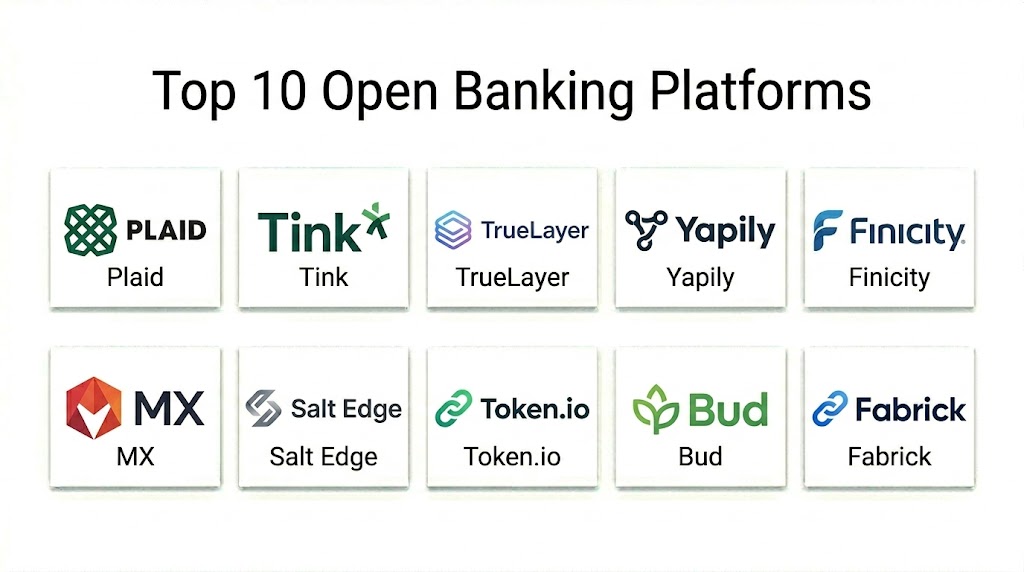
Top 10 Open Banking Platforms
#1 — Plaid
Short description: Plaid is a widely used open banking and financial data platform that helps apps connect to bank accounts, verify identities, analyze transactions, and support fintech workflows. It is especially popular among fintech startups, personal finance apps, lenders, wealth platforms, and embedded finance products. Plaid provides APIs for account connectivity, transactions, identity, income, assets, payments-related workflows, and risk use cases depending on region. It is best for teams building financial applications that need broad bank connectivity and developer-friendly APIs.
Key Features
- Bank account connectivity for financial apps.
- Transaction data access and account aggregation.
- Account ownership and identity verification workflows.
- Income, assets, and lending-related data products depending on region.
- Developer-friendly APIs and sandbox testing.
- Risk, fraud, and onboarding-related financial data tools.
- Strong ecosystem adoption among fintech developers.
Pros
- Strong developer experience and brand recognition.
- Good fit for fintech startups and financial apps.
- Broad product suite beyond simple account data.
- Useful for lending, personal finance, investing, and embedded finance.
Cons
- Pricing may be challenging for early-stage teams at scale.
- Coverage and product availability vary by region.
- Bank connectivity issues can still occur depending on institution.
- Some enterprise workflows may require custom implementation planning.
Platforms / Deployment
Cloud / API / Web dashboard / Developer platform.
Security & Compliance
Security features may include encrypted data handling, consent-based access, API controls, authentication flows, and administrative controls depending on product and plan. Specific certifications and compliance claims should be verified directly. If uncertain, write: Not publicly stated.
Integrations & Ecosystem
Plaid integrates with fintech apps, lending systems, personal finance tools, wealth platforms, payroll-related workflows, payments products, and risk systems. It is often used as a core financial data layer for customer-permissioned banking data.
- Fintech applications
- Lending and credit platforms
- Personal finance management tools
- Wealth and investing apps
- Risk and fraud workflows
- Embedded finance systems
Support & Community
Plaid offers documentation, developer tools, support resources, and enterprise support options. Community awareness is strong among fintech developers and product teams.
#2 — Tink
Short description: Tink is an open banking platform that provides account data, payment initiation, financial insights, and bank connectivity across European markets. It is useful for banks, fintechs, lenders, payment companies, and financial service providers building open banking-powered experiences. Tink helps companies access financial data, initiate payments, verify accounts, and improve onboarding or credit decisions. It is best for businesses focused on European open banking use cases.
Key Features
- Open banking data access across supported European markets.
- Payment initiation and Pay by Bank-style workflows.
- Account aggregation and financial data connectivity.
- Transaction categorization and enrichment capabilities.
- Account verification and onboarding support.
- APIs for fintech and financial service products.
- Strong fit for banks, lenders, and payment providers.
Pros
- Strong European open banking coverage.
- Useful combination of data and payments.
- Good fit for banks and fintech companies.
- Supports multiple financial product use cases.
Cons
- Best suited to supported European markets.
- Integration complexity depends on use case and region.
- Pricing and packaging may vary by product.
- Buyers should validate specific bank coverage before launch.
Platforms / Deployment
Cloud / API / Web dashboard / Open banking infrastructure.
Security & Compliance
Security features may include consent flows, secure authentication, regulated access workflows, encrypted data handling, and platform controls depending on product and configuration. Specific certifications should be verified directly. If uncertain, write: Not publicly stated.
Integrations & Ecosystem
Tink fits financial products that need bank data, payment initiation, onboarding, lending insights, and customer finance tools across Europe.
- Banking apps
- Lending platforms
- Payment providers
- Personal finance tools
- Account verification workflows
- Financial data enrichment systems
Support & Community
Tink provides documentation, integration support, and enterprise resources. It is strongest for companies building open banking products in supported European markets.
#3 — TrueLayer
Short description: TrueLayer is an open banking platform focused on account-to-account payments, payouts, account verification, and financial data access. It is especially strong for Pay by Bank experiences, instant payments, wallet top-ups, withdrawals, refunds, and onboarding flows. TrueLayer is commonly used by merchants, fintechs, marketplaces, financial apps, and payment-focused businesses. It is best for companies that want open banking payments with strong user experience and bank connectivity.
Key Features
- Pay by Bank and account-to-account payment workflows.
- Payouts, refunds, withdrawals, and wallet funding use cases.
- Bank account verification and user onboarding support.
- Financial data API capabilities depending on use case.
- Consent-based bank connectivity.
- Developer APIs for payment and data flows.
- Strong focus on payment conversion and payment experience.
Pros
- Strong fit for open banking payments.
- Useful for merchants, fintechs, and wallet-based products.
- Good user experience focus for payment flows.
- Supports both payment and verification use cases.
Cons
- Regional availability should be validated carefully.
- Best fit is payment-led open banking rather than all-purpose global data aggregation.
- Some use cases may require regulatory or product-specific setup.
- Pricing depends on volume, product, and region.
Platforms / Deployment
Cloud / API / Web dashboard / Payment and data infrastructure.
Security & Compliance
Security features may include bank authentication flows, consent handling, encrypted data transfer, account verification, and platform controls depending on product. Specific certifications and compliance claims should be verified directly. If uncertain, write: Not publicly stated.
Integrations & Ecosystem
TrueLayer integrates into fintech products, ecommerce checkouts, wallet top-ups, gaming deposits, payment providers, financial apps, and merchant flows.
- Payment checkout systems
- Wallet and account funding
- Refund and payout workflows
- Fintech onboarding
- Bank account verification
- Financial data products
Support & Community
TrueLayer provides developer documentation, integration support, and business onboarding resources. It is strongest for companies building payment-first open banking products.
#4 — Yapily
Short description: Yapily is an open banking infrastructure platform that provides APIs for financial data access and payment initiation across supported markets. It is used by fintechs, lenders, payment providers, banks, accounting tools, and embedded finance platforms. Yapily helps businesses connect to bank accounts, initiate payments, verify account information, and access real-time financial data. It is best for organizations that need open banking infrastructure across the United Kingdom and Europe.
Key Features
- Open banking data and payment APIs.
- Account-to-account payments and Pay by Bank workflows.
- Account information access for onboarding, lending, and financial insights.
- Account verification and real-time data access.
- Support for business and consumer bank connectivity.
- API-first developer experience.
- Licensing support options depending on product structure.
Pros
- Strong infrastructure focus for open banking.
- Useful for both data and payment use cases.
- Good fit for fintechs, lenders, and payment providers.
- Developer-friendly API approach.
Cons
- Market and bank coverage should be validated before launch.
- Some workflows may require licensing or compliance planning.
- Pricing may not fit very early-stage teams.
- Implementation can vary by bank and region.
Platforms / Deployment
Cloud / API / Web dashboard / Open banking infrastructure.
Security & Compliance
Security features may include secure customer authentication, consent flows, regulated data access, encrypted communication, and platform controls depending on product. Specific certifications should be verified directly. If uncertain, write: Not publicly stated.
Integrations & Ecosystem
Yapily fits fintech and payment products needing bank connectivity, open banking data, payments, onboarding, and lending workflows.
- Payment service providers
- Lending platforms
- Accounting and finance apps
- Digital banking products
- Account verification workflows
- Embedded finance platforms
Support & Community
Yapily provides developer documentation, support resources, and onboarding assistance. It is best suited for teams building production open banking products in supported markets.
#5 — Salt Edge
Short description: Salt Edge is an open banking and open finance platform that provides data aggregation, payment initiation, data enrichment, compliance solutions, and bank connectivity. It is useful for fintechs, banks, lenders, ecommerce businesses, and financial apps that need access to financial account data and payment workflows. Salt Edge also supports compliance-related open banking solutions for financial institutions. It is best for teams needing both data aggregation and open banking compliance support.
Key Features
- Data aggregation across supported financial institutions.
- Payment initiation and Pay by Bank workflows.
- Data enrichment, merchant identification, and financial insights.
- Open banking compliance solutions for financial institutions.
- Account verification and onboarding use cases.
- APIs for financial data and payments.
- Useful for banking, lending, ecommerce, and personal finance apps.
Pros
- Broad open banking and open finance scope.
- Useful for both fintechs and financial institutions.
- Combines data, payments, enrichment, and compliance tools.
- Good fit for teams needing financial data intelligence.
Cons
- Buyers should validate real coverage for target markets and banks.
- Integration experience may vary by region and institution.
- Product breadth may require careful selection of modules.
- Support expectations should be tested during evaluation.
Platforms / Deployment
Cloud / API / Web dashboard / Open finance platform.
Security & Compliance
Security features may include consent flows, secure authentication, encrypted data handling, compliance tooling, and platform controls depending on product. Specific certifications and compliance claims should be verified directly. If uncertain, write: Not publicly stated.
Integrations & Ecosystem
Salt Edge integrates into financial apps, banking platforms, lending workflows, ecommerce checkout experiences, data enrichment systems, and compliance programs.
- Banking platforms
- Lending and credit systems
- Personal finance apps
- Ecommerce payment workflows
- Data enrichment tools
- Open banking compliance systems
Support & Community
Salt Edge provides documentation, API resources, and support options. It is useful for teams that need open finance coverage plus compliance-oriented capabilities.
#6 — Token.io
Short description: Token.io is an open banking payments infrastructure platform focused on account-to-account payments, Pay by Bank, recurring payment capabilities, and bank connectivity. It is useful for payment service providers, merchants, ecommerce businesses, fintechs, and financial platforms that want direct bank payment flows. Token.io supports payment initiation, bank authorization flows, refunds, settlement workflows, and recurring payment use cases depending on market support. It is best for organizations that prioritize open banking payments rather than only data aggregation.
Key Features
- Open banking payment initiation workflows.
- Pay by Bank for ecommerce and merchant payments.
- Support for single payments, future-dated payments, and recurring-style payment flows depending on availability.
- Settlement, refunds, and payment tracking capabilities.
- APIs for payment providers and fintech platforms.
- Bank connectivity across supported markets.
- Strong focus on account-to-account payment infrastructure.
Pros
- Strong fit for payment-first open banking.
- Useful for merchants, payment providers, and fintechs.
- Supports direct bank payment experiences.
- Can reduce reliance on card-based payment flows.
Cons
- Less focused on broad financial data aggregation.
- Regional and bank coverage should be validated.
- Payment workflows may require operational and compliance planning.
- Buyers should confirm support for recurring payment needs in target markets.
Platforms / Deployment
Cloud / API / Payment infrastructure / Web dashboard.
Security & Compliance
Security features may include bank authentication, consent-based authorization, payment controls, encrypted communication, and platform access controls depending on product. Specific certifications should be verified directly. If uncertain, write: Not publicly stated.
Integrations & Ecosystem
Token.io fits payment providers, ecommerce platforms, fintech products, and merchant checkout systems that need account-to-account payments.
- Ecommerce checkout systems
- Payment service providers
- Fintech platforms
- Bank payment flows
- Refund and settlement workflows
- Recurring payment use cases
Support & Community
Token.io provides developer documentation, payment integration resources, and business support. It is best suited for teams focused on open banking payment infrastructure.
#7 — Mastercard Open Banking
Short description: Mastercard Open Banking provides financial data connectivity, account verification, income insights, lending support, and open banking services, including capabilities associated with Finicity. It is useful for banks, lenders, fintechs, payroll platforms, mortgage providers, and financial institutions that need permissioned financial data access. The platform is especially relevant in North American financial data and lending workflows. It is best for organizations that need trusted financial data connectivity backed by a major payments network.
Key Features
- Consumer-permissioned financial data access.
- Account verification and account ownership workflows.
- Income, employment, and cash flow insights depending on product availability.
- Lending and credit decision support.
- Financial data APIs for fintech and enterprise systems.
- Integration with broader Mastercard ecosystem capabilities.
- Useful for banks, lenders, and financial service providers.
Pros
- Strong fit for lending and financial data verification.
- Backed by a major global payments and financial technology brand.
- Useful for enterprise and financial institution workflows.
- Good option for North American account data and verification use cases.
Cons
- Product availability varies by market and use case.
- Pricing and enterprise packaging may require sales engagement.
- Developer experience may differ from startup-first API platforms.
- Buyers should validate exact bank coverage and data fields.
Platforms / Deployment
Cloud / API / Enterprise financial data platform.
Security & Compliance
Security features may include consent-based data access, secure APIs, identity and account verification controls, platform governance, and enterprise controls depending on product. Specific certifications should be verified directly. If uncertain, write: Not publicly stated.
Integrations & Ecosystem
Mastercard Open Banking fits lending, financial verification, account validation, and embedded finance products that need trusted bank data connectivity.
- Lending platforms
- Mortgage workflows
- Account verification systems
- Payroll and income verification
- Fintech applications
- Enterprise financial services
Support & Community
Mastercard provides enterprise support, implementation resources, and financial services expertise. It is strongest for organizations needing enterprise-grade support and financial institution alignment.
#8 — MX
Short description: MX is a financial data platform that helps organizations connect, clean, enhance, and use financial data for digital banking, personal finance, lending, and customer insights. It is especially useful for financial institutions, fintechs, and enterprises that need account aggregation, transaction cleansing, categorization, and financial wellness experiences. MX focuses heavily on data quality and enrichment. It is best for banks, credit unions, fintechs, and financial apps that want reliable financial data intelligence.
Key Features
- Financial data aggregation and connectivity.
- Transaction cleansing and categorization.
- Account verification and financial data insights.
- APIs for digital banking and fintech applications.
- Personal finance and financial wellness support.
- Data enhancement for better customer understanding.
- Useful for banks, credit unions, lenders, and fintechs.
Pros
- Strong data enrichment and categorization focus.
- Good fit for banks and credit unions.
- Useful for personal finance and digital banking experiences.
- Helps turn raw transaction data into usable insights.
Cons
- Regional coverage should be validated for target markets.
- Pricing and packaging may be enterprise-oriented.
- Payment initiation may not be the primary focus.
- Implementation can require data mapping and product planning.
Platforms / Deployment
Cloud / API / Financial data platform / Enterprise dashboard.
Security & Compliance
Security features may include secure data handling, access controls, consent-based connectivity, administrative controls, and enterprise platform protections depending on plan. Specific certifications should be verified directly. If uncertain, write: Not publicly stated.
Integrations & Ecosystem
MX integrates into digital banking platforms, fintech apps, lending systems, financial wellness tools, and customer insight workflows.
- Banks and credit unions
- Digital banking platforms
- Personal finance apps
- Lending workflows
- Financial wellness tools
- Customer analytics systems
Support & Community
MX provides documentation, implementation support, and enterprise resources. It is especially relevant for financial institutions and fintechs that need enriched financial data experiences.
#9 — Bud
Short description: Bud is an open banking and financial data intelligence platform focused on transaction enrichment, affordability insights, lending support, and customer financial understanding. It helps banks, lenders, fintechs, and financial institutions turn open banking data into actionable insights. Bud is especially useful for credit decisioning, personal financial management, customer segmentation, and financial health use cases. It is best for organizations that need data intelligence layered on top of open banking connectivity.
Key Features
- Open banking data intelligence and enrichment.
- Transaction categorization and merchant insights.
- Affordability and lending support workflows.
- Customer financial behavior analysis.
- APIs for banks, fintechs, and lenders.
- Useful for credit risk and financial wellness use cases.
- Helps transform raw banking data into meaningful insights.
Pros
- Strong focus on data intelligence and enrichment.
- Useful for lenders and financial institutions.
- Helps improve affordability and credit assessments.
- Good fit for financial wellness and customer insight products.
Cons
- May not be the best fit for payment-first open banking.
- Coverage and connectivity should be validated by region.
- Buyers should test categorization accuracy using real samples.
- Enterprise workflows may require implementation support.
Platforms / Deployment
Cloud / API / Financial data intelligence platform.
Security & Compliance
Security features may include consent-based data handling, access controls, secure APIs, and platform governance depending on product and configuration. Specific certifications should be verified directly. If uncertain, write: Not publicly stated.
Integrations & Ecosystem
Bud fits products that need financial insights from open banking data, especially lending, affordability, financial health, and personalization use cases.
- Lending platforms
- Banking apps
- Personal finance products
- Affordability assessment workflows
- Customer analytics systems
- Financial wellness tools
Support & Community
Bud provides documentation, onboarding, and support resources. It is strongest for organizations that need enriched financial intelligence rather than only raw bank connectivity.
#10 — Akoya
Short description: Akoya is a financial data access network focused on secure, API-based consumer-permissioned data sharing. It is especially relevant for financial institutions, fintechs, and businesses that want standardized data access without relying on credential-sharing approaches. Akoya supports account data access, account verification, and secure financial data connectivity. It is best for organizations operating in markets where bank-backed, API-based financial data sharing is a major priority.
Key Features
- Consumer-permissioned financial data access.
- API-based account connectivity.
- Account verification and financial data workflows.
- Focus on secure data sharing between financial institutions and third parties.
- Designed to reduce reliance on credential-sharing patterns.
- Useful for fintechs, banks, and financial service providers.
- Supports standardized access across participating institutions.
Pros
- Strong fit for API-based financial data sharing.
- Useful for compliance-conscious financial institutions.
- Helps reduce credential-sharing concerns.
- Good option for account verification and data access use cases.
Cons
- Coverage depends on participating institutions.
- May not provide the same broad global reach as some aggregators.
- Product availability and access model should be validated directly.
- Not primarily a Pay by Bank payment platform.
Platforms / Deployment
Cloud / API / Financial data access network.
Security & Compliance
Security features may include API-based access, permissioned data sharing, consent flows, secure connectivity, and platform controls depending on configuration. Specific certifications and compliance claims should be verified directly. If uncertain, write: Not publicly stated.
Integrations & Ecosystem
Akoya fits financial data sharing workflows where institutions and fintechs want secure API-based access to customer-permissioned data.
- Financial institutions
- Fintech applications
- Account verification workflows
- Consumer-permissioned data sharing
- Lending and onboarding systems
- Data access compliance workflows
Support & Community
Akoya provides business and technical support resources depending on partnership and access model. It is best for organizations seeking secure bank-backed data connectivity in supported markets.
Comparison Table
| Tool Name | Best For | Platform Supported | Deployment | Standout Feature | Public Rating |
|---|---|---|---|---|---|
| Plaid | Fintech apps and financial data connectivity | Cloud / API / Web dashboard | Cloud | Broad financial data APIs and fintech ecosystem | N/A |
| Tink | European open banking data and payments | Cloud / API / Web dashboard | Cloud | Strong European data and payment coverage | N/A |
| TrueLayer | Pay by Bank and account-to-account payments | Cloud / API / Web dashboard | Cloud | Open banking payments and verification flows | N/A |
| Yapily | Open banking infrastructure across supported markets | Cloud / API / Web dashboard | Cloud | Data and payment APIs with infrastructure focus | N/A |
| Salt Edge | Open finance data, payments, and compliance | Cloud / API / Web dashboard | Cloud | Data aggregation plus compliance tooling | N/A |
| Token.io | Account-to-account payment infrastructure | Cloud / API / Payment platform | Cloud | Pay by Bank and recurring payment workflows | N/A |
| Mastercard Open Banking | Lending and financial data verification | Cloud / API / Enterprise platform | Cloud | Account, income, and verification data workflows | N/A |
| MX | Financial data enrichment and digital banking | Cloud / API / Enterprise dashboard | Cloud | Transaction cleansing and financial insights | N/A |
| Bud | Lending insights and financial data intelligence | Cloud / API / Data intelligence platform | Cloud | Affordability and transaction enrichment | N/A |
| Akoya | Secure API-based financial data access | Cloud / API / Data access network | Cloud | Bank-backed permissioned data sharing | N/A |
Evaluation & Scoring of Open Banking Platforms
| Tool Name | Core 25% | Ease 15% | Integrations 15% | Security 10% | Performance 10% | Support 10% | Value 15% | Weighted Total |
|---|---|---|---|---|---|---|---|---|
| Plaid | 9 | 9 | 9 | 8 | 8 | 8 | 8 | 8.55 |
| Tink | 9 | 8 | 9 | 8 | 8 | 8 | 8 | 8.35 |
| TrueLayer | 9 | 8 | 8 | 8 | 9 | 8 | 8 | 8.35 |
| Yapily | 8 | 8 | 8 | 8 | 8 | 8 | 8 | 8.00 |
| Salt Edge | 8 | 8 | 8 | 8 | 8 | 8 | 8 | 8.00 |
| Token.io | 8 | 8 | 8 | 8 | 8 | 8 | 8 | 8.00 |
| Mastercard Open Banking | 8 | 7 | 8 | 9 | 8 | 9 | 7 | 7.95 |
| MX | 8 | 8 | 8 | 8 | 8 | 8 | 8 | 8.00 |
| Bud | 8 | 8 | 8 | 8 | 8 | 8 | 8 | 8.00 |
| Akoya | 7 | 7 | 7 | 9 | 8 | 8 | 7 | 7.45 |
These scores are comparative and based on open banking platform fit, not absolute product quality. A higher score means the provider aligns strongly with data access, payment capability, integrations, security, developer experience, and commercial readiness. Payment-focused platforms score well for Pay by Bank and account-to-account flows, while data intelligence platforms score well for enrichment, lending, and financial insights. Buyers should adjust the weights based on whether their priority is payments, account verification, lending, aggregation, or financial data enrichment.
Which Open Banking Platform Is Right for You?
Solo / Freelancer
Solo developers should start with platforms that offer strong documentation, sandbox testing, and simple API onboarding. Plaid can be a practical starting point for financial data apps, while TrueLayer, Yapily, or Tink may fit payment or European open banking experiments. If your use case is only personal finance tracking, make sure the provider supports your target region and bank coverage. Solo users should avoid complex regulated workflows until they understand consent, licensing, and data protection obligations.
SMB
SMBs should focus on affordability, coverage, integration speed, and customer experience. Plaid is useful for financial data and fintech workflows, while TrueLayer, Yapily, Token.io, and Tink are stronger when Pay by Bank or payment initiation is central. Salt Edge can be useful when data aggregation and open finance features are needed. SMBs should run a pilot with real banks and users before committing to one provider.
Mid-Market
Mid-market companies usually need stronger reliability, enrichment, support, and compliance workflows. Tink, TrueLayer, Yapily, and Salt Edge are strong options for European data and payment use cases. Plaid, Mastercard Open Banking, MX, and Akoya are useful for North American financial data and verification workflows. Bud is valuable when the goal is transaction intelligence, affordability checks, and lending insights. Mid-market buyers should evaluate both raw API capability and operational support.
Enterprise
Enterprises should prioritize security, reliability, regulatory alignment, support, auditability, and integration flexibility. Mastercard Open Banking, MX, Plaid, and Akoya are strong candidates for financial data and verification workflows in supported markets. Tink, TrueLayer, Yapily, Salt Edge, and Token.io are strong options for open banking payments and financial data in supported regions. Enterprises should involve legal, compliance, security, engineering, product, and customer support teams during evaluation.
Budget vs Premium
Budget-conscious teams should compare sandbox access, minimum commitments, per-call pricing, payment pricing, enrichment costs, and support tiers. Some providers are easier for early-stage testing, while others are better suited for enterprises with serious volume. Premium platforms may be worth it when reliability, coverage, compliance support, and conversion rates directly affect revenue. The cheapest API is not always the best option if bank coverage, consent flow, or support quality creates user drop-off.
Feature Depth vs Ease of Use
For ease of use and developer adoption, Plaid, TrueLayer, and Yapily are strong candidates depending on market. For data enrichment depth, MX, Bud, and Salt Edge are strong options. For payment-first depth, TrueLayer, Token.io, Tink, and Yapily deserve careful evaluation. For secure API-based financial data sharing, Akoya may fit compliance-conscious teams. The best choice depends on whether your product needs data, payments, verification, enrichment, or compliance support.
Integrations & Scalability
Integration requirements vary by product. Lending platforms need income, affordability, transaction categorization, and account verification. Payment providers need payment initiation, settlement tracking, refunds, reconciliation, and high-conversion consent flows. Personal finance apps need bank coverage, account aggregation, transaction history, and categorization. Enterprises need APIs, webhooks, dashboards, support SLAs, audit logs, and production monitoring. Always test with real bank connections before scaling.
Security & Compliance Needs
Security-sensitive teams should prioritize consent management, secure authentication, encrypted data handling, API controls, audit logs, access management, and compliance support. Open banking products often involve regulated financial data, so legal and compliance review is essential. If payment initiation is involved, operational risk and fraud controls become even more important. Buyers should verify licensing support, data retention practices, regional compliance, and customer support workflows before production launch.
Frequently Asked Questions
1. What is an open banking platform?
An open banking platform provides APIs that allow businesses to access bank account data or initiate bank payments with customer consent. These platforms connect fintechs, banks, lenders, payment providers, and financial apps to bank infrastructure. They often support account aggregation, account verification, income checks, Pay by Bank, and transaction enrichment. The goal is to make financial data and payment flows more secure, automated, and user-friendly.
2. How does open banking work?
Open banking usually works through a consent-based flow where the customer selects their bank, authenticates securely, and grants permission for specific data access or payment action. The open banking platform then connects to the bank through APIs and returns authorized data or payment status to the business. Permissions are usually limited by scope and duration. The business must handle the data responsibly and follow applicable regulations.
3. What are common open banking use cases?
Common use cases include account aggregation, bank account verification, income verification, lending decisions, affordability checks, personal finance management, accounting automation, Pay by Bank, wallet top-ups, recurring payments, payouts, and reconciliation. Open banking is also used in ecommerce, payroll, wealth management, insurance, and embedded finance. The best use case depends on whether the business needs data, payments, or both.
4. What is Pay by Bank?
Pay by Bank is an account-to-account payment method where customers pay directly from their bank account instead of using cards. The customer authenticates through their bank, and the payment is initiated securely through open banking rails where supported. Businesses use Pay by Bank to reduce card dependency, improve settlement speed, and lower payment friction. Availability and features vary by country, bank, and provider.
5. Are open banking platforms secure?
Open banking platforms can be secure when implemented correctly, but security depends on consent handling, authentication, API controls, encryption, data minimization, and operational practices. Customers should never be asked to share credentials outside approved flows. Businesses should verify provider security controls, access management, audit logs, data retention, and compliance support. Security review is especially important for payments and sensitive financial data.
6. How are open banking platforms priced?
Pricing varies by provider, region, product, and volume. Some platforms charge by API call, connected account, successful payment, verification, transaction volume, or monthly minimum. Enrichment, premium data, enterprise support, and payment services may cost extra. Buyers should estimate expected usage carefully and compare total cost, not only headline pricing. Early-stage teams should also ask about minimum commitments and sandbox access.
7. What are common mistakes when choosing an open banking provider?
A common mistake is choosing a provider based only on brand name without testing real bank coverage in the target market. Another mistake is ignoring consent conversion, bank reliability, and support response times. Teams may also underestimate compliance work, user support needs, and data quality differences between banks. A strong pilot should test real users, real banks, API reliability, error handling, and data accuracy.
8. Do open banking platforms work globally?
Open banking coverage varies significantly by country and provider. Some regions have mature regulated open banking APIs, while others rely more on aggregator partnerships or less standardized connectivity. A provider may be strong in one market but weaker in another. Businesses should verify bank coverage, payment support, consent flows, licensing requirements, and data fields for each target region before launch.
9. What integrations should buyers look for?
Important integrations include KYC systems, lending platforms, payment gateways, accounting software, CRM tools, fraud systems, data warehouses, mobile apps, web apps, and customer support workflows. Developers should look for clean APIs, SDKs, webhooks, sandbox tools, and monitoring dashboards. Payment teams should evaluate settlement, refunds, reconciliation, and payment status updates. Lending teams should test income, affordability, and categorization quality.
10. What is the best open banking platform overall?
There is no single best open banking platform for every business. Plaid is strong for fintech data connectivity, Tink, TrueLayer, Yapily, Salt Edge, and Token.io are strong across European data and payment use cases, Mastercard Open Banking, MX, and Akoya are strong for financial data and verification workflows in supported markets, and Bud is strong for data intelligence and lending insights. The best choice depends on your region, bank coverage, data needs, payment requirements, compliance model, and budget.
Conclusion
Open Banking Platforms help businesses build faster, safer, and more automated financial products by connecting to bank data and payment rails through customer-permissioned APIs. The right platform depends on your main use case: Plaid is strong for fintech data connectivity, Tink and Yapily are strong for European open banking data and payments, TrueLayer and Token.io are strong for Pay by Bank and account-to-account payments, and Salt Edge combines open finance data, payments, and compliance tools. Mastercard Open Banking, MX, Akoya, and Bud are strong options for financial data, account verification, enrichment, lending, and customer insight workflows in supported markets. Buyers should not choose only by provider popularity; they should test bank coverage, consent conversion, API reliability, data quality, payment performance, pricing, and support. Start by defining whether your product needs data, payments, or both, shortlist two or three providers, run a real-market pilot, validate compliance and security requirements, then scale once the user experience and operational reliability are proven.

This article clearly explains open banking platforms and how they help businesses and financial institutions enable secure data sharing and seamless digital banking services.
Open banking success depends heavily on API reliability and customer consent management. Strong governance is essential to maintain trust as data-sharing ecosystems expand.